
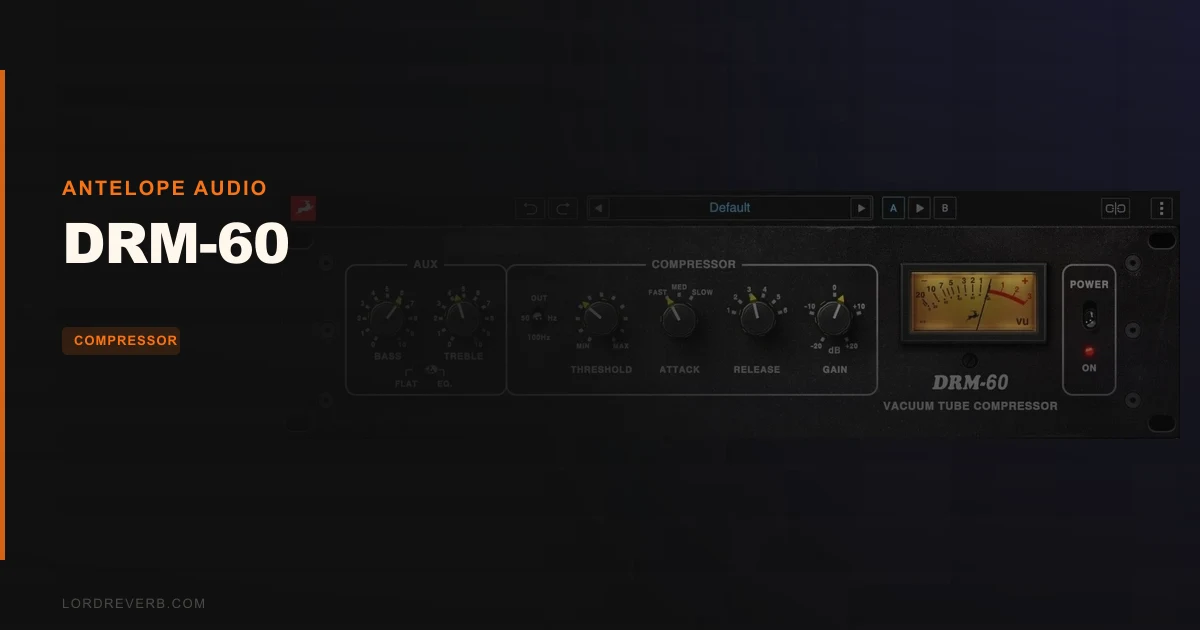
The Antelope Audio DRM-60 is a solid vintage-colored channel strip plugin that earns its $149 price on the right sources, but it's not the transparent workhorse some buyers expect, and that distinction matters before you buy.
We dropped it onto a dry lead vocal during a folk-adjacent session. No EQ pre, no saturation. Just the DRM-60 in the signal chain. Threshold pulled to around -18 dBFS, medium attack, medium release. The compression came in slowly, the way vari-mu always does, not clamping transients but squeezing the body of the vowels together. The vocal got thicker. More mid-presence, maybe a 1-2dB perceived lift in the 800Hz-1kHz area from the preamp saturation stage. It sat in the mix without any additional processing. That was the satisfying moment.
But then we tried it on a pop/electronic lead vocal with fast transients and a wide dynamic range. The compression chased the signal in a way that felt loose. Not musical. Annoying. We wanted tighter, faster control. The DRM-60 couldn't give it.
That gap is the honest story of this plugin.
A Colored Channel Strip, Not a Transparent Tool
The DRM-60 combines a tube preamp stage, a musical EQ, and a vari-mu compressor in a single unit, built for complete tone shaping from subtle coloration to full-on analog saturation. That's the pitch. And in that lane, it performs.
It's modeled after a high-end British analog channel strip, with the hardware original first introduced in the late 1980s. Vari-mu compression means the ratio changes with the input level. Gentle signals get gentle compression. Loud signals get squashed harder. There's no hard knee. No ratio dial. That's not a flaw, it's the topology.
Where it's not good: fast transient control, clinical leveling, mastering work requiring flat frequency response, or any context where you need the compressor to stay out of the way tonally. This is a coloring tool. Use it like one.
Living With the DRM-60 Across a Real Session
Setup is fast. It runs natively on Mac or PC with no additional hardware required, so there's no iLok dance or hardware dongle situation. Load it, set a threshold, move on.
The three switchable attack speeds are the most useful performance controls here. Slow attack on a snare lets the stick crack punch through before compression grabs the body. We ran a snare bus at -12 dBFS threshold, slow attack, and the hit still cracked. Then the sustain compressed down about 4-5dB, making the tail feel tighter. That's the behavior you want from a vari-mu on drums.
We also tested it on acoustic guitar. The high-pass filter at 100Hz cleaned up low-end room rumble, the EQ gave a slight top-end lift, and the compressor held the strumming dynamics together without audible pumping. Three controls, one pass. Quick.
The frustrating part: no blend knob. Parallel compression with vari-mu is a classic technique, and without a wet/dry control built in, you're forced to set up a send/return in your DAW. It adds two extra minutes every single time. For a plugin at $149, that's a miss.
The 2-band EQ is predictably broad. It's not surgical. You're not carving 2dB notches with a tight Q. You're adding air or body at fixed points. For vintage coloration, that's fine. For problem-solving, reach for something else.
CPU load is light to medium in our testing. It's available as a native plugin without any hardware dependency, and we saw no meaningful CPU spikes even with 12 instances open on a session with 64 tracks. Antelope publishes no official CPU percentage figure, so treat that as anecdotal rather than specification.
The Trade-Offs
The DRM-60's greatest strength is also its core limitation: it always colors your signal. The preamp saturation is always on. That lush tube tone and all-in-one versatility is what made the hardware a mastering and tracking studio staple. But ITB, you'll sometimes want the compression without the saturation, and the DRM-60 doesn't give you that choice.
The threshold range spans -33 dBFS to 0 dBFS. That's wide. But with only 6 release settings (not continuous) and 3 fixed attack speeds, you're doing macro shaping, not micro sculpting. If your sessions need that level of control, this isn't your tool.
Makeup gain goes up to +20dB. That's enough to push a heavily compressed signal back to nominal. Good. But again, no output limiter is built in, so gain staging after the DRM-60 is your responsibility. Don't sleep on that when you're pushing +15dB of makeup on a drum bus.
The high-pass filter options are 50Hz or 100Hz. Two choices. Pick one. That works for tracking and basic mix prep, but anyone trying to tune a filter precisely to a room mode at 73Hz is going to be frustrated.
Against the Field
The DRM-60 is competing in a crowded vintage compressor space, and it needs to justify itself against more established names.
For vari-mu character specifically, the Mellowmuse CP2V goes deeper with its transformer and tube stage modeling and offers more nuanced ratio control. If vari-mu is your primary obsession, CP2V gives you more to work with at a similar price point.
For overall vintage compression quality, the Native Instruments Vintage Compressors R2 bundles multiple classic topologies. More value per dollar if you need variety.
For bus and mastering compression where transparency matters more, the Bettermaker Mastering Compressor is in a different class. Don't even compare them in that context. The DRM-60 wins on vibe, ease, and fast setup on individual tracks. It loses on precision and flexibility everywhere else.
The Real Verdict
The DRM-60 is a clever little channel strip with a genuine sound. We'd reach for it on vocals, acoustic instruments, and drums when the goal is to add character fast. The vari-mu behavior is musical. The preamp saturation is tasteful and consistent.
Skip it if you're mixing electronic music with fast transients, need transparent leveling, or do any mastering work. Also skip it if zero community reviews on KVR makes you nervous about long-term support. That silence is worth noting.
At $149, it's not a steal and it's not overpriced. It's fair for what it delivers.
Score Breakdown
| Category | Score | Notes |
|---|---|---|
| Sound Quality | 4.0/5 | Vari-mu compression sounds natural; preamp saturation is musical and consistent |
| Value for Money | 3.5/5 | $149 is fair but tight with no trial available to confirm fit before buying |
| Ease of Use | 4.0/5 | Fast to set up; fixed attack/release options keep decisions simple |
| Features | 3.0/5 | No wet/dry blend, only 2 HPF options, and no continuous ratio control limit versatility |
| CPU Efficiency | 4.0/5 | Light to medium draw; 12 instances ran cleanly in our session with no spikes |
| Overall | 3.5/5 | A genuinely good-sounding vintage color tool let down by a lack of modern flexibility |
Alternatives to Consider
If you love the idea of vari-mu compression but want more surgical control, the Mellowmuse CP2V Compressor offers deeper parameter access at a similar price.
For a broader vintage compression toolkit in a single purchase, the Native Instruments Vintage Compressors R2 covers multiple classic topologies and is worth comparing directly.
If your work skews toward bus or mastering compression and you need precision over color, the Bettermaker Mastering Compressor is the better spend. And for anyone who wants a strong all-round bus compressor to pair with something like the DRM-60 on individual tracks, the Kiive Audio Complexx is worth a look too.
The DRM-60 at $149 is a buy for producers who track organic instruments and want fast, musical compression with tube character baked in. If that's not your session, save the money.
Frequently Asked Questions
Does the DRM-60 require Antelope Audio hardware to run?
No. DRM-60 runs natively on Mac or PC without any additional hardware needed. It's a fully standalone plugin available in VST3, AU, and AAX formats. You don't need an Antelope interface in your signal chain.
What type of compressor is the DRM-60?
It's a vari-mu compressor, meaning the compression ratio increases automatically as the input level rises. You don't set a hard ratio. This makes it feel musical on dynamic sources like vocals and acoustic instruments, but it's less suited to fast transient control compared to FET or VCA designs.
Is the DRM-60 good for mastering?
We'd say no, and we'd mean it. The preamp saturation is always-on and always coloring your signal. The EQ is 2-band with fixed-frequency behavior. There's no transparent bypass for the tube stage. If you need mastering-grade dynamics control, look at something like the PSP MasterComp instead.
What does the high-pass filter in the DRM-60 do?
The HPF cuts low-frequency content below either 50Hz or 100Hz, depending on which setting you choose. It's useful for removing room rumble on vocals or tightening up bass-heavy sources before they hit the compressor. There are only two options, no continuous sweep, so if you need to tune the cutoff precisely, it won't give you that.