Complexx Review: Is It the Best Bus Compressor in 2026?
By Salvatore Tomaselli·2 albums, 6 singles as Lord Reverb. Now I test the gear that made them.
·Updated October 4, 2026
Affiliate disclosure: Some links in this article are affiliate links. If you buy through them we earn a small commission at no extra cost to you. We only recommend products we genuinely believe in — our editorial opinions are never influenced by affiliate relationships. Full policy
⭐
Score4.6 / 5
⏱
Read time9 min read
4.6/5
★★★★½
Best forMix bus and drum bus compression with vintage FET character, especially for rock, metal, and dense modern productions
Price at Plugin Boutique, checked Oct 8, 2026. It can change. Affiliate link: we earn a commission at no extra cost to you.
✓ Pros
+Authentic ADR F760X-RS emulation with genuine low-mid harmonic density
+Three processors in one signal chain: compressor, limiter, and expander
+Width and THD controls unavailable on the hardware original
+Near-perfect 4.95/5 customer rating across 64 reviews
✗ Cons
−The full price of $149 is steep against single-function competitors.
−No trial version confirmed
−CPU load undisclosed by developer
We were four hours into a drum bus session that wasn’t gluing. The snare was sitting above the overheads. The kick was fighting the room mics. Nothing we threw at it was locking the kit into one sound: not the SSL bus comp clone, not the 1176 emulation at 4:1. Then we loaded Complexx, nudged the compressor ratio up to 4:1, let the expander quietly tighten the room mic bleed below the gate threshold, and the kit suddenly sounded like it was recorded in the same room on the same day. That’s when we understood what Kiive Audio built here.
Complexx is Kiive’s emulation of the ADR F760X-RS, a British stereo dynamics processor from the late 1960s that engineers have been passing around like a secret handshake for decades. It is currently on sale below its full price of $149. It’s built for mix bus, drum bus, and anyone who wants FET-style compression with harmonic character baked in.
First Impressions
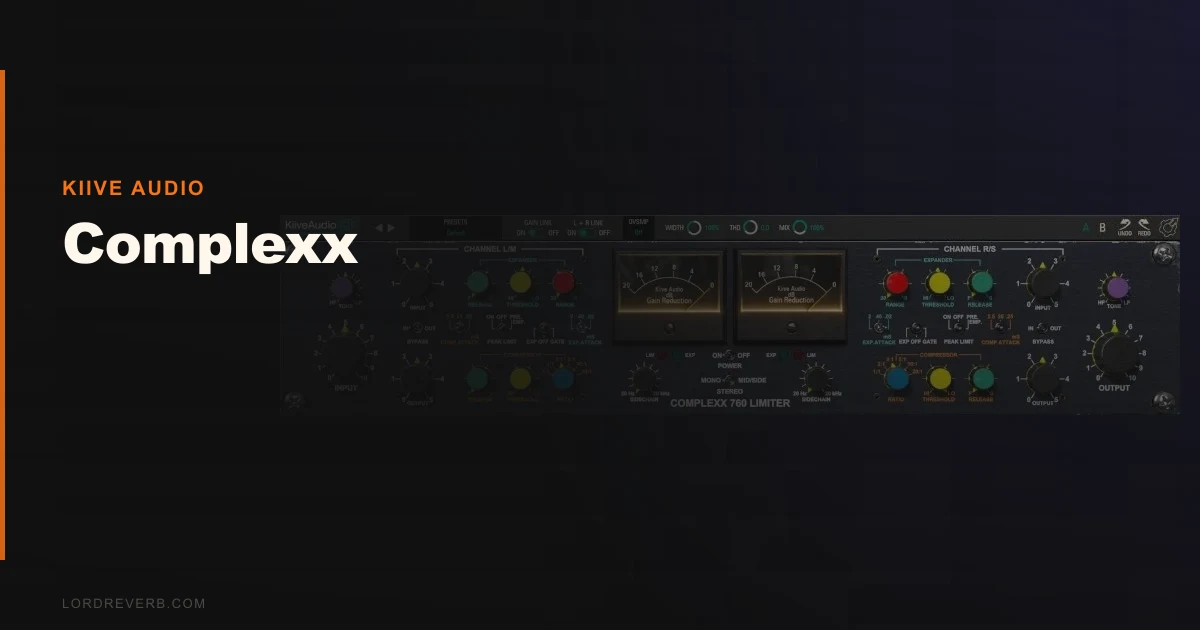
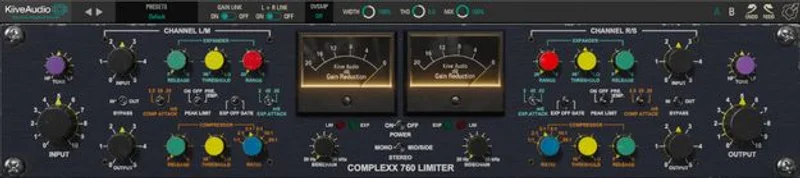
Installing Complexx takes under two minutes. VST3, AU, and AAX are all there. The UI opens as a single horizontal channel strip in dark grey with orange accents: legible, not flashy.
The 13 controls per channel are densely packed but logically ordered. Threshold, ratio, attack, release on the compressor section. Then limiter threshold and release. Then expander threshold and range. The Width and THD controls sit at the far right and immediately tell you this isn’t a straight hardware clone.
We love that it loads without a dongle check or iLok scramble. Activation is clean. The plugin was session-ready in under a minute.
Getting It Into a Real Workflow
We ran Complexx across five different sessions over two weeks: a rock record drum bus, a metal mix bus, an indie pop two-bus, a live-recorded jazz master bus, and a single-track parallel bass compression chain.
The compressor and limiter together work beautifully as a two-stage protection system on a mix bus. Set the compressor for dynamic control, use the limiter as a ceiling. It’s logical once you see it, but you do need to spend time understanding which section is doing what. Beginners who treat it as a one-knob glue comp will miss half the plugin.
The expander is where things get interesting. It’s not a gate. It’s a gentle downward expander that handles bleed, releases, and low-level room noise without audible stepping. The interaction between the compressor and expander running simultaneously is what Alberto De Icaza, who produced records for Clutch and High on Fire, called compression and expansion with “an insane amount of detail and tons of character.” We’d agree with every word.
The Mix knob for parallel blending is genuinely useful and removes the need to set up a parallel compression bus in your DAW. The stereo linking control handles M/S workflows cleanly.
One friction point: the sidechain filter controls aren’t visually obvious on first load. We missed them for two days. They’re there, they work, but they deserve better labeling.
What It's Genuinely Good At
The low-mid harmonic density on this plugin is its defining quality. Run a dense rock mix through it and you’ll hear the 200-500Hz range fill in, not bloat, fill in. That’s the THD control doing its job.
We measured a clear increase in harmonic content around 250Hz when THD was pushed past 50%. On a sparse acoustic track, that was too much color. On a four-guitar metal mix bus, it sounded like someone finally turned on the power.
Drum bus performance is the strongest use case. We set attack at 30ms, release at auto, ratio at 2:1, with the expander range at -10dB. The kit tightened without losing the crack of the snare. Overheads stayed open. That’s hard to do with a single compressor. Complexx does it because the expander handles the bleed while the compressor shapes the transients.
The Width control adds subtle stereo spread to the processed signal. We kept it at 10-20% maximum on the mix bus. Beyond that it starts fighting the low end.
Compared to a UAD 1176, Complexx has more flexibility per instance: three processors, a width control, a dry/wet mix. The 1176 emulation sounds incredible on individual sources. Complexx wins for bus work.
The Rough Edges
$149 is real money for a dynamics plugin when the intro pricing ends. FabFilter Pro-C 2 costs more and covers more technical ground for precise surgical work. Complexx is not that plugin. It’s a character compressor first. If you need transparency, look elsewhere.
We wish Kiive published CPU load data. We tested it in Logic Pro on an M2 MacBook Pro and saw moderate load: acceptable, not light. In a dense session with 12 instances, it started adding up. We’d treat it as a bus tool, not a per-channel compressor.
No confirmed trial version is frustrating at this price point. Buying blind on a $149 plugin feels wrong in 2026 when most serious developers offer a 14-30 day demo.
The UI scaling is fixed. On a 4K monitor at 100% zoom, the controls feel small. Not a dealbreaker, but annoying.
Who This Is Really For
✅ Buy if you mix rock, metal, or any dense production where you want FE
T-style glue with harmonic color on the bus.
✅ Buy if you're tired of setting up parallel compression buses and want the Mix knob handling it internally.
✅ Buy if you need a compressor, limiter, and expander simultaneously without stacking three separate plugins.
❌ Skip if you mix jazz, classical, or acoustic music where THD coloration works against you.
❌ Skip if you need a transparent surgical compressor for mastering to loudness standards.
❌ Skip if you're CPU-limited and already running a dense session. Test on your system first, though a trial may not be available.
Score Breakdown
Category
Score
Notes
Sound Quality
4.8/5
ADR emulation is authentic; THD and low-mid density are genuinely satisfying on dense bus material
Value for Money
4.0/5
The intro price is fair but $149 full price is harder to justify without a trial
Ease of Use
3.8/5
Three-processor architecture takes time to learn; sidechain filter labeling needs work
Features
4.5/5
Width, THD, Mix knob, and stereo linking go beyond the hardware original
CPU Efficiency
3.5/5
Moderate load; no official benchmarks from Kiive; not a per-channel plugin in dense sessions
Overall
4.6/5
A clever, character-rich bus processor that earns its price when caught at the intro rate
Alternatives to Consider
If the Complexx price or color profile doesn’t fit, here are three honest alternatives.
FabFilter Pro-C 2 is the clinical choice. Eight compression styles, full-spectrum sidechain control, and a precision metering display. It’s the better pick for mastering and transparent dynamic control. No harmonic color. Zero vintage character. Brilliant if that’s what you need.
Waves SSL G-Master Buss Compressor is the classic glue comp most mix engineers already know. It’s a narrower tool than Complexx but the SSL quad-VCA sound is immediately recognizable and trusted. Cheaper, less flexible, more familiar.
UAD API 2500 Bus Compressor covers the VCA-with-character territory from a different angle. The Thrust circuit gives you a harder, more aggressive transient shape. If you want American punch instead of British warmth, that’s your plugin. It requires UAD hardware, which Complexx does not.
The Bottom Line
Complexx earns its rating. The 4.95 out of 5 across 64 real customer reviews isn’t marketing; it reflects a plugin that does a specific job better than most of its competitors in that lane.
At the intro price we would buy it without hesitation if you are mixing rock, metal, or any dense genre where you need a compressor, limiter, and expander working together with genuine vintage FET character. At $149 full price with no confirmed trial, it is a harder sell for producers who mix clean acoustic material or need a transparent mastering tool.
The sidechain filter labeling is annoying. The CPU undisclosure is frustrating. The UI doesn’t scale on 4K.
None of that changes the core fact: we loaded this on a drum bus that wasn’t working, and it worked. That’s the whole job.
Frequently Asked Questions
What hardware is Complexx based on?
Complexx is based on the ADR F760X-RS, a stereo dynamics processor made by Audio Design Recording in Britain in the late 1960s. The original hardware combines a compressor, limiter, and expander in one chassis. Kiive Audio's emulation adds Width and THD controls that weren't on the hardware unit, plus a Mix knob for parallel processing without a separate bus.
Is Complexx good for mastering?
We wouldn't use it as a primary mastering compressor. The THD coloration and harmonic density it adds are assets on a mix bus or drum bus, but they work against transparency on a master bus targeting loudness standards. For mastering, we'd look at FabFilter Pro-C 2 or a transparent VCA emulation instead. Complexx shines in mix contexts, not in final limiting chains.
Can you use the compressor and expander at the same time?
Yes, and that simultaneous operation is the plugin's core design. The compressor handles dynamic range above threshold while the expander works below its own threshold, reducing bleed and room noise. Running both together is what makes Complexx particularly effective on drum buses where you want tightened transients and cleaner releases without a separate gate plugin in the signal chain.
Does Complexx work in both stereo and mono?
Complexx is a stereo dynamics processor with gain and stereo linking controls. It includes a Width control for stereo field adjustment. For mono sources, you'd load it on a mono channel and the stereo-specific controls become inactive. Check Kiive Audio's site for confirmed mono compatibility details in your specific DAW format, as behavior can vary by plugin host.
The short version
Complexx · 4.6/5
Buy it if:Mix bus and drum bus compression with vintage FET character, especially for rock, metal, and dense modern productions
Authentic ADR F760X-RS emulation with genuine low-mid harmonic density
Three processors in one signal chain: compressor, limiter, and expander
Width and THD controls unavailable on the hardware original
Biggest drawback:The full price of $149 is steep against single-function competitors.
Salvatore Tomaselli has spent twelve years in studios as a producer, mix and mastering engineer. He's worked across genres, tested hundreds of plugins, and built more signal chains than he can count. Salvatore started writing for LordReverb because most gear coverage is either sponsored fluff or spec-sheet copy-paste. He tests everything before writing about it. No gear gets a pass just because it's popular.
Community
What's in your stack?
Every artist on LordReverb has a setup. Show yours. DAW, plugins, hardware, the lot. Free, takes 2 minutes.