If you're comparing Vintage Compressors R2 to the UAD 1176 and LA-2A emulations, here's where we land: UAD wins on depth and hardware authenticity, but NI wins on price and getting three compressors for the cost of one. That's the whole review in two sentences. Everything below is the detail you need to decide whether those three compressors are the right three for you.
Vintage Compressors R2 is a bundle of three software emulations: the VC 76 (based on the Urei 1176 FET), the VC 2A (Teletronix LA-2A optical), and the VC 160 (dbx 160 VCA). Native Instruments built it in collaboration with Softube, whose emulation work we respect. It is $99 at Plugin Boutique, with a lower loyalty price if you are already in the NI ecosystem.
It's built for producers and mix engineers who want the "holy trinity" of vintage compression without renting UAD hardware or buying three separate plugins at full price.
How It Compares Out of the Box
Put this next to the Waves CLA-76, CLA-2A, and dbx 160 individually and you're spending significantly more for those three than the $99 bundle price here. That's a real advantage.
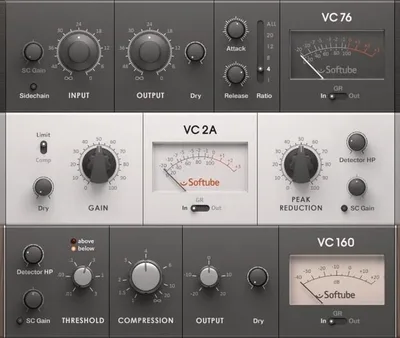
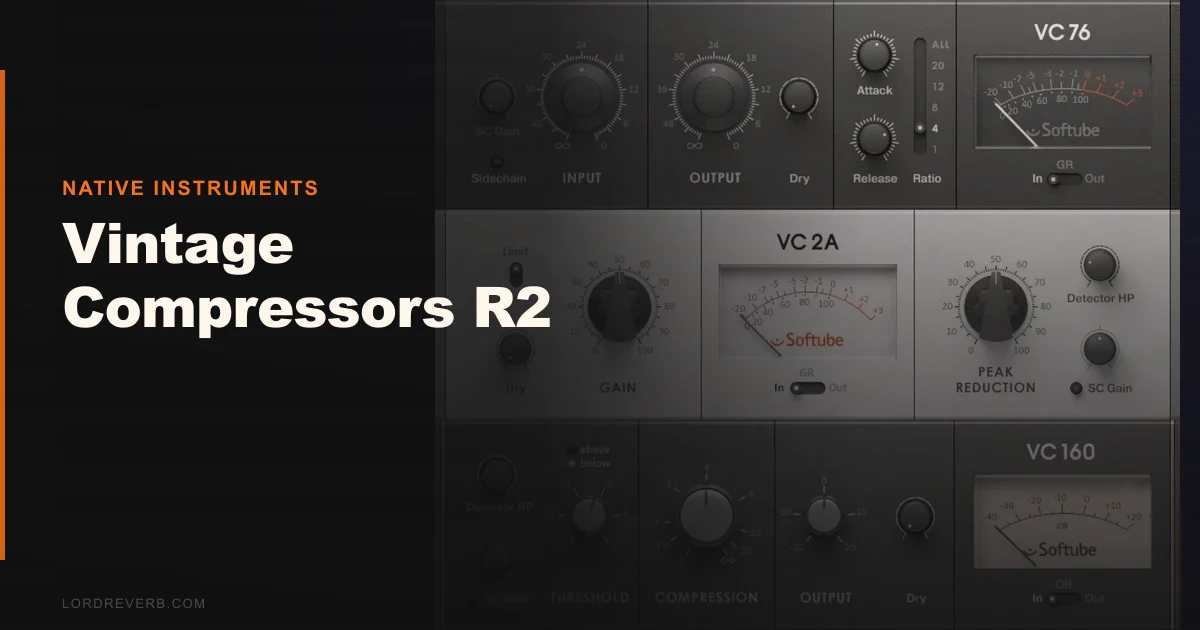
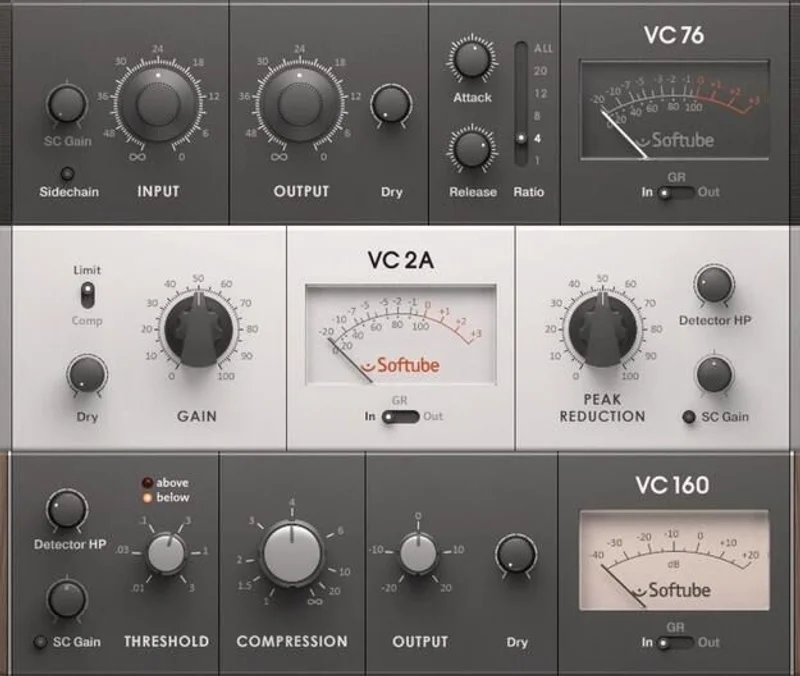
The GUIs match the originals closely. The VC 76 has the attack and release knobs, the ratio buttons, the input/output meters. The VC 2A has the peak reduction and gain controls, the limit/compress switch. We've used the real hardware, and nothing here made us wince at a fake-looking layout.
The first catch hits immediately. These don't load as standard VST3/AU/AAX in your DAW browser. They run inside the NI Effects Rack. If you've used any NI effects plugin before, you know the drill. If you haven't, expect 15 minutes of frustration the first session.
Competing bundles from IK Multimedia and Waves load directly. That's the out-of-the-box difference that matters most in daily workflow.
Performance Deep Dive
We ran the VC 76 on a lead vocal with attack at 7 (its fastest setting), release at 7, ratio at 4:1. The transient grab was immediate and the release chatter, that fast, almost rhythmic breathing UAD fans love, was present and audible. Not identical to the UAD 1176 Rev A, but genuinely close. Closer than we expected for the price.
We put the VC 2A on a bass guitar bus. Pulled about 4-6dB of gain reduction at a moderate program-dependent attack. The low end thickened without pumping. Satisfying. We've heard this described as "smooth" by every reviewer ever. What that means here: the optical emulation doesn't clip transients abruptly. The compressor eases in over 10-50ms depending on signal level, which means bass fundamentals stay round.
The VC 160 on a kick drum bus at 4:1 with the fastest attack added that dbx "snap" to the beater. We also noticed a subtle harmonic saturation on harder hits, around 2nd-order. It's quiet but it adds presence in the 3-6kHz range.
On CPU, we ran all three simultaneously in Ableton Live 12 on an M2 MacBook Pro. Total load sat around 3-4% per instance pair. Not light, but not a problem at reasonable track counts. We couldn't find independent benchmark data to compare against UAD native or Waves equivalents. That gap in public data is frustrating.
Where It Wins
The sidechain input on all three is the headline upgrade over hardware originals. The 1176 never had a sidechain. Neither did the LA-2A in standard configuration. Here you can feed a separate signal for frequency-conscious compression. High-pass the sidechain to stop low frequencies triggering the VC 2A unnecessarily on a vocal bus. That's a real, useful feature.
The dry blend control enables parallel compression without a separate bus. Dial in 30% dry on the VC 160 across your drum bus and you've got New York compression without a single extra routing step. Clever.
We love that the Softube collaboration isn't just marketing. The circuit modeling on the VC 76 responds differently at high gain reduction versus low, which reflects the real transformer behavior. That's the kind of detail that matters when you're printing.
Three distinct compression characters for $99 is hard to argue with. For producers starting out, this is a legitimately strong entry point into vintage-flavored dynamics.
Where the Competition Wins
UAD's 1176 emulations have multiple revisions: Rev A, Rev E, the "All Buttons In" mode. Each revision sounds different in documented, measurable ways. The VC 76 is one flavor. It's a good flavor. But you don't get to choose.
The hosting requirement is a real workflow tax. Loading inside NI Effects Rack adds steps. It breaks the muscle memory of your DAW plugin browser. For engineers doing 40-track mixes, that friction adds up. Annoying in a way that's hard to quantify but easy to feel after two hours of work.
IK Multimedia's T-RackS compression bundle and Waves' CLA series load natively, have more active development cycles, and come with better documentation on what each model sounds like and why. The R2 update is real, but minimal public information exists on what specifically changed from the original release.
We also wish the VC 160 had more saturation character on hard limiting. The dbx 160 hardware bites harder when you push it
. The emulation stays polite.
Who Should Buy Which
- ✅ Buy if you're already inside the NI ecosystem and want vintage compression to match your NI effects chain without friction.
- ✅ Buy if you want all three classic compression types (FET, optical, VCA) at $99 with sidechain capability built in.
- ✅ Buy if you're producing rather than mixing sessions daily. The workflow compromise hurts less when you're not switching between 40 tracks.
- ❌ Skip if you need standalone VST3/AU/AAX loading in your DAW browser. The Effects Rack hosting will drive you to open another plugin instead.
- ❌ Skip if you need multiple hardware revisions of the 1176 for A/B testing. UAD or Waves give you more model options.
- ❌ Skip if you're after the most CPU-efficient compression bundle available. There are lighter options for the same price range.
Score Breakdown
| Category | Score | Notes |
|---|---|---|
| Sound Quality | 4.0/5 | VC 76 and VC 2A emulations are genuinely convincing; VC 160 plays it safe |
| Value for Money | 4.0/5 | Three compressor characters for $99 is competitive against any alternative |
| Ease of Use | 3.0/5 | NI Effects Rack hosting adds friction that standalone loaders don't have |
| Features | 3.5/5 | Sidechain and dry blend go beyond hardware; revision options are thin |
| CPU Efficiency | 3.0/5 | Respectable but not lightweight; no independent benchmarks to compare |
| Overall | 3.9/5 | Strong value and solid emulations held back by workflow and limited update history |
Alternatives to Consider
Mellowmuse CP2V: If you want a single plugin that covers multiple vintage compression types without the hosting overhead, the CP2V is worth a look. Can the CP2V Compressor Replace 3 Vintage Hardware Units?
Fuse Audio Labs VQP-Bundle: Not a compressor bundle, but if you're building a vintage signal chain and want passive EQ to pair with these compressors, Fuse's bundle addresses the same classic hardware obsession at a comparable price. VQP-BUNDLE Vintage Passive EQs: Still Worth It in 2026
Fuse Audio Labs VPRE-2C: Before you compress, you need a preamp stage that earns it. If you're stacking vintage tools for vocal chains, the VPRE-2C gives you the tube character that the VC 2A then shapes. Can the VPRE-2C Vintage Tube Booster Fix Flat Vocals?
For drum sources that play well with these compressors, vintage drum samples worth pairing with hardware emulations gives you the transient content that actually rewards the VC 76's fast attack.
Vintage Compressors R2 is a genuinely good bundle wearing a frustrating coat. The Softube collaboration means the emulations hold up in real sessions. The sidechain additions are legitimately useful. But in 2026, a plugin that requires a host rack to operate is asking for tolerance that its competitors don't. At $99 it's fair. At the loyalty price it is a buy. If you're not in the NI ecosystem already, start somewhere else and come back when there's a sale.
Frequently Asked Questions
Do I need to own Guitar Rig to use Vintage Compressors R2?
No. NI provides the free Guitar Rig 4 Player as a host, so you don't need a paid Guitar Rig license. If you already own any NI Komplete product with effects, you can host the compressors there instead. Either way, the compressors don't load directly as standalone plugins in your DAW browser.
What's the difference between the three compressors in the bundle?
The VC 76 (based on the Urei 1176) is a FET compressor with fast attack times, best for drums, vocals, and anything needing aggressive transient control. The VC 2A (based on the Teletronix LA-2A) is optical, with program-dependent attack and release, best for smooth vocal and bass compression. The VC 160 (based on the dbx 160) is a VCA design with tight, punchy behavior and subtle saturation on driven signals, best for kick, snare, and bass bus work.
Is Vintage Compressors R2 worth buying if I already own Waves CLA plugins?
Probably not as a replacement. The Waves CLA plugins load natively and the CLA-76 in particular has strong community documentation around it. Where R2 adds value is the sidechain input and built-in dry blend for parallel compression, which the CLA series doesn't offer without extra routing. If those features matter to your workflow, it's a reasonable addition at loyalty pricing.
What does the R2 update actually change from the original release?
Public documentation on the specific R2 changes is thin, which is one of our frustrations with this bundle. NI positions it as a refinement of the original emulation and interface. We couldn't find detailed changelog notes confirming specific circuit model changes or new features beyond what shipped in the first version. Check the Native Instruments changelog directly for the most current information before purchasing.