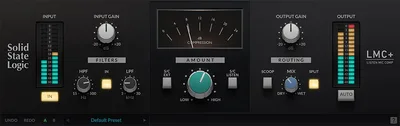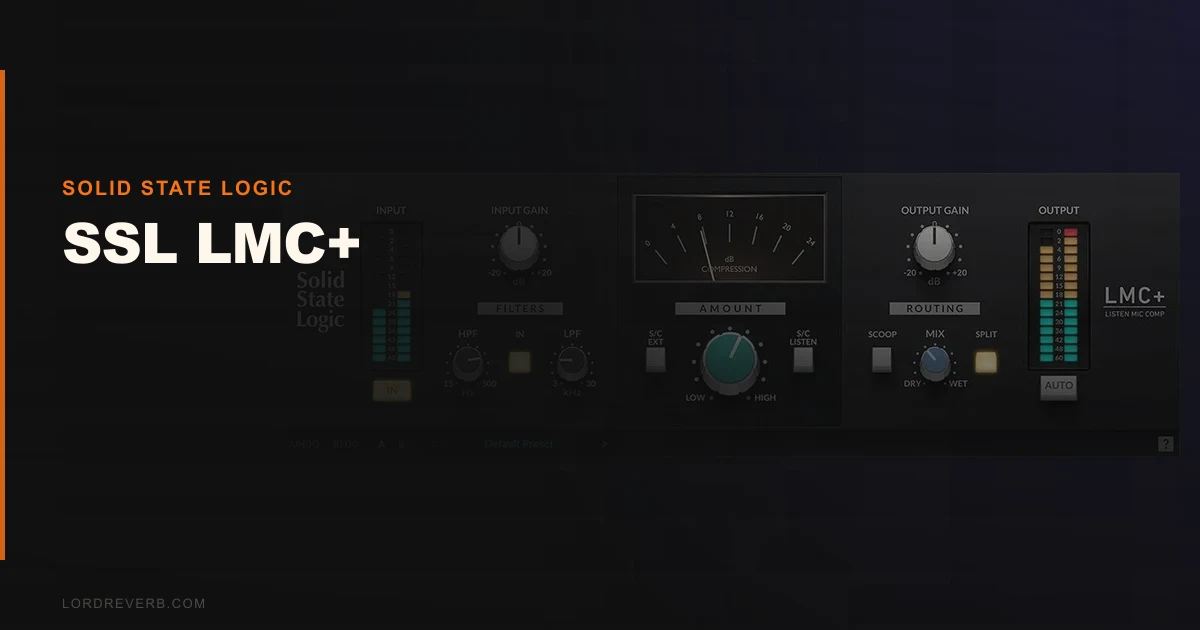
The SSL LMC+ is a legitimately great plugin for one very specific job: smashing drums until they sound like they were recorded in 1982 on an actual SSL 4000E console. For anything else, skip it.
It's a FET brickwall limiter modeled on the SSL 4000E's talkback compressor circuit. Not the famous stereo bus comp. Not the channel strip dynamics. The talkback compressor. That distinction matters, because it tells you everything about where this thing belongs in your signal chain.
We tested it across three sessions: a live rock kit, a programmed 808 beat, and a pop vocal bus. It earned its keep on two of those. On the third, we bypassed it after 90 seconds.
Here's the honest breakdown.
What You're Actually Getting
The LMC+ is SSL's plugin recreation of the Listen Mic Compressor from the 4000E console. The original was built to compress talkback mic signals. Engineers discovered it sounded brutal and brilliant on ambient drum mics. SSL eventually acknowledged this, added some controls, and the LMC+ is that expanded version.
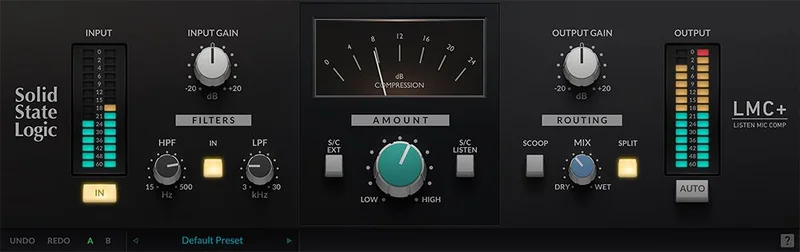
You get a high-pass filter, a low-pass filter, an external sidechain input with a Listen switch, a Scoop switch that phase-flips the processed signal, and a Split switch that pulls the plugin into a bandpass subtraction mode.
The compression ratio is extreme. The attack and release curves are fixed. You set an input level and an output level. The plugin does the rest.
It's available in VST3, AU, and AAX formats. Apple M1 native support is confirmed. Regular price is higher than the current price. Check the SSL store for current sale pricing, which has dropped significantly with promo codes at the time of writing.
The Good
We put the LMC+ across an overhead bus on a live-recorded kit session. The overheads had been recorded in a medium-sized room with decent natural ambience. We pushed the input to about 75%, pulled the output back to compensate, and hit play.
The room came alive. That's the only way to describe it. The transient snare crack sat loud in the first 10ms, then the compressor slammed shut and the tail of the room swelled up behind it in a way that took us back to "In the Air Tonight"-era drum sounds. It's that sound. It delivers it instantly.
The Listen switch on the sidechain is brilliant. You can audition exactly what's triggering the compressor before committing. That saves real time when you're filtering the sidechain to avoid low-frequency pumping from kick bleed.
The Scoop switch is underrated. Phase-flipping the compressed signal against a dry parallel gives you a mid-scooped, wide, aggressive texture that works on toms and room mics without any EQ. We used it on a programmed 808 kick bus and got a punchy low-mid shape that would have taken four moves in a conventional EQ.
CPU load is light. We ran eight instances across a full mix on an M1 Mac without touching performance.
The Not-So-Good
The fixed attack and release curves are a real limitation. There's no way to dial in the exact transient shape you want. You're either in or you're out. On a snare channel with a very fast initial crack, we wanted to tighten the release slightly to stop the compressor from breathing too obviously between hits. No option. You take what SSL's engineers decided in the 1980s or you don't use the plugin.
There's no wet/dry blend. If you want parallel compression, you're building a parallel track or a send yourself. That's not the end of the world, but on a plugin at this price point, a dry/wet knob costs nothing to implement and saves four mouse clicks every time you load it.
We tested it on a pop vocal bus out of curiosity. Frustrating. The attack is too aggressive for anything sung by a human being. The compression ratio is too extreme for anything where nuance matters. We bypassed it fast.
Don't put this on your 2-bus. It's not a mastering tool. It's not designed for it and it sounds awful trying.
Compared to the Alternatives
The obvious comparison is other SSL-flavored compressors. The Kiive Audio Complexx bus compressor is targeting a completely different use case: that classic SSL stereo bus glue sound. Complexx gives you ratio, attack, and release controls. It's a workhorse. The LMC+ is a weapon.
The Mellowmuse CP2V compressor covers vintage VCA territory with more tonal flexibility. If you want something that can sit on multiple bus types, look there instead.
For a direct LMC+ competitor in the "aggressive drum smashing" category, the Kush Audio Novatron does similar work with slightly more tonal control and a steeper price. The Empirical Labs Arouser is more flexible across sources. Both cost more.
If you genuinely just want that gated-reverb 80s drum sound and nothing else, nothing else does it faster or cheaper than the LMC+.
Who Should Buy This
- ✅ Buy if you produce 80s-influenced rock, pop, or anything where aggressive room compression on a drum kit is part of the palette.
- ✅ Buy if you work heavily with 808 beats and want a fast, destructive limiter to shape transients on kick and sub buses.
- ✅ Buy if it's on sale at a low price and you're curious. At that price, you're not gambling much.
- ❌ Skip if you want a general-purpose compressor with attack and release control. This isn't it.
- ❌ Skip if you're building a mastering chain. It will not work on a 2-bus.
- ❌ Skip if you need one plugin that does many jobs. Buy the Native Instruments Vintage Compressors R2 instead.
Score Breakdown
| Category | Score | Notes |
|---|---|---|
| Sound Quality | 4.5/5 | Does exactly what it claims with genuine SSL character |
| Value for Money | 3.5/5 | At sale price it's a steal; full price is hard to justify for a one-use tool. |
| Ease of Use | 4.5/5 | Almost no learning curve; Scoop and Split switches are immediately intuitive |
| Features | 2.5/5 | No wet/dry blend, no attack or release control, too limited for the price |
| CPU Efficiency | 4.5/5 | Eight instances ran without issue on M1 Mac |
| Overall | 3.8/5 | Brilliant specialist tool that scores low only because its use case is genuinely narrow |
Alternatives to Consider
If the LMC+'s one-trick focus frustrates you, these are worth your time instead.
Kiive Audio Complexx, Our Complexx review covers this in detail, but the short version is: if you want SSL bus comp character with real attack and release control, this is the smarter buy for most mixes.
PSP MasterComp, If you're building a mastering chain and thought the LMC+ would slot in there, it won't. The PSP MasterComp is what you actually want: transparent, controllable, mastering-grade.
Bettermaker Mastering Compressor, For stereo bus and mastering use cases, the Bettermaker Mastering Compressor is worth a look if you want analog-modeled dynamics that work across the full mix without aggression for its own sake.
The LMC+ has a high full price with regular promotional windows that drop it to a much lower amount. At a deep discount it's an easy yes if drums are a significant part of your work. At full price we'd wait for a sale.
If you produce anything where a room mic sounds better destroyed than natural, you'll love this plugin. If you need a compressor that follows your creative decisions rather than making them for you, you'll hate it inside a week.
Buy it on sale. Use it on drums. Leave it off everything else.
Frequently Asked Questions
What is the SSL LMC+ based on?
It's modeled on the Listen Mic Compressor circuit from the SSL 4000E console. This was originally a talkback mic compressor, not a dedicated dynamics processor. Engineers started routing ambient drum mics through it and discovered the aggressive FET limiting created a distinct 80s snare and room sound. SSL later formalised this with added controls and released the LMC+ plugin version.
Can you use the SSL LMC+ on a 2-bus for mastering?
We wouldn't. The LMC+ is a brickwall FET limiter with an extreme compression ratio and fixed attack and release times. It's built for aggressive channel-level signal smashing, not the transparent, controlled dynamics you need on a stereo master. For mastering compression, look at dedicated tools like the PSP MasterComp or the Bettermaker Mastering Compressor instead.
Does the SSL LMC+ work with Apple Silicon Macs?
Yes. The LMC+ ships as a universal binary with confirmed Apple M1 native support. We ran multiple instances on an M1 Mac without stability issues or performance hits. CPU load is light across the board.
What's the best way to use the SSL LMC+ for parallel compression?
The LMC+ has no built-in wet/dry blend control, so you'll need to set up a parallel routing yourself. The standard approach is to send your drum bus to a dedicated parallel track, insert the LMC+ on that track at full wet, then blend it back against the unprocessed signal to taste. Starting with the input at around 60-70% gives you the aggressive room swell without completely destroying the original transients.