
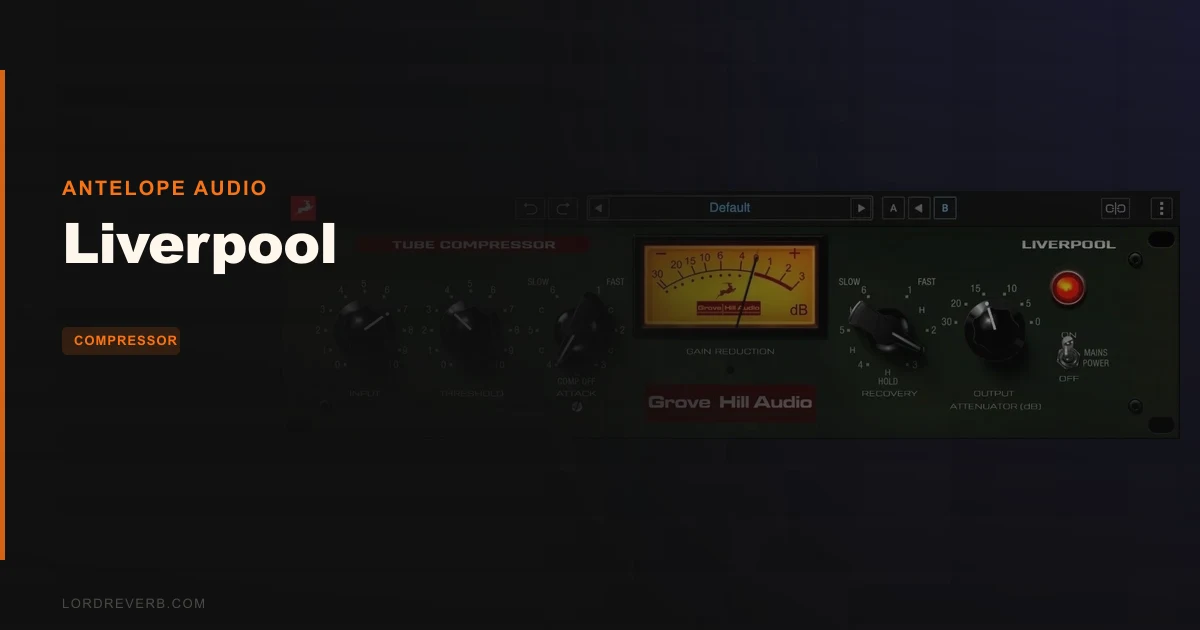
The doubt is fair: how do you trust a compressor plugin that claims to fuse three separate vintage hardware personalities without just becoming a muddy identity crisis? Liverpool answers that by design. Antelope Audio combined the mid-range smoothing of an Altec 436C, the fast transient attack of a Fairchild 670, and a unique Hold recovery from an RS124 into one processor that the developer says is forgiving almost to a fault. At $17.90, the question isn't whether it sounds interesting. The question is whether it earns its place in your plugin chain over things you already own.
Liverpool suits producers and engineers who want tube warmth and character on vocals, bass, or mid-heavy sources without reaching for three separate plugins. It also runs on Antelope's Synergy Core hardware for real-time tracking with no perceptible latency.
Does It Actually Deliver?
Liverpool is Antelope Audio's emulation of a modified Altec 436C circuit, the kind of unit that spent decades in studios getting quietly beloved before prices on the hardware became ridiculous. The plugin layers in attack behavior drawn from the Fairchild 670 and a Hold recovery from the RS124, which is a BBC-developed derivative of the same 436C family.
What that means in practice is that you get compression that grabs transients quickly, holds onto them, then releases in a way that tends to feel musical rather than mechanical. The developer says it enriches mid-range and thickens low-end, and given how the 436C design behaves, that's not a stretch.
The clever part: you can bypass the compression entirely and just drive the input for vintage coloring. That's a genuinely useful design choice, not a gimmick. You get the transformer saturation and harmonic rounding without the dynamics processing touching your signal at all.
Where It Shines
Put Liverpool on a vocal that feels brittle and thin in the mids. The 436C character specifically addresses that frequency range. Owners of the hardware know that 300Hz to 2kHz region gets a smooth, rounded quality that most compressors leave cold. Drive the input before you even engage compression and that harmonic thickness starts shaping the sound.
Push it into heavy compression on a bass bus. The lush smoothening the developer describes isn't just marketing language for the 436C family. It's the way those circuits handle gain reduction at high ratios without introducing the kind of pumping you'd get from faster, more aggressive designs. Your bass can sit tighter without losing its body.
The Hold recovery function is the underrated piece here. Standard compressors give you attack and release. The RS124-derived Hold stage means the plugin grips the signal for a defined period before releasing, which keeps the compression feeling controlled even when you're pushing it hard. That's genuinely satisfying to work with on sources that tend to escape other compressors mid-phrase.
And if you're tracking live through Synergy Core hardware, the zero-latency version means Liverpool is actually useful during recording, not just mixing. That's a practical advantage most plugin emulations can't match.
Where It Falls Short
The native version without Synergy Core hardware loses the zero-latency advantage entirely. If you're mixing ITB on a standard interface, you're running the native plugin like any other, which is fine, but the latency-free tracking angle disappears. Annoying if that's why you were interested.
The design is intentionally colored and characterful. If your sessions need a transparent, surgical compressor that stays out of the signal's way, Liverpool is the wrong tool. The developer is upfront that this enriches and thickens. Those aren't neutral words. Engineers who want a workhorse clean compressor should look elsewhere.
And the niche source set is real. Vocals and bass are obvious fits. On material that's already midrange-heavy or dark, that 436C character can tip things in the wrong direction.
Is the Price Fair?
At $17.90, Liverpool is priced where impulse buys live. And for a plugin that the developer calls the only true emulation of this specific dynamics processor, that's not a bad place to be.
The question is whether you need this character. If you're already well-stocked on vintage compressor emulations, Liverpool needs to earn its slot against tools you've already paid for. If your collection is thin on 436C-style warmth specifically, $17.90 is a genuinely low barrier to bring that sound into your sessions.
It's not a free-alternative situation. The specific Hold recovery and triple-heritage design aren't things you're finding in a free plugin bundle. For what it's targeting, the price is fair.
Specs & Technical Details
| Developer | Antelope Audio |
| Price | $17.90 |
| Plugin Format | N/A |
| OS Support | Mac / Windows |
| Activation | N/A |
| CPU Usage | N/A |
| Trial Available | N/A |
| Version Reviewed | N/A |
Score Breakdown
| Category | Score | Notes |
|---|---|---|
| Sound Quality | 4.3/5 | Triple-heritage design targets a specific, characterful result that the 436C family is known to deliver |
| Value for Money | 4.2/5 | Low price point for a claimed one-of-a-kind emulation; hard to argue with at this cost |
| Ease of Use | 4.0/5 | Specially designed controls aim for flexibility without complexity |
| Features | 3.8/5 | Compression bypass for input drive is clever; Synergy Core version adds real-time tracking value |
| CPU Efficiency | N/A | No data available |
| Overall | 4.1/5 | A focused, character-driven compressor at a price where the risk is low enough to just try it |
If you're chasing mid-range warmth and want one plugin that smooths, thickens, and colors without asking you to chain three separate tools, Liverpool has a specific, clever answer. It's not for everyone. Transparent compression this is not.
Skip it if your sessions need neutral, controlled dynamics processing. Skip it if you're already loaded on vintage tube emulations and can't justify another. But if the 436C character is a gap in your chain and $17.90 is what it costs to fill it, the risk is low and the potential reward is a compressor that the developer says you'll be hard-pressed to use badly. That's a rare thing to claim, and at this price, it's worth finding out if they're right.
Frequently Asked Questions
What hardware is Liverpool based on?
Liverpool fuses elements from three vintage units: the Altec 436C for mid-range smoothing compression, the Fairchild 670 for fast transient attack, and the RS124 for its unique Hold recovery behavior. The RS124 itself is a BBC-developed derivative of the 436C family. Antelope Audio says it's the only true plugin emulation of this specific dynamics processor.
Do I need Antelope Audio hardware to use Liverpool?
No. Liverpool is available as a native plugin that runs on Mac or PC without additional hardware. The Synergy Core Real-Time version, which runs with no perceptible latency, requires a compatible Synergy Core device. The native version works with any DAW and interface for standard mixing use.
Can I use Liverpool just for coloring without compressing my signal?
Yes. Liverpool lets you bypass the compression entirely and drive the Input stage for vintage harmonic coloring. This means you get the character and saturation from the circuit design without the dynamic processing affecting your gain structure. It's a genuinely useful option if you want grit or warmth without touching your transients.
What sources does Liverpool work best on?
The 436C design is known for enriching the 300Hz to 2kHz mid-range region, which makes Liverpool a natural fit for vocals, bass, and mid-heavy instruments that need body and smoothing. If you're working with sources that are already dark or congested in the mids, the character it adds can work against you. It's built for color, not transparency.