The CP2V in an Actual Session
The CP2V Compressor from MellowMuse is $49 vintage-styled plugin that trades surgical control for fast, character-forward compression, and it earns that trade on some sources more than others.
We dropped it on a DI bass during a funk session. The player had dynamics all over the place: a quiet verse fingerstyle groove that needed gluing, a slapped chorus that was punching the limiter on the master. One instance of the CP2V, Drive dialled to about 11 o'clock, and the whole performance sat together inside 40 seconds. No fussing with attack and release. No riding automation. Just a compressor doing its thing.
That's the promise. The CP2V is built for producers who want analogue-style compression colour without opening a manual. At $49 and available in VST, VST3, AU, and AAX formats for both macOS and Windows, it's aimed squarely at beatmakers, singer-songwriters, and home studio producers who want "the sound" more than "the control."
First Impressions
Installation is clean. Download, authorise, open. It showed up in our DAW browser immediately, which sounds basic but isn't always guaranteed with smaller developers.
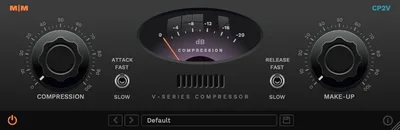
The UI is minimal. You get a Threshold/Ratio combo knob (both parameters move together as you turn it), a Drive knob for saturation, and an output gain control. That's mostly it. No attack knob. No release knob. No visual gain reduction meter that tells you anything specific.
First reaction: this feels undercooked. Second reaction, after actually running audio through it: the preset timing is smart for the sources it's designed for. It's tuned for musical material, not mastering transparency. That's a design choice, not an oversight. We'd still love a GR meter. Annoying that it's missing.
Getting It Into a Real Workflow
We ran the CP2V through four sessions over two weeks: bass guitar, acoustic guitar, a drum bus, and a lead vocal.
Bass and acoustic guitar: brilliant. The Threshold/Ratio combo control is genuinely clever here. As you push the knob clockwise, it simultaneously lowers the threshold and increases the ratio. That means more signal gets caught and gets caught harder, simultaneously. It mirrors how vintage hardware like a Fairchild actually responds, and the result on bass is that the low-mids tighten without sounding squashed.
We used the Drive at around 10 o'clock on an acoustic guitar buss. The transients softened just enough to push the strummed body into the midrange of the mix without losing the pick attack. That's the saturation working. It's adding second and third harmonics that make the source feel denser.
Drum bus: mixed results. The preset release worked fine on slower material, but on a 130 BPM hip-hop pattern with tight snare hits, we heard pumping that we couldn't dial out because there are no release controls. We ended up pulling the CP2V off the drum bus and reaching for the Kiive Audio Complexx instead.
Lead vocal: we'd skip it here. The lack of attack control means you can't protect the transient consonants the way you'd want to. It softened the character of the performance in a way that felt frustrating rather than musical.
What It's Genuinely Good At
Low-end sources are where the CP2V earns its keep. Bass guitar, synth bass, bass-heavy pads. The 4x oversampled 64-bit internal processing keeps things clean in the low frequencies even when you're driving the compressor hard. We didn't hear aliasing or digital harshness at any Drive setting.
The harmonic saturation from the Drive knob is genuinely useful. We A/B'd it against running the same bass through a clean compressor followed by a separate saturation plugin. The CP2V sounded more cohesive, probably because the saturation and compression are interacting at the circuit-model level rather than sitting in series as separate processes.
Speed of use is a real strength. We were at a usable sound in under 60 seconds every time we loaded it on a bass track. For producers who get paralysed by compressor parameter choices, that matters.
At $49, compare it to the Waves Renaissance Compressor (check current pricing on Waves' site): the CP2V adds Drive colour that the RComp doesn't offer at any price. It's a different tool, but the saturation integration makes the CP2V feel more like a character piece than a workhorse, which is the right comparison.
If you need a more forensic look at what dedicated mastering compression can do, the PSP MasterComp is worth reading alongside this review. Completely different targets.
The Rough Edges
No gain reduction meter is a real problem. Not a quirk. A problem. You're compressing by ear with zero visual confirmation of how hard the plugin is working. On a quiet mix, that's workable. On a dense session with lots of automation, it's a liability.
No manual attack and release controls. We understand the design philosophy: preset times remove decision fatigue, and for the target audience that's valid. But the fixed timing means the CP2V fails on fast transient material. You can't adapt it. You accept it or you move on.
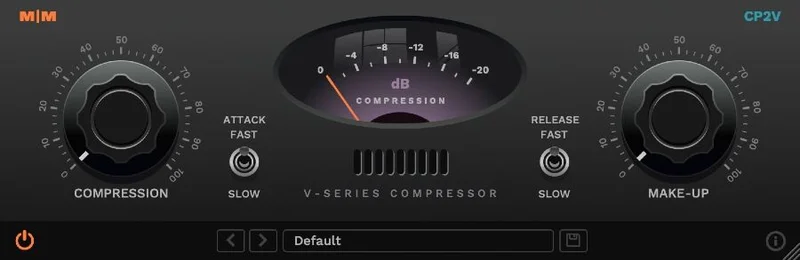
The UI is small. On a 4K monitor at 150% scaling, it's still cramped. The knobs are close together, and fine adjustments require careful mouse movement.
MellowMuse has been quiet since 2019. There's been no major update t o the CP2V that we could find. No M1/M2/M3 native build is confirmed. It runs fine on Apple Silicon under Rosetta 2, but in 2026 that feels like a gap the developer should have addressed.
Who This Is Really For
✅ Buy if you produce bass-heavy music (hip-hop, R&B, funk, electronic) and want a quick colour compressor for DI bass or synth bass.
✅ Buy if you lose time fussing with attack and release knobs and want to remove that variable from your workflow.
✅ Buy if you're building a starter plugin collection and need a vintage-character compressor at a low price.
❌ Skip if you need a compressor for lead vocals or fast transient drums where attack control is non-negotiable.
❌ Skip if you want a metered, transparent compressor for mastering or bus work. Look at the Bettermaker Mastering Compressor for that job.
❌ Skip if native Apple Silicon support is a hard requirement for your studio.
Score Breakdown
| Category | Score | Notes |
|---|---|---|
| Sound Quality | 3.8/5 | Flatters bass and low-mid sources well; saturation integration is cohesive |
| Value for Money | 4.0/5 | $49 is a fair ask for what it does on the right sources |
| Ease of Use | 4.3/5 | Genuinely fast to dial in; minimal controls are a feature not a flaw for the right user |
| Features | 2.5/5 | No GR meter, no manual timing controls, and the UI is cramped |
| CPU Efficiency | 4.3/5 | Runs light even with 4x oversampling; multiple instances cause no strain |
| Overall | 3.8/5 | A focused, honest tool that's right for a specific job and wrong for most others |
Alternatives Worth Considering
If you need more control without losing the vintage vibe, the United Plugins Royal Compressor gives you mu-style compression with actual attack and release knobs. It costs more, but you get far more flexibility on the sources where the CP2V falls short.
For bus and drum compression where the CP2V's fixed timing breaks down, the Kiive Audio Complexx is our current go-to at a higher price point. It handles transient-heavy material in a way the CP2V simply can't.
If you're stacking multiple compressors in a mastering chain, the PSP MasterComp is the transparent option that pairs well alongside a character piece like the CP2V as a first-stage colour compressor.
The Bottom Line
The CP2V does one job well: it makes bass sound like it belongs in the mix fast. Drive at 10-11 o'clock, Threshold/Ratio pushed until the low-mids tighten, output gain trimmed to taste. Done in under a minute.
That's worth $49 if bass compression is something you do daily and you hate fussing with timing controls. It is not worth $49 if you're hoping it'll replace a proper all-purpose compressor. It won't.
The lack of a gain reduction meter and the absent manual timing controls aren't things you'll work around. They're limits you'll hit repeatedly. Know what you're buying.
At $49, the risk is low. But if you need a compressor that can handle everything in your session, spend a bit more and buy a plugin with a GR meter and actual attack and release knobs. The CP2V is a good specialist tool sold at a price that makes it easy to forgive being narrow. Just don't ask it to be something it's not.
Frequently Asked Questions
Does the CP2V Compressor work on Apple Silicon Macs in 2026?
It runs on Apple Silicon Macs under Rosetta 2, and we didn't experience crashes or stability issues during testing. However, MellowMuse hasn't confirmed a native Apple Silicon build as of our review date. If Rosetta 2 compatibility is a concern for your studio setup, check the MellowMuse site for any updates before buying.
Why does the CP2V only have one main control knob instead of separate threshold and ratio knobs?
MellowMuse designed the Threshold/Ratio knob so both parameters move together simultaneously. As you turn the knob clockwise, the threshold lowers and the ratio increases at the same time. This mimics how some vintage analogue circuits behave, and it removes the decision of balancing two parameters separately. It's fast, but it means you can't set a high threshold with a high ratio independently.
Is the CP2V Compressor good for mastering?
We'd steer you away from using it as a mastering compressor. The lack of a gain reduction meter and the fixed attack and release times make precision mastering work difficult. The Drive saturation also adds harmonic colour, which may not be appropriate for sources that are already close to finished. For mastering compression, look at dedicated tools with full metering.
How does the Drive knob on the CP2V actually work?
The Drive control adjusts the level of saturation applied within the plugin's internal circuit model. Turning it up adds second and third harmonic content, which makes sources sound denser and more present in the mix. At lower Drive settings (8-10 o'clock) the effect is subtle and adds warmth without obvious colouration. Above noon the effect becomes more audible and works best on bass and rhythm guitars where harmonic density is a benefit rather than a problem.