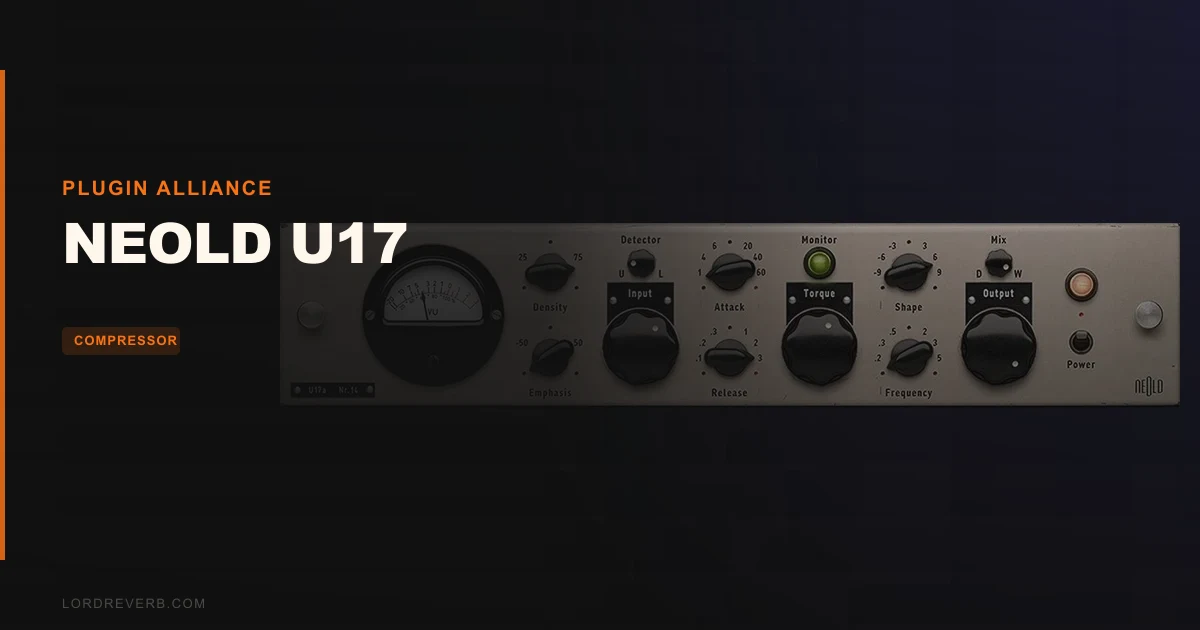
The NEOLD U17 is one of the most satisfying bus compressors we've tested in the last two years, and if you catch it on sale, it's a near-certain buy. But it is not transparent, it is not surgical, and it will color your mix whether you asked it to or not. That's either the whole point or a hard dealbreaker, depending on where you are in your session.
The U17 is a plugin emulation of an almost impossibly rare piece of 1954 German broadcast hardware. We've reviewed glue compressors at every price point, and this one earns its spot. It's built for mix bus work, drum buses, and source material where you want the compression to be felt as much as heard. Producers chasing clean and invisible need to look elsewhere.
What You're Actually Getting
In 1954, a compressor appeared that almost nobody got to use: the U17, built by Allgemeine Telefon-Fabrik in Hamburg for the NWDR broadcasting network. Only a few dozen units were ever manufactured, making it one of the rarest compressors ever built.
The hardware combined a solid-state diode bridge using Germanium crystal semiconductors with all-tube, transformer-coupled amplification. A genuinely sophisticated hybrid topology for the era.
NEOLD's digital version was developed by Roger Schulte alongside Dominic Klassen (founder of Elysia) and Raimund Dratwa of Fuse Audio Labs. That's a credible team. They didn't just model the circuit, they added controls the original hardware lacked entirely.
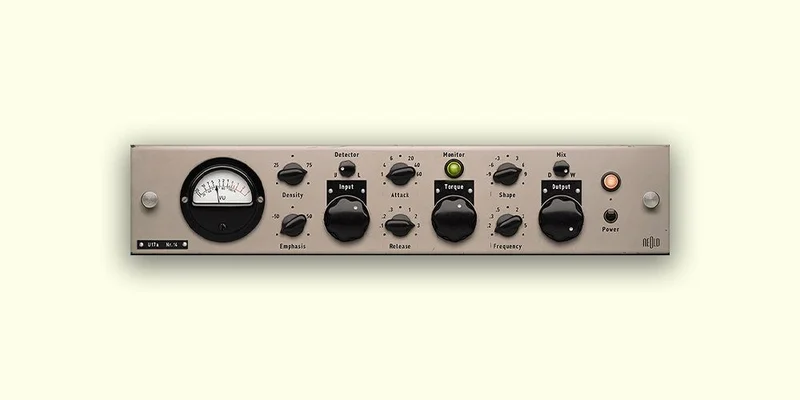
A preceding soft clipper adds pleasant coloration while taming heavy transients before entering the actual compressor, which can blend from gentle and transparent to straight and aggressive operation via its Torque control.
Formats covered: AAX, AU, and VST3. No VST2. Mac and Windows both supported.
The Good
We put the U17 across a full drum bus: kick, snare, overheads, room mics, all summed. We set attack to 30ms, release to auto, and dialed in about 4 dB of gain reduction with the Torque control sitting at roughly 60%. The snare thickened immediately. Not louder, thicker. The low-mid body of the snare, around 200-250Hz, got denser without getting muddy. That's the Germanium diode-bridge character doing its thing, adding second and third harmonic content that you'd pay serious money for in hardware.
The Density stage (that soft-clipper pre-stage) is genuinely clever. We used it to shave transient energy off a bus with a overly hot room mic before compression even touched it, which saved us from over-compressing to tame peaks. It removed roughly 2dB of peak energy and let the compressor work more musically at 3:1 rather than slamming at 6:1.
The auto attack and release modes are also underrated. On a heavily syncopated hip-hop session with irregular groove, auto mode tracked the program content cleanly, no pumping artefacts, just glue. We love that they included a sidechain monitoring button so you can hear exactly what's triggering the compressor.
On vocals, 2-3 dB of gain reduction with a slow attack (around 40ms) and Torque at 40% gave us an almost Neve-ish thickness in the upper-low midrange: that presence at 1-2kHz that makes a vocal sit in front of a dense arrangement without needing a separate harmonic exciter in the signal chain.
The Not-So-Good
Here's what most reviews won't tell you: the U17 has an inherent high-frequency presence built into its character. Around 5-8kHz, the diode-bridge topology introduces a subtle lift that is satisfying on individual sources but becomes frustrating on a master bus when your mix already runs bright.
We tested it at the end of a fully-produced mix with dense hi-hats and bright synth pads. At over 40% mix, the high-end accumulation was annoying enough that we had to pull 1.5dB at 6kHz after the U17 just to get back to our reference loudness target at -14 LUFS integrated. That's an extra step you shouldn't need on a master bus compressor.
No dedicated companion EQ from NEOLD is a real gap. If you're building a channel strip approach, you're bolting on third-party EQ every single time.
VST2 is gone entirely in v1.3. If you're on an older DAW that doesn't support VST3, this won't load at all. Check your DAW's format compatibility before you buy.
Compared to the Alternatives
The obvious comparison is to the Neve 33609 emulations, plug-ins like the Brainworx bx_townhouse Buss Compressor or UAD's version. The 33609 circuit is also transformer-coupled and also colors, but it runs brighter and tighter. The U17 sits thicker in the low-mids. Pick the 33609 for modern pop or EDM master bus work where transient snap matters. Pick the U17 when you want weight and density.
Kiive Audio's Complexx is a genuinely strong alternative for mix bus compression, with cleaner program-dependent behaviour and a more flexible knee. If you need transparency with just a touch of character, Complexx edges U17 out.
The MellowMuse CP2V covers vintage Vari-Mu territory. Different beast entirely: smoother attack, rounder release, less of the diode-bridge midrange density. If you mix soul or jazz where the U17's coloring would be too thick, CP2V makes more sense.
For mastering specifically, PSP MasterComp is a more controlled tool with better transparency at low gain reduction settings, better suited when you need the compressor to be invisible.
Who Should Buy This?
- ✅ Buy if you want a mix bus compressor that actively adds density, low-mid body, and harmonic coloration as part of its function.
- ✅ Buy if you're working in rock, hip-hop, soul, or any genre where a thick, slightly pushed low-midrange is a feature rather than a problem.
- Buy if you catch it on sale. At that price, the risk is trivial and the reward is high.
- ❌ Skip if you need a clean, low-coloration compressor for mastering or broadcast delivery at -14 to -23 LUFS targets.
- ❌ Skip if your mix already runs bright and you don't want to manage an extra EQ correction step after the bus.
- ❌ Skip if you're on a DAW that only accepts VST2 format, you won't be able to load it.
Score Breakdown
| Category | Score | Notes |
|---|---|---|
| Sound Quality | 4.5/5 | Diode-bridge coloration is brilliant on the right source; less so on bright masters |
| Value for Money | 4.0/5 | Excellent at sale price; harder to justify at full price. |
| Ease of Use | 4.5/5 | Minimal controls, smart auto modes, sidechain monitor is a nice touch |
| Features | 3.5/5 | Density stage is clever but no sidechain filter and no companion EQ leaves gaps |
| CPU Efficiency | 4.5/5 | Light footprint; runs comfortably across multiple buses simultaneously |
| Overall | 4.2/5 | One of the better colored bus compressors available ITB at its sale price |
Alternatives to Consider
Kiive Audio Complexx, Our current pick for a flexible mix bus compressor that works across genres without committing hard to a colored sound. More control, less character. Better for mixers who want options rather than a signature.
Native Instruments Vintage Compressors R2, If you need an affordable entry point to vintage compressor emulation across multiple hardware references, this bundle covers more ground for a similar investment. Spread across sources, it's better value as a toolkit.
Bettermaker Mastering Compressor, The Bettermaker is the right call for master bus work where you need analog-style compression without the high-frequency presence the U17 introduces. Cleaner, more surgical, and designed specifically for the final stage.
If you produce records where the mix bus needs to breathe, thicken, and push, and you understand that the U17 is a character tool first and a dynamic controller second, buy it on the next sale. If you're after a neutral compressor that stays out of your mix's way, it's a hard pass regardless of price.
Frequently Asked Questions
Is the NEOLD U17 good for mastering?
For track mastering where you want color and density, yes, especially at low gain reduction (1-3 dB). For final mix bus mastering on already bright material, we'd steer you toward something cleaner. The U17's inherent high-frequency presence can build up on masters at higher settings and requires compensatory EQ, which adds steps to your mastering chain you may not want.
What's the difference between the Density stage and the main compressor on the U17?
The Density stage is a soft clipper that sits before the compressor in the signal chain. It handles transient reduction and adds harmonic saturation before the compressor even sees the signal. Think of it as a pre-conditioner: it shapes peak energy and tone, while the main compressor handles dynamic range. You can run the Density stage alone without significant compression if you just want the coloration.
Does the NEOLD U17 need an iLok dongle?
No physical dongle required. Activation runs through Plugin Alliance's account-based system, which ties the license to your account and machine. You'll need to install the Plugin Alliance Connect app to manage the license, but there's no hardware dongle involved.
How does the NEOLD U17 compare to Neve 33609 emulations?
Both are transformer-coupled and both color the signal. The 33609 emulations tend to run tighter and brighter, with more transient definition. The U17 sits thicker in the low-mids due to its Germanium diode-bridge topology, adding body rather than snap. On a dense rock or hip-hop mix bus, the U17 tends to feel heavier. On a pop or EDM master bus where brightness and punch matter more, most 33609 emulations will serve you better.