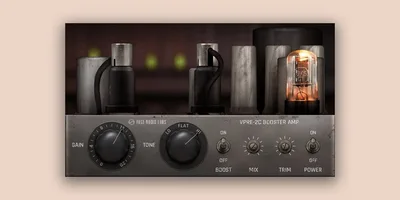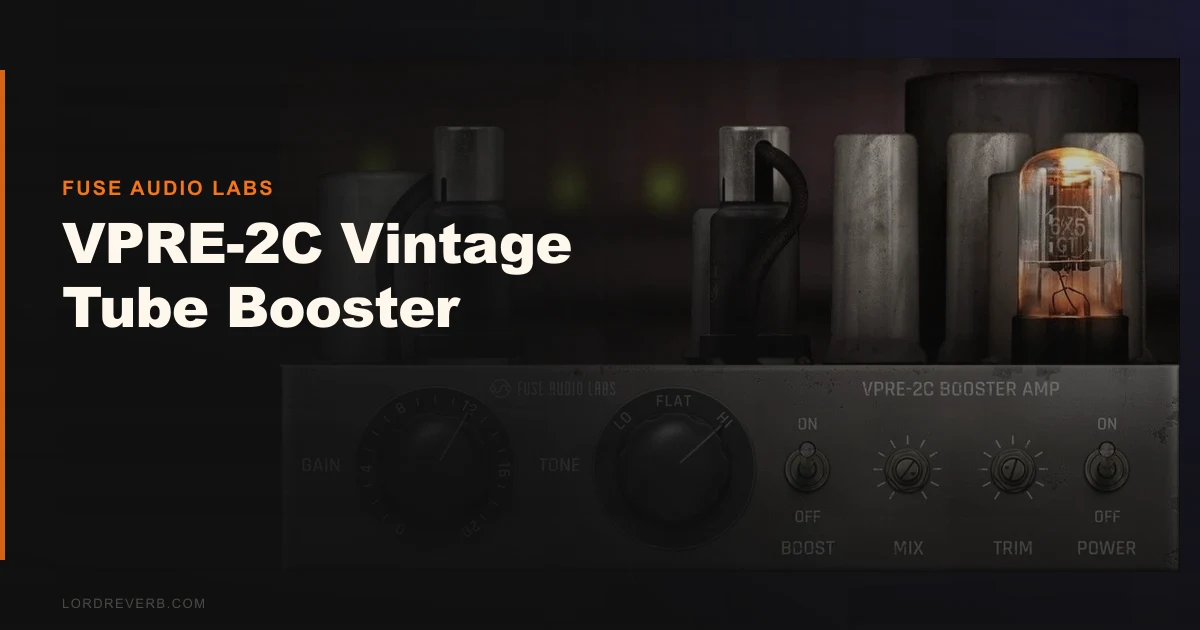
You've pulled a vocal take that sounds flat and lifeless, sitting on top of the mix instead of inside it, and no amount of EQ or compression is fixing the problem. The issue isn't level. It's character. The VPRE-2C Vintage Tube Booster by Fuse Audio Labs exists specifically for that moment.
This plugin models the RCA Model BA-2C, a transformer-based all-tube booster amp from the 1950s that saw serious use in broadcast, film, and recording studios before most of us were born. Fuse Audio Labs modelled the 6J7 pentode tube and the transformer circuit that gave the original its texture.
At $49 retail (with a 14-day free trial), this is positioned as a character tool, not a mixing utility. We ran it hard across sessions to figure out whether it earns that positioning or just looks the part.
The Problem With "Just Add Saturation"
Most saturation plugins oversell themselves. You load one up, push the drive, and suddenly your vocal sounds like it's been processed rather than recorded through something interesting. The harmonic content gets thick and obvious. The transients smear.
What producers actually need from a tube preamp emulation isn't more saturation. It's the right saturation at the right level. The RCA BA-2C was never a character cannon. It was a broadcast tool built for clarity with a specific kind of warmth baked in from the transformer and tube topology.
The VPRE-2C targets that gap between "sounds clean" and "sounds interesting." We've tested bus compressors that colour the signal and mastering tools that add analog texture, but a dedicated tube preamp emulator at this price point is a different category entirely.
How It Actually Performs
We dropped the VPRE-2C onto a dry condenser vocal recorded in a treated room. Gain at noon, Boost at about 30 percent. The result was a subtle forward push in the 2kHz to 4kHz region with a slight softening of the top-end edge above 10kHz. Not dramatically different. Just more settled.
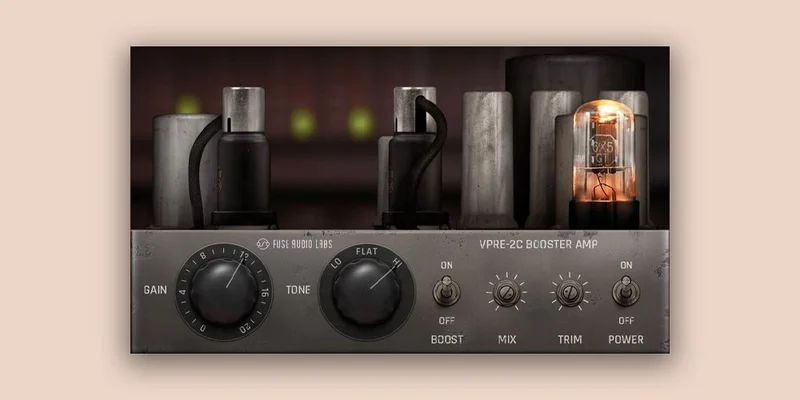
We pushed Boost to 75 percent on a DI bass track. That's where the 6J7 pentode character showed up clearly: odd-order harmonics came in below 500Hz, giving the low-mids a slight grittiness that made the bass feel like it had been recorded through something rather than plugged straight into a interface. The transformer saturation rounded off hard transient peaks without killing the attack.
On acoustic guitar, we ran the Gain high and Boost low. The plugin added about 2dB of perceived loudness without touching the fader, the kind of gain staging trick that analog-modelled compressors often claim but rarely deliver this cleanly.
CPU load was light across all three scenarios. We had 12 instances running simultaneously in a 48-track session on an Intel i7 before we noticed any measurable impact. That's genuinely low overhead for a tube preamp emulation.
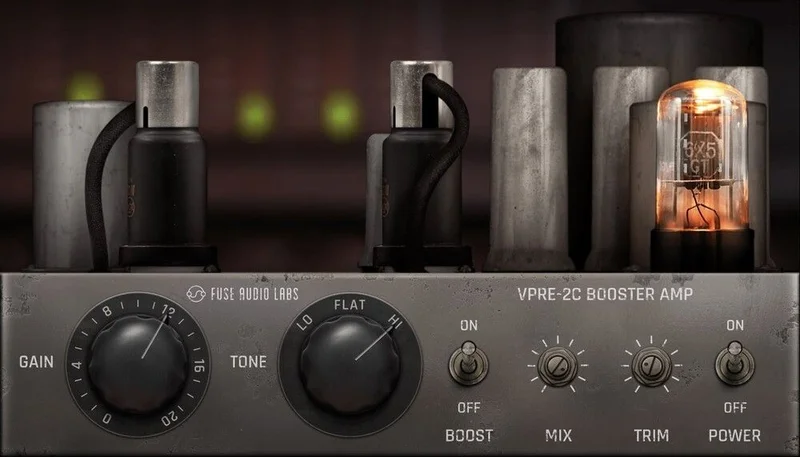
The one frustration: no spectrum display or meter to show you what the harmonic content is doing. You're going entirely by ear. That's authentic to vintage hardware, but it slows down precise work.
Strengths and Weaknesses
The strongest thing about the VPRE-2C is that it sounds like a piece of hardware doing its job, not a plugin trying to impress you. Load it on a lead vocal, nudge the controls, and it sits in the mix in a way that feels earned rather than processed. That's harder to achieve than it sounds.
The Gain and Boost controls cover a satisfying range. Low Boost settings are subtle enough to use on every channel in a mix without buildup. Higher settings push into gritty territory that works brilliantly on guitars and bass. We love that the plugin doesn't force you to choose between "barely audible" and "obviously distorted."
The weaknesses are real, though. Without any visual feedback, new users will spend time they don't have just figuring out what the controls are doing to their signal. We wish Fuse had included a simple THD meter or even a before/after toggle. The tone control reportedly affects stereo imaging, but the UI gives you no indication of this. That's a missed opportunity.
There's also a format gap worth flagging. VST, AU, VST3, and AAX are all covered, so major DAWs are fine. But check compatibility with your specific setup before you buy.
Value for the Price
$49 is fair for what this does. The 6J7 pentode emulation is convincing, the CPU overhead is low enough to run across a whole session, and the character it adds is the kind you'd previously need hardware to get.
We wouldn't call it essential at full price if your budget is tight. But at this promotional price, it is a hard argument to make against it. Even at $49, it competes well with plugins that cost twice as much and do less. Royal Compressor at its price point offers different colouring, but the
VPRE-2C is more transparent when you want it to be.
The 14-day trial removes the risk entirely. There's no reason not to try it first.
Who Should (and Shouldn't) Buy This
- ✅ Buy if you want tube preamp character on vocals, bass, or guitar without a complex signal chain
- ✅ Buy if you're running large session track counts and need a low-CPU saturation option
- ✅ Buy if you want the RCA BA-2C broadcast sound ITB without hunting for hardware
- ❌ Skip if you want a heavy-hitting distortion or creative saturation unit with lots of routing options
- ❌ Skip if you need visual feedback or metering to dial in your processing with precision
- ❌ Skip if you already own Fuse Audio Labs' VPRE-376 or VPRE-562A and are looking for something meaningfully different in character
Score Breakdown
| Category | Score | Notes |
|---|---|---|
| Sound Quality | 4.3/5 | Convincing 6J7 pentode character, honest rather than hyped |
| Value for Money | 4.0/5 | The current price is fair, and the launch price was a steal. |
| Ease of Use | 3.5/5 | Simple controls, but no visual feedback slows down precision work |
| Features | 3.3/5 | Does one thing well with limited extras; no metering or width control |
| CPU Efficiency | 4.5/5 | One of the lightest tube emulations we've tested at this quality level |
| Overall | 4.1/5 | Focused, honest, and underrated for the price |
Alternatives to Consider
If you want more flexibility in your harmonic saturation stack, Fuse Audio Labs' own VPRE-376 models the API 312 preamp circuit and delivers a different flavour of transformer character, with more aggressive midrange presence. Worth comparing before you commit. best preamp plugins for mixing
Waves' CLA-2A and its preamp emulation character sits in a similar "add life, not effect" territory. It's a different circuit topology but solves a similar problem for vocals. multiband processing as an alternative approach
If you're thinking about tube saturation at the bus or mastering stage rather than on individual tracks, the approach shifts entirely. mastering compressors with analog character cover that ground better than a preamp emulator will.
Our Verdict
The VPRE-2C doesn't try to be everything. It models one circuit, the RCA BA-2C, and it models it well. The 6J7 pentode character is honest rather than exaggerated, the CPU overhead is low enough to run across an entire session, and the price doesn't require a conversation with your accountant.
The lack of visual feedback is annoying. The stereo imaging behaviour of the tone control is undersold. And if you own the VPRE-376 or VPRE-562A already, the 2C won't surprise you enough to be worth the added spend.
But if you've been struggling to give dry recorded tracks the feeling that they were recorded through something rather than into nothing, this plugin solves that problem at $49. Download the 14-day trial. If it doesn't make your vocals sit better within the first session, uninstall it and save your money. We'd bet you keep it.
Frequently Asked Questions
What is the VPRE-2C based on?
The VPRE-2C models the RCA Model BA-2C, a transformer-based all-tube booster amplifier from the 1950s. The original hardware was used extensively in broadcast, film, and professional recording studios. Fuse Audio Labs specifically modelled the 6J7 pentode tube and the transformer circuit that defined its tonal character.
Is the VPRE-2C CPU-heavy?
No. It's one of the lighter tube emulations we've tested. We ran 12 simultaneous instances in a 48-track session on an Intel i7 without any meaningful performance impact. You can stack it across multiple channels without worrying about your session grinding down.
How does the VPRE-2C differ from other Fuse Audio Labs VPRE plugins?
The VPRE-2C models a 1950s broadcast preamp circuit with subtle, transformer-coloured character. The VPRE-376 targets an API 312-style preamp with more aggressive midrange presence, and the VPRE-562A covers different console circuitry. They're not interchangeable. The 2C is the most subtle and broadcast-honest of the range.
Is there a free trial for the VPRE-2C?
Yes. Fuse Audio Labs offers a 14-day free trial with no credit card required. We'd strongly recommend downloading it before buying since the plugin's character is subtle enough that you'll want to hear it on your own material before committing. Check the Fuse Audio Labs site for current trial availability and download instructions.