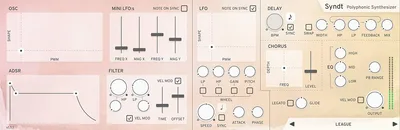
Syndt by Klevgrand is a morphing-oscillator synth plugin that sounds better than its price suggests, but frustrates faster than it should. We tested it across a late session building a slow-burn ambient cue. The presets loaded quickly, the pad tones sat well in the mix without much fuss, and for about forty minutes we were impressed. Then we tried to build something from scratch. The font on the parameter labels is so small we had to lean into the screen to read them. On a standard 1080p monitor, "Pulse Width" reads like an eye chart. That friction matters. It pulled us out of the creative headspace Syndt's sound had put us in.
This is a synth built for a specific kind of producer. If that's you, it delivers. If it's not, the walls show up fast.
What Syndt Actually Is (and Where It Runs Out of Road)
Syndt is a single-oscillator synth with a waveform morphing architecture. The oscillator moves continuously between sine and square, with pulse width control to shape the harmonic content at the square end. That's the core sound source.
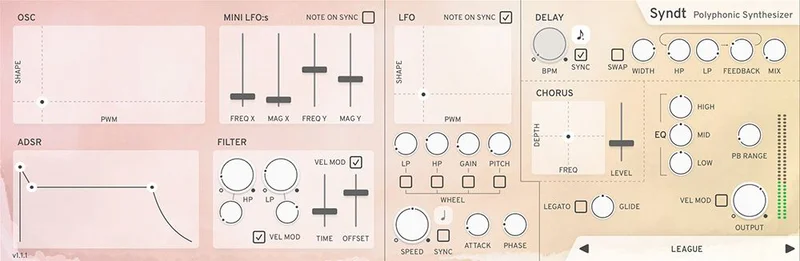
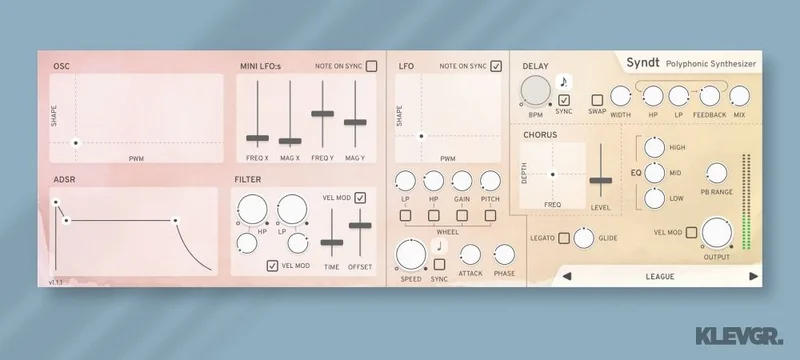
Layered on top: a dual LFO system, finely tuned low-pass and high-pass filters with velocity-sensitive filter attack, stereo chorus, ping-pong delay, and an EQ section that syncs to host BPM. It runs as VST, VST3, AU, and AAX on macOS and Windows, with a paid iOS version available separately.
What it's not: a deep sound design tool. There's no FM, no wavetable import, no complex modulation matrix. If you need to route an envelope to oscillator pitch or set up parallel filter paths, Syndt won't do it. It's narrow by design, and that's fine, as long as you know it going in.
Living With Syndt Day to Day
Installation is clean. Drop in the plugin, scan, done. No iLok. No account login. We had it running in under three minutes.
The 70+ factory presets are sorted into categories: pads, leads, bass, and keys. The ambient and cinematic pads are where Syndt earns its money. We loaded "Slow Glass" (a long-attack pad preset) into a 74 BPM downtempo session and it sat in the mix immediately. No EQ, no filtering. The morphing oscillator produces a softness in the sine-heavy positions that sounds satisfying in ways a straight sawtooth doesn't. Pull toward the square end and you get presence without aggression. It's a genuinely clever oscillator structure for this use case.
The dual LFOs are easy to assign and cover the basics: pitch, filter cutoff, amplitude. We set LFO 2 to modulate pulse width at 0.12 Hz with a triangle wave and the result had slow, organic movement. That took about twenty seconds to dial in.
Then we hit the wall. We wanted to shorten the filter attack on a bass preset while keeping the envelope release long. The velocity-based filter attack is the only real envelope control here. There's no dedicated ADSR for the filter. We ended up compromising on a sound we didn't love because the routing simply doesn't exist. Annoying. Not a dealbreaker for preset users. Genuinely frustrating if you want to sculpt.
The UI issue compounds this. Labels like "LFO Rate" and "Filter Env" are rendered in a font that's too small for comfort. On iPad Pro 12.9" the problem is even worse. We checked with a second pair of eyes in the room and they agreed: it feels like the UI was designed at 200% zoom and shipped at 100%. That's a UX oversight we wish Klevgrand had caught before release.
The Trade-Offs Worth Knowing
The morphing oscillator is Syndt's best argument for itself. The continuous sine-to-square sweep with pulse width control produces a tonal range that sounds musical without requiring expertise to navigate. That's a real strength.
But that same simplicity creates a ceiling. The BPM-synced ping-pong delay and chorus are fixed-effect-chain tools. You can't reorder them. You can't run the delay pre-chorus. The signal chain is locked. For most users building ambient pads, that won't matter. For anyone trying to design a lead with delay-driven rhythm, it becomes a hard limitation.
CPU usage is light. We ran eight instances across a busy session without a spike. That is worth something at that price.
The iOS version is a separate paid purchase. There's no cross-platform bundle. If you work on both iPad and desktop, you're paying twice. That stings more than it should given the price point.
Against the Field
At this price, the direct competition is thin. Most serious morphing synths cost significantly more. But let's be honest about the landscape above it.
Serum handles wavetable morphing with a modulation matrix that makes Syndt look like a toy. If sound design is your work, SynthMaster One is another strong option worth comparing before committing here. For
iOS polyphonic work with more routing depth, Imaginando DRC is the better iPad synth.
Klevgrand also released SyndtSphere as a free companion, which strips the architecture back further and uses the same sound engine. If you want to test the tone before buying, start there.
For producers who want more oscillator variety in a bundle format, the Bleass Analog FM Synth Bundle covers territory Syndt doesn't touch.
The Real Verdict
Syndt is a synth that does one thing well: it makes ambient and cinematic pad sounds that sit in a mix without effort. The morphing oscillator is genuinely musical, the presets are useful, and the CPU cost is almost nothing.
But it's not a sound designer's tool. The UI will irritate you. The locked signal chain will limit you. And if you work across desktop and iOS, you'll pay twice for the same engine.
Buy it if you produce ambient, cinematic, or lo-fi music and want a preset-forward synth that doesn't eat CPU. Skip it if you need modulation depth, flexible routing, or a UI you can read without squinting.
Score Breakdown
| Category | Score | Notes |
|---|---|---|
| Sound Quality | 3.8/5 | Morphing oscillator sounds musical; limited tonal range overall |
| Value for Money | 3.5/5 | The price is fair; paying twice for iOS stings. |
| Ease of Use | 2.8/5 | UI labels are too small; preset workflow is easy, scratch-build is not |
| Features | 2.5/5 | Dual LFOs and BPM-synced delay are good; no filter ADSR or mod matrix |
| CPU Efficiency | 4.5/5 | Eight instances without a spike. Genuinely light. |
| Overall | 3.6/5 | Solid for one narrow use case; hits a ceiling fast outside of it |
Alternatives to Consider
If you want more oscillator architecture for a similar price, the Audio Blast ABX3 Bundle gives you more signal chain flexibility without a steep learning curve.
For serious morphing synth work, Xfer Serum or Arturia's Pigments offer full modulation matrices and wavetable import. They cost more. They're worth it if sound design is your actual workflow.
On iOS specifically, Imaginando DRC handles iPad polyphonic synthesis better with deeper routing and a more legible interface.
If you're after vocal synthesis tools that sit in a similar cinematic space, the Jin 2 for Synthesizer V review is worth reading for context on where that category sits in 2026.
Syndt is $24.99. It sounds better than that number. It also stops growing before you do. Know which one matters more to you.
Frequently Asked Questions
Is Syndt free or does it cost money?
The desktop version of Syndt costs $24.99. Klevgrand also offers SyndtSphere as a free plugin that runs the same core sound engine with a simplified interface. The iOS version of Syndt is a separate paid purchase, so there is no cross-platform bundle deal if you work on both iPad and desktop.
What makes the Syndt oscillator different from a standard synth oscillator?
Syndt uses a morphing architecture that sweeps continuously between a sine wave and a square wave. You control where the oscillator sits in that range, and pulse width control shapes the harmonic character at the square end. It's a narrow range compared to wavetable synths like Serum, but the tonal quality in the sine-heavy positions is smoother and more musical than a basic analog-style oscillator in that register.
Is Syndt good for sound design, or just presets?
Honest answer: it's better for presets. The 70+ factory patches cover ambient, cinematic, pad, and basic lead territory well. If you want to build sounds from scratch, the lack of a dedicated filter ADSR and the absence of a modulation matrix become real limitations quickly. Advanced sound designers will hit the ceiling within a session.
Does Syndt work on the latest macOS and Windows versions?
Syndt supports VST, VST3, AU, and AAX formats on 64-bit macOS and Windows. We'd recommend checking Klevgrand's official site for the latest compatibility notes before purchasing, especially if you're running an ARM-native Mac or a recent DAW version. The iOS version runs separately and requires its own purchase through the App Store.