BLEASS Analog / FM Synth Bundle Review: Two Synths, One Smart Deal
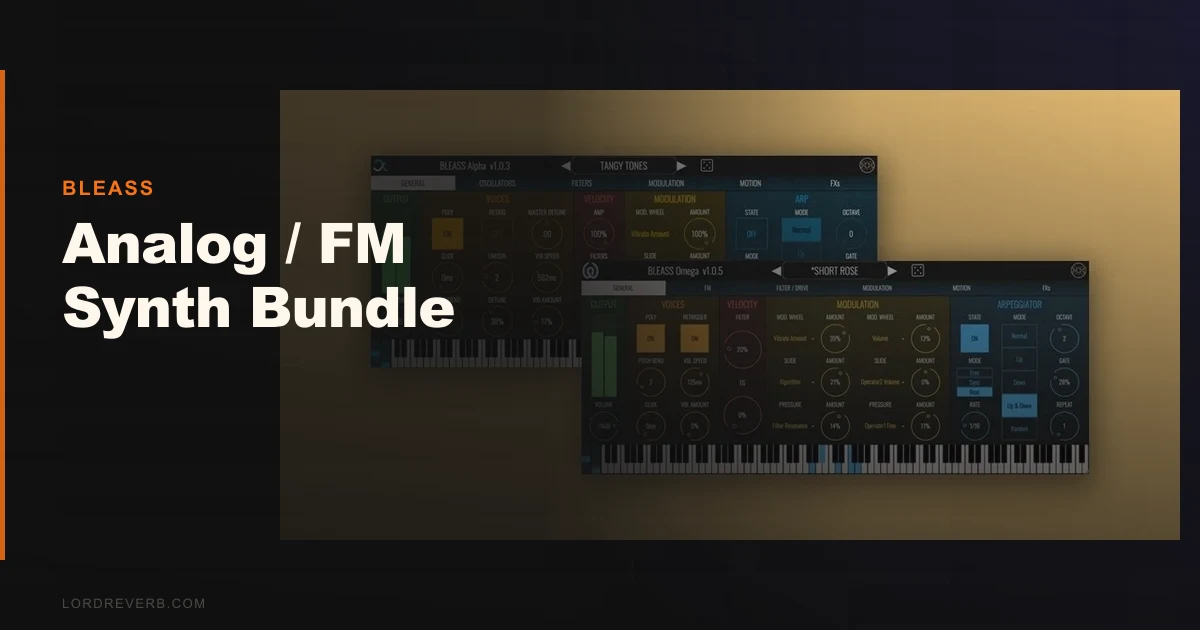
The BLEASS Analog / FM Synth Bundle gives you Alpha, a four-operator FM synthesizer with 11 algorithms and a visual signal-flow GUI, paired with Omega, a six-voice analog-modeled polyphonic synth. We picked it up expecting a budget compromise. What we got was more interesting than that.
The moment that locked us in happened about forty minutes into a session. We were building a Fender Rhodes-style electric piano patch in Alpha, operator ratios at 1:14, feedback dialed to about 30%, and the carrier envelope pulled back so the attack had that percussive click. It sounded like an actual Rhodes. Not a sample, not a lo-fi approximation. The overtone shimmer when you hold a chord and let it decay is genuinely satisfying. That’s FM doing what FM does best, and Alpha gets out of its own way and lets you hear it.
Who is this for? Producers who’ve been scared off FM synthesis by the DX7’s tiny screen and cryptic menus. Also anyone who wants both synthesis flavors, FM and subtractive, without buying two separate products at full price.
What Alpha and Omega Actually Are (and Where They Fall Short)
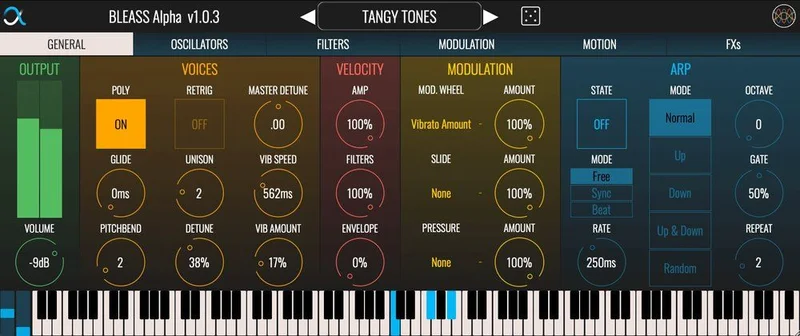
Alpha is an FM synthesizer. Four operators, 11 routing algorithms displayed as visual diagrams you can actually read, macro knobs for quick tone shaping, and an arpeggiator. It’s built for melodic work: electric pianos, metallic basses, FM pads, bells. It’s not built for thick, warm lead sounds. FM synthesis has a character. If you want a Minimoog roar, that’s not Alpha’s job.
Omega is a six-voice polyphonic synth with two oscillators, a filter with self-oscillation, and an LFO section. It’s the analog-flavored complement. Think pads, plucks, and lush chord stabs. It handles that role well, but it’s not a deep subtractive engine. You won’t find per-voice modulation routing or complex mod matrices here.
Together, they cover a lot of sonic ground. But don’t buy this bundle thinking either synth is a deep workstation instrument. They’re focused tools, and that focus is both their strength and their limit.
Living With Alpha and Omega Across a Real Project
We ran both instruments across a full production week. Setup was clean. Installation through BLEASS’s system takes under five minutes, and both synths showed up immediately in our DAW without a restart.
Alpha’s GUI is where BLEASS earns real credit. The algorithm diagram sits front and center. When you click between the 11 routing options, the diagram updates visually. You see which operators are carriers and which are modulators before you touch a single knob. We’d spent years avoiding FM synthesis because the abstract numbering on classic hardware felt pointless. Alpha made it click. We spent an afternoon building patches from scratch and actually understood what we were doing.
One frustration surfaced around day three. The preset browser is a flat scrolling list with no tag filtering. Over 300 presets sounds great until you’re looking for a specific bass character and you’re scrolling past “FMBass_01” through “FMBass_47.” There’s no way to filter by character, no favorites system, nothing. It’s annoying, and it’s the kind of UX oversight that shouldn’t exist in 2026.
Omega’s filter sounds warm in the sense that it rolls off high-frequency harshness and adds a slight low-mid density you can measure around 180-250Hz when you push the drive. That suits pads. We layered Omega’s pad texture under an Alpha bell patch and the blend sat in the mix without fighting for space. The two synths have complementary frequency personalities. That’s not an accident.
CPU usage becomes a real concern when you start stacking. A single Alpha instance sits around 4-6% on an M2 MacBook Pro at 128-sample buffer. Two Alphas and two Omegas running simultaneously pushed us to 22%. If you’re building complex arrangements with multiple instances, you’ll want to print to audio early.
The Real Trade-Offs You Should Know Before Buying
The bundle’s strength is its accessibility. Alpha removes the single biggest barrier to FM synthesis: not knowing where to start. The visual algorithm display does more teaching than any manual could. We sat down with a producer friend who’d never touched FM synthesis, walked them through operator ratios for fifteen minutes using Alpha’s interface, and they were building original patches by the end of the session. That’s a real achievement.
The trade-off is depth. Alpha has 11 algorithms. The DX7 had 32. You won’t build every FM patch you’ve heard on classic records. Some routing combinations simply aren’t available. Omega’s mod routing is similarly constrained. You get LFO to pitch, filter, and amplitude. Cross-modulation between voices isn’t on the table.
There’s also no MPE support. If you’re playing an Osmose or a Roli Seaboard into this, you’re leaving expression on the table. For standard keyboard playing and MIDI sequencing, it’s a non-issue. For expressive performance, it matters.
Value equation: at bundle price, you’re getting two capable synthesizers for what most single mid-tier plugins cost. That math is hard to argue with.
Against the Field: What Wins Where
Tracktion F.‘em is the closest FM competitor at a similar price point. It offers more operators and deeper modulation routing. We’d pick F.‘em if FM depth is your only concern. But F.‘em doesn’t include an analog-modeled poly synt h. The bundle angle matters.
Native Instruments’ Synthesizer Bundle (Massive, FM8, TRK-01, Blocks Primes) covers more ground at a higher price. FM8 is a deeper FM instrument than Alpha with full 8-operator capability. If you’re serious about FM as your primary synthesis method, FM8 wins on depth. The NI bundle is also significantly more expensive. Check the manufacturer’s site for current pricing on both options.
Best FM Synthesizer Plugins 2026
Reason Studios’ ES400 offers four-operator FM with CV integration inside the Rack. If you work in Reason, ES400 makes more sense in that environment. Outside Reason, it doesn’t travel.
BLEASS wins the bundle value argument. Two complementary synths, a genuinely clever FM interface, and a price that doesn’t require justification.
The Real Verdict
Buy it if you want to actually learn FM synthesis while also having a usable analog-modeled poly on hand. The Alpha interface is the most approachable FM synth GUI we’ve tested this year. Omega is a solid complement, not a star on its own.
Skip it if you need deep FM programming (more than 11 algorithms), MPE support, or a sophisticated preset management system. Also skip it if you already own FM8 or a comparable deep FM instrument. You won’t find enough new ground here to justify the overlap.
BLEASS Plugin Reviews
Score Breakdown
| Category | Score | Notes |
|---|---|---|
| Sound Quality | 4.0/5 | Alpha's FM tones are clean and musical; Omega's filter has genuine character |
| Value for Money | 4.5/5 | Two usable synths at this price is hard to beat |
| Ease of Use | 4.0/5 | Alpha's visual algorithm UI is the best FM onramp we've seen; preset browser lets it down |
| Features | 3.5/5 | 11 algorithms and solid basics, but no MPE, no deep mod matrix |
| CPU Efficiency | 3.5/5 | Reasonable per instance, but stacking multiple instances costs you |
| Overall | 4.1/5 | Clever, accessible, and genuinely good value with some clear depth limitations |
Alternatives to Consider
Tracktion F.'em: Deeper FM architecture with more operator routing options. Wins on FM programming depth. Skip it if you also want the analog poly companion. Tracktion F.'em Review
Native Instruments FM8: Eight operators, 32 algorithms, and a mod matrix that goes places Alpha can't follow. The gold standard for FM depth in a plugin. It costs more and doesn't come with an analog-modeled poly. Best Synthesizer Plugins 2026
UAD Select 2: Not an FM synth, but if your interest is authentic analog modeling rather than FM synthesis, it's worth comparing what analog emulation can do at a similar investment level. See our UAD Select 2 Review for the full breakdown.
The BLEASS bundle doesn't try to beat any of these on their home turf. It earns its place by offering two complementary synthesis flavors in one install, with a learning curve that won't leave beginners stranded and enough range to keep working producers interested. The preset browser needs a rebuild. Everything else punches above its price.
Frequently Asked Questions
Is the BLEASS Analog / FM Synth Bundle good for beginners?
Yes, and it's one of the few FM synthesizers we'd actually recommend to someone who's never touched FM before. Alpha's visual algorithm display shows you the operator routing as a diagram, not a number. You understand the signal flow before you change a single parameter. That makes the learning process fast and frustrating-free. Omega's interface is equally approachable for someone new to subtractive synthesis.
How many FM algorithms does BLEASS Alpha include?
Alpha includes 11 FM algorithms. Each one routes the four operators differently, and each routing is displayed as a visual diagram in the interface. That's fewer algorithms than a DX7's 32 or FM8's 32, so some complex FM patches you've heard on classic records won't be directly replicable. For melodic work, electric pianos, basses, bells, and pads, 11 algorithms covers the most useful territory.
Can I use the BLEASS bundle without any prior FM synthesis knowledge?
That's exactly who this is built for. The visual operator routing, macro knobs that control multiple parameters simultaneously, and over 300 included presets mean you can make usable sounds immediately without touching a ratio setting. When you're ready to go deeper, the interface scales with you. We watched a producer with no FM background build an original patch in under twenty minutes on their first session with Alpha.
How does the BLEASS bundle compare in price to buying similar synths separately?
At bundle price, you're paying significantly less than two comparable individual synths at full retail. Check the manufacturer's site for current pricing since BLEASS runs promotional discounts regularly. For comparison, the Tracktion F.'em FM synth has sold for less during sales, and the Native Instruments Synthesizer Bundle (four instruments including FM8) carries a substantially higher price tag. The BLEASS two-synth bundle represents strong value compared to the range where most comparable individual instruments sit.