You've downloaded four iOS synth apps in the last two years. Two are already abandoned by their developers. One crashes on your current OS. The fourth still works, but the desktop version never existed, so every patch you dial in lives and dies on your phone. That's the problem Imaginando's DRC Polyphonic Synthesizer is built to solve: a cross-platform subtractive synth that doesn't orphan your work the moment you switch devices.
DRC is priced differently on mobile versus desktop. It's a fully subtractive, 8-voice polyphonic synth with a dual-filter architecture, a built-in effects chain, and cloud preset sync that actually keeps your patches portable. It's built for producers who move between a phone on the train and a DAW at home, and for anyone who wants a solid subtractive voice without touching a hardware rack.
We ran it hard for three weeks. Here's what we found.
The Real Problem DRC Is Fixing
The iOS synth graveyard is real. Apps get orphaned. Updates stop. A patch you spent an afternoon building becomes inaccessible the moment an OS update breaks compatibility. Desktop plugins have their own version of this problem: presets locked inside session files, no portability, no sync.
DRC's answer is cloud preset sync. Your patches live in Imaginando's cloud infrastructure and follow you across iOS, Android, and desktop. Pull up a bass patch you built on your phone during a commute, and it's waiting in your VST session when you sit down at your DAW.
That's not a gimmick. For producers who sketch on mobile and finish in the box, it's a genuine workflow fix. No other synth at this price point does it this cleanly.
The naming tells you something, too. DRC stands for Digital Resistor Capacitor, referencing the capacitor-charged-through-resistor model used to shape its envelopes. That's not marketing copy. It reflects a design philosophy focused on analog-accurate envelope behavior over visual nostalgia.
How DRC Actually Performs
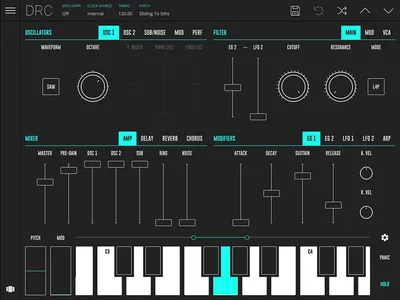
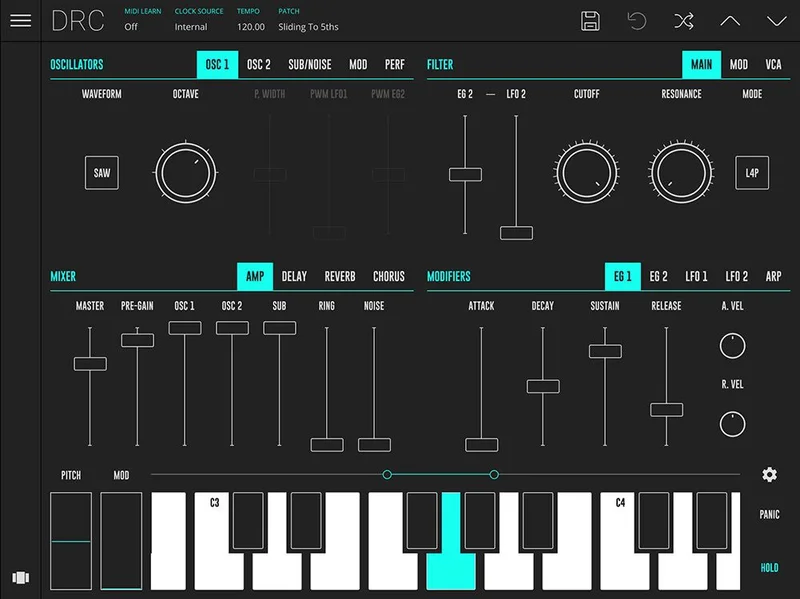
The signal chain starts with two main oscillators plus a sub-oscillator and a noise generator. Standard waveforms: sine, saw, square, triangle. No wavetable scanning, no FM matrix. It's a clean, classic subtractive architecture and it doesn't apologize for that.
Where it gets interesting is the filter section. You get a 4-pole ladder filter and a 2-pole multi-mode filter running LP, HP, bandpass, and notch. We stacked them on a pad patch and rolled the ladder off at 2kHz while the multi-mode ran a notch sweep at 800Hz. The result was a midrange scoop with controlled low-end warmth, meaning the fundamental stayed full while the boxiness dropped out. That took about 45 seconds to set up.
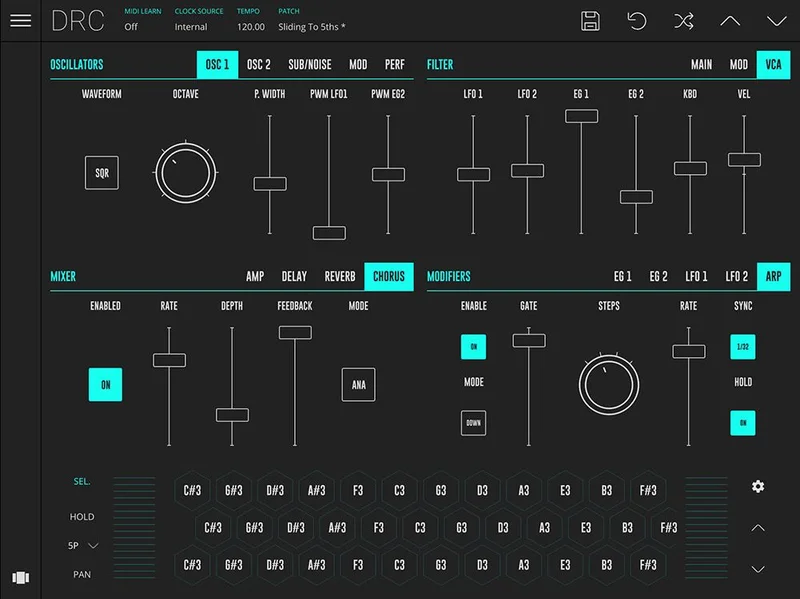
The effects chain is genuinely good for a synth this compact. Stereo tape delay, reverb, and an analog chorus all live inside the plugin. We ran a plucked-string patch through the tape delay at 1/8 note sync with 30% feedback and 15ms of wow/flutter. The repeats aged correctly. They didn't just copy-paste the signal.
Eight voices handle dense chord work without dropouts. CPU load sits in the medium range. On an M2 MacBook Pro, a 6-voice pad with full effects running drew about 4-6% CPU per instance. That's reasonable. Not light, but not a problem.
Compared to UAD Polymax, which is free, DRC trades modulation depth for portability and ease. Compared to Pigments, DRC is simpler and cheaper at full price. Compared to Twin3 on iOS, DRC wins on cross-platform continuity. Each of those is a real tradeoff, not a clear win.
Strengths and Weaknesses
The dual filter is the standout feature. Most synths at this price give you one filter and call it a day. Having the ladder and the multi-mode available simultaneously lets you shape tone in ways that feel closer to hardware patching than typical plugin menus.
The 600+ presets across 6 soundbanks are actually useful. We've tested synths with 1,000 presets where 700 are variations of the same lead sound. DRC's banks cover pads, leads, keys, bass, and rhythmic patches with enough variation to make browsing productive.
The cloud sync is clever and it works. We tested it by building a patch on an iPhone 14, closing the app, opening the desktop VST in Logic Pro, and pulling the preset from the cloud browser. Eleven seconds, no drama.
The weaknesses are real, though. No step sequencer is genuinely frustrating for a polyphonic synth in 2026. The modulation routing is shallow: you get LFOs and envelopes, but the matrix is limited compared to what Pigments or even SynthMaster One offer at comparable prices. Check out our SynthMaster One review to see how deep modulation routing can go at a similar price.
The noise generator is also underused in the signal flow. It runs, but it doesn't modulate well. For building snappy, organic textures, it feels bolted on rather than integrated.
Value for the Price
On mobile, DRC is a no-brainer purchase. There's almost no argument against it.
On desktop, the decision is harder. You're paying for polish, cross-platform sync, and Imaginando's track record of sustained updates in a category where abandonment is common. That's worth real money. But UAD Polymax is free, and Pigments regularly drops on sale.
The desktop price feels a bit high for the modulation depth you are getting. If you split your time between mobile and
desktop, that premium is justified by the sync alone. If you’re desktop-only, look harder at the competition before clicking buy.
For a broader look at how DRC fits into the plugin landscape, our synth plugins guide breaks down the core synth categories and where subtractive fits.
Who Should (and Shouldn't) Buy This
- ✅ Buy if you work across mobile and desktop and hate rebuilding patches from scratch on every device.
- ✅ Buy if you want a clean subtractive synth with a serious dual-filter setup and zero menu-diving required.
- ✅ Buy if you're grabbing the mobile version. On mobile, the value-to-quality ratio is hard to argue with.
- ❌ Skip if you need deep modulation routing. DRC's matrix won't satisfy you if you're used to Pigments-level depth.
- ❌ Skip if you want a step sequencer baked in. It's not here, and there's no workaround inside the plugin.
- ❌ Skip if you're desktop-only and price-sensitive. On desktop, there are more powerful options available, especially during sale periods.
Score Breakdown
| Category | Score | Notes |
|---|---|---|
| Sound Quality | 4.0/5 | Dual filter architecture delivers real tonal flexibility; oscillators are clean and musical |
| Value for Money | 3.5/5 | Mobile pricing is excellent; desktop pricing is a little above where it should land. |
| Ease of Use | 4.5/5 | Layout is intuitive, cloud sync is frictionless, preset browser is fast |
| Features | 3.5/5 | Dual filters and effects chain impress; no step sequencer and shallow modulation matrix disappoint |
| CPU Efficiency | 4.0/5 | Medium draw, but well-managed and consistent across voices |
| Overall | 4.1/5 | Solid synth with a genuinely useful cross-platform workflow, held back by modulation limitations |
Alternatives to Consider
UAD Polymax is free and covers polyphonic subtractive synthesis with more modulation routing than DRC. If you're desktop-only and not married to cross-platform sync, start here before spending anything.
Arturia Pigments hits deeper on modulation, wavetable scanning, and granular capabilities. It regularly drops on sale. If you're after a subtractive synth that can grow with you into more complex synthesis, Pigments is a better long-term investment. Our SynthMaster One review covers another strong alternative in this price bracket.
Loot Audio Zero 1 is worth a look if you're working in Kontakt-adjacent territory and want something that punches above its price point. See our full Zero 1 Synth review for how it stacks up against more expensive competition.
DRC wins on portability. None of those alternatives sync patches across iOS, Android, and desktop the way DRC does. That's a specific use case, but if it's your use case, no other synth at this price solves it as cleanly.
Buy it on mobile without hesitation. Consider the desktop version if cross-platform workflow matters to you. If you want a modulation powerhouse and you are staying in the box, that money could work harder elsewhere.
The best thing we can say about DRC is this: it's an honest synth. It does what it says, it works across your devices, and it sounds good. In a category full of abandoned apps and overpromised plugins, that's not nothing. It's actually kind of satisfying.
Frequently Asked Questions
Does DRC Polyphonic Synthesizer work on both mobile and desktop?
Yes. DRC runs on iOS, Android, Mac, and Windows. The cloud preset sync feature lets you build a patch on your phone and access it in your DAW without any manual export. The desktop version runs as VST3, AU, and AAX, so it covers Logic, Ableton, Pro Tools, and most other major DAWs.
Is the desktop price worth it compared to free alternatives?
That depends entirely on whether you need cross-platform portability. UAD Polymax is free and capable, so desktop-only producers should try that first. If you regularly sketch ideas on mobile and finish them in a DAW, paying for DRC buys you a workflow that nothing free currently replicates. It's not a sound quality argument, it's a workflow argument.
How many presets does DRC come with, and are they actually usable?
DRC ships with 600+ presets spread across 6 soundbanks. We found the quality higher than average for a bundled library. The pads and keys banks are strong starting points for production work. You'll overwrite most of them eventually, but they're useful for learning how the dual-filter architecture and effects chain interact before you start building from scratch.
Does DRC have a step sequencer?
No. This is a real gap. DRC's architecture is focused on the synthesis and effects chain, and no step sequencer is included in any version. If you need that functionality, you'll have to use your DAW's built-in sequencer or a dedicated step sequencer plugin alongside DRC. It's the one feature absence that limits the synth's usefulness in live and loop-based workflows.