If you're on VA-2 or VA-1, the upgrade to Ultra Analog VA-3 is worth it, but only if you actually use the library and care about the new ladder filter. It costs $79 and delivers real additions: 560 new presets, a rebuilt multi-effects chain, and a filter that previous owners have been asking about for years. But the same UI problems that annoyed VA-2 users are still here, and the RAM consumption hasn't moved. That's the deal. Take it or leave it.
Quick verdict: VA-3 is a solid, if imperfect, upgrade from VA-2 or VA-1. The preset library is now one of the largest in its class, the ladder filter is a genuine improvement, and the two-timbre architecture gives you serious layering options without touching a second plugin. Score: 3.5/5 at $79. If you're already deep in the VA ecosystem, the library alone probably justifies the move. If you're running 4K displays or low-RAM sessions, you'll feel the gaps every single day.
What You Are Upgrading To
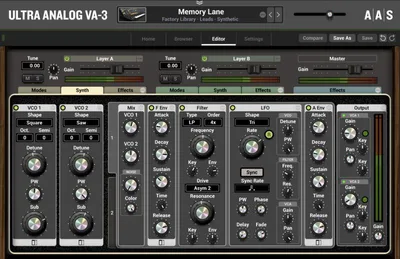
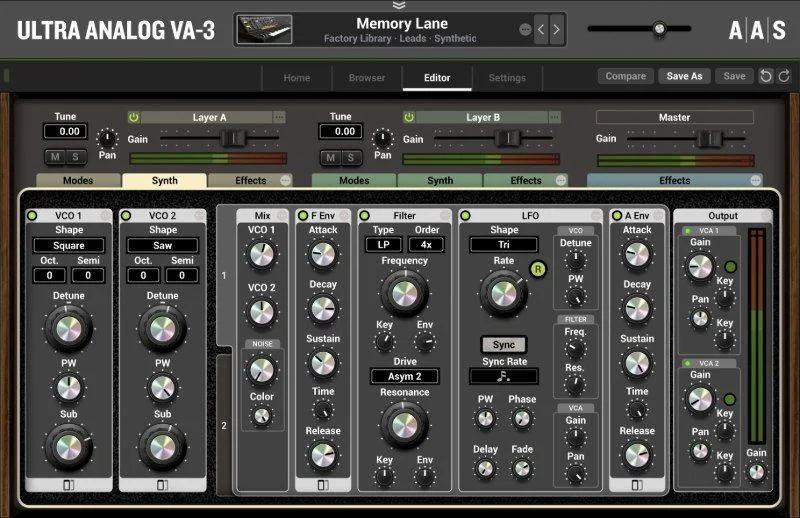
VA-3 is a two-oscillator virtual analog synthesizer from Applied Acoustics Systems. It runs as a 64-bit VST, AU, RTAS, AAX Native, and Standalone. The core architecture carries over from VA-2: two independent timbres you can stack on top of each other or split across a keyboard, each with its own oscillator and filter path.
What's new in VA-3 is not the engine. It's what surrounds it.
The factory library jumps to over 1,200 presets. 560 of those are completely new, built by designers including Richard Devine, Christian Halten, Jerry Kovarsky, and six others with real credits behind them. The remaining 648 are revised VA-2 patches, re-gain-staged to unity, with better dynamics and cleaner effect routing.
The ladder filter is new. VA-2 had its own filter character, but the ladder-type addition in VA-3 gives you a classic low-pass response that owners describe as "really nice." Push it into heavy modulation territory and it holds its shape in a way that filters in similar synths sometimes don't.
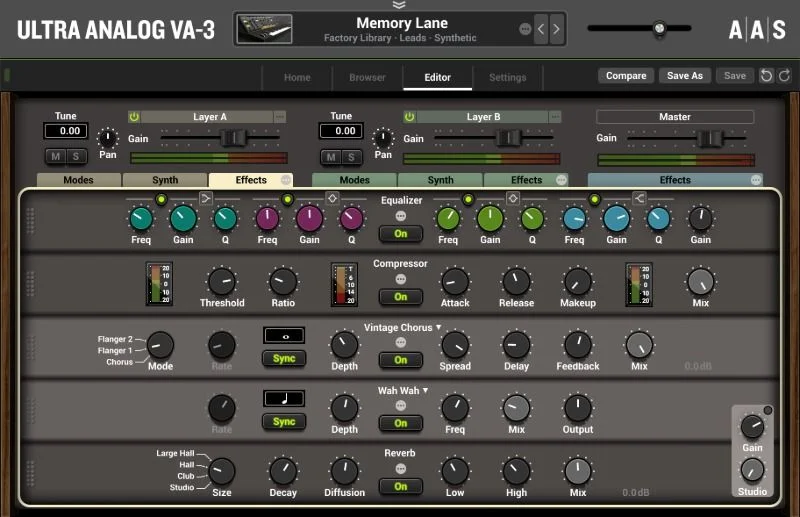
The multi-effects module has been expanded. You now get five re-arrangeable effect slots with reverb, delay, distortion, phaser, chorus, flanger, filters, equalizer, compressor, guitar amplifier, and tremolo all available. That's eleven processor types across five flexible slots.
VA-2 sound banks can be converted by copying them to VA-3's packs folder. No complex process. No lost sounds.
Who Qualifies for This Upgrade
If you own VA-2 or VA-1, this review is about your decision. Applied Acoustics Systems built VA-3 as a continuation of that lineage, not a platform replacement.
The revised versions of your old patches live alongside the new library in the same browser.
The minimum system specs are identical for Mac and PC. Mac users need macOS 10.11 or later, an Intel Core i5 from around 2015 or Apple M1, and a 64-bit DAW. PC users need Windows 10 64-bit or later and the same CPU class. If your machine ran VA-2 without choking, it'll run VA-3. The DAW compatibility list covers Ableton Live, Logic Pro, Pro Tools, Cubase, Reaper, Studio One, and Reason.
If you've never owned a VA version and you're arriving fresh, this review still applies. But the upgrade framing matters most for existing owners deciding whether to spend $79 on something they already have a version of.
The Value Case
At $79, the upgrade price point sits in a range where you can feel it without breaking a session budget. The question is whether the additions earn it.
The library renovation alone is a strong argument. Getting 560 new patches from designers like Richard Devine isn't filler. These aren't presets built to tick a number. The sonic range runs from what owners describe as "graceful pads" to "snarling tones" and "dissonant electronic backdrops." If you're pulling sounds for client work across multiple genres, that breadth matters.
The 648 revised VA-2 patches are also a real win. Gain staging across a preset library sounds administrative, but in practice it means you stop riding your channel fader every time you switch sounds. Unity-gain effects mean your signal chain stays predictable. For producers who've been living with the old patches, that consistency alone is worth something.
The ladder filter is new engineering, not a checkbox feature. Owners and reviewers single it out specifically. If you've been routing VA-2 through external filter plugins to get that response, the math on that workaround probably doesn't favor the workaround anymore.
What the $79 doesn't fix: the UI, the RAM, the external monitor bugs. Those are real limits, and they don't shrink with a price tag attached.
The Home View and Preset Browser
The first place you'll spend time is the Home View. It strips back the editing interface and puts four macros front and center: modulation, timbre, envelope, and effect. These aren't decorative. Each macro morphs between states in real time, and you can assign them to any MIDI controller you want.
If you're playing live or doing sketch sessions where you want to move fast, this is the right way into VA-3.
The browser offers four views: Packs, Sounds, Categories, and Creators. The Creators view is clever. If you like what Richard Devine built, you can filter the entire library to just his patches. Same for Jerry Kovarsky or any of the other designers in the library. For producers who've learned which designers match their taste, that's a satisfying shortcut.
The 32 categories are broad. Arpeggios, basses, bells, brass, chimes, choirs, claps, clavs, cymbals, effects, formants, guitars, hi-hats, impacts, keys, kicks, layers, leads, noises, organs, pads, percussions, plucks, reeds, rhythmics, sequences, snares, splits, strings, sweeps, textures, and toms. The scope runs from bread-and-butter production staples to sound design territory. The splits and layers categories specifically take advantage of the two-timbre architecture in ways you won't find in a single-oscillator-path synth.
Honestly? The preset browser is better than average. The Creators filter is the kind of thoughtful detail that larger companies sometimes miss.
The Two-Timbre Architecture
This is the structural feature that separates VA-3 from most two-oscillator synths at a comparable price point.
Two independent timbres doesn't mean two detuned oscillators feeding the same filter. It means two separate signal paths, each with its own oscillator-plus-filter arrangement, each with its own editing options. Stack them and you get one complex, layered sound. Split them across a keyboard range and you've got a performance patch that covers bass and lead from a single plugin instance.
Imagine you're building a live performance rig in Ableton. You want fat low-end pads on the left hand and an expressive lead on the right, but you're trying to keep your CPU count sane. Load one VA-3 instance, set timbre one to a pad using the chorus and reverb slots, set timbre two to a lead with some distortion in the chain, split at a sensible note, and you're done. That's real workflow value for keyboard players and electronic performers who need to manage complexity without multiplying instances.
Each timbre gets four performance macros. Those macros respond to whatever MIDI controls you map, in real time. Modulation depth, timbre character, envelope shape, effect intensity. You can assign an expression pedal to the effect macro and have a completely dry pad bloom into a washed-out reverb tail mid-phrase. That kind of real-time playability is what the developer means when they describe VA-3 as "performance-friendly."
The microtonal support deserves a mention. VA-3 handles Scala scale files and reference note frequency tuning. If you work in alternate tuning systems, most synths at this price point simply don't support this.
The Ladder Filter and Modulation Depth
Filters make or break a virtual analog synth. Full stop.
The new ladder-type filter in VA-3 targets the classic low-pass response that players associate with certain hardware synths from the 1960s and 70s. That response has a particular character: smooth rolloff in the passband, an expressive resonance peak, and a kind of organic collapse when you push the cutoff into self-oscillation territory.
What reviewers single out about VA-3's ladder filter is that it stays musical under extreme modulation. Run a fast LFO into the cutoff on many budget virtual analogs and you get zipper noise, aliasing, or a sound that just turns into a grinding mess. Owners report that VA-3's filter handles that modulation without falling apart.
Push the drive into the filter path and the top end turns gritty in a way that feels controlled rather than accidental. This is where the preset descriptions of "snarling tones" come from. It's not that the presets demonstrate it perfectly. Some reviewers describe the factory presets as dated-sounding. But get into the filter controls yourself, dial the cutoff down, crank the resonance, and throw an envelope with a fast attack and a medium decay at it, and you'll find sounds that sit aggressively in a mix without needing extra saturation from your channel strip.
The two-oscillator-plus-filter arrangement also supports the editing options described in the notes as "advanced." The filter represents a genuine upgrade over VA-2 on the technical side, handling advanced editing options that give you expressive control over the sound.
The Multi-Effects Module
Five slots. Eleven processor types. Full reorder.
That's the architecture. Put the guitar amplifier before the reverb, or after it. Run distortion into a phaser into an EQ. Chain a compressor after a flanger. The order changes the character, and VA-3 lets you work through it without committing to a fixed signal path.
The effect types available: reverb, delay, distortion, phaser, chorus, flanger, filters, equalizer, compressor, guitar amplifier, and tremolo. For a synthesizer's internal effects rack, that's a wide set. Most VA-class synths send you out to your DAW's effects chain fairly quickly. VA-3 gives you enough to build a complete sound inside the plugin.
Say you're designing a textured pad for an ambient section. Load a lush chorus in slot one, set a long reverb in slot two, add a gentle EQ in slot three to cut some buildup around 400Hz, and leave the other two slots empty. The pad sits in the mix without additional busing. That's a real time-saver in a session where your CPU is already handling a lot.
The revised VA-2 patches use unity-gain effects across the board. That means the effect levels are calibrated so switching presets doesn't throw your mix level around. It's the kind of boring, necessary work that makes a library actually usable in a professional session.
One thing to watch: the effect macro in the Home View morphs the effect parameters in real time. If you've built a sound where the dry/wet or the reverb tail is mapped to that macro, you can sweep through it live. It's a satisfying feature for performance or for adding movement to an otherwise static pad without automation.
The Resource Situation
This is where we have to be straight with you.
900MB RAM per instance. That's not a small number. For producers running a laptop with 8GB of RAM shared across a 60-track session, loading three or four VA-3 instances starts eating into the headroom you need for everything else. Users report high resource usage alongside praise for the sound quality, and those two things are genuinely in tension.
If you're on a newer machine with 16 or 32GB of RAM, this is a manageable constraint. You load your instances, you bounce when you're ready, and you move on. That's the standard workflow with any CPU-hungry instrument.
But if you're on an older machine, say the minimum-spec Intel Core i5 from around 2015, running multiple VA-3 instances in a dense session will cause problems. Freeze tracks early. Bounce to audio before layering more. Don't try to run four instances live during a mix revision.
The CPU side of this isn't detailed precisely in the owner reports. RAM consumption at 900MB per instance is the number that shows up consistently. Plan your session architecture around that figure and you'll stay ahead of it.
The UI Problem
Frustrating. Genuinely frustrating. And this is where VA-3 loses points it shouldn't have to lose.
The interface has no resize option. On modern 4K displays, owners report it looks broken. Squinting at plugin controls in 2026 on a display that costs more than the plugin is an annoying tax on an otherwise competent product.
The external monitor control bugs from VA-2 are still present. Not "reduced." Not "improved." Still there. For users who run a secondary display for their plugin windows, this is a known, unresolved problem that crossed from one version to the next without a fix. That's hard to defend.
If your studio runs a 4K main display or a multi-monitor rig, check whether owners with your specific setup have found a workaround before you buy. The sound quality doesn't change, but staring at a small, partially broken interface every session is a real quality-of-life hit.
Swing and Workflow Gaps
Short section. Worth noting anyway.
VA-3 doesn't have a swing function. For producers building rhythmic patches, sequences, or arp-based material from the 32-category library, that's a gap. The arpeggios and rhythmics categories are real and usable, but adding groove to a sequence means going to your DAW's MIDI tools rather than handling it inside the plugin. Not a dealbreaker for most workflows, but owners have flagged it as something they want fixed.
The presets are described by some reviewers as "somewhat dated" and "busy." That's a subjective call, and the range of designers in the new 560-patch library probably moves the needle on the dated end. But if your taste runs toward minimal, clean, and contemporary, you may find yourself spending more time in the edit view building sounds from scratch than browsing the library. That's not a bad outcome, but it changes the value math if you were buying VA-3 primarily as a preset instrument.
Who Should Skip It
If you're running a 4K monitor setup and you rely on external displays for your plugin windows, the unresolved UI and control bugs are going to annoy you daily. That's a real reason to hold off until a patch addresses them.
If your RAM is limited to 8GB, running multiple VA-3 instances will push you into freeze-and-bounce territory faster than you'd like. That's a workflow that can work, but it's one more constraint in an already constrained environment.
If you're a VA-2 owner who barely uses the library and mostly works with sounds you've built from scratch, the upgrade is lighter than the marketing suggests. The ladder filter is new. The presets are new. The engine underneath is not. If your workflow doesn't use those additions, $79 might sit better in a different purchase.
The Verdict
VA-3 is a credible upgrade from VA-2 or VA-1. The ladder filter is real, the library is now genuinely large, and the two-timbre architecture still stands out at this price range.
But the UI problems haven't been touched. The RAM consumption is still punishing. And some of the presets feel like they belong to a different era of production.
If you're a VA-2 owner who runs a standard 1080p or 1440p display and your machine has the RAM to handle it, the upgrade earns its price. The 560 new patches and the ladder filter are not cosmetic additions.
If you're on 4K, limited RAM, or a secondary monitor rig, the unresolved bugs and resource demands will make this a disappointing purchase regardless of the sound quality. Wait for a patch. Or don't upgrade yet.
Specs & Technical Details
| Developer | Applied Acoustics Systems |
| Price | $79 |
| Plugin Format | VST / AU / RTAS / AAX Native / Standalone |
| OS Support | Mac (macOS 10.11+) / Windows (10 64-bit+) |
| Activation | N/A |
| CPU Usage | Heavy (approx. 900MB RAM per instance) |
| Trial Available | N/A |
| Version Reviewed | VA-3 |
Score Breakdown
| Category | Score | Notes |
|---|---|---|
| Sound Quality | 4.5/5 | Owners praise sonic diversity from graceful pads to gnarly filtered tones; ladder filter stands out |
| Value for Money | 3.5/5 | 560 new presets and a new filter justify the upgrade price for active VA-2 users, less so for occasional ones |
| Ease of Use | 3.0/5 | Home View and macro system work well; persistent UI bugs and 4K scaling issues drag this down |
| Features | 4.0/5 | Two-timbre architecture, Scala support, 11 effect types, and 32 preset categories are genuinely deep |
| CPU Efficiency | 2.5/5 | 900MB RAM per instance is a consistent owner complaint; not viable for dense sessions on limited machines |
| Overall | 3.5/5 | Strong sound with real new additions, held back by unresolved bugs and high resource demands |
Alternatives to Consider
These are the synths owners and reviewers compare VA-3 against. Each one trades something.
Diva
Diva is known for precision analog modeling and a workflow that rewards deep programming. If your main frustration with VA-3 is that you want more architectural options at the oscillator level, Diva is the direction to look. It's known for precision analog modeling and a workflow that rewards deep programming.
Pigments
Pigments offers a more straightforward approach to programming. If the two-timbre depth of VA-3 feels like more than you need, and you want a modern virtual analog that you can dial in quickly without getting lost in architecture, Pigments might be a better fit for your workflow.
KORG ARP Odyssey
The KORG ARP Odyssey is a classic-flavored analog synth option to consider. If the 900MB per instance figure is your primary obstacle and you need a classic-flavored analog synth that sits lighter on your machine, this is worth checking against VA-3 before you commit.
Analog Lab
Analog Lab offers a preset-focused collection for users interested in sounds without building patches. If you just want a large, organized library of sounds and have no interest in building patches from scratch, Analog Lab covers that use case without the complexity of a full synthesizer engine.
The honest summary on alternatives: if you want to program, Diva or Pigments are the natural comparisons. If you want presets without programming, Analog Lab. If you want lighter CPU overhead in a classic-sounding analog synth, check the KORG ARP Odyssey first.
VA-3 sits in the middle of all of these. More programmable than Analog Lab, more library-driven than Diva, heavier than the KORG, and arguably more complex to navigate than Pigments. Whether that middle position is a strength or a liability depends entirely on what you need from a synthesizer in your day-to-day session work.
If you're a VA-2 or VA-1 owner with a modern Mac or PC, a standard display setup, and sessions that benefit from a wide preset range: the upgrade is a reasonable call at $79. If you're arriving fresh to the platform, run the specs against your studio before you buy anything.
Frequently Asked Questions
Can I use my VA-2 presets in VA-3?
Yes. VA-2 sound banks migrate to VA-3 by copying them into VA-3's packs folder. No complex conversion process is required. Your old patches appear in the browser alongside the new library. The 648 revised VA-2 presets included with VA-3 have been re-gain-staged, so they may sound slightly different from your original versions.
Does VA-3 work on Apple Silicon Macs?
Yes. The minimum system requirements list Apple M1 as a supported processor alongside Intel Core i5 (circa 2015). It runs in 64-bit AU and AAX Native formats on Mac, so Logic Pro and Pro Tools users on M1 or M2 machines are covered. Check with your DAW's compatibility notes if you're running a less common host.
Is the UI scaling issue fixed in VA-3?
No. Owner reports confirm that the interface still lacks a resize option and displays poorly on 4K screens. The external monitor control bugs carried over from VA-2 are also still unresolved in VA-3. If your workflow depends on HiDPI scaling or secondary monitor management, this is a known, unfixed problem as of this writing.
How does the two-timbre system work in practice?
VA-3 gives you two independent signal paths, each with its own oscillator and filter. You can stack them to create a single layered sound, or split them across a keyboard range to run two completely different patches from one plugin instance. Each timbre has four performance macros you can assign to MIDI controllers, so both layers respond to live input independently. It's a genuinely useful architecture for keyboard players and live electronic performers.