
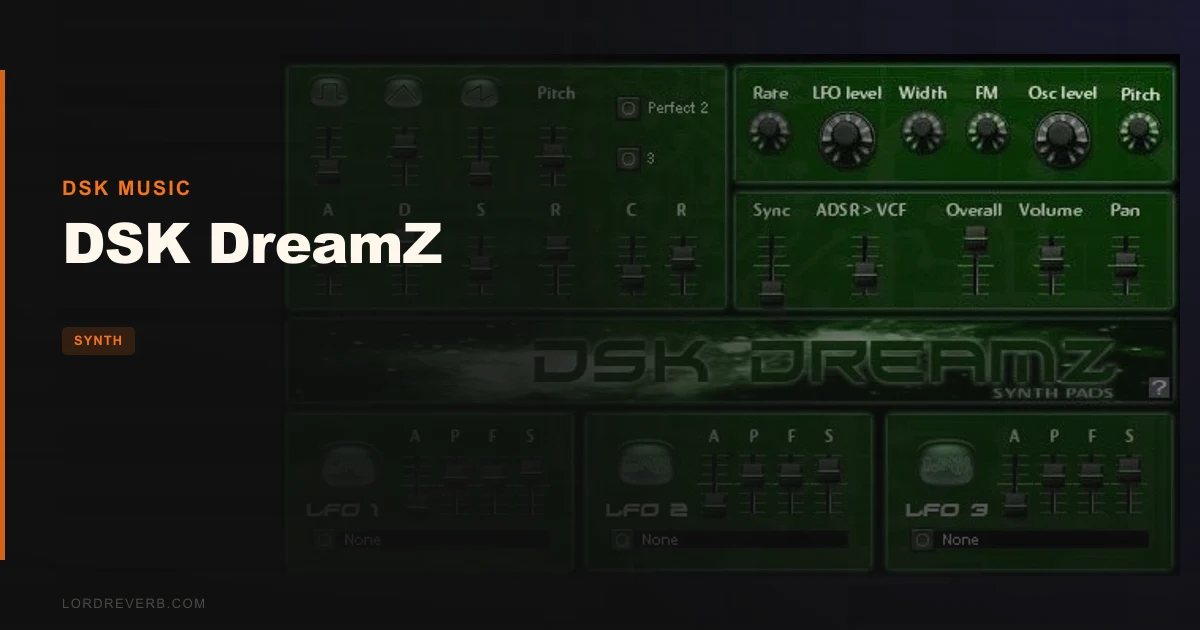
You need an evolving ambient pad for a trance intro, and you don’t want to burn money or hours on it. That’s the gap DSK DreamZ fills, and our DSK DreamZ review verdict is simple: it’s a free, slightly rough synth worth grabbing for pads and textures, not for anything that needs polish.
It’s a PC VST from DSK Music, shipped as a.dll file. It’s built for beat-making and ambient production.
If you make trance, ambient or atmospheric beats on Windows, this is for you. If you want a clean, studio-grade lead machine, keep walking.
Why Does a Free Ambient Synth Still Matter?
Picture bar one of your track. Four bars of nothing but a slow, shifting wash before the kick lands. That wash is where a lot of producers stall.
Wavetable monsters can do it, but you end up scrolling presets for an hour. Sample packs work, but they’re static.
DreamZ goes at it with experimental additive engines and modulation you can reach in a couple of clicks. The developer pitches it on ease of use for sound design and low CPU overhead for real-time work.
Free helps. is the number on the seller page, and that changes the whole risk calculation.
How Does DSK DreamZ Perform?
The headline feature is modulation. There’s an oscillator-controlled LFO, plus three more LFOs you can assign to cutoff, resonance and pan.
Owners and reviewers call the LFO modulation powerful, and the multiple synthesis engines give you more starting points than a free synth usually does.
Here’s a scene you’ll hit. Hold a long chord, assign an LFO to pan, and slow it right down. The pad starts drifting left and right across the stereo field. Now put a second LFO on cutoff at a different rate. The two rates beat against each other and the texture never repeats the same way twice. That’s the ambient trick, and it’s satisfying here.
It supports MIDI and automation, so you can draw filter moves over a full intro instead of relying on the LFOs alone.
Now the annoying part. Users report CPU energy spikes during performance, which cuts against the low-overhead claim. Don’t stack twelve instances without checking your meter first.
What Are the Strengths and Weaknesses?
The strengths are obvious. Three assignable LFOs, a separate oscillator LFO, several engines, and it costs nothing. For trance intros specifically, owners say it delivers.
The weaknesses are real, and they’d bug us too.
Launch it and you may get a loud startup. Turn your monitors down before you load an instance. Frustrating, and potentially painful on headphones.
Play a note and notes can ring on far too long after you lift your finger. For pads that’s forgivable. For plucks or tight rhythmic parts it’s a problem, so check your release settings straight away.
Demo sound quality has also been called lacking in some evaluations. Judge it with your own ears on your own material before building a track around it.
And if you’re running Reaper on Windows XP 32-bit, it may crash. That’s a narrow case, but it’s a documented one.
Is It Worth the Price?
It’s free. The only cost is your time and the risk of a CPU spike mid-session.
At that price, the rough edges are easy to forgive. We’d argue the cost of trying it is close to zero, which is the whole case for it.
Would we pay for it if it had a price? Not on this evidence. As a free tool for ambient layers, it’s a sensible download. As your main synth, hard pass.
Who Should (and Shouldn't) Buy This?
The trance producer: Grab it. Slow LFOs on cutoff and pan give you intro washes without a preset hunt. Buy it, meaning download it.
The beginner on Windows: Worth a go. The LFO routing teaches modulation without drowning you in menus. Just turn your volume down before loading.
The mix or sound-design perfectionist: Wait. Reported demo-quality complaints and CPU spikes mean you’ll want to audition it carefully before trusting it on a client project.
The Mac or Reaper-on-XP user: Skip it. It’s a Windows.dll, and the XP 32-bit Reaper crash report rules out that setup.
✅ Buy if you make ambient trance intros on Windows. ✅ Buy if you want hands-on LFO modulation for free. ✅ Buy if you’re happy to audition and tweak rough tools.
❌ Skip if you need tight, short plucks without long note tails. ❌ Skip if your CPU is already near the limit. ❌ Skip if you’re on a Mac or want a polished main synth.
Specs & Technical Details
| Spec | Detail |
|---|---|
| Developer | DSK Music |
| Price | |
| Plugin Format | VST (.dll) |
| OS Support | Windows (PC) |
| Activation | N/A |
| CPU Usage | N/A |
| Trial Available | N/A |
| Version Reviewed | N/A |
Score Breakdown
| Category | Score | Notes |
|---|---|---|
| Sound Quality | 3.0/5 | Good for ambient intros, but demo quality is reported as lacking |
| Value for Money | 4.5/5 | It's free, so the risk is minimal |
| Ease of Use | 3.5/5 | Simple LFO routing, held back by loud startup behaviour |
| Features | 3.5/5 | Three assignable LFOs, an oscillator LFO and multiple engines |
| CPU Efficiency | 2.5/5 | Spikes reported despite the low-overhead claim |
| Overall | 3.4/5 | A free, flawed ambient tool worth downloading for the right job |
The Bottom Line on DreamZ
Free, flawed and genuinely useful for one thing: slow, drifting ambient texture for the front of a trance track. Download it, lower your monitors first, and keep it in the pads-and-atmospheres drawer. Pushing it into lead duty or a CPU-tight session is where it falls apart. Windows only, no Mac, and nothing here for anyone who wants polish.
Frequently Asked Questions
Is DSK DreamZ free?
Yes. The seller page shows it as free, so you can try it without spending anything. That makes the rough edges easier to live with.
What is DSK DreamZ best used for?
Ambient sounds and intro textures, especially in trance. Owners report it works well for that, helped by the three assignable LFOs and multiple synthesis engines.
Does DSK DreamZ use a lot of CPU?
The developer claims low CPU overhead, but users report CPU energy spikes during performance. Watch your meter if you plan to run several instances at once.
Does DSK DreamZ work on Mac?
It's a PC VST supplied as a.dll file, built for Windows. The synth may crash in Reaper on Windows XP 32-bit systems.