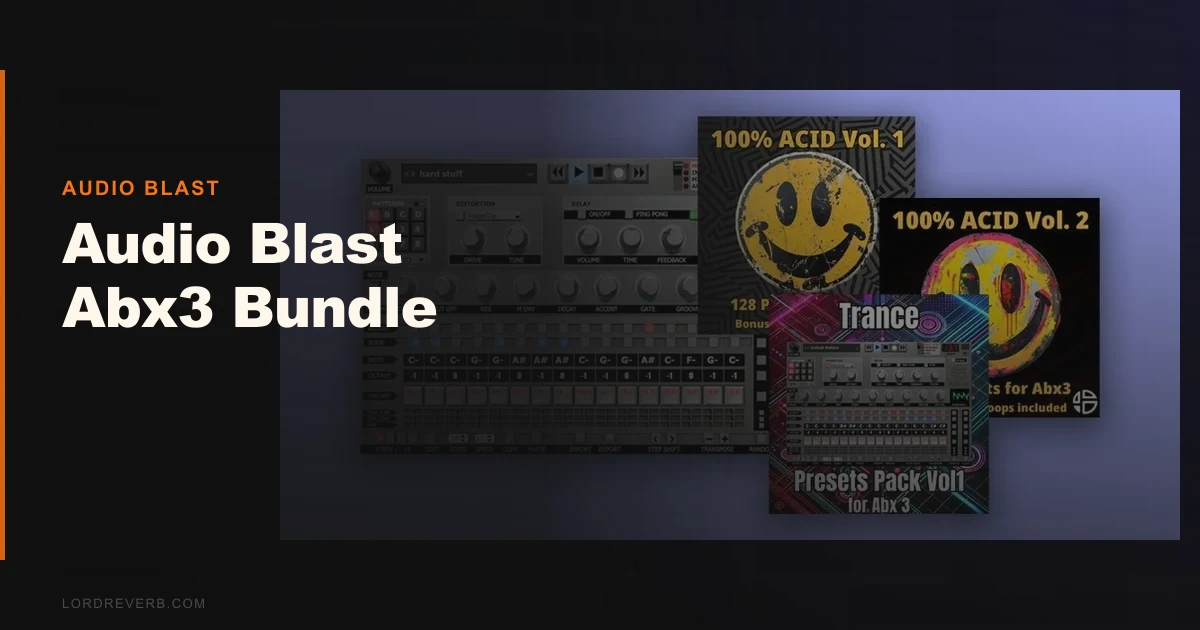
The first thing we heard when we loaded ABX3 was exactly what we wanted. Punchy, nasal, round-bottomed acid squelch with a resonance that zipped up the filter like a zipper on a leather jacket. We were running a 16-step pattern in a techno session at 130 BPM, and the sequence locked in fast. Good sign.
Then we opened the preset browser. Six hundred and six presets. We scrolled for eight minutes. Found maybe forty we’d actually use. That’s not a review. That’s the session.
The Audio Blast ABX3 Bundle is a 303-style acid synthesizer with a sequencer that outguns its competitors on paper, a preset library that is better than average, and a UI that makes you question the list price every time you look at it. It’s worth buying at its current promotional price. At full retail, it’s a tougher sell.
What ABX3 Actually Is (and What It Isn't)
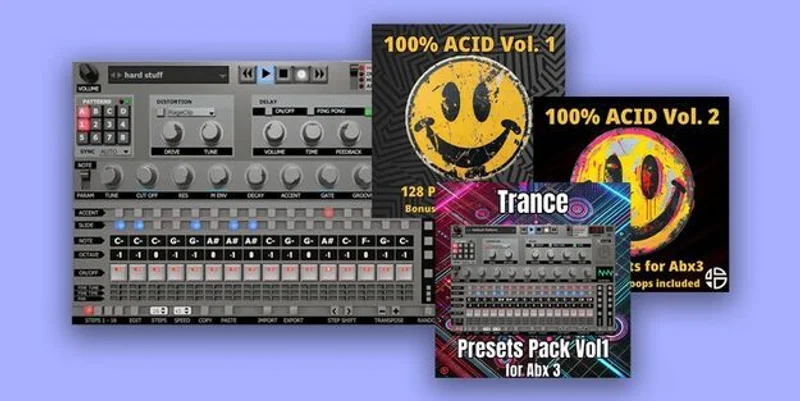
ABX3 is a modern 303 emulation, not a sample-accurate clone. That distinction matters. It doesn’t pretend to be an exact circuit model like some competitors do. Instead, it takes the 303’s DNA and extends it: 32 oscillator shapes, 8 distortion units, a 16-to-64-step sequencer, and 32 independent patterns. Those are real numbers, not marketing fluff.
What it isn’t: a general-purpose synthesizer. Don’t load this expecting lush pads or FM bells. It’s built for acid lines, squelchy bass, and the aggressive mid-range grunt that lives under techno kicks and inside acid house breakdowns. Use it outside that lane and it fights you.
It also isn’t a live performance tool with a slick, stage-ready interface. The layout is functional, not inspiring.
Living With ABX3 Over a Real Session
Setup took under five minutes. VST3 on Windows, scanned clean, no authorization drama. That’s always satisfying.
The sequencer is where ABX3 earns its place. We built a 32-step pattern with separate note, accent, slide, and gate data per step. The slide behavior sounds right: glide that stretches between notes the way a real 303 does, not a generic portamento that just eases pitch. We pushed the pattern to 64 steps for a longer acid loop that varied over eight bars. It worked without jumping through menus.
The 8 distortion units are genuinely different from each other. We ran the same acid riff through all eight. Three of them we’d use on a record. Two were too fizzy to be useful. Three sat somewhere between usable and ugly. That’s an honest range.
One frustrating moment: the preset browser has no tag filtering. Six hundred presets organized into folders by genre, but no way to filter by oscillator shape or distortion type. We spent twenty minutes looking for a specific bright saw-wave preset we’d found earlier and couldn’t relocate it. Annoying. Real annoying.
The CPU load is light. Running four instances of ABX3 in a dense techno session alongside heavy synth plugins like Unfiltered Audio LION didn’t cause issues. That’s worth something.
Where the Trade-Offs Actually Bite
The sound design is clever in places. The 32 oscillator shapes mean you can dial in tones that no original 303 would produce, which is the point of a modern tribute rather than a clone. That extended palette is the strongest argument for choosing ABX3 over a more historically faithful emulation.
But the interface trades away immediacy for that depth. Tweaking oscillator shapes mid-session requires navigating menus that feel one generation behind where plugin UI design currently sits. Compared to competitors with drag-and-drop modulators and visual waveform displays, ABX3 looks like it was designed before Retina screens existed.
The value equation is the real trade-off. At a promotional price, ABX3 is a satisfying purchase with a few frustrations. At list price, you are paying for features that competitors offer with better interfaces at lower cost. The plugin itself didn’t change between those two prices. Your perception of it will.
Against the Field: ABL3, Phoscyon 2, Arturia Acid V
ABL3 by AudioRealism is the circuit-modeled option. It’s narrower in scope, no extended oscillator shapes, but the 303 authenticity is tighter. Better pick for purists.
Phoscyon 2 by D16 Group sits closest to ABX3 in intent. It’s cheaper than ABX3 at list price, has a cleaner UI, and has the deeper critical track record. Check the best acid synth plugins guide for a full comparison. Phoscyon 2 wins on workflow speed.
Arturia Acid V has the best interface of the group and Arturia’s support
network behind it. If you want something that feels modern to use, Acid V wins.
ABX3 beats all three on raw sequencer depth: 64 steps, 32 patterns, per-step parameter control. If that specific spec is what you need, ABX3 is your pick.
The Real Verdict
At promo price, buy it without overthinking. The sequencer alone justifies that spend for any producer working in acid, techno, or trance.
At list price, skip it. Phoscyon 2 and Arturia Acid V both give you a better all-round experience for that money or less.
The caveat: if you need 64-step patterns and 32 independent sequences in a single 303-style instrument, ABX3 is the only plugin currently doing that. That’s a narrow need, but it’s real.
Score Breakdown
| Category | Score | Notes |
|---|---|---|
| Sound Quality | 3.8/5 | Acid character is convincing; 8 distortion units vary in quality but the best ones are genuinely good |
| Value for Money | 3.0/5 | Excellent at promo price, hard to defend at list price against current competition |
| Ease of Use | 2.8/5 | Sequencer depth takes time to learn; preset browser lacks tag filtering; UI feels dated |
| Features | 4.0/5 | 64-step sequencer with 32 patterns and 32 oscillator shapes is a real differentiator |
| CPU Efficiency | 4.3/5 | Light footprint; runs multiple instances without strain in a dense session |
| Overall | 3.6/5 | Strong engine in a frustrating shell; price-dependent recommendation |
Alternatives Worth Considering
D16 Group Phoscyon 2 is the closest direct competitor and wins on UI clarity and critical reputation. We’d pick it over ABX3 at full retail price without hesitation. See how D16 Group plugins compare across the board
Arturia Acid V is the best-looking and most accessible 303-style instrument available right now. It’s built for producers who want acid sound without a learning curve. Recommended for anyone prioritizing workflow over raw sequencer depth.
AudioRealism ABL3 is for purists only. Narrower feature set, but the circuit modeling is the most faithful to the original 303 hardware. Best vintage emulation plugins reviewed
If you’re deep into live techno or acid performance and you’ve already tried the above, ABX3’s sequencer spec makes it worth a look, specifically at promo pricing.
The line we keep coming back to: ABX3 sounds like a 303 that went to night school. It learned things the original never knew. Whether that is worth it depends entirely on which price you catch it at.
Frequently Asked Questions
Is the Audio Blast ABX3 Bundle a faithful 303 emulation or a modern reinterpretation?
It's a modern reinterpretation. ABX3 uses the 303's character as a starting point, then extends it with 32 oscillator shapes and 8 distortion units that go well beyond anything the original hardware could produce. If you want strict circuit-model accuracy, AudioRealism ABL3 is the closer match. ABX3 is better described as a 303-inspired acid synthesizer with expanded sound design range.
How many presets does the ABX3 Bundle include, and are they actually useful?
The bundle ships with 606 presets organized by genre across acid house, techno, and trance. Quality is uneven. We found roughly 40 immediately usable presets in a working session, with more worth exploring for sound design starting points. The bigger frustration is the browser itself, which lacks tag filtering and makes finding specific sounds time-consuming.
What DAWs is the Audio Blast ABX3 Bundle compatible with?
ABX3 supports VST2, VST3, AAX, and Audio Unit formats. That covers Ableton Live, Logic Pro, Pro Tools, FL Studio, Cubase, Reaper, and most other major DAWs on both Mac and Windows. Setup is straightforward and we didn't encounter scan or authorization issues during testing.
Is the ABX3 Bundle worth buying at full price compared to Phoscyon 2 or Arturia Acid V?
At list price, it is a harder sell than both competitors. Phoscyon 2 and Arturia Acid V offer better interfaces and stronger support communities at competitive price points. ABX3 justifies its purchase when caught at a promotional price, or if you specifically need its 64-step, 32-pattern sequencer depth, which neither competitor currently matches.