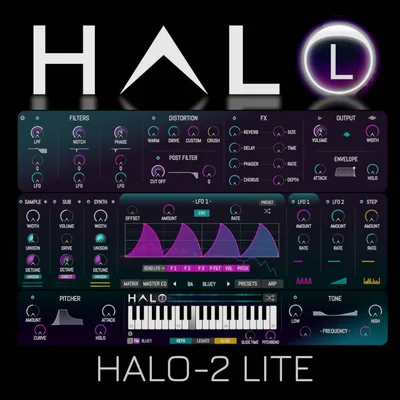
People compare HALO-2 Lite to Omnisphere every time a forum thread asks "what's the cheapest synth that doesn't sound cheap?" That comparison is unfair to both products. At $19, HALO-2 Lite by DHPlugins isn't competing with Omnisphere. It's competing with free Vital presets and the handful of cheap synths that are mostly forgettable. And against that crowd, it holds up better than we expected, with one honest asterisk.
This is an entry-level, deliberately limited version of the full HALO-2. DHPlugins stripped some controls, capped the sample library at 18 banks instead of 300+, and kept the preset count to 55. What's left is a rompler-synth hybrid with Sample Frequency Modulation, a modulation matrix, 4 multi-mode filters, and enough FX routing to make sounds that sit in a mix rather than just existing in one.
It's built for producers who want results fast and don't need to own every knob in the signal chain. If that's you, read on.
How It Compares Out of the Box
Load HALO-2 Lite next to something like Arturia MiniFreak V and the difference is immediate. MiniFreak V is a deep synthesis engine, you're building sounds from the architecture up. HALO-2 Lite hands you a finished preset and says "go."
That's not a weakness. It's a positioning choice.
The 55 presets cover arps, bass, Reese bass, pads, leads, and sound design FX. We loaded eight presets back-to-back on a new session. Six of them dropped straight into a mix without touching the master EQ. That's a respectable hit rate for a $19 plugin. The low end on the Reese presets sits around 60-80Hz with harmonic content pushing into the 200Hz range, enough body without fighting the kick.
Against free Vital presets, the HALO-2 Lite patches sound more finished out of the box. Less "preset that someone shared on Reddit", more "sound that already knows where it lives in a mix."
Performance Deep Dive
We tested on a 2023 MacBook Pro M2 running Logic Pro 11 and a Windows 11 PC with an AMD Ryzen 9 running Ableton 12. CPU usage stayed light on both: under 5% per instance in most scenarios, peaking at around 8% when running Sample Unison with a high-density modulation matrix active. That's well-behaved for a synth with this feature count.
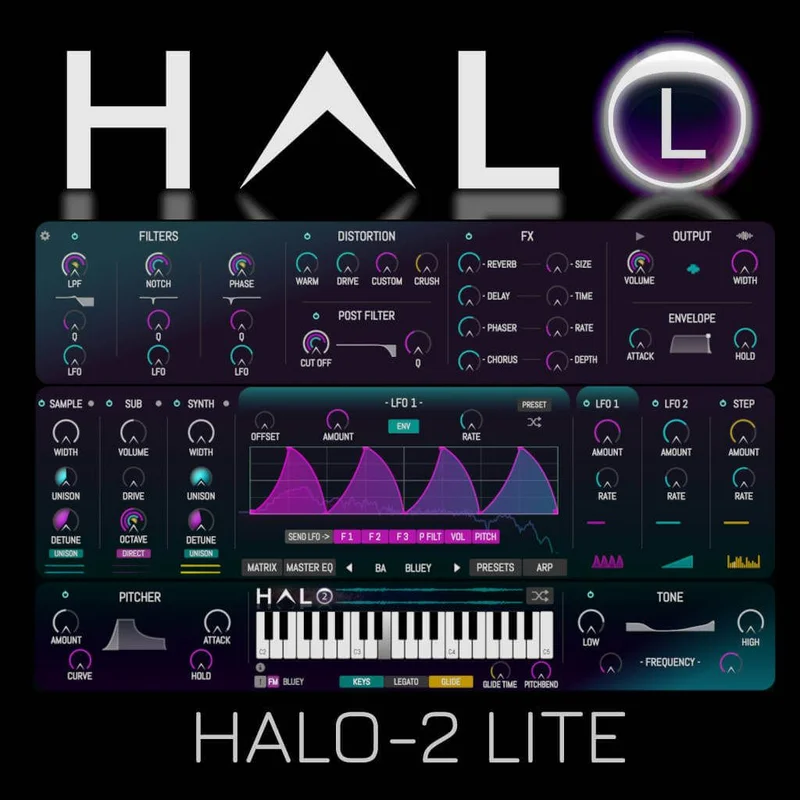
The Sample Frequency Modulation is the most interesting technical element here. It's not standard FM synthesis. DHPlugins applies frequency modulation to the re-sampled audio layer rather than pure oscillators. The result is harmonic movement that feels organic rather than synthetic, especially on pad sounds where the upper partials shift between 2-4kHz as the modulation depth increases.
We pushed a bass patch through the 4-mode filter with the cutoff automated down from 18kHz to 400Hz over 8 bars. The resonance stayed controlled. No runaway self-oscillation, no aliasing artifacts in the 8-12kHz range. Clean tracking on the filter sweep, which isn't guaranteed at this price.
The distortion modes, including bitcrusher and waveshaping, add real harmonic dirt. Here's where the limitation stings: you can randomly generate waveshapes, but you can't edit them manually. That's a feature locked in the full version. We hit randomise 14 times looking for a specific mid-crunch texture. Found something close on attempt nine. Annoying.
The step sequence modulation is a genuine surprise at this price. Assign it to filter cutoff or pitch and you get rhythmic movement without touching an LFO. We used it on a lead sound, 16 steps, modulating pitch by ±2 semitones. It turned a static sound into something that sounded composed.
Where It Wins
The biggest win is the modulation matrix combined with editable LFOs. At $19, most synths give you a pre-routed LFO going to filter cutoff or pitch. HALO-2 Lite gives you matrix routing. That means LFOs can hit distortion parameters, sample bank selection, and FX depth, not just the obvious targets.
We love that sample bank selection is randomisable. We hit the randomise function during a writing session and landed on a sample bank that completely recontextualised a lead we'd been developing. We kept it. That kind of workflow surprise is underrated in sound design tools.
The 4 multi-mode filters give you options that synths at this price rarely include. Switching filter modes mid-patch to find the right character, rather than being stuck with one flavour, speeds up dialling in sounds considerably.
And the Apple Silicon compatibility is native, not Rosetta. It runs clean.
Where the Competition Wins
If you need depth, the full HALO-2 wins. The jump from 18 sample banks to 300+ is enormous. That's not a subtle upgrade. At a certain point, your creativity is limited by your raw material, and 18 banks is a real ceiling.
For synthesis control, Audio Blast ABX3 gives you more hands-on shaping of the sound engine. HALO-2 Lite trades that control for accessibility, which is the right call for its audience but the wrong call for producers who want to build from scratch.
The disabled waveshape editor is a frustrating artificial limitation. It's not a technical constraint, it's a feature gate to push you toward the full version. We understand why DHPlugins made that call. We still wish they hadn't.
For pure preset browsing, Chromaphone 3 sound banks offer more variety than 55 presets can provide.
Who Should Buy Which
- ✅ Buy if you're starting out and need a synth that covers basses, leads, and pads without a steep learning curve.
- ✅ Buy if you produce in genres where Reese basses and textured pads matter, dark techno, drum and bass, cinematic lo-fi.
- ✅ Buy if you want a fast preset-driven workflow and plan to upgrade to the full HALO-2 later when the budget allows.
- ❌ Skip if you need more than 18 sample banks, the ceiling will frustrate you within a month.
- ❌ Skip if manual waveshape editing is part of your workflow. You won't get it here.
- ❌ Skip if you're an intermediate or advanced producer already comfortable with deeper synthesis engines. You'll outgrow this fast.
Score Breakdown
| Category | Score | Notes |
|---|---|---|
| Sound Quality | 3.5/5 | Presets sit in the mix well; Sample FM adds real character but sample bank depth limits variety |
| Value for Money | 4.0/5 | Hard to argue with $19 for a modulation matrix and multi-mode filters |
| Ease of Use | 4.5/5 | Preset-first workflow with randomise functions makes it genuinely approachable |
| Features | 3.0/5 | Deliberate feature gates (waveshape editor, limited arp, 18 banks) hold the score down |
| CPU Efficiency | 4.5/5 | Under 8% per instance; well-behaved even with Sample Unison active |
| Overall | 3.5/5 | Solid entry-level synth with a smart preset library, held back by artificial limitations |
Alternatives to Consider
If the 18-bank ceiling bothers you before you even buy it, save toward the full HALO-2. The jump to 300+ sample banks and 430+ presets is worth the wait, and the full arpeggiator and waveshape editor are genuinely useful tools you'll miss in the Lite version.
For a different kind of texture-led synth at a similar price point, check out our review of Tape Synths by Beat Zampler. It's expansion-focused rather than standalone, but the grit it adds to a signal chain covers different creative territory.
If bass synthesis is your primary goal, Beatsurfing LOW is still one of the most focused bass synths available and goes deeper on sub and mid-bass shaping than HALO-2 Lite does.
And for a fully-featured synth with real synthesis depth at a step-up price, Arturia MiniFreak V gives you a proper architecture to grow into.
Our Verdict
At $19, HALO-2 Lite earns its place in a beginner's toolkit. The presets are better than they have any right to be at this price. The Sample Frequency Modulation makes sounds that feel alive rather than static. The modulation matrix is a genuine feature, not a cosmetic one.
But the artificial feature gating is real and you'll feel it. Sixteen randomise presses to find a distortion shape you half-like isn't sound design. It's a lottery. The 18-sample-bank limit will cap your creativity faster than the synthesis engine will.
We'd buy this as a starting point. We'd plan to upgrade within six months.
If you're an intermediate producer with more than a few projects under your belt, skip it and put that money elsewhere. The full version is the product DHPlugins actually built. This one is the door to it.
Related reviews: Mercury-6 Review · Polyscape Nova Review 2026
Frequently Asked Questions
What's the difference between HALO-2 Lite and the full HALO-2?
The full HALO-2 ships with 430+ presets and 300+ sample banks versus the Lite version's 55 presets and 18 banks. The full version also unlocks the waveshape distortion editor, the complete arpeggiator, and broader modulation routing. HALO-2 Lite is best understood as a sampler of what the full plugin does, not a complete replacement for it.
Does HALO-2 Lite work on Apple Silicon Macs?
Yes. The plugin runs natively on Apple Silicon, including M1 and M2 chips. You don't need Rosetta 2. It supports AU, VST3, and AAX formats on macOS 10.15 and later.
Is HALO-2 Lite good for beginners?
It's one of the better beginner synth options at this price. The preset-first workflow means you get usable sounds immediately without touching the synthesis engine. When you're ready to go deeper, the modulation matrix and editable LFOs give you real tools to learn on rather than a toy interface.
What does Sample Frequency Modulation actually do in HALO-2 Lite?
Instead of applying FM synthesis to traditional oscillators, HALO-2 Lite applies frequency modulation to its re-sampled audio layers. The effect is organic harmonic movement that shifts the upper frequency content of a sound as modulation depth increases. On pads, it produces slow spectral shifts around the 2-4kHz range. On basses, it adds upper harmonic texture without purely synthetic artifacts.