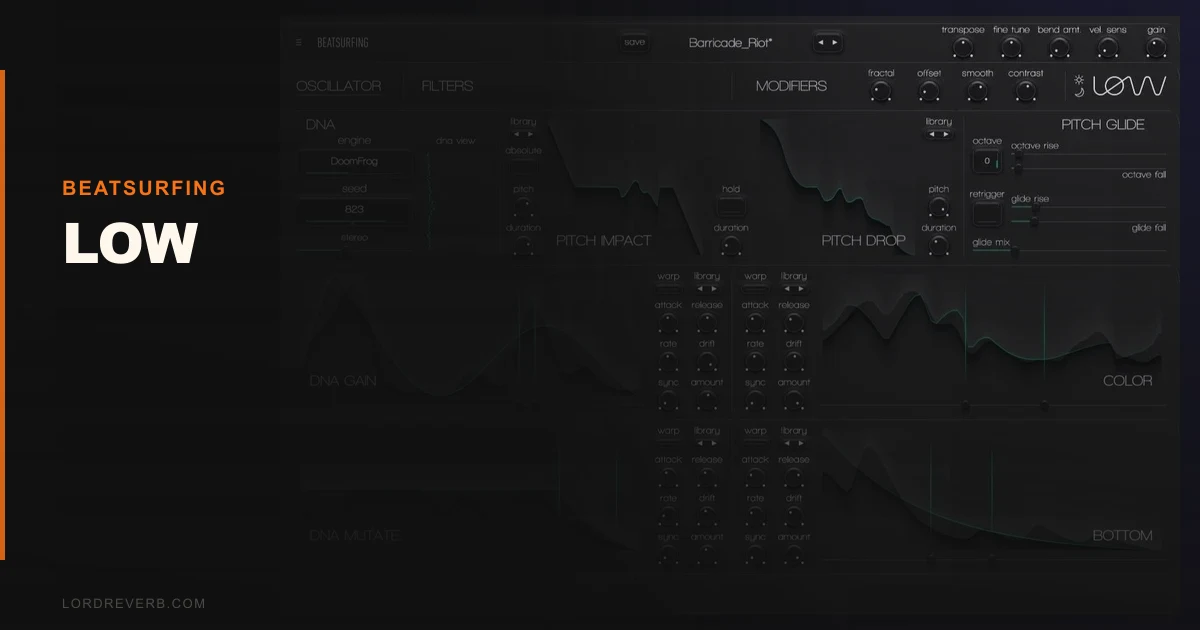
LØW by Beatsurfing is a monophonic bass synthesizer plugin that earns its place in a modern session, but it is not for everyone, and at $149 full price, it should not have to be.
We were three hours into a boom-bap session, and the 808 we'd been nursing for an hour still wasn't sitting right. Too much mid-bark, not enough chest. We loaded LØW on a whim, pulled up an engine called "Tube Grief," dialled the free-hand amplitude envelope into a slow, chest-forward shape, and the track locked in inside 90 seconds.
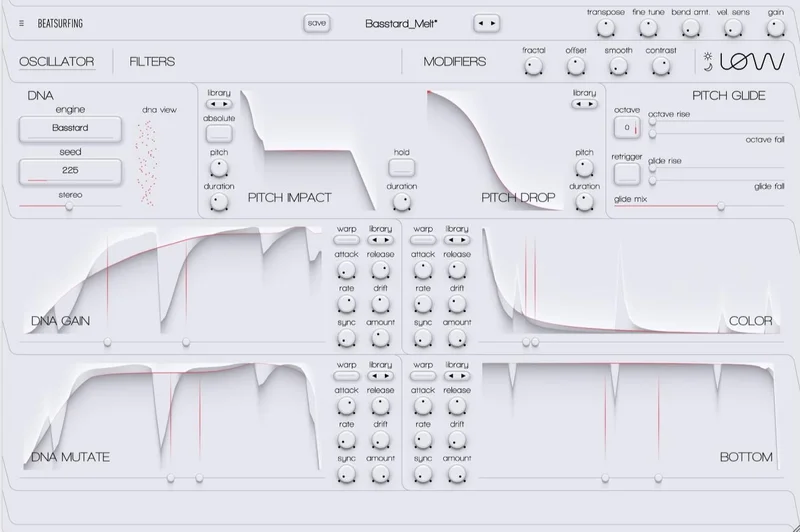
That one moment tells you most of what you need to know about Beatsurfing's LØW. It's a bass-focused synthesizer built around 20 distinct engines, 12 free-hand envelope controls, and a DNA mutation system that generates variations on any engine until you land on something that works. It runs as VST, VST3, AU, and AAX on both Mac and Windows.
It's built for producers who know roughly what they want from their low end but are tired of either sculpting it from a blank oscillator or fishing through 400 presets hoping something sticks.
First Impressions
Installation is clean. No dongle, no iLok drama. Authorisation runs through a Beatsurfing account, which takes about two minutes and doesn't require the account to stay connected during sessions.
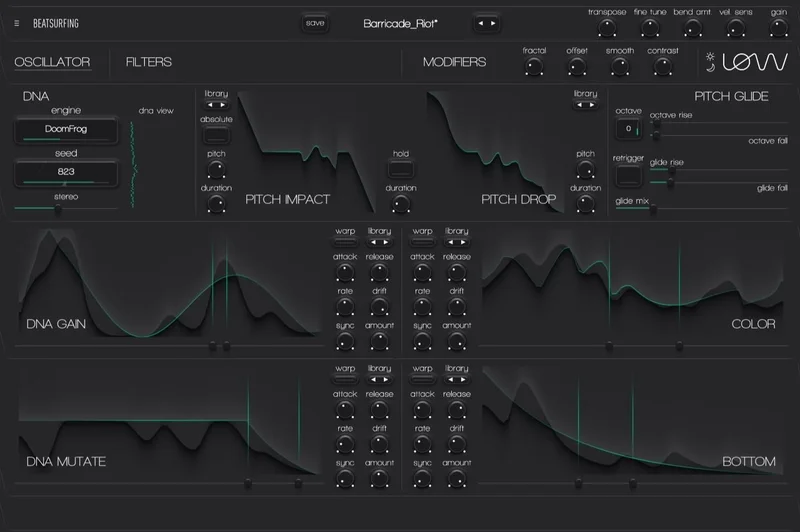
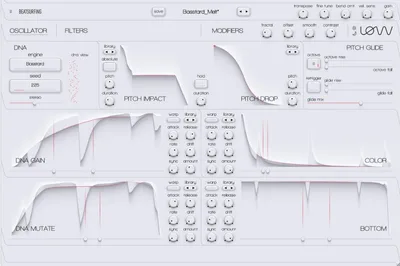
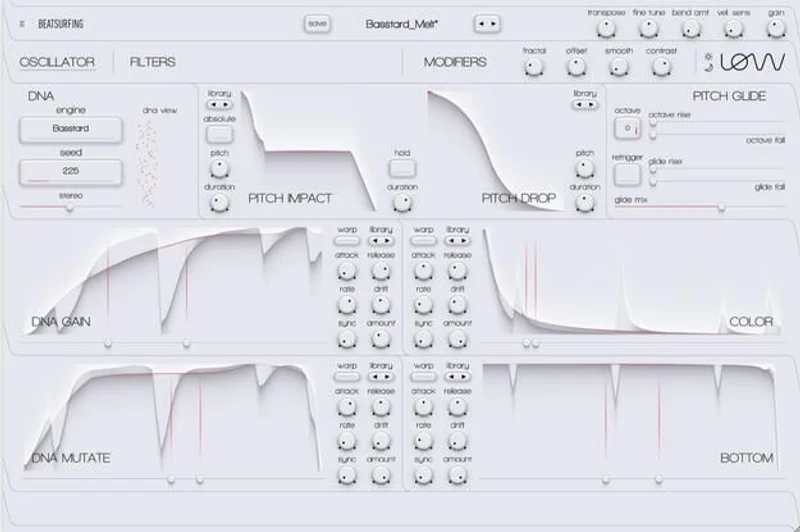
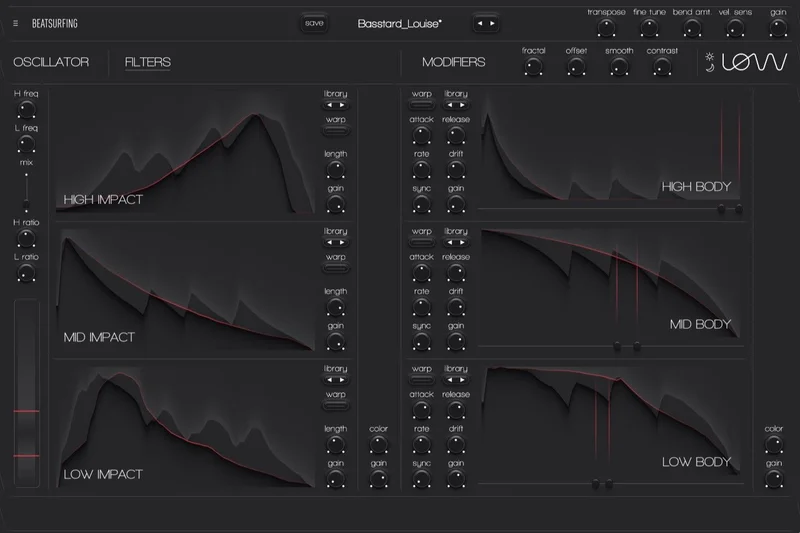
Opening LØW for the first time, the UI reads dark and purposeful. The 20 engines sit in a scrollable browser on the left. The centre panel shows the free-hand envelope editor, which looks like a freeform draw canvas rather than a traditional node editor.
Honestly, that envelope canvas is where we spent the first 20 minutes just exploring. You draw curves directly with your mouse. No snapping, no preset shapes forced on you. We drew a slow swell for one patch, a sharp transient with a dragging tail for another. Both sat in the mix without needing a separate envelope shaper on the channel.
The DNA system isn't obvious from the start. Plan on 15 minutes of reading before it clicks.
Getting It Into a Real Workflow
LØW drops into a standard bass synth plugin workflow without friction. One instance per bass channel, MIDI in, done. Because it's monophonic, you won't layer chords inside it, so any harmonic stacking has to happen outside the plugin.
That limitation bit us on an R&B session where we wanted a moving bass chord for a pre-chorus. LØW couldn't do it alone. We ran two instances on parallel MIDI tracks instead, which worked but added CPU overhead we didn't love.
The DNA system is where the workflow either speeds up or stalls. When it works, you hit "mutate" and the engine shifts its underlying character: slightly different harmonic weighting, different transient shaping, different sub emphasis. We got three usable bass sounds from one engine in under five minutes during a test session on a dark trap beat.
When it doesn't click immediately, the lack of in-app documentation is annoying. There's no tooltip explaining what "mutation depth" affects at different settings. We had to cross-reference an external walkthrough to understand why two mutations at max depth sounded nearly identical.
Gain staging deserves attention here. LØW outputs hot. We clipped our channel strip twice before adding 3dB of headroom before the plugin's output. Build that into your template if you adopt it regularly.
What It's Genuinely Good At
The 20 engines aren't just cosmetically different. We A/B tested six of them on the same MIDI line. Engine to engine, the harmonic character shifts meaningfully: one leans into 2nd and 3rd order harmonics with a clear mid presence, another pushes sub content below 80Hz with almost no mid bark. Those aren't subtle texture changes. They're different tools.
The free-hand envelopes are brilliant. A standard ADSR gives you four points. LØW's canvas gives you as many control points as you want to draw. We shaped a filter envelope with a fast initial cut, a plateau at 800Hz, and a slow bloom back to 2kHz over four seconds. Try doing that with a conventional ADSR on a Sublab patch.
For comparison: Sublab and similar one-shot bass tools are faster to load and easier to learn, but their envelope control is far less expressive. LØW wins on sound-shaping depth, full stop.
CPU usage lands in the medium range. One instance in Ableton 12 on an M2 MacBook Pro pulled about 4% CPU with a 256-sample buffer. Two instances: 7-8%. That's manageable. Not light, but not a problem on modern hardware.
The Rough Edges
The monophonic constraint is the biggest. For straight-ahead bass lines it doesn't matter. For anything harmonically adventurous, it does. That's not a flaw in the design, just a hard limit you should know before buying.
No trial version is a real problem. Asking producers to buy blind is a tough sell at any price, especially when competitors like Phase Plant offer time-limited demos. We wish Beatsurfing would fix this.
The preset library is deep (over 200 presets at launch), but the tagging system is basic. Searching "sub" returns 40 results with no secondary sortin
g by engine type or energy. Browsing becomes tedious after the first session.
Mobile compatibility is listed as "in development" for iOS and Android. Don't factor that into your purchase today. It's not here yet.
Who This Is Really For
- ✅ Buy if you produce hip-hop, trap, R&B, or any bass-driven genre and want real envelope control beyond ADSR.
- ✅ Buy if you're tired of resampling 808s and want synthesized bass with genuine character variation between patches.
- Buy if you caught it at the introductory price. The value equation changes at full price.
- ❌ Skip if you need polyphonic bass chords or pad-style low-end layers inside one plugin.
- ❌ Skip if you want a plug-and-play tool with zero learning investment. LØW has a real curve.
- ❌ Skip if you're on older hardware below 2019-era specs. Medium CPU is fine on modern machines, but CPU-heavy plugin considerations stack up fast in dense sessions.
Score Breakdown
| Category | Score | Notes |
|---|---|---|
| Sound Quality | 4.3/5 | 20 engines deliver real tonal variety; sub content is full and controlled |
| Value for Money | 4.0/5 | Strong at intro price; harder to justify at full price without a trial |
| Ease of Use | 3.3/5 | DNA system needs better in-app guidance; envelope canvas is intuitive but preset browsing isn't |
| Features | 4.0/5 | Free-hand envelopes and DNA mutation are genuinely clever design choices |
| CPU Efficiency | 3.5/5 | Medium usage; fine in isolation, adds up fast when stacking instances |
| Overall | 4.1/5 | Expressive, focused bass synth that earns its price at the intro rate |
Alternatives Worth Considering
Sublab XL (Future Audio Workshop) is the closest direct competitor. It's faster to learn, ships with sample-based 808 layering built in, and has a generous trial. The envelope control is shallower than LØW's, but for producers who want to get a bass sound in 60 seconds and move on, Sublab wins on speed. Check Sublab-style bass tools and workflow tips if that sounds like your session style.
Phase Plant (Kilohearts) does everything LØW does and then some, polyphonically, with a full modular routing system. It's more expensive and takes significantly longer to learn. If you're already comfortable designing from first principles, Phase Plant is the better long-term investment. If you just want great bass fast, it's overkill.
Vital (Matt Tytel) is free at its base tier and handles bass design with real depth. It lacks the dedicated bass-engine DNA concept LØW offers, but for producers on a strict budget, free and low-cost synth plugin options are worth exploring before spending anything.
LØW sits in a real gap between "quick 808 loader" and "full modular patch everything yourself." It fills that gap well. At the introductory price, it is a smart buy for producers who live in hip-hop and R&B sessions and want bass that breathes. At full price without a trial, it becomes a harder recommendation to make with a straight face.
The free-hand envelopes alone justify the intro price. Just don't buy it expecting to skip the learning curve.
Frequently Asked Questions
Is LØW by Beatsurfing suitable for genres outside hip-hop and R&B?
It works in any genre where bass is central: lo-fi, afrobeats, dark techno, and cinematic scoring all benefit from its engine variety. The monophonic design does limit it for genres that lean on harmonic bass movement, so for prog or jazz production, you'll likely want to pair it with a polyphonic synth for chord-based low-end work.
What is the DNA system in LØW and how does it actually work?
The DNA system mutates the selected engine's underlying parameters to generate new tonal variations. You set a mutation depth, hit mutate, and LØW shifts characteristics like harmonic weighting, sub emphasis, and mid presence. It's a sound-design shortcut, not a random preset generator. The results stay related to the source engine, which keeps mutations usable rather than chaotic.
How does LØW compare to Sublab for 808-style bass?
Sublab is faster to load and easier to learn, with built-in sample layering that lets you blend an 808 sample with a synthesized sub. LØW is purely synthesis-based, so there's no sample layer option. LØW wins on envelope expressiveness and engine variety. Sublab wins on speed and accessibility. If you want to dial in an 808 in under a minute, Sublab is still the quicker tool.
Does LØW work on Apple Silicon Macs without Rosetta?
Yes. LØW ships as a native Apple Silicon build alongside Intel support. On M-series Macs, it runs natively without Rosetta translation, which keeps CPU usage at the lower end of its medium-usage range. We tested it on an M2 MacBook Pro in Ableton 12 without any compatibility issues.