If you make lo-fi beats, ambient drifts or liminal-space soundtracks, Usynth DUST is the cheap, fast way to get a worn, dusty keyboard part into your session, and at $19 it’s an easy yes for that job.
If you make hard techno or glossy pop, keep walking. DUST is not built for you.
It’s a synth plugin from UJAM with 100 synthesizer patches and 100 global presets. The pitch is simple: sounds that feel aged, faded and a little fragile. Think tape hiss, soft imperfections and chords that sound like they were sampled off a dusty record.
We like the focus. We don’t love the ceiling. Both come from the same design choice.
Below we cover where it fits, where it doesn’t, how the engine works, and who should buy it.
Where It Belongs
DUST belongs in any track where the keys, pads or textures are supposed to feel old.
Lo-fi hip-hop is the obvious home. The preset categories read like a lo-fi producer’s shopping list: keys and chords, pads and textures, plucks and bells, vox, lofi and liminal, and faux sampled sounds.
Ambient is the second fit. Owners report the preset variety suits ambient work, and the effects section helps with ambience, background layers and rhythmic textures.
Then there’s film-style underscore, study-beat playlists and anything built on nostalgia. If your reference tracks sound like a cassette left on a car dashboard, you’re in the right place.
Where It Doesn't
Don’t buy DUST for aggressive, sharp or experimental work.
UJAM positions it for a focused lo-fi aesthetic rather than broad synthesis experimentation. That’s honest, and it means you won’t be building a razor-edged hyperpop lead here.
Low-level parameter access is reduced by design. If you want to open a wavetable editor and draw your own harmonics, this isn’t that plugin.
There’s also no MPE support. Users have flagged that as a missing feature, and we agree it’s a gap if you play an expressive controller.
The Two-Layer Engine
Everything in DUST sits on a two-layer synthesis engine, and that’s where its character comes from.
Each layer can draw on a different synthesis method. The engine covers virtual analogue, wavetable, FM and multisampling. Stack two of them and you get movement and complexity without ever opening a deep menu.
Why four methods matter
Virtual analogue gives you the rounded, familiar body. Wavetable adds evolving motion. FM brings bell-like and glassy edges. Multisampling is what makes the faux-sampled sounds feel like real recordings rather than synthesis.
Layer a soft analogue pad under an FM bell and you’ve got the classic dusty-keys sound before you touch a single effect.
What the layering costs you
You’re working with a curated set of controls, not a full modular canvas. For a lo-fi player that’s a feature. For a sound designer it’s a wall.
The Sound Itself: Degradation, Filtering and Distortion
DUST can also run acoustic and electric instrument sources through degradation, filtering and distortion, and that’s what separates it from a plain preset synth.
The result is the worn quality the developer talks about: tape hiss, soft imperfections, tones that feel fragile and glowing. Owners say the sound modification is intuitive, with unbelievable results from small tweaks.
That matches how this kind of tool works. A little degradation goes a long way, and pushing it hard turns pretty keys into grit.
Honestly? This is the best part of the plugin. Most synths make you build dirt with a chain of third-party processors. Here it’s the point of the instrument.
The Presets: 100 Patches, 100 Global Sets
The preset count is 100 synthesizer patches plus 100 global presets, sorted into eight categories.
Those are keys and chords, pads and textures, leads, basses, plucks and bells, vox, lofi and liminal, and faux sampled sounds. The sorting is practical. You can land on a bass or a lead without scrolling through ambient washes.
Owners say it’s quick and easy to get decent sounds out of it. We believe that. A well-curated, narrow library does that.
The catch: the library is narrow in tone. Scroll through all 200 and you’ll hear a family resemblance. That’s cohesive if you want one vibe. It’s repetitive if you want range.
Sequencer, Arpeggiator and Effects
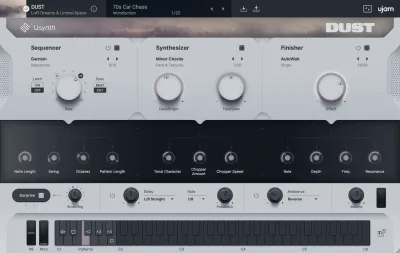
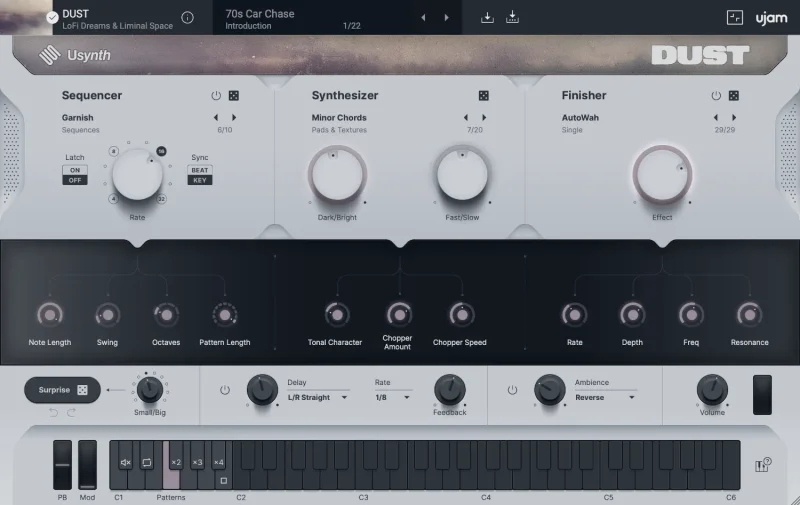
DUST ships with a sequencer/arpeggiator with swing, octave and pattern controls.
Swing matters more than it sounds. A lo-fi groove lives or dies on the push and pull of the offbeats, and having it in the arp saves you from nudging MIDI by hand.
Set the octave range wide on a slow pattern and a single held chord turns into a drifting, rhythmic bed. Pair it with the multi-effects and you can build a whole background layer from one MIDI clip.
The multi-effects are what owners praise for sound expansion: ambience, backgrounds and rhythmic textures. Use them for space and movement, not to rescue a weak patch.
Playing It Live: CC Learn
CC learn is available on all parameters, so you can map any control to a knob or fader for live expression.
That’s a smart inclusion for a texture synth. Map the degradation amount to a mod wheel or a spare knob and ride it through a section. A pad that slowly dirties up over eight bars sounds alive in a way automation drawn in a grid often doesn’t.
It also partly softens the missing MPE. You can’t get per-note expression, but you can get hands-on control of the whole sound.
CPU, Formats and System Needs
DUST runs as VST 2, VST 3, AU 2 and AAX 64-bit. It needs a minimum of 8 GB RAM and a 1280×768 display.
On Windows it supports 10 through 11. On macOS it runs from Big Sur (11) through Tahoe (26), on both Intel and Apple silicon.
We don’t have a CPU figure for it, so we won’t invent one. Check the demo on your own machine and your usual project size before you commit. DUST was released in November 2025, so it’s a fresh plugin.
Who Should Buy It?
Different producers get different answers here.
The lo-fi beatmaker
Buy it. This is exactly the sound you’re chasing, and $19 is less than most single sample packs. You’ll have usable keys in minutes.
The ambient and soundtrack composer
Buy it. The pads, textures and effects section are made for slow, atmospheric work. The sequencer adds rhythmic movement without much effort.
The beginner
Buy it, with a note. The ease of use is real, and you’ll get good results quickly. Just know you’re learning a narrow slice of synthesis, not the whole craft.
The sound designer
Skip it. Reduced low-level access means you’ll hit the ceiling fast. You’ll be happier elsewhere.
The MPE player
Skip it. No MPE support, and no workaround that replaces it.
Against the Field
UJAM’s own siblings point in other directions. Usynth VORTEX is trance-forward with sharper energy. Usynth WEBCORE chases hyperpop, digicore and aggressive digital experimentation. DUST is the soft, aged one of the family.
Serum and Vital Pro are the bigger names people compare it to. Both are favoured for superior sound design and broader presets. If you want one synth to do everything, they win, and it isn’t close.
DUST wins on speed to a specific mood. You don’t build the dusty sound. You open it. That’s a different job than a full sound-design workstation, and it’s priced like it.
Specs & Technical Details
| Spec | Detail |
|---|---|
| Developer | UJAM |
| Price | $19 |
| Plugin Format | VST 2 / VST 3 / AU 2 / AAX 64-bit |
| OS Support | Windows 10-11 / macOS Big Sur (11) to Tahoe (26), Intel and Apple silicon |
| Activation | N/A |
| CPU Usage | N/A |
| Trial Available | N/A |
| Version Reviewed | N/A |
Score Breakdown
| Category | Score | Notes |
|---|---|---|
| Sound Quality | 4.5/5 | Aged, dusty character is the whole point and it delivers |
| Value for Money | 4.5/5 | 100 patches and 100 global presets with a full engine at $19 |
| Ease of Use | 4.5/5 | Owners report quick, intuitive sound shaping |
| Features | 3.0/5 | Reduced low-level access and no MPE |
| CPU Efficiency | N/A | No figure available |
| Overall | 3.9/5 | A focused lo-fi synth that's great at one job |
Alternatives to Consider
Serum
Go here if you want deep wavetable sound design and a huge preset world. It does far more than DUST, but you build the character yourself.Vital Pro
Same story: broader presets and stronger sound design. Pick it when you want one synth to cover every genre.UJAM Usynth VORTEX
Pick this if your tracks lean trance and want sharper energy rather than soft nostalgia.Our Call: Buy It for the Mood, Skip It for the Toolbox
Buy DUST at $19 if your tracks live in lo-fi, ambient or liminal territory and you want old-sounding keys without building them yourself.
Skip it if you need MPE, deep synthesis access or a do-everything workhorse. For the right producer it’s a bargain. For the wrong one it’s a dusty drawer you never open.
Frequently Asked Questions
Is Usynth DUST good for lo-fi hip-hop?
Yes, it's the best fit. The presets include a dedicated lofi and liminal category plus faux sampled sounds and keys and chords. The degradation and filtering give you the worn character without extra plugins.
Does Usynth DUST support MPE?
No. Users report the lack of MPE as a missing feature. You do get CC learn on all parameters, so you can map controls to hardware for live expression, but it isn't per-note.
What formats and systems does Usynth DUST run on?
It comes as VST 2, VST 3, AU 2 and AAX 64-bit. It runs on Windows 10-11 and macOS Big Sur (11) through Tahoe (26), on Intel and Apple silicon. You'll need at least 8 GB RAM and a 1280×768 display.