
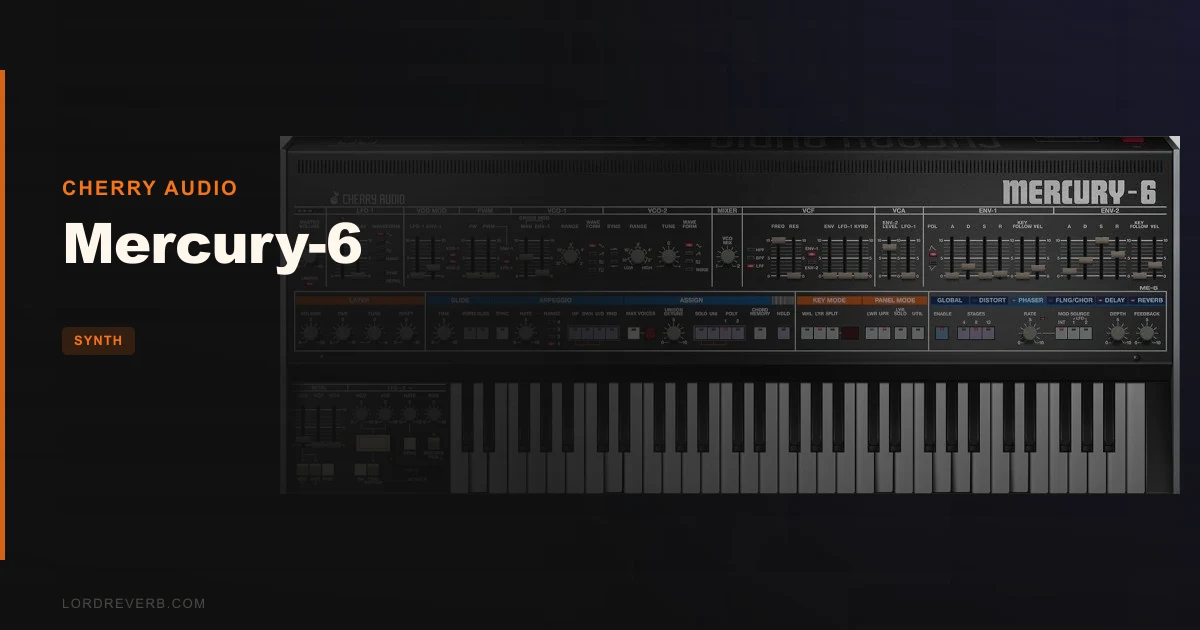
Everyone asks if the Mercury-6 is just a cheaper Jupiter-8 plugin wearing a different badge. It isn’t. The Cherry Audio Mercury-6 is a faithful recreation of the Roland Jupiter-6, a synth that sounds sharper, darker, and more aggressive than its flagship sibling, and this review is going to tell you straight: it beats the Arturia Jupiter-8 V for that specific character, costs less, and ships with a more usable preset bank. If you’re after the polished, padded warmth of a Jupiter-8, look elsewhere. If you want that hard-edged, filter-driven techno and electro character the Jupiter-6 built its cult reputation on, the Mercury-6 is the right call.
It’s aimed at producers who want a serious analog polysynth without spending serious analog money.
How It Compares Out of the Box
Stack the Mercury-6 against the Arturia Jupiter-8 V and the TAL-U-NO-LX, and the difference is immediate. The Arturia leans warm and open. The TAL is a Juno recreation entirely. The Mercury-6 has bite.
We loaded a basic saw patch across all three with identical filter settings. The Mercury-6 cut higher in the mids, sat more forward in the mix without boosting, and had a faster filter response character in the 24dB lowpass mode. That’s the Jupiter-6 DNA. The hardware was built as a cost-optimized alternative to the Jupiter-8, but the filter circuit came out different enough to become its own sound.
Cherry Audio’s interface gives you layer A and B from the start. You’re not hunting through menus to find the split mode. It’s just there.
Performance Deep Dive
The Mercury-6 runs 16 polyphonic voices per layer, so 32 total in stacked mode. That’s up from the original hardware’s 6 voices. In Unison mode, you’re pushing 32 oscillators simultaneously.
We ran a stacked pad with both layers active, unison on, drift engaged, reverb and chorus on each layer, at 4x oversampling. CPU sat at around 9% on an Apple M2 with 16GB RAM inside Logic Pro. That’s clean. Comparable patches in Arturia Pigments 5 with similar modulation and effects depth hit 18-22% on the same machine.
The oversampling control matters. At 1x, aliasing is audible on high oscillator pitches with FM cross-modulation dialed in. Bump it to 2x and it clears up. 4x is for final bounce quality if you’re printing to audio.
The VCO-2 to VCO-1 FM cross-modulation is where things get satisfying. We pushed the FM amount hard on a square wave source. The result was metallic, aggressive, and harmonically dense. That’s a specific tone. It’s not FM synthesis in the DX7 sense, but it gives the Mercury-6 a nasty edge that pads-and-strings players don’t need but techno and electro producers will love.
Where It Wins
The dual-layer architecture is the biggest practical advantage over any hardware Jupiter-6 and most competing plugins. You get two independent full synth engines, each with their own effects chain, panning, detuning, and sustain controls. We ran a gritty bass patch on the lower layer and a slow-attack pad on the upper, split at C3. It took about 40 seconds to set up. On hardware, that kind of layering requires two keyboards or a lot of compromises.
The 500 presets are legitimately usable. We found ourselves wanting to keep the third preset we loaded. That doesn’t happen often.
The arpeggiator’s MIDI tempo sync and hidden Up/Down modes from the original hardware are preserved and joined by a Random mode. Small thing. Annoyingly useful.
Velocity sensitivity is added where the original had none. Your playing dynamics now shape the sound. That’s not a minor update.
Where the Competition Wins
Arturia’s Jupiter-8 V benefits from Arturia’s TAE engine, which has a longer development track record on Roland hardware modeling. If you’re doing A/B tests against actual Jupiter-8 hardware, Arturia is the safer bet for accuracy. We’d trust it more in a direct hardware comparison context.
The Mercury-6 has no offline activation. You need an internet connection to activate. For producers with a travel rig or a locked-down studio machine, that’s frustrating. Cherry Audio uses their own licensing system, but offline mode isn’t there.
The preset browser is functional but basic. Arturia’s Analog Lab integration is more powerful if you’re managing a large collection across multiple instruments.
We also wish the 12dB bandpass mode got more attention in the factory presets. It’s the most unusual filter option in the set, and the preset bank barely touches it.
Who Should Buy Which
✅ Buy the Mercury-6 if you want that specific Jupiter-6 filter aggression for techno, electro, or big beat production and don’t want to spend hardware prices to get it.
✅ Buy it if you need a dual-layer polysynth engine with low CPU overhead for a dense ITB session.
✅ Buy it if you’re building a Jupiter-6 sound in a project and the Arturia Jupiter-8 V keeps landing too warm and clean.
❌ Skip it if you need a Jupiter-8 emulation specifically. The character is different enough to matter.
❌ Skip it if you’re working on a machine without reliable internet access for activation.
❌ Skip it if you need a preset browser with tagging, filtering, and cross-instrument management. The browser here is straightforward but basic.
Score Breakdown
| Category | Score | Notes |
|---|---|---|
| Sound Quality | 4.5/5 | Jupiter-6 filter character is accurate and sits well in a mix without EQ work |
| Value for Money | 4.5/5 | 500 presets, dual-layer engine, and integrated effects at this price is hard to argue with |
| Ease of Use | 4.5/5 | Logical layout, Focus zoom helps on smaller screens, panel navigation is fast |
| Features | 4.5/5 | Dual layers, arpeggiator, chord memory, and a full effects chain cover most workflows |
| CPU Efficiency | 4.5/5 | One of the lightest-loading dual-layer polysynths we've tested at this voice count |
| Overall | 4.5/5 | Underrated emulation of an underrated synth, priced fairly, performs cleanly |
Alternatives to Consider
If the Mercury-6’s Jupiter-6 character is too aggressive for what you’re building, the Arturia MiniFreak V covers broader sonic territory with its hybrid engine and is worth a look for producers who need more flexibility across genres.
For a completely different approach to analog-style layering and sound design, Synth City Chromaphone 3 explores physical modeling territory that pairs well with a Jupiter-style pad layer for contrast.
If you’re building an ITB bass-focused rig and the Mercury-6’s lower register patches aren’t sitting right, LOW by Beatsurfing is purpose-built for sub and bass work in a way no general polysynth matches.
For producers who want tape-saturated analog texture underneath the Mercury-6’s cleaner oscillator character, Tape Synths Expansion adds grit in a different direction entirely.
The Bottom Line
We ran the Mercury-6’s cross-mod FM into a distortion patch at maximum oscillator detuning with both layers stacked, reversed the reverb tail manually using a send, and it held up. It sounded like a machine with an opinion. That’s the Jupiter-6 legacy. Not pretty. Not polite. Present.
The honest buy recommendation is this: if the Jupiter-6’s aggressive filter character is what you’re after, the Mercury-6 is the most practical way to get it in 2026. The dual-layer engine is smarter than the hardware, the CPU load is honest, and the preset bank earns its keep.
The caveat is real. If you want Jupiter-8 warmth, you’re in the wrong plugin. And if you’re on a no-internet studio machine, the activation requirement will annoy you before you’ve played a single note.
The current price is shown in the buy box on this page. It’s priced low enough that the question isn’t really whether it’s worth it. It’s whether the Jupiter-6 sound is the sound you need.
It probably is.
Related reviews: Can Theia Replace Your Go-To Pad Synth in 2026?
Frequently Asked Questions
Is the Mercury-6 an accurate emulation of the Roland Jupiter-6?
Cherry Audio built the Mercury-6 to recreate the Jupiter-6's core architecture, including its multimode filter, dual VCOs with cross-modulation, and arpeggiator with the original's hidden Up/Down modes. We can't do a direct A/B against hardware, and most buyers can't either. What we can say is that the filter character, the FM cross-mod behavior, and the overall frequency profile match what the Jupiter-6 is documented to sound like, and the result sits differently in a mix than any Jupiter-8 emulation we've used.
How does the Mercury-6 differ from Cherry Audio's other synth plugins?
The Mercury-6 is Cherry Audio's Jupiter-6 emulation specifically. It's distinct from their Mercury synthesizer (which covers different Roland territory) and sits as a focused, single-instrument recreation rather than a general-purpose synth. The dual-layer architecture and the integrated effects chain are more developed here than in some of their simpler emulations.
Can you run Mercury-6 in split keyboard mode for live performance?
Yes. The split mode lets you assign layer A to the lower register and layer B to the upper, with independent controls for each layer including effects. The split point is adjustable. Cherry Audio also improved on the original hardware's split implementation, which was limited by its mono audio output. In the plugin, each layer has its own stereo panning.
Does Mercury-6 work on Apple Silicon Macs?
Yes. Cherry Audio has confirmed native M1 and M2 support, including Apple M1 Ultra. We tested on M2 and saw no compatibility issues. The plugin runs natively rather than through Rosetta, which is why the CPU numbers are as clean as they are. macOS 10.13 or above is required.