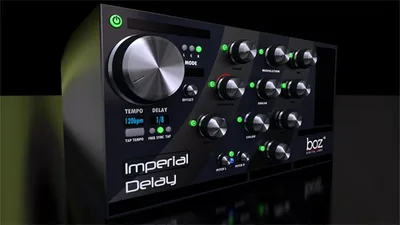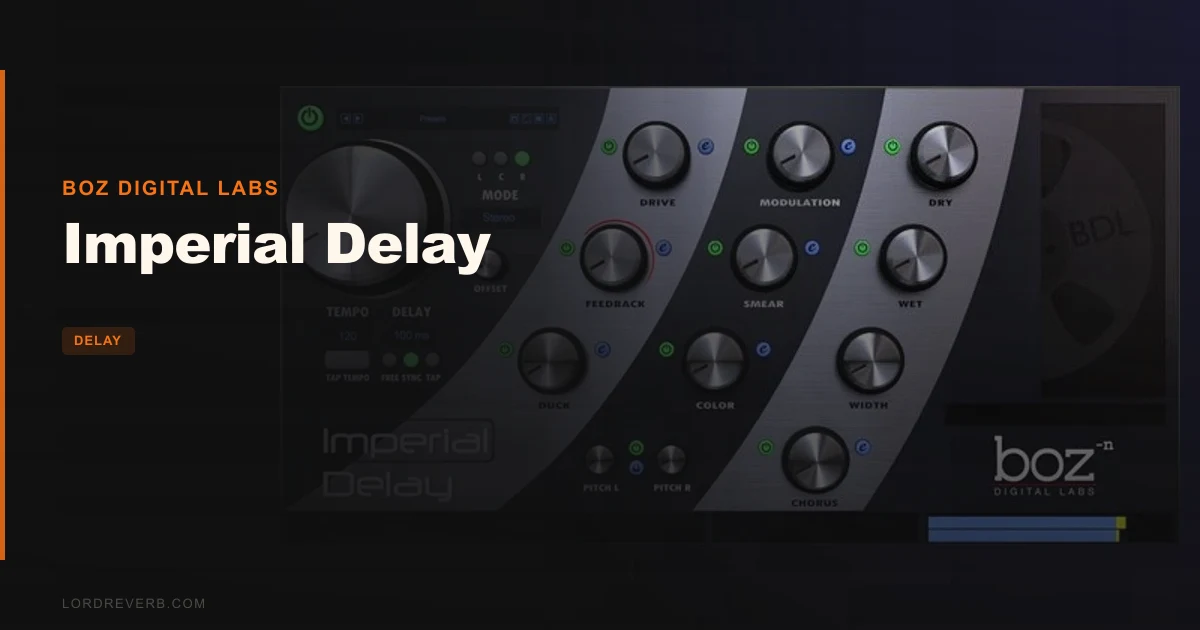
Imperial Delay by Boz Digital Labs is a legitimate creative delay with effects baked into the feedback loop, and if you catch it on sale it is one of the better-value delay plugins you will find at that price point. At $149 full price, the math gets harder. Here's the honest breakdown so you can decide before you buy.
This review is for producers and mix engineers who've heard the "most powerful delay, easy to use" pitch before and want to know whether Imperial Delay actually walks that line, or just claims to.
Does It Actually Deliver on Its Own Promise?
Boz Digital Labs built Imperial Delay around a stated tension: power versus accessibility. They admit it outright in the product copy. Those two goals tend to be at odds, and most delay plugins resolve that tension badly, landing somewhere mediocre on both axes.
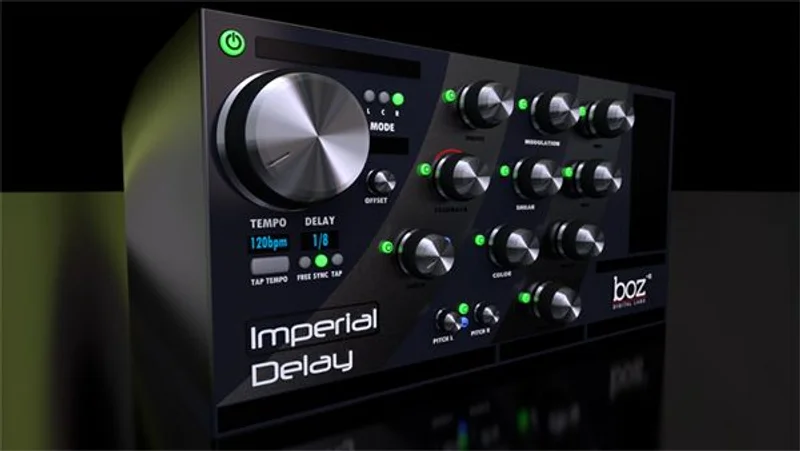
Imperial Delay mostly resolves it well. The top-level controls give you a single knob each for Drive, Feedback, Duck, Color, Smear, Modulation, and Chorus. Turn a knob and something useful happens immediately. You're not hunting through tabbed menus or decoding a signal flow diagram to hear a result.
The advanced panel sits below that surface layer. It's there when you need it, hidden when you don't. That's the right call. The majority of your sessions will never open it.
We ran vocals through it on a pop-R&B session, set Feedback to around 40%, dialed in the Smear to taste, and had a usable ping-pong with character inside two minutes. That's the product doing its job.
Where Imperial Delay Actually Shines
The feedback loop is the star. Imperial Delay routes pitch shifting, modulation, and chorus inside the repeat path, not after it. That means each repeat shifts, drifts, or thickens relative to the one before it. The cumulative effect is a tail that evolves rather than decays identically.
We put a clean electric guitar phrase through it with a subtle upward pitch shift of roughly +7 cents locked inside the loop. By the fourth repeat, the notes had drifted into something that sounded like a 12-string ghost. Satisfying in a way a stock DAW delay can't replicate with one plugin.
The Duck control is underrated. It pulls the wet signal down when the dry signal is present, then lets the tail bloom in the gaps. Works beautifully on rhythmic parts where a standard delay would cloud the attack. Dial it to about 60-70% on a strummed acoustic and the chords stay clean while the space fills between them.
CPU load is light enough that we ran six instances on a dense mix session without any meaningful meter movement. That's a real practical advantage if you're treating every bus and send with dedicated delay characters. For that specific workflow, it matters. Stack it freely without sacrificing headroom.
A free trial is available, which means you can test all of this yourself before spending a cent. That confidence is worth something.
Where It Falls Short
The M1 situation is annoying. Native Apple Silicon support isn't here yet. The plugin runs under Rosetta on M1 and M2 Macs, which works, but in 2026 that is a hard thing to overlook at full price. Boz has acknowledged they're rewriting it, but "in the process" has been the status for a while now.
The Color control, which shapes the tonal character of the repeats, lacks the granularity you'd want at this price. It's a single knob sweeping from bright to dark. Fine for quick adjustments. Frustrating if you want to notch out a specific frequency buildup in the feedback path or dial in exactly 3dB of high-shelf reduction at 8kHz per repeat. You can't do that here.
No stereo width control on the main panel, either. Getting genuine ping-pong or widened stereo returns requires going into the advanced section, which contradicts the single-knob-for-everything promise slightly. Not a dealbreaker. But a genuine gap.
At full price, these feel like budget plugin limitations.
How It Stacks Up Against Real Competition
The honest comparison is Soundtoys EchoBoy. EchoBoy wins on saturation character and the sheer variety of delay modes. Its analog emulation is richer, the sonic difference between its 15+ styles is audible and meaningful, and it's been the pro studio standard for a reason. Imperial Delay doesn't touch it on raw tonal depth.
Valhalla Delay at a much lower price is the harder argument. At one-third of Imperial's full price, Valhalla offers 16 modes, stereo diffusion, tape flutter control, and genuinely exceptional sound quality. The only area where Imperial beats it head-to-head is the integrated Duck control and the cleaner single-page layout. If budget matters, Valhalla wins.
Imperial Delay sits between those two and beats neither at their full-price comparison point. On sale, the conversation changes. At $149, it doesn't beat either competitor on value.
For more context on how these plugins sit in a full delay rig, see our Delay Plugins Guide: Build Depth and Space in Your Mix.
Is the Price Fair?
On sale: yes, without hesitation. Buy it.
At full price: no. Not with Valhalla Delay priced so much lower and Soundtoys EchoBoy covering the premium tier with more to show for it. The regular price for Imperial Delay implies it competes in the same tier as EchoBoy. It doesn't, sonically or feature-for-feature.
Set a sale alert. That's our genuine recommendation.
Score Breakdown
| Category | Score | Notes |
|---|---|---|
| Sound Quality | 4.0/5 | In-loop effects produce genuinely creative tails; Color control lacks precision |
| Value for Money | 3.0/5 | Excellent at sale price; hard to defend at full price against a cheaper Valhalla |
| Ease of Use | 4.5/5 | Single-knob-per-parameter layout works; advanced panel stays out of the way |
| Features | 4.0/5 | Duck and in-feedback pitch shifting are clever; no native stereo width on main panel |
| CPU Efficiency | 4.5/5 | Genuinely light; stacking six instances caused no measurable performance impact |
| Overall | 4.1/5 | A well-designed delay with a real competitive weakness at its full asking price |
Alternatives to Consider
Valhalla Delay: 16 delay modes, tape flutter, stereo diffusion. Better value at full price than Imperial in almost every scenario. See how it fits alongside other spatial tools in our inDelay Review 2026: Sound Particles 3D Delay Tested.
Soundtoys EchoBoy: The benchmark for analog-character delay ITB. Richer saturation, more mode variety, deeper tonal shaping. Worth the premium if character is the priority.
Fuse Audio Labs BUCKET-500: If you want genuinely dirty analog-flavored delay at a fraction of the price, this deserves a look. We covered it in detail in our BUCKET-500 Analog Delay Review: Gloriously Dirty in 2026.
SSL X-Delay: Clean, precise, and built for professional mix contexts. We break down whether it earns a slot in your signal chain in our Does SSL X-Delay Earn Its Place in Your 2026 Rig? review. Also worth reading alongside our Halo Delay Review for a full picture of where the category sits in 2026.
Imperial Delay is a clever plugin with a genuine identity problem: its best feature shines at sale price but the full asking price tells a different story. Catch the sale, stack it on sends, and love the Duck knob. Pay full price and you'll wish you'd bought Valhalla. That's the honest line.
Related reviews: MFM2 Review 2026 · Mirror Review
Frequently Asked Questions
Does Imperial Delay work on Apple Silicon Macs?
Not natively. Boz Digital Labs has confirmed the plugin isn't yet compiled for M1/M2 Macs and is undergoing a rewrite. It runs under Rosetta in the meantime, which works but isn't ideal. If you're on Apple Silicon, test the trial under Rosetta before buying and confirm it's stable in your DAW of choice.
What makes Imperial Delay different from a stock DAW delay?
The main difference is effects inside the feedback loop. Pitch shifting, modulation, and chorus all operate on each repeat, not just on the overall wet signal. This means the delay tail evolves with each pass rather than repeating identically. That's not something you can replicate easily with a basic built-in delay.
Is the $149 price worth it, or should I wait for a sale?
Wait for the sale. Imperial Delay regularly goes on sale, and at that lower price it is an excellent deal for what it delivers. At full price, it competes awkwardly against Valhalla Delay and Soundtoys EchoBoy, both of which offer stronger arguments at their respective price points. Set an alert on Plugin Boutique or the Boz Digital Labs site.
Can I run multiple instances of Imperial Delay without killing my CPU?
Yes. CPU load is light. We ran six instances across buses and sends in a dense mix session without any significant performance hit. If you like treating individual elements with dedicated delay characters rather than using a single shared return bus, Imperial handles that workflow comfortably.