We were three hours into a dub techno session when it happened: every delay plugin we reached for sounded too clean. Too Hi-Fi. Too plugin-brained. The reverb tails had character, the drums had grit, but every repeat felt like it was rendered in a server farm. We needed something that degraded the way a circuit board degrades. That’s when we dropped in the BUCKET-500 Analog Delay by Fuse Audio Labs, and it solved the problem before we’d even touched the filter knob.
This is our full BUCKET-500 Analog Delay review. It’s built for producers and guitarists chasing authentic vintage BBD color: dub, ambient, shoegaze, lo-fi hip-hop, any genre where the decay is supposed to feel old and slightly broken. It’s not a Swiss Army delay. It’s a scalpel with rust on it, and sometimes that’s exactly what you need.
First Impressions: Smaller Than You Expect, Smarter Than It Looks
The installer is tiny. The GUI loads in under a second. We’re talking a plugin that looks like someone photographed a battered stompbox and slapped it on your screen. No modular routing matrix. No 47-page preset library. No welcome screen with a spinning logo.
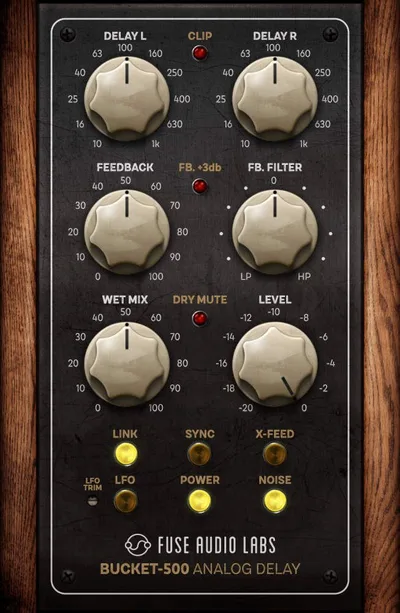
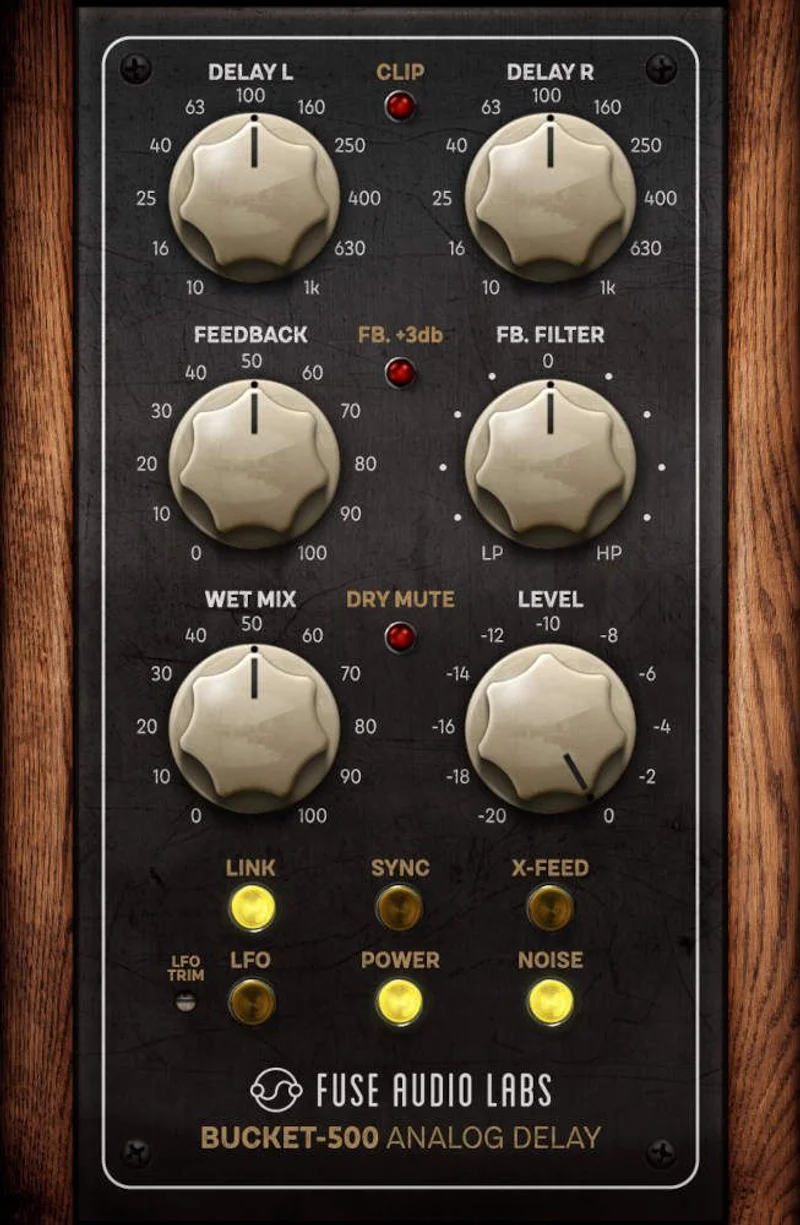
What you get is: a Delay Time knob, Repeats (feedback), Mix, Tone (the tilt filter), a Modulation section, and a Stereo switch. That’s the ballgame. First instinct is to wonder what they left out. By the second pass, you realize they left out the stuff that makes other delays annoying to dial in fast.
It’s satisfying in a very specific way. Like finding a screwdriver that fits perfectly.
Getting It Into a Real Workflow
We run it as a send plugin, which is where most delay work should live anyway. setting up delay sends properly The dry/wet Mix control makes it workable in-line too, but send routing is where the BBD character really opens up.
Tempo sync works exactly as you’d want: host BPM locks in via a simple switch, and you pick your subdivision. No friction there. The delay clock LFO for flanging is the clever move. Patch it to a channel feeding filtered room recordings and you get that swimmy, tape-warped flange without loading a separate modulation plugin. We did this on a conga loop and got three different usable textures in under four minutes.
The tilt filter is the feature that separates this from a “slap a free BBD clone on it” situation. Rolling off the highs on each repeat replicates how a real BL-3208 chip bleeds treble with each pass. Cut the tilt around 8kHz on a guitar DI and the repeats sit behind the dry signal instead of competing with it. That’s not an accident of design. That’s Fuse Audio Labs actually understanding what analog delay does to a signal.
One friction point: there’s no visual modulation indicator. You’re flying blind on LFO depth and rate until your ears confirm it’s working. Annoying, especially when you’re comparing two settings in a loud mix.
What It's Genuinely Good At
The BBD emulation is the reason this plugin exists, and it delivers. Fuse Audio Labs modeled the BL-3208 bucket-brigade delay chip alongside the SA-571 compandor system. That compandor is what gives hardware BBD delays their characteristic noise floor behavior: a slight compression on the way in, expansion on the way out, with aliasing artifacts that cluster at the top end. You hear it as warmth that isn’t just EQ rolloff. It’s harmonic content that wasn’t there before.
We ran a synth pad through at 380ms with feedback at 65%. The first repeat lost around 2-3dB of perceived brightness. By the third repeat, it sounded like it was being played from the next room through a broken speaker. That’s the SA-571 compandor doing its job.
The anti-aliasing and reconstruction filters keep the transients clean while the repeats degrade. Your attack stays intact. The tails get grungy. That’s a hard balance to get right, and BUCKET-500 gets it right.
Stereo cross-feed adds width by routing a small portion of each channel’s repeat into the opposite side. Not ping-pong, but enough spread to make a mono source feel genuinely three-dimensional on headphones. building depth in your mix with delays
CPU load is light. We ran 14 instances on a mid-spec MacBook Pro without the session choking.
The Rough Edges
Let’s be honest about the limits.
There’s no ping-pong mode. If you want hard left-right alternating repeats, this isn’t the plugin. The stereo cross-feed is subtle by design, which we love for mix glue, but it won’t give you dramatic stereo delay throws.
No per-tap control. No multi-tap delay. If your track needs rhythmic, staggered echoes with different feedback amounts on each tap, skip this and load a full-featured multi-tap delay.
The GUI scaling is fixed. On a 4K display it’s small. Not a dealbreaker, but it’s something that would frustrate producers who work at high DPI.
And that lack of visual modulation feedback we mentioned? We wish it showed a moving indicator. Even a tiny LED-style dot. Working with LFO depth that you can’t see in a busy session is a workflow tax.
Who This Is Really For
- ✅ Buy if you produce dub, ambient, or lo-fi and want repeats that degrade like real tape-and-chip hardware.
- ✅ Buy if you play guitar ITB and want a stomp-style delay that sounds analog without the analog price tag.
- ✅ Buy if you already own a transparent digital delay and need a dirty second character option at a low price.
- ❌ Skip if you need ping-pong, multi-tap, or per-repeat EQ control in a single plugin.
- ❌ Skip if pristine, high-fidelity delay is the goal. This will color your signal, full stop.
- ❌ Skip if you rely on visual modulation feedback to dial in LFO settings quickly.
Score Breakdown
| Category | Score | Notes |
|---|---|---|
| Sound Quality | 4.5/5 | BL-3208 and SA-571 modeling produces genuinely convincing BBD degradation with clean transient preservation |
| Value for Money | 5.0/5 | At $29 for this level of circuit accuracy it is almost unfair to the competition. |
| Ease of Use | 4.0/5 | Stompbox simplicity earns high marks; blind LFO modulation costs one point |
| Features | 3.0/5 | Tilt filter and stereo cross-feed are clever; no ping-pong or multi-tap is a real gap |
| CPU Efficiency | 5.0/5 | One of the lightest analog delay emulations we've run at scale |
| Overall | 4.0/5 | A brilliant specialist tool that earns its place in the rack for anyone chasing vintage BBD color |
Alternatives to Consider
Valhalla Delay is the obvious first alternative if you want more algorithm variety. It covers BBD-style modes alongside tape, diffusion, and pitch-shifting delays in one plugin. The BBD character isn’t as surgically accurate as BUCKET-500’s BL-3208 model, but the sheer flexibility is hard to beat. best delay plugins for producers in 2026
Antelope Audio Halo Delay goes the other direction: it’s a premium, full-featured delay that prioritizes pristine modeled analog hardware. If you want the vintage color with much more routing control and you can stomach the price difference, it’s worth comparing. Halo Delay review and comparison
SSL X-Delay is the one to check if your workflow lives in a mix-bus-heavy, SSL-flavored signal chain. It’s cleaner than BUCKET-500 by design, but its tempo-sync features and character options give a different kind of vintage without the lo-fi grit. SSL X-Delay full review
None of these replaces what BUCKET-500 does. If you want the BL-3208 character specifically, there isn’t a cheaper way to get it.
The BUCKET-500 Analog Delay is the kind of plugin you buy first and justify later. We’d have paid $49 without flinching. The BBD degradation is underrated in a market obsessed with clean and transparent. If your mixes need repeats that feel like they came out of a circuit board rather than a compute cluster, this is the one.
Wrong for you if you need multi-tap, ping-pong, or any form of visual modulation feedback. Right for almost everyone else making music that lives below 90 BPM and above 60% reverb.
Frequently Asked Questions
What does the BUCKET-500 Analog Delay actually emulate?
It models the BL-3208 bucket-brigade delay chip paired with an SA-571 compandor circuit. The compandor system is what gives the plugin its characteristic warmth: it compresses slightly on input and expands on output, generating the noise floor behavior and high-frequency roll-off that real analog BBD hardware produces. The anti-aliasing and reconstruction filters are also modeled, keeping transients clean while the repeats degrade naturally with each pass.
Is the BUCKET-500 good for guitar players, or is it purely a studio plugin?
It works well for both. The stompbox-style interface was clearly designed with guitarists in mind, and the tilt filter makes it easy to dial in repeats that sit behind a live guitar tone without masking the dry signal. It runs in every major DAW format including AAX, so it fits both live rig emulation setups and full studio sessions. CPU load is light enough that it won't choke a plugin-heavy rig.
Does the BUCKET-500 Analog Delay support tempo sync to DAW BPM?
Yes. Host tempo sync is built in via a simple switch on the GUI. You select your subdivision and it locks to your session BPM automatically. The delay clock LFO for flanging effects operates independently and is set manually, which is where the lack of visual modulation feedback becomes a small frustration in fast-paced sessions.
How does the BUCKET-500 compare to free BBD delay plugins?
Most free BBD emulators model the general character without modeling the specific chip and compandor circuit. The SA-571 compandor behavior in BUCKET-500 is what separates it: the noise floor interaction and high-frequency degradation per repeat are specific and accurate in a way that generic free plugins don't match. The gap between free and BUCKET-500 is small enough in dollars that the accuracy difference almost always justifies the spend.