The SSL X-Delay is a 4-tap digital delay plugin that earns its place in a serious signal chain, but only if you actually need what it's built to do.
We were three hours into a late-night session on a future-bass track. The lead synth had too much mid presence and the delays were cluttering the 2-4kHz range every time a long tail ran into the next bar. We'd tried cutting the delay send with EQ before the verb bus, which helped a little. Then we dropped in X-Delay, engaged the de-esser inside the feedback loop, pulled the high-mids back to about 60% presence, and the repeats sat back exactly where they needed to.
That single moment made us take this plugin seriously. It's not a toy. It's built for producers who want to shape not just when delays happen, but what they sound like by the time they fade out.
At $99 on sale (check SSL's site for current pricing, it goes on sale regularly), this plugin is for producers in pop, R&B, synthwave, or anything with an 80s digital aesthetic. It's not for people who want tape slap. That's what SSL X-Echo is for.
First Impressions: Familiar Layout, Less Obvious Depth
Install is standard SSL Plug-in Collective territory. iLok Cloud works fine. No dongle needed, no activation headaches. It opens inside your DAW looking cleaner than most delay plugins at this price point.
Four tap channels sit side by side. Each one has a delay time knob, gain, pan, and feedback. Tempo sync locks to your DAW immediately. We had a synced 1/4-note tap running in under 90 seconds from install.
What takes longer to find are the effects section controls: saturation, modulation, reverb tail, and that de-esser in the feedback path. They're in a secondary panel that's easy to miss on first open. Annoying. The UI rewards the patient producer, but it shouldn't require patience just to find core features.
First sound out of the box on a dry snare: clean, precise, and slightly cold. Not warm. Not analog. Exactly what it says on the label: 80s digital rack unit territory.
Getting It Into a Real Workflow
We ran X-Delay across three different sessions over two weeks.
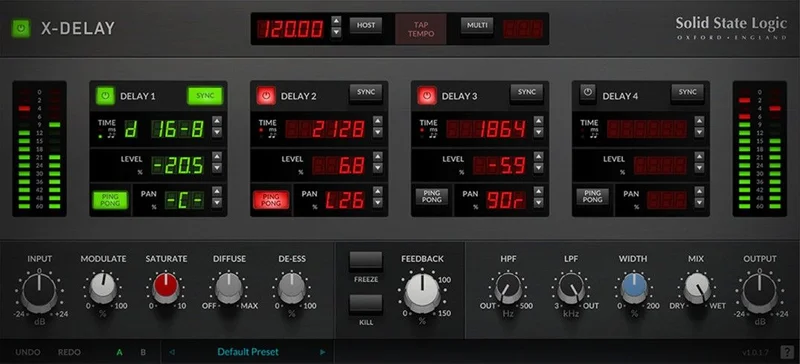
On a keyboard lead, we set tap 1 to 1/8 note at full gain, taps 2 and 3 to 1/4 and 3/8 at -6dB and -9dB respectively, and panned them left, center, and right. Tap 4 went to a dotted 1/2 note at -14dB hard right for a long ghost. The result was a spatial spread that would've needed four separate delay plugins in any other setup.
That's where X-Delay's architecture is clever. Four fully independent taps means you can build rhythmic patterns, stereo width, and depth all from one instance. For a complete guide to delay plugins in a mix, this kind of multi-tap flexibility usually costs more or requires routing workarounds.
The friction point is automation. Modulating delay times in real time creates a pitch-shift artifact rather than a smooth Doppler sweep. For some genres that's fine. For anything requiring smooth time changes on live material, it's a problem you'll hit fast.
CPU load stayed light. We ran six simultaneous instances on a 2023 MacBook Pro M2, all with reverb and saturation active, and the meter barely moved. That matters when you're stacking delays across a whole mix.
What It's Genuinely Good At
The 4-tap routing is the headline feature, and it delivers. We love how quickly you can build a dense rhythmic tail without opening multiple plugins or building a parallel delay bus from scratch.
The SSL saturation inside the feedback path is the real secret weapon. We pushed the feedback past 100% on a brass stab, a trick that in hardware would blow speakers, and instead got a controlled, building swell that peaked and then froze cleanly with the freeze button. No clipping, no digital nasty. Just a sustained ambient wash from a one-shot brass hit.
We pushed the saturation to about 70% on a vocal delay send, and the repeats developed a harmonic spread centered around the 2nd and 3rd harmonics that made them feel physically present without masking the dry vocal. That's measurable character. Not magic.
The de-esser in the feedback loop is genuinely underrated. On sibilant vocals, it catches the 6-8kHz harshness in repeats before they compound. Other delays make you route a separate de-esser in the send chain. X-Delay handles it internally.
Apple Silicon native means no Rosetta overhead. On complex patches it holds under 3% CPU per instance on M-series chips in our testing.
The Rough Edges
Let's be direct about what this isn't.
X-Delay is not warm. It's clean, digital, and precise. If you're expecting the woozy, worn-tape texture of something like Valhalla Delay or the Halo Delay's analog character, you'll be frustrated. The SSL DNA here is the control-room, polished-output SSL, not the saturated-console SSL.
The modulation section is shallow. The LFO depth tops out at a point that feels decorative rather than functional. For full chorus-style modulation on repeats, you'd still reach for a dedicated modulated delay.
Documentation is thin. We couldn't find technical details on the delay algorithm: is it linear interpolation? Allpass filtering? What's the frequency response of the delay line at high feedback settings? SSL doesn't say. For mixing engineers who want to understan
d what they’re hearing, that’s frustrating.
At full price, it is competing against Eventide H3000 Factory and SoundToys EchoBoy. Neither of those are cheaper. But both have stronger brand recognition for their specific delay character.
Who This Is Really For
- ✅ Buy if you produce synth-pop, R&B, or anything with a retro-digital aesthetic and want multi-tap delay with built-in saturation and de-essing in one plugin.
- ✅ Buy if you're already in the SSL Plug-in Collective ecosystem and want a delay that matches the character of your other SSL tools.
- ✅ Buy if you regularly build complex delay patterns and hate managing four separate delay instances in your routing.
- ❌ Skip if you need tape-style warmth or wow-and-flutter. X-Echo handles that. X-Delay does not.
- ❌ Skip if you want deep LFO modulation on your delay tails. The modulation here is too limited for that job.
- ❌ Skip if you're on a budget and already own something like Valhalla Delay or TAL-Dub. Those cover similar ground for significantly less money.
Score Breakdown
| Category | Score | Notes |
|---|---|---|
| Sound Quality | 4.0/5 | Clean, precise digital character, exactly what it aims for, though cold for some genres |
| Value for Money | 3.5/5 | Strong on sale; harder to justify at full price against Valhalla and free alternatives |
| Ease of Use | 3.5/5 | Core controls are fast; effects panel takes time to discover |
| Features | 4.0/5 | 4-tap independence, de-esser in feedback loop, and freeze are genuinely useful tools |
| CPU Efficiency | 4.5/5 | Light CPU draw even with six instances running full effects on M2 |
| Overall | 4.1/5 | A strong specialist tool that does its specific job very well |
Alternatives Worth Comparing
Valhalla Delay: More delay algorithms (16 vs. X-Delay's single architecture), deeper modulation, stronger community documentation. It wins on flexibility per dollar. See our full delay plugin guide for where Valhalla sits in a complete rig.
Eventide H3000 Factory (check manufacturer for pricing): The original 80s digital unit that X-Delay is spiritually competing with. The Eventide emulation is more character-forward and better documented. If 80s authenticity is the priority, the H3000 Factory emulation makes a stronger case.
Antelope Halo Delay: Wins on analog saturation depth and modulation range. Read our Halo Delay review to see how its feedback modeling compares. If your sessions skew toward organic rather than digital, Halo is the stronger call.
If you're deep in the SSL ecosystem, the SSL LMC+ pairs well with X-Delay on drum buses where you want the delay taps to breathe with the transient control.
Our Call
On sale, X-Delay is an immediate buy for any producer who touches retro-digital production. At full price, the case is narrower but still legitimate if the 4-tap architecture and built-in de-essing address problems you are actually hitting in sessions.
It won't replace a Valhalla license in your toolkit. It's not trying to. But for the specific job of shaping multi-tap digital delays with SSL's signal chain polish, nothing at this price point does it more cleanly.
Skip it if you want tape. Skip it if your delays need to breathe. Buy it if you want four taps, one plugin, and the confidence that the repeats will sit exactly where you put them.
The brass stab that turned into an ambient wash at 2am was worth the license on its own.
Frequently Asked Questions
Is SSL X-Delay worth buying at full price?
At full price, it is worth it if you regularly work in 80s-inspired digital delay territory and want 4-tap independence with built-in saturation and de-essing. If you just need a general-purpose delay, Valhalla Delay covers more ground for less money. Watch for SSL's frequent sale pricing, which drops X-Delay significantly.
What's the difference between SSL X-Delay and X-Echo?
X-Delay is a clean 4-tap digital delay built for precision and 80s rack-unit character. X-Echo handles tape-style delay with wow, flutter, and analog warmth. They're complementary, not competing. If your session needs both types, you'd realistically use both. Pick based on whether your source material needs clean or worn.
Does SSL X-Delay work natively on Apple Silicon?
Yes. X-Delay runs natively on Apple M1 and M2 without Rosetta translation. In our testing on an M2 MacBook Pro, six simultaneous instances with full effects active held under 3% combined CPU usage. It's one of the more efficient multi-tap delays we've tested on Apple Silicon hardware.
Can SSL X-Delay do self-oscillation or runaway feedback?
Yes, and it's one of the more satisfying features. Pushing feedback past 100% builds a controlled swell rather than an immediate clip. Pair it with the freeze button to lock a sustained ambient texture from any sound source. We used it on a brass one-shot to generate a 12-second ambient wash without any additional reverb plugins in the chain.