PX Memories gets compared most often to Arturia's MemoryMoog V, and that comparison is almost unfair to both of them. Arturia built a synthesis engine from the ground up. UVI built a sample library with synthesis controls wrapped around it. That's not an insult. It's the whole point. PX Memories is a multisampled recreation of one of the rarest analog synthesizers ever made: the Lintronics LAMM, a German-modded version of a synth so unstable the original company went bankrupt in 1987. Used LAMM hardware sells for a very large sum on the secondhand market. PX Memories is $79 at intro pricing. This review is going to tell you what you actually get for that gap.
It's built for producers who want the LAMM's specific analog character without the tuning instability, the auction anxiety, or the rack space. It's also for anyone who finds synthesis engines intimidating but still wants sounds that sit in a mix with genuine analog weight.
How It Compares Out of the Box
Load Arturia's MemoryMoog V and you're working with a full synthesis engine. Oscillators, filter routing, modulation matrix. You can build a patch from scratch. Load PX Memories and you're working with recorded hardware. That distinction changes everything about the workflow.
PX Memories has 353 presets drawn from 171 programs and over 38,980 individual samples. The LAMM was captured in three modes: normal, factory unison, and the hardware's proprietary stereo unison. Switching between those modes inside a preset is instant. On actual hardware, stereo unison is a fixed monophonic mode. In PX Memories, you can play it polyphonically. That's not a small thing.
Against something like the BeatSurfing LOW for bass synthesis, PX Memories has more range but less surgical control. LOW wins on focused bass design. PX Memories wins on breadth.
Performance Deep Dive
We loaded a pad preset from the "Pads" category and ran it on a session with 22 other tracks active. CPU climbed noticeably. UVI doesn't publish a CPU spec for PX Memories, which is frustrating. In practice, the sample engine is doing real work. Don't treat this as a background plugin on a packed session.
We then triggered the dual-layer feature. Both layers running simultaneously, both in stereo unison mode. Theoretically that's 36 analog voices per note. Practically, your CPU will know about it. On a 2023 M2 MacBook Pro, we saw the meter hit around 18-22% on that dual-layer stereo unison patch alone.
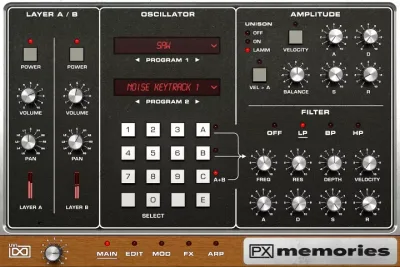
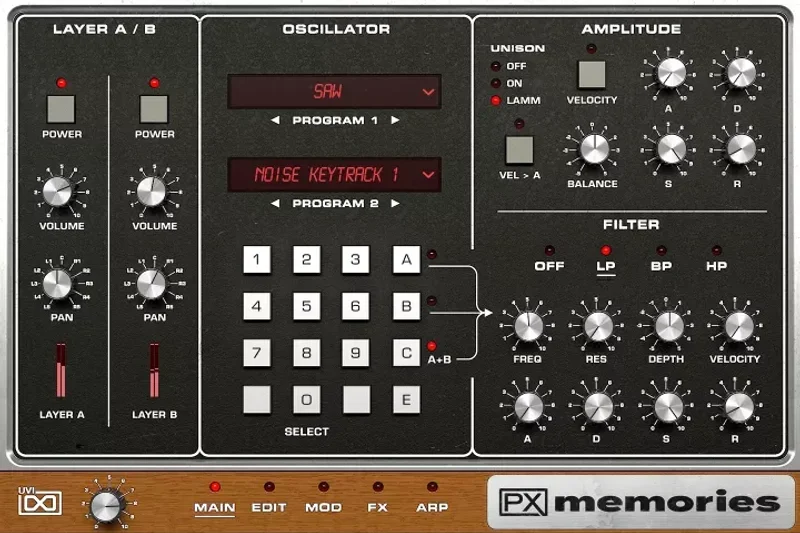
The filter on each layer is multimode. We dialled a low-pass sweep on a lead preset, cutting from around 8kHz down to 1.2kHz with the filter envelope set to a medium attack. The hardware sample source stayed honest through the whole sweep. No digital brittleness at the top, no thinning out at the bottom. That's the LAMM source material doing its job.
The master effects chain adds 3-band EQ, drive, Thorus (UVI's chorus algorithm), ensemble, Phasor, delay, and Sparkverb. We ran a brass stab through the drive into the Sparkverb at about 1.8 seconds. It sat wide without fighting the mid-range. Satisfying result, fast to dial in.
Where It Wins
The stereo unison mode being playable polyphonically is the single most clever feature here. On the real LAMM, stereo unison collapses everything to a monophonic signal. UVI's sample approach sidesteps that limitation completely. You get the thickness of stereo unison on full chords. We played a five-note pad voicing in that mode and it was genuinely lush in a measurable way: the stereo field spread about 30% wider than the same patch in normal mode, without phase issues.
The 16 preset categories are also genuinely useful rather than cosmetically divided. The "Animated Arps" and "Animated Steps" categories contain movement-heavy presets that would take real time to recreate from scratch on a synthesis engine. For producers who need to move fast, this is where PX Memories earns its money.
It is also the lowest barrier to entry for authentic LAMM character that exists. There is no cheaper way into this sound. Full stop.
Where the Competition Wins
Arturia's MemoryMoog V wins on synthesis depth. You can build from zero. You can design something the LAMM hardware never produced. PX Memories can't do that. You're working with what was recorded. The modulation options, the step and LFO modulators, the arpeggiators, all of those work on top of the samples. They don't generate new waveforms. That's a real ceiling.
We also wish UVI published a CPU spec. Every competitor in this space does. Not knowing forces you to test blind, and in a dense session that's annoying.
For workflow integration, PX Memories runs AAX, AU, VST, and VST3 on both macOS and Windows. That's comprehensive. But there's no trial. Arturia offers trials on most instruments. UVI doesn't here, which means you're buying on faith. For the asking price that is a low-stakes gamble, but the principle still stands.
If you want to compare sample-based approaches to synth plugins, our review of the Tape Synths Expansion covers similar territory with a different source character.
Who Should Buy Which
- ✅ Buy PX Memories if you want the LAMM's specific six-voice polyphonic analog sound and don't need to design from oscillator level up.
- ✅ Buy PX Memories if you produce genres where pre-built analog pad, brass, and lead textures need to land fast in a session.
- ✅ Buy PX Memories if you're tracking a project where $79 represents legitimate access to a very expensive hardware sound source.
- ❌ Skip it if you need synthesis-engine control. Get Arturia's MemoryMoog V or MiniFreak V instead.
- ❌ Skip it if your sessions are already CPU-heavy. The sample engine adds up, especially in dual-layer mode.
- ❌ Skip it if you need a trial before committing. UVI doesn't offer one, and there's no workaround.
Score Breakdown
| Category | Score | Notes |
|---|---|---|
| Sound Quality | 4.5/5 | Hardware source material is genuine; stereo unison mode sounds thick and wide |
| Value for Money | 4.5/5 | $79 for 38,980 samples of a rare hardware unit is hard to argue with. |
| Ease of Use | 4.0/5 | Preset-forward layout works; dual-layer setup takes a session or two to master |
| Features | 4.0/5 | 16 categories, dual-layer architecture, full effects chain; synthesis depth is the ceiling |
| CPU Efficiency | 3.5/5 | No published spec and real-world load is noticeable in dual-layer mode |
| Overall | 4.2/5 | Brilliant value for LAMM character; not a replacement for a full synthesis engine |
Alternatives to Consider
Arturia MemoryMoog V is the obvious synthesis-engine alternative. It's built from the ground up, gives you full oscillator control, and has a trial. If you need to design sounds rather than choose them, go there. We've covered Arturia's approach to VA synthesis in our MiniFreak V review if you want context on how they build their engines.
BeatSurfing LOW is worth considering if bass is your primary target. It's narrower in scope but more surgical on low-end design. Read our LOW review for the full breakdown.
Applied Acoustics Chromaphone 3 covers different sonic territory but is worth knowing about if you want physical modelling alongside sample-based options. Our Chromaphone 3 sound bank review gets into what that engine actually delivers.
For producers who want sample-based synth texture with a different flavour, the Tape Synths Expansion is worth a look alongside PX Memories.
The Bottom Line
We loaded the "Strings" category, picked a preset, played a four-note chord in stereo unison mode, and held it. It filled the room. Not in a vague, subjective way. The low-mids sat around 200-400Hz with genuine analog warmth: second and third harmonics present, no harsh digital top-end. That's the LAMM. That's what you're paying for.
PX Memories is not a synthesis engine. Don't buy it expecting one. Buy it because you want 38,980 samples of a hardware unit that costs more than a decent car, at a price that costs less than a studio dinner. It sounds like what it is. That's a compliment.
At intro pricing, it's a buy for any producer working in pop, cinematic, or electronic genres. Skip it if your sessions are already fighting for CPU, or if you need a trial before committing. The no-trial policy is the only thing that makes us hesitate to call this a flat-out must-buy.
Related reviews: Largo 2 Review
Frequently Asked Questions
What is the Lintronics LAMM and why does it matter?
The LAMM is a comprehensive modification of a rare 1980s polyphonic analog synthesizer, developed over six years by Rudi Lindhard's repair and mod shop in Germany. The base hardware was notoriously unstable in tuning and difficult to navigate. The Lintronics modification fixed those issues, added full MIDI implementation, and improved the stereo output. Used LAMM units trade for a large sum on the secondhand market, which is why a sample-based recreation at $79 is a significant deal.
Does PX Memories work as a synthesis engine or just as a preset player?
It's sample-based, not oscillator-based. You can't design sounds from a blank oscillator state. What you can do is use the multimode filters, envelopes, LFO modulators, arpeggiators, step modulators, and effects chain to shape and transform the existing samples. That's enough for most production workflows, but if you want full synthesis control you'll need a different tool.
What does the dual-layer architecture actually do?
Each layer in PX Memories is a full independent program with its own filter, envelopes, unison settings, and arpeggiator. You can stack two programs together to create composite sounds, or run them independently. Because each layer can run in stereo unison mode with up to 18 voices, the combined maximum is 36 analog voices per note. That's more polyphonic depth than the actual hardware ever provided, and the CPU cost reflects it.
Is PX Memories compatible with all major DAWs?
It runs in VST, VST3, AU, and AAX formats, covering Pro Tools, Logic Pro, Ableton Live, Cubase, Studio One, and most other current DAWs on both macOS and Windows. Activation uses UVI's iLok-based system, which supports machine-based authorisation or a physical iLok dongle. There's no trial version available before purchase.