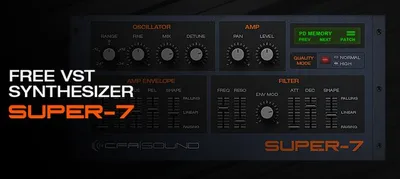
The CFA Sound Super-7 is a free, competent supersaw synth from 2015 that sounds good for the price but can't run natively in any 64-bit DAW without a workaround, which makes it a frustrating recommendation in 2026.
We'd still point certain producers toward it. If you're building a classic trance or synthwave track, the core supersaw oscillator genuinely delivers that wide, detuned wall-of-sound character the Roland JP-8000 made famous. That sound still works.
But if you're on a modern studio setup, be honest with yourself about the compatibility problem before you spend any time dialling this in.
What You're Actually Getting
Super-7 is CFA Sound's anniversary release from February 2015, dropped as a gift to mark their seventh year. It's a single-purpose synth. It does supersaw, and that's largely it.
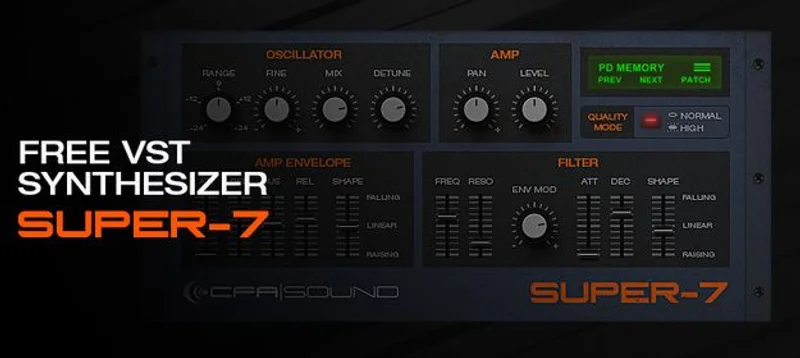
You get 32 voices of polyphony, a 4-pole lowpass filter, and 20 factory presets covering the expected trance and dance music territory. The interface is clean and minimal. There's one oscillator section, one filter section, one envelope, and a basic modulation setup.
No arpeggiator. No effects section. No modulation matrix worth speaking of. It's a stripped-back instrument built to produce one category of sound with minimal friction.
Format is VST 2.3, 32-bit, Windows only. That's the spec. That's the box it lives in.
The Supersaw Itself Is the Good Part
We loaded Super-7 into a 32-bit instance via jBridge and ran it against a basic trance lead template: sustained chord stabs at 138 BPM, long filter sweep from around 800Hz down to 200Hz, moderate release.
The result was satisfying in a way we didn't fully expect from a decade-old freeware plugin. The detune spread feels wide without turning phasey or hollow at the extremes. Pull the unison width to maximum and you get that thick, slightly chorused wall that defined mid-2000s trance production. It sits in the mix without needing aggressive EQ to carve a space.
The 4-pole lowpass filter has a character we'd call slightly aggressive above 50% resonance. It starts to self-oscillate in a way that's actually usable rather than ugly.
We ran a sustained pad chord through it with resonance at 65% and a slow filter envelope. The resonant peak added harmonic content around 2-3kHz that gave the pad presence without needing a mid boost in the channel EQ. That's not nothing.
CPU load is light. In our test session inside a bridged 32-bit wrapper, Super-7 with 8 active voices used roughly the same CPU as a single instance of a basic stock synth. It's not going to kill your session.
For classic trance and supersaw sound design territory, the sound engine punches above its price point. Which is zero dollars, but still.
The Not-So-Good, and We Won't Soften This
The 32-bit VST 2.3 format is the biggest problem, and it's not a small one. Every major DAW dropped native 32-bit support years ago. Ableton, Logic, Studio One, Reaper, FL Studio, none of them load this natively in their current versions.
jBridge works. We used it. But it costs money, adds latency risk, occasionally produces instability on complex sessions, and is a workaround you should never need for a plugin you're using seriously.
The 20 presets are thin. Not bad, just thin. You get a handful of leads, a few pads, some basic bass patches. Nothing that'll make you stop and say "that's the one." They read more like starting points than finished sounds, which is fine if you're a sound designer and annoying if you just want to drop something in and move.
There's no AU format. No Mac support at all. No AAX. If you're on Pro Tools or any Apple silicon machine, this plugin doesn't exist for you.
CFA Sound has not updated this plugin since release. That's over a decade of silence. We wouldn't hold our breath for a 64-bit rebuild.
How It Compares to What We'd Actually Recommend
Free supersaw options have improved a lot since 2015. Surge XT is the honest comparison here. It's free, actively maintained, cross-platform, available in VST3 and AU, and includes a more capable supersaw oscillator type inside a full-featured synth engine. If you want free and functional in 2026, Surge XT is the honest recommendation.
For paid options, SynthMaster One covers supersaw territory and does a lot more besides. If budget trance production is your focus, the Audio Blast ABX3 Bundle covers acid and dance synthesis in a modern, compatible format.
The BLEASS Analog FM Synth Bundle is a different flavour but handles that 90s dance era with more depth and modern DAW compatibility.
Super-7 wins on one metric: it costs nothing. Against plugins that run natively in 2026, it loses on almost every other metric.
Who Should Actually Download This
- ✅ Buy if you're running a legacy 32-bit DAW setup and want a dedicated supersaw synth at zero cost
- ✅ Buy if you already own jBridge and want a lightweight supersaw option to complement a bigger synth rig
- ✅ Buy if you're studying classic trance synthesis and want a focused, stripped-back tool for experimenting with supersaw detuning
- ❌ Skip if you're on a 64-bit DAW without jBridge, it simply won't load
- ❌ Skip if you're on Mac or working in Pro Tools, no compatible format exists
- ❌ Skip if you want a preset-rich synth for quick composition, 20 presets won't cut it for most workflows
Score Breakdown
| Category | Score | Notes |
|---|---|---|
| Sound Quality | 3.5/5 | Supersaw character is authentic and sits well in a mix without heavy EQ |
| Value for Money | 4.0/5 | Free is hard to argue with, even accounting for jBridge costs |
| Ease of Use | 3.5/5 | Minimal interface is fast to navigate; compatibility setup is the difficult part |
| Features | 2.0/5 | 20 presets, no effects, no modulation matrix, no arpeggiator |
| CPU Efficiency | 4.0/5 | Genuinely light even with high polyphony across a bridged instance |
| Overall | 3.2/5 | Good sound engine, dead format, the compatibility wall costs it heavily |
Alternatives to Consider
Surge XT (Free), Free, cross-platform, VST3 and AU, actively developed, and includes supersaw oscillator types. It's the honest free recommendation for 2026. No compatibility gymnastics required.
SynthMaster One, Paid, but covers supersaw and wavetable synthesis in a modern 64-bit format with a much deeper preset library and modulation routing.
DRC Polyphonic Synthesizer, If you're working in a mobile or cross-platform context and want classic polyphonic synth sounds without legacy format headaches, DRC is worth a look.
If you're building a full trance or synthwave production rig from scratch, we'd also check the Jin 2 for Synth V 2 Pro overview for adjacent production tools that play well with modern setups.
Our Final Call
Super-7 is a time capsule. Inside it, the sound design is good. Outside it, nothing in 2026 is built to open it.
If you own jBridge and want a dedicated, zero-cost supersaw for Windows-based trance and synthwave work, download it. It'll do what it says. The supersaw engine has genuine character, the CPU hit is minimal, and the price is obviously right.
If you're on a modern 64-bit DAW without a bridging solution, this plugin is not for you. Not because the sound is bad. Because it won't load. That's not a workflow inconvenience. It's a hard stop.
Free doesn't mean worth your time. In this case, it's worth the time of exactly the right producer, and no one else.
Frequently Asked Questions
Can I use CFA Sound Super-7 in Ableton Live, FL Studio, or Reaper in 2026?
Not natively. Super-7 is a 32-bit VST 2.3 plugin, and every current version of those DAWs runs in 64-bit mode only. Your only option is a bridging tool like jBridge, which wraps the 32-bit plugin in a 64-bit shell. It usually works, but it is an extra step that introduces occasional instability and costs money for the bridge itself.
Is CFA Sound Super-7 really free, or is there a catch?
It's completely free. No account required, no email signup, no time-limited trial. CFA Sound released it as an anniversary gift in February 2015. You download it, install it, and it works. The only catch is the 32-bit format, which requires a workaround in modern DAWs.
How does the Super-7 compare to the Roland JP-8000 it's based on?
It captures the character of the JP-8000's supersaw oscillator reasonably well, particularly that wide, detuned spread across the stereo field. It doesn't have the JP-8000's Motion Control, vocoder, or full synthesis architecture. Think of it as one good idea from that synth, extracted and delivered as a lightweight plugin.
Will CFA Sound update Super-7 to 64-bit or VST3?
There's been no developer activity since the original 2015 release. No patches, no updates, no public statements about future development. We wouldn't count on a new version appearing. If 64-bit native support is what you need, Surge XT is the free alternative we'd point you toward instead.