
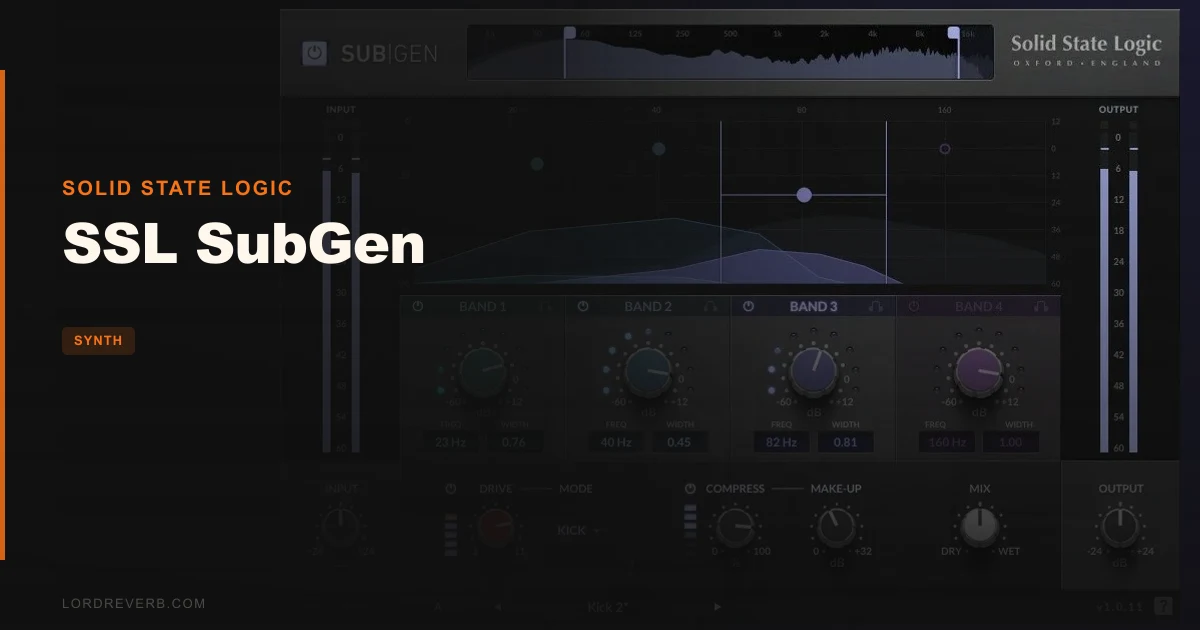
SSL SubGen is a four-band subharmonic synthesizer that generates frequencies an octave below your source signal using wave inversion, and it's one of the more honest-sounding tools for the job we've tested this year.
We pulled it up mid-session on a hip-hop record. The kick had been sampled from a 90s break, processed twice already, and it still sat too high in the body. No real sub presence below 60Hz. We'd already tried layering a 808, boosting with an EQ at 45Hz, and running it through a transient shaper. Nothing felt locked in.
Loading SubGen, we set Band 1 to 50Hz with a bandwidth of 0.4 and dialled the amount up to around 6dB. We switched the saturation to "kick" mode and hit play. The low end arrived. Not scooped, not flabby. It sat under the kick like it had always been there. That's the thing about wave inversion done right: the sub it generates is phase-coherent with your source, so it doesn't fight the original.
This review is for producers who track real instruments with inconsistent low-end, anyone building LFE for picture, and anyone tired of patching three plugins together to solve one problem.
What SubGen Actually Does (and Where It Falls Short)
SubGen synthesizes new sub-bass content by inverting the waveform of your source signal and producing a bipolar wave one octave lower. That's meaningfully different from pitch-shifting or harmonic excitation.
Pitch-shifting creates artifacts. Harmonic exciters add high-frequency content and hope you hear "warmth." SubGen's approach generates a waveform that's mathematically derived from your input. The result tracks dynamics naturally.
Where it falls short: it's not a creative synthesis tool. You're not building pads, designing textures, or layering oscillators. It's a problem-solver for thin low-end, not a sound design playground. If you want that, look elsewhere.
It also won't save a recording with phase issues already baked in. Garbage in, garbage out still applies. SubGen amplifies what's there and adds below it. It doesn't fix comb filtering or out-of-phase bass.
Living With It: Four Bands, Three Modes, One Subscription
Setup is fast. Load it on a kick bus, a bass guitar channel, or a full mix's low-end bus. The interactive graph is clean: grab a band, drag it to your target frequency anywhere between 20Hz and 160Hz, adjust the bandwidth from 0.1 to 1.0, and set the amount from -60dB to +12dB.
Per-band soloing is a genuinely satisfying feature. We solo'd Band 2 at 80Hz to hear exactly what SubGen was generating before blending it back. No guessing. You hear the synthesized content in isolation, dial it in, then unsolo and judge it in context. This workflow shortcut saves real time.
The three saturation modes have distinct characters. "Pre" runs a 50s valve-style overdrive with subtle overtones. Works best on acoustic sources, room mics, or anything that isn't kick or bass guitar. "Kick" uses 60s/70s transistor drive with lighter harmonics. "Bass" leans harder: 70s transistor grit with strong harmonics and aggressive overtones, built for bass guitar and synth bass.
Mix lock is one of those workflow features you don't think you need until you're A/B-ing presets at 2am. It freezes your wet/dry ratio while you swap presets. No accidental jumps in level. Annoying that more plugins don't do this.
The built-in compressor adds glue to the generated sub. Make-up gain and a gain reduction meter are included. It's not a full-featured compressor, but it keeps the synthesized content from pumping awkwardly when the source dynamics swing wide.
One frustration: SSL Complete is the only route in. No standalone purchase, no perpetual license. You're renting it. That changes the value calculation completely depending on whether you're already subscribed.
The Trade-Offs Worth Understanding
The sound quality argument is strong. Wave inversion generates sub that tracks your source dynamically. An 808 layered under a kick does not do that. You can automate the 808's volume, but the relationship between attack, sustain, and sub content is never as locked as what SubGen produces natively.
But there's a cost. You're locked into four bands max. For most sessions that's more than enough. For complex sound design work where you want five or six synthesis layers with independent routing, it becomes a ceiling.
The macOS support cap is a real issue in 2026. Ventura (macOS 13) is two versions behind current. If you're on Sonoma or Sequoia, check SSL's current compatibility documentation before buying in. We'd hate for you to subscribe and hit a wall on day one.
CPU usage sits in the light-to-medium range. We ran four instances simultaneously on a dense session without hitting problems. It's not CPU-hungry. That's worth noting for anyone stacking it across multiple channels.
Against the Field: Where SubGen Wins and Where It Doesn't
Leapwing Audio's RootOne also uses subharmonic synthesis and costs more as a standalone purchase. RootOne gives you slightly more flexibility in the synthesis algorithm and a cleaner single-band workflow for quick jobs. If you're not in the SSL ecosystem, RootOne is probably our pick for standalone sub synthesis.
Waves' Renaissance Bass is cheaper and much simpler: one band, one frequency, one amount knob. It works. It's been working since 1999. But it can't touch SubGen's four-band precision or saturation variety.
Plugin Alliance's MAAG Audio EQ4 does something adjacent at the low end with its Air Band approach, but it's not subharmonic synthesis. It's shelving EQ. Different tool, different problem.
SubGen wins on musicality and workflow within its class. It loses on accessibility: the subscription model and macOS lag are real barriers.
For bass synthesis more broadly, check out our LOW review, which covers dedicated bass synth territory that SubGen doesn't touch.
The Real Verdict
SubGen does exactly what it promises, and it does it better than most of the competition sounds-wise. The wave inversion algorithm is the reason to buy in. It generates sub-bass that feels like it came from the recording, not from a plugin.
The problem is access. SSL Complete subscription only. No standalone pricing. If you're already subscribed, this is a brilliant addition to your signal chain. If you're not, spending subscription fees just for SubGen is a hard sell when RootOne exists.
Wrong for: producers on a tight budget who only need sub-bass occasionally. Right for: anyone already running SSL Complete who deals with thin kicks and bass guitar tracks regularly.
Score Breakdown
| Category | Score | Notes |
|---|---|---|
| Sound Quality | 4.5/5 | Wave inversion algorithm sounds natural and phase-coherent with the source |
| Value for Money | 3.5/5 | Strong if you're already subscribed to SSL Complete, poor value as a standalone reason to subscribe |
| Ease of Use | 4.5/5 | Interactive graph, per-band soloing, and mix lock make it fast to dial in |
| Features | 4.0/5 | Four bands, three saturation modes, built-in compressor, and global filters cover most use cases |
| CPU Efficiency | 4.5/5 | Light-to-medium load; four simultaneous instances caused no issues in testing |
| Overall | 4.2/5 | A genuinely great sub-bass tool held back by subscription-only access and a macOS compatibility lag |
Alternatives to Consider
Leapwing Audio RootOne is the closest direct competitor. Standalone purchase, no subscription needed. If you're outside the SSL ecosystem, this is probably where we'd point you first. best sub-bass plugins 2026
Waves Renaissance Bass is the budget option. One band, simple controls, and it's been working reliably for decades. It won't match SubGen's surgical precision, but it costs a fraction of an SSL subscription. Waves plugins review
BeatSurfing LOW covers dedicated bass synthesis territory that SubGen doesn't touch. If you want to build bass sounds from scratch rather than enhance existing recordings, LOW is worth your time. It's a different problem, but a related one.
For anyone exploring the broader world of synth-based bass tools, our MiniFreak V review covers a more versatile instrument that can handle sub territory alongside a lot else. And if you want to understand where synth bass generation fits into a broader production context, the ABX3 Bundle review covers acid-style synthesis that overlaps in interesting ways.
SubGen is the right tool for one specific job: adding natural-sounding sub to thin recordings quickly. It does that job better than almost anything else we've tested. Just make sure the subscription math works in your favour before you commit.
Related reviews: Mercury-6 Review
Frequently Asked Questions
Can you buy SSL SubGen as a standalone plugin?
No. As of our testing in 2026, SubGen is only available as part of the SSL Complete subscription. There's no perpetual license or one-time purchase option. If you only need sub-bass synthesis occasionally, a standalone alternative like Leapwing RootOne will cost you less overall.
How does SSL SubGen's wave inversion work differently from pitch-shifting?
Pitch-shifting moves your original audio down an octave, which creates artifacts and sounds processed. SubGen inverts the waveform of your source signal to mathematically generate a new bipolar wave one octave lower. That new waveform tracks the dynamics of your source naturally, which is why the generated sub sounds like it belongs to the recording rather than sitting on top of it.
What's the difference between SubGen's three saturation modes?
"Pre" emulates a 50s valve preamp with subtle, smooth overtones. It's the most transparent option and works best on sources that aren't kick or bass. "Kick" uses lighter transistor drive from the 60s/70s, adding definition without overwhelming transients. "Bass" is the most aggressive: heavy 70s transistor grit with strong harmonics, built for bass guitar and synth bass where you want real bite in the sub.
Is SSL SubGen compatible with Apple Silicon Macs?
Yes, M1 compatibility is confirmed. However, macOS support listed in the system requirements caps at Ventura (macOS 13). If you're running Sonoma (macOS 14) or Sequoia (macOS 15), check SSL's current compatibility documentation before subscribing. We'd hate for you to commit to a subscription and find it won't load in your DAW.