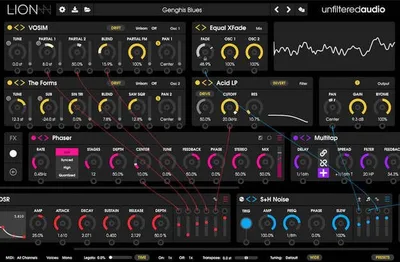
Unfiltered Audio LION is a dual-oscillator synthesizer from Plugin Alliance that earns its reputation as a sound design tool, not a bread-and-butter synth. We tested it across a month of sessions, and the honest answer is: it's brilliant in the right hands and quietly frustrating in the wrong ones.
We were three hours into a session building a score cue for a short film. Dark, industrial, needed something between a drones and a pitched texture. We'd already burned through Serum patches and nothing sat right. So we loaded LION, scrolled to one of its Microsound oscillator modes, and started stacking. Within ten minutes we had a shifting metallic shimmer that no other synth in our rack produced that day. The tail had movement. It felt alive.
That moment captures what LION does well. It also doesn't tell you about the twenty minutes before it, when we were lost in the preset browser trying to find a useful starting point. Both things are true.
This review is for producers who want to know whether LION deserves a permanent slot in their signal chain, or whether it's a plugin you install, admire, and rarely open.
First Impressions: The Interface Earns Some Patience
Installing through Plugin Alliance's plugin manager is painless. You're up in under five minutes on Mac or Windows. Open it and the first thing you notice is how much information the UI is trying to show you at once.
The layout is dense. Two oscillator columns, a mixer section in the center, four filter slots beneath, the BYOME effects row along the bottom, and a modulation lane that runs across the full width. On a 27-inch monitor at native resolution, it's manageable. On a 1080p laptop screen, it's tight enough to feel punishing.
There's no GUI scaling. That's not a minor gripe in 2026. It's a real barrier.
The sound on first load, though, is striking. LION doesn't sound like anything you've heard from a Plugin Alliance synth before, and that's because it's Unfiltered Audio's first synthesizer. Five years of building effects plugins clearly informed how they thought about synthesis.
Getting It Into a Real Workflow
LION's dual oscillators each carry 26 modes. Not 26 waveforms. 26 distinct operational modes, covering FM synthesis, subtractive waveforms, additive stacks, super-oscillator configurations, and Microsound options. That's the reason it sounds different from most synths. It's also the reason it takes longer to dial in.
The mixer between the oscillators offers 8 combination algorithms: standard mix, ring modulation, bitwise operations, sample-and-hold modes, and others. Each one changes the character of how the two oscillators interact at a fundamental level. Ring modulation between a sine-based FM oscillator and a Microsound mode, for instance, produces textures that genuinely surprised us.
We loaded LION on an instrument track, routed MIDI from a controller with MPE output, and spent time with the MIDI Input modulator. This is where LION separates itself from most synths in this price range. Per-note pitch, pressure, and slide can modulate almost any parameter in the synth, including effect parameters in the BYOME row. That's expressive territory most subtractive synths don't touch.
The friction point is iteration speed. If you want to move quickly through ideas, LION slows you down. Patch-building requires intention. That's not always a problem. But it's a mismatch if your session workflow depends on fast sound selection.
The SynthMaster One review covers a synth that handles fast iteration much better if that's your priority. LION is a different kind of tool.
What LION Is Genuinely Good At
The BYOME effects row is the feature that makes LION worth the current street price on its own. BYOME is Unfiltered Audio's modular effects plugin, and a curated version of it sits inside LION with 40+ effects that are fully modulatable from within the synth's modulation system.
We ran a slow-attack pad through LION's Korg MS-20 filter model, then added granular pitch shifting from the BYOME row modulated by an LFO synced to 1/4 note. The result was a breathing, slightly chaotic texture that moved with the track without needing automation. That kind of internal complexity, built into one patch, is something you'd normally need a plugin chain and a routing diagram to achieve.
The four filter models cover Minimoog, Korg MS-20, Roland TB-303, and Oberheim Xpander designs. They're not just branding. The MS-20 model's self-oscillation behavior is noticeably different from the Minimoog model's saturation curve. You can run all four simultaneously in series. That's unusual at any price.
The nearly 600 factory presets are genuinely useful as study material. Even if you skip most of them in a session, opening patches in the editor and tracing how they're built is faster than any tutorial. The Sugar Bytes Aparillo FM synth review is worth reading alongside this if FM architecture interests you.
The Rough Edges
The preset browser is frustrating. 580-odd presets, minimal filtering, no star-rating system, and a search function that only matches exact strings. Finding a "dark drone that isn't too modulated" means scrolling. On a cramped GUI. Annoying doesn't cover it.
CPU usage runs medium to heavy depending on patch complexity. A single instance with two active oscillators, two filters, and three BYOME effects sat at around 8-12% on a modern Apple Silicon M2 Mac. Load four instances on a dense arrangement and you'l l feel it. LION is not the plugin you use for 16-voice polyphony on a string ensemble replacement.
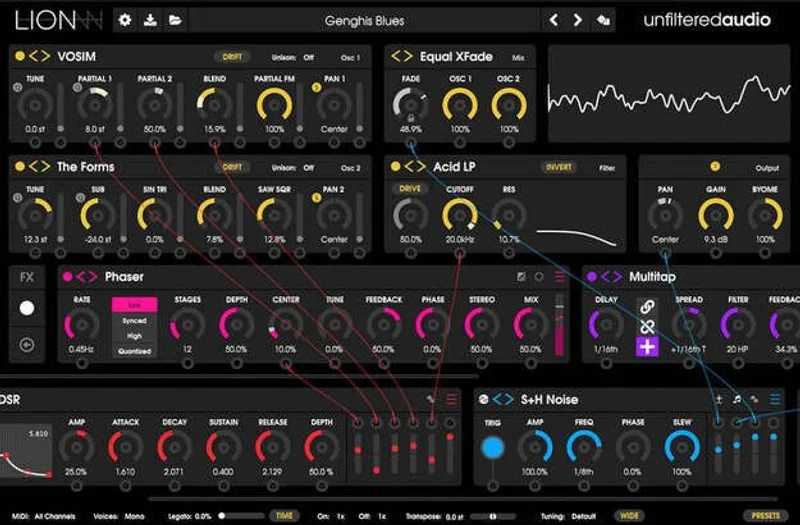
The learning curve is real. We've been building patches in modular environments for years and still spent two sessions just understanding how LION's modulation routing interacts with the BYOME effects layer. A producer coming from Serum or Sylenth1 will need dedicated time. Tutorial resources from Plugin Alliance are thin.
The Imaginando DRC Polyphonic Synthesizer review is a much gentler onramp if you want expressive synthesis without the steep learning investment.
Who This Is Really For
- ✅ Buy if you do film, game audio, or experimental electronic music and need textures that don't sound like everyone else's presets.
- ✅ Buy if you own an MPE controller and want a synth that actually uses per-note expression at the parameter level, not just pitch bend.
- ✅ Buy if you're at the $49 current street price. At that number, the BYOME row alone justifies it.
- ❌ Skip if you need a fast workflow synth for pop or hip-hop production where you're moving through sounds quickly.
- ❌ Skip if you're still learning synthesis fundamentals. LION will teach you bad habits through confusion before it teaches you anything useful.
- ❌ Skip if you're working primarily on a laptop at 1080p. The GUI will drive you to hate the plugin before you learn it.
Score Breakdown
| Category | Score | Notes |
|---|---|---|
| Sound Quality | 4.5/5 | Genuinely unique timbral range across 26 oscillator modes per oscillator |
| Value for Money | 4.5/5 | At current street price, the BYOME integration alone covers the cost |
| Ease of Use | 2.5/5 | Dense UI without scaling, slow preset browser, steep patch-building curve |
| Features | 4.5/5 | Four filter models, 8 mixer algorithms, MPE, 40+ modulatable effects inside the synth |
| CPU Efficiency | 3.0/5 | 8-12% per instance on M2 Mac with moderate patch; heavy patches push it higher |
| Overall | 4.1/5 | Brilliant sound design tool let down by interface decisions that haven't aged well |
Alternatives to Consider
If you want deep synthesis without LION's interface friction, Aparillo by Sugar Bytes is a strong alternative. It's narrower in scope (FM-focused) but easier to dial in quickly and just as capable of producing unusual textures.
For producers who want experimental synthesis with better usability, the BLEASS Analog FM Synth Bundle covers FM territory with a more approachable layout. It's a different synthesis model but occupies similar creative space.
If budget is the main concern and you want a synth that covers more conventional territory alongside experimental patches, Zero 1 Synth by Loot Audio is worth a look before committing to LION.
The Final Word
At its current street price, LION is the most underrated synthesis tool in Plugin Alliance's catalogue. At its original full price, it was a harder argument. Today, the price-to-capability ratio is genuinely hard to beat for the right producer.
But "for the right producer" is doing a lot of work in that sentence. If you make pop, hip-hop, or anything where fast sound selection matters more than deep sound design, LION will collect dust. Buy Serum. Don't look back.
If you make film scores, game audio, or experimental electronic music and you've been stacking plugin chains to get textures that feel genuinely original, LION gives you most of that architecture inside one patch. That's worth a cramped GUI and a slow preset browser. Barely. But it is.
The best thing about LION is the same thing that makes it difficult: it doesn't make any of this easy.
Frequently Asked Questions
Does Unfiltered Audio LION support Apple Silicon natively?
Yes. Version 1.5.0, released November 2023, added native Apple Silicon support. If you're running an M-series Mac and an earlier version, update through the Plugin Alliance manager. The performance difference on M2 hardware is noticeable, especially on CPU-heavy patches.
Is LION good for beginners to synthesis?
Honestly, no. LION's 26 oscillator modes, 8 mixer algorithms, and modular-style routing assume you already understand what you're trying to achieve. If you're still learning subtractive synthesis basics, start with something like Serum or SynthMaster One. Come back to LION once you know why you need it.
What is the BYOME effects row in LION?
BYOME is Unfiltered Audio's standalone modular effects plugin. Inside LION, a curated version of BYOME runs as an integrated effects processor with 40+ effects that can be modulated by LION's modulation system. This means you can have, for example, a granular pitch effect depth controlled by an envelope or LFO from inside a single patch, without any external routing.
How does LION compare to Serum for sound design?
They're built for different things. Serum is faster to use, has a cleaner interface, better wavetable import workflow, and a much larger third-party preset ecosystem. LION produces textures Serum can't, particularly through its Microsound oscillator modes and the BYOME effects integration. We'd have both if the budget allows. If we had to pick one for speed and versatility, it's Serum. If we had to pick one for sounds nobody else has, it's LION.