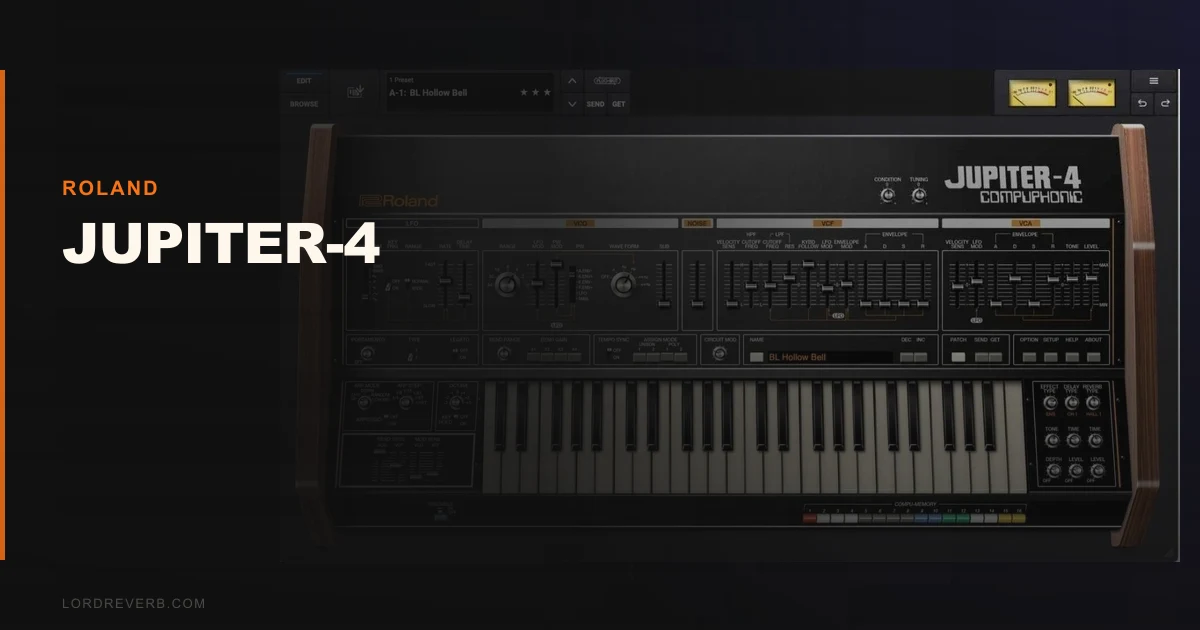
You find a Jupiter-4 on Reverb for a steep price. It looks clean in the photos. Then you read the listing fine print: "tunes okay on most keys, serviced recently, one voice cutting out intermittently." That's the Jupiter-4 hardware experience in 2025. The Roland Cloud JUPITER-4 plugin exists specifically because the real thing is a 45-year-old maintenance project dressed as a synthesizer.
This review is for producers who want that specific JP-4 sound: bright, clear, with a filter that sits in a mix without fighting everything else. Not the fat, syrupy Jupiter-8. Not a generic vintage-style poly. The JP-4 had its own thing, and if you need it, this plugin is the most sensible way to get it.
The Problem the Jupiter-4 Was Built to Solve
Most vintage poly synths from 1978 to 1981 land in one of two camps. Fat and warm (Oberheim, Moog) or bright and cutting (early Yamaha CS series). The Jupiter-4 sat somewhere unusual: clear highs, a resonant lowpass that sweetened without going full Moog mud, and a sub-oscillator that added body without weight.
Hardware units now trade at a significant premium. And they're fragile. The original CMOS ICs that power the voice cards fail regularly, tuning drifts across voices, and finding someone qualified to service one takes time and money. Buying hardware is buying a project.
The plugin solves all of that. You get the sound, the 4-voice architecture, the arpeggiator, and the memory system, without a single dead voice or a tuning trimmer to touch. For producers who want the tone and not the treasure hunt, this is the direct answer.
How It Performs in Practice
We ran the plugin through three sessions: a synth-pop lead track, a film score pad layer, and a bass-focused electronic production. The results were consistent across all three.
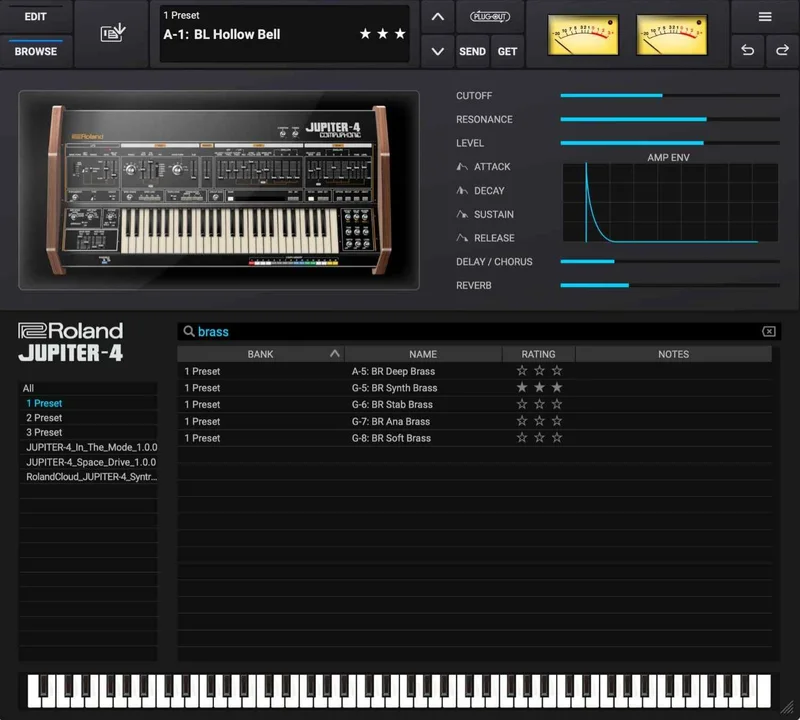
The filter is the story. The Jupiter-4 has one resonant lowpass and one highpass. That's it. We swept the lowpass cutoff from about 400Hz up to 8kHz on a square wave pad. At around 2.5kHz with resonance at 65%, there's a point where it opens up into something genuinely satisfying. Bright but controlled. The competing PWM Malevolent has more filter types and more modulation options, but it doesn't hit that specific sweet spot the same way.
We loaded a JP-4 brass patch and played it against a BLEASS analog emulation in the same frequency range. The JP-4 plugin held its own in the upper mids, cutting through a dense mix without needing a boost at 3kHz to hear it. We covered the BLEASS Analog/FM bundle separately, and it's more flexible, but it doesn't have this character.
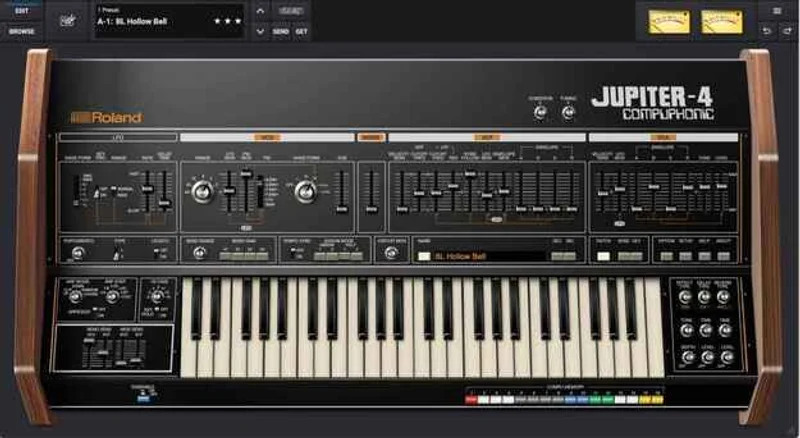
The Condition parameter deserves a proper mention. Set it to zero and you get a pristine, perfectly tuned machine. Dial it up and voices start drifting, tuning wobbles, the oscillators breathe against each other. We ran it at about 40% on a long pad held for eight bars. The slow drift between voices added a chorus-like width without needing a chorus plugin. Satisfying in a way no knob marked "chorus" has been in a while.
CPU usage is light. In a session with 12 instances of other plugins running, the JP-4 barely registered. No complaints there.
Strengths and Weaknesses
The sound design ceiling is lower than modern poly synths. Four voices with one VCO and a sub per voice leaves you working within tight constraints. That's accurate to the original, but it means you can't build the dense, 8-voice stacked textures you get from something like a full Roland JX-3P emulation or a Diva patch. The limitations are intentional and period-correct. They're still limitations.
The arpeggiator sounds brilliant in use. We locked it to a 16th-note pattern in a 128 BPM session and it sat perfectly without fighting the grid. The portamento is smooth and musical, not electronic-sounding.
MIDI implementation is where it gets annoying. No MPE. Pitch bend range is fixed at two semitones with no way to change it in the plugin UI. For most playing, that's fine. If you're doing expressive, wide-interval bends, it's frustrating. Third-party emulations like the ones in Cherry Audio's catalog tend to handle this better.
The preset library is solid. The 10 original factory patches are all here, translated faithfully. The additional Roland Cloud presets expand the palette without straying from what the instrument actually sounds like. We didn't hate a single one.
Value for the Price
The Roland Cloud lifetime key puts you in a position of paying a notable sum for access to a single plugin. That's not nothing. But weigh it against the hardware alternative with its failing CMOS chips and you understand the math quickly.
The subscription at the Pro tier makes more sense if you want the full Roland Cloud library, including the JX-3P, the SH-101, and others. If you're building a synth collection on a budget, the monthly subscription is worth at least a trial period.
Standalone, this specific plugin is harder to justify unless the JP-4 sound is genuinely central to your work. We'd lean toward the subscription if you're testing the waters.
Who Should and Shouldn't Buy This
- ✅ Buy if you specifically need the JP-4's crisp, clear filter character and don't want to manage vintage hardware.
- ✅ Buy if you're already a Roland Cloud subscriber and want to fill out your vintage poly collection.
- ✅ Buy if you produce synth-pop, new wave revival, or cinematic work where period-correct brightness matters.
- ❌ Skip if you need more than 4-voice polyphony for dense pad work.
- ❌ Skip if MPE or deep MIDI routing is part of your workflow.
- ❌ Skip if you want a general-purpose poly synth. More flexible options exist for less money.
Score Breakdown
| Category | Score | Notes |
|---|---|---|
| Sound Quality | 4.3/5 | The filter character is accurate and distinctive; limited by 4-voice architecture |
| Value for Money | 3.8/5 | The lifetime key is steep for a single synth; subscription makes it smarter |
| Ease of Use | 4.0/5 | UI is clean and faithful; MIDI limitations are a friction point |
| Features | 3.5/5 | Condition parameter and arpeggiator are great; no MPE, fixed pitch bend |
| CPU Efficiency | 4.5/5 | Runs light even with multiple instances open |
| Overall | 4.1/5 | Niche but excellent at what it does; not a general-purpose poly synth |
Alternatives to Consider
PWM Malevolent (hardware / plugin version check manufacturer site): More modulation routing, more filter types, more voices. If you want a full-featured modern analog poly rather than a vintage recreation, this wins on flexibility. It doesn't have the JP-4's specific character, but it doesn't pretend to.
Cherry Audio Memorymode: A Memorymoog-style emulation with 6-voice polyphony and far deeper MIDI routing than the JP-4 plugin. If filter warmth and polyphonic depth matter more than period accuracy, this is worth a look. We've also covered options for producers building out a synth sound library if you're in that phase.
Roland Cloud JX-3P: If you want more voices, more modulation options, and a Roland-authentic tone that's more flexible than the JP-4, the JX-3P sits on the same subscription tier. And if you're chasing vintage texture broadly, the tape synth world is worth a look alongside any of these options.
The Jupiter-4 plugin is the right call for exactly one kind of producer: someone who knows what a JP-4 sounds like, wants that specific thing, and isn't interested in building a workshop around a vintage keyboard that might not make it through a session. For everyone else, there's something more flexible at a comparable or lower price. Try the 30-day Roland Cloud trial before committing to the lifetime key. If you don't love the filter by day three, save your money.
Frequently Asked Questions
Is the Roland Cloud JUPITER-4 plugin accurate to the original hardware?
It's close. The filter character, voice architecture, and arpeggiator all translate faithfully. The Condition parameter replicates the drift and tuning instability of a worn hardware unit with more control than you'd ever get from a real one. Where it differs: the hardware had physical feel and mechanical key action that a plugin can't replicate. Sonically, we'd say it's the most practical way to access that sound in 2026.
Do I need a Roland Cloud subscription to use it?
Yes. You either subscribe at a monthly rate on the Pro or Ultimate tier, or you buy a lifetime license key. There's no one-time purchase outside of the lifetime key option. A 30-day free trial is available through Roland Cloud if you want to test it before committing.
How does the JUPITER-4 plugin compare to the JUPITER-8 plugin?
They're different instruments with different characters. The JP-8 is warmer, fatter, and more harmonically dense. The JP-4 is crisper and clearer in the high mids, with a filter that opens up brighter. The JP-8 is the more famous name, but the JP-4 often sits better in a busy mix without additional EQ work. Pick based on the tone you actually need, not the name recognition.
What's the Condition parameter and how much does it matter?
Condition simulates the age and wear state of a vintage hardware unit. At zero, the plugin sounds pristine. As you increase it, oscillators drift slightly out of tune with each other, voices develop subtle character differences, and the sound becomes less "perfect" in a musical way. We found it genuinely useful on pads and held chords. Set it between 30% and 50% for a result that sounds vintage without sounding broken.