If you're comparing RP-VERB 2 to Valhalla Room or FabFilter Pro-R as a general-purpose mix reverb, stop now. It loses that fight. But as an upgrade from RP-VERB 1 at $39, it's a different argument entirely, and we're here to tell you it's worth making. Rob Papen's second version of his reverb plugin drops from 18 algorithms to 10, adds a Reverser section, a full Modulation Matrix, and a Distortion module, and completely redesigns the interface. It's aimed squarely at producers who already know RP-VERB 1 and want to push into more creative, motion-based reverb territory. If that's you, keep reading.
How RP-VERB 2 Compares Out of the Box
The first name that comes up whenever RP-VERB 2 is discussed is Valhalla Room. On pure reverb quality for mixing, Valhalla wins. The algorithms are smoother, the CPU footprint is lighter, and the presets sit in a mix with less work.
But RP-VERB 2 isn't really competing there. The Modulation Matrix and Reverser section put it closer to Soundtoys SpaceBlender territory. See how SpaceBlender handles modulated reverb differently if that comparison interests you.
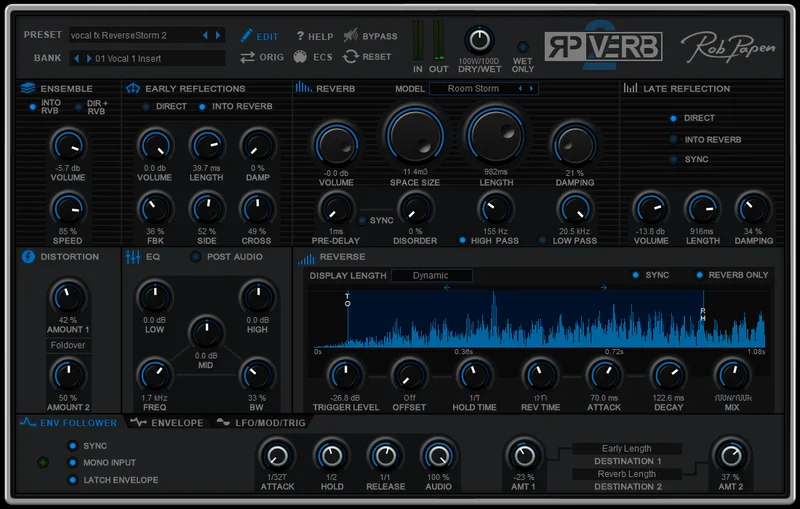
Out of the box, RP-VERB 2 loads with 500 presets across its 10 algorithms: Hall Clean, Hall Cave, Hall Warm, Room Cold, Room Edged, Room Storm, Vintage Type 1, Vintage Type 2, Space Orbit 1, and Space Orbit 2. The interface is dense but navigable. First impressions are of a plugin built for sound designers, not mix engineers.
Performance Deep Dive
We loaded RP-VERB 2 on a synth pad in Ableton Live 12, running a Mac M2. CPU hit sat around 4-6% per instance on that session, which is moderate. Running three instances simultaneously pushed us to 14%. Not CPU-hungry, but not light either. Valhalla Room sits under 2% per instance on the same machine.
The Modulation Matrix lets you route three controllers (Envelope Follower, LFO, Envelope, Offset, or MIDI) to three parameter destinations simultaneously. We routed an LFO to Pre-Delay and a second LFO to the Room Size on a Space Orbit 2 patch. The reverb tail started breathing. It took about four minutes to dial in from scratch.
The Reverser section is tempo-synced. We set it to 1/2 note at 120 BPM on a vocal chop. The reverse sweep built over a full beat before the dry signal hit. Satisfying. That kind of effect normally requires exporting, flipping the audio, and re-importing it. Here it's a toggle.
The Distortion module offers four types: Fold-over, Fuzz, Power, and Saturation. We ran a snare hit through Power mode with the reverb tail at 2.1 seconds. The crack gained presence. The tail didn't turn to mush. That said, Fold-over and Fuzz into a long hall reverb can get ugly fast. That's not entirely a criticism.
Where RP-VERB 2 Wins
The upgrade price is the first win. $39 to unlock a genuinely different plugin is hard to argue against. Full version owners pay more, which is fair but less exciting.
The Reverser section is a legitimate workflow improvement. We'd have spent 20 minutes doing manually what it handles in seconds. For electronic music, film scoring, and any production where reverse reverb swells are a tool rather than a novelty, this alone earns the upgrade cost.
The combination of Distortion into Reverb in a single signal chain is clever. It removes a plugin from the chain and removes the gain staging headache that comes with running saturation into a separate reverb. For creative sound design on synths and drums, it's the most practical feature in the whole plugin.
And 500 presets is a real library. Not filler. We found 30-40 presets we'd actually use in a session without modification.
Where the Competition Wins
For transparent hall and room reverb on vocals, guitars, and acoustic instruments, FabFilter Pro-R and Valhalla Room are both better tools. RP-VERB 2's sound is modern and digital. It doesn't disappear into a mix the way a great algorithmic reverb should on those sources.
The algorithm reduction from 18 to 10 is a real loss for some users. If you loved a specific RP-VERB 1 algorithm that isn't in version 2, that's annoying. Rob Papen improved the remaining 10 rather than carrying all 18 forward, and that's a legitimate creative decision. It's also a frustrating one if your favourite didn't make the cut.
For the kind of room sound Mark Clearmountain made famous, RP-VERB 2 isn't the answer. The Vintage algorithms get close to that warmer character, but they don't match a dedicated convolution or high-end algorithmic reverb tuned for that specific sound.
Who Should Buy Which
- ✅
Buy RP-VERB 2 if you already own RP-VERB 1 and the $39 upgrade is the obvious question. It is. Do it.
- ✅ Buy RP-VERB 2 if you produce electronic music, cinematic sound design, or anything where modulated, moving reverb tails are part of your palette.
- ✅ Buy RP-VERB 2 if you want Reverser and Distortion into Reverb in one plugin and don't already own tools that cover both.
- ❌ Skip RP-VERB 2 if you need a transparent, mix-ready reverb for acoustic sessions, live recordings, or orchestral work.
- ❌ Skip RP-VERB 2 if you're a first-time reverb plugin buyer. Start with Valhalla Room. Our reverb plugins guide covers exactly that starting point.
- ❌ Skip RP-VERB 2 if you relied on specific RP-VERB 1 algorithms that didn't survive the redesign. Check the algorithm list first.
Score Breakdown
| Category | Score | Notes |
|---|---|---|
| Sound Quality | 3.8/5 | Strong for sound design; too digital for transparent mixing work |
| Value for Money | 4.5/5 | $39 upgrade is one of the better deals in the plugin market right now |
| Ease of Use | 3.5/5 | Modulation Matrix has a learning curve; presets shortcut the process well |
| Features | 4.3/5 | Reverser and Distortion module make this a genuine multi-tool |
| CPU Efficiency | 3.5/5 | Moderate usage; fine for most sessions, watch it on CPU-limited systems |
| Overall | 4.1/5 | Brilliant upgrade price, clever feature set, wrong tool for transparent mixing |
Alternatives to Consider
Valhalla Room is the honest recommendation if you want a mixing reverb. Lighter CPU, cleaner algorithms, and it disappears into a mix the way a good reverb should. We break down how Valhalla compares to the full reverb plugin field in our complete guide.
Safari Audio Rhino Reverb deserves a look if spring reverb character is what you're after. Our Rhino Reverb review explains why it beats pricier options for that specific sound.
Rob Papen eXplorer 11 is worth checking if you don't already own RP-VERB 1. Buying into the full bundle can work out cheaper than individual purchases, and it includes RP-VERB 2. We reviewed the eXplorer 11 upgrade path here.
RP-VERB 2 at $39 upgrade is a yes for the right producer. It's not a workhorse hall reverb. It never tries to be. If you want modulation, reverse sweeps, and distortion grit baked into a single reverb plugin at a price that's hard to resent, this is it. If you want something that disappears behind a vocal at 3am and just works, get Valhalla Room first and come back to this later.
Frequently Asked Questions
Is the RP-VERB 2 upgrade worth it if I already own RP-VERB 1?
At $39, yes. You get the Reverser section, the Modulation Matrix with up to three controllers routed to three destinations, a four-type Distortion module, and a rebuilt interface. The one caveat: RP-VERB 2 ships with 10 algorithms rather than RP-VERB 1's 18. Check the new algorithm list against your most-used v1 patches before upgrading if that matters to you.
What are the 10 reverb algorithms in RP-VERB 2?
Hall Clean, Hall Cave, Hall Warm, Room Cold, Room Edged, Room Storm, Vintage Type 1, Vintage Type 2, Space Orbit 1, and Space Orbit 2. Rob Papen rebuilt these rather than porting all 18 from the original, so each one is improved in both sound and operability compared to its v1 equivalent.
How does the Reverser section work in RP-VERB 2?
The Reverser is tempo-synced to your DAW. You set the note length (e.g. 1/2 note, 1/4 note), and the plugin generates a reverse reverb sweep that builds into the dry signal on beat. It removes the need to manually export audio, flip it, and re-import it in your DAW, which used to be the standard workflow for this effect.
Is RP-VERB 2 good for mixing vocals and acoustic instruments?
Not our first recommendation. The sound is modern and digital, which works brilliantly for electronic music and sound design but doesn't sit as naturally behind vocals or acoustic instruments as Valhalla Room or FabFilter Pro-R. If transparent, mix-ready reverb is the priority, those two plugins are better starting points at similar or comparable price points.