
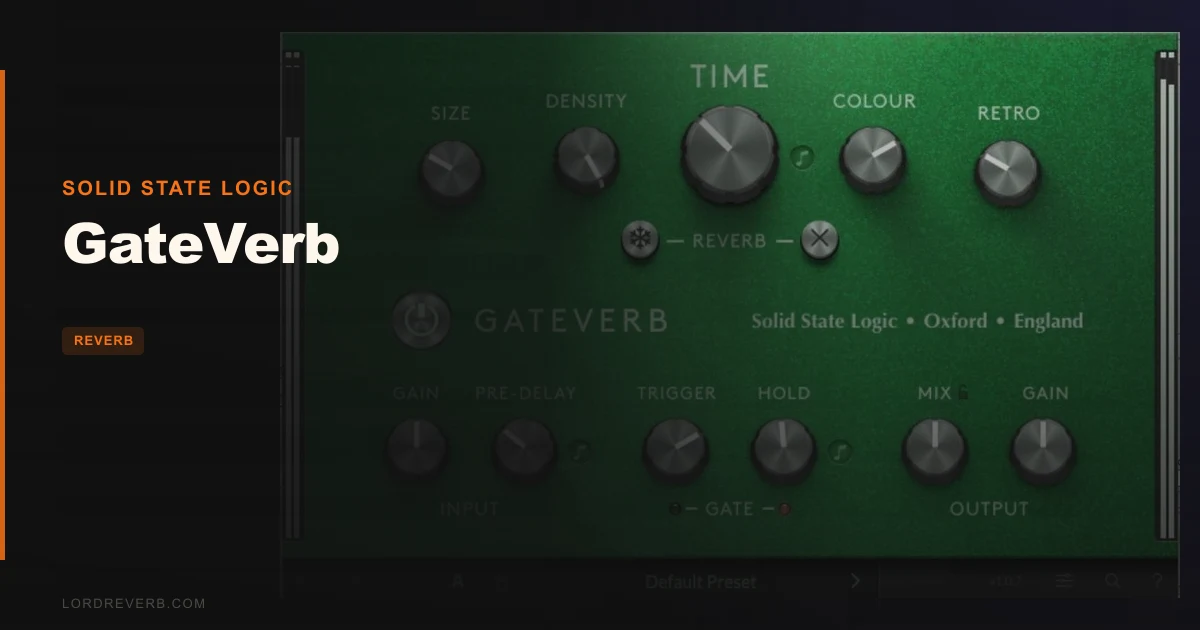
SSL's GateVerb ($49) is a focused, non-linear gated reverb plugin that nails the sound of '80s drum rooms without overcrowding your signal chain or your budget.
We were two hours into a pop-adjacent session, snare bus pulled up, when the mix hit that frustrating wall: the snare had no size. Too short to breathe, too long to gate manually without artefacts. We'd already tried a plate from our usual reverb bundle. It sounded like a bathroom, not a stadium.
So we dropped GateVerb on the bus. Set Time to about 60%, Size at noon, pushed Density until the reverb felt dense enough to grab. The snare went from dry and polite to cracking with authority. Not "warm" in a vague sense: the lower midrange weight between 200-400Hz filled in immediately, and the tail choked off cleanly right at the gate threshold. That's the plugin earning its keep in under two minutes.
This review is for drum producers, pop engineers, and synthwave builders who want that 1980s non-linear texture without buying a Lexicon hardware unit or spending hours sculpting IRs.
First Impressions: Smaller Than Expected, Faster Than Expected
The GUI opens compact. There's no preset browser sprawl, no tabbed menu system to navigate. You get the controls up front: Density, Time, Colour, Size, and a Retro toggle, plus the gate section with threshold and trigger settings. It looks like SSL kept the interface honest.
Installation requires a free iLok account. No iLok hardware dongle needed, but the account step is one extra click of friction that's mildly annoying during a first-launch. After that, authorisation is fast and the plugin shows up in VST3/AU/AAX without any drama.
The default patch is a mid-length gate with moderate density. It's usable straight out of the box. We've opened reverb plugins that sound broken on the default preset. GateVerb doesn't. That matters.
Getting It Into a Real Workflow
We run it on a send, not directly on the drum bus. That's how we'd recommend using it: parallel, so you can blend the gated return underneath the dry signal without committing entirely.
Tempo-sync is brilliant here. Lock the pre-delay and Time parameter to your DAW's BPM, and the gate tails snap to quarter-note or eighth-note increments. At 120 BPM with Time synced to an eighth-note, the reverb tail sits cleanly in the pocket between snare hits without washing into the next beat. It's the difference between a mix that feels tight and one that just sounds loud.
The ducking/sidechain feature is where GateVerb surprises you. Route your kick into the sidechain input, and the reverb ducks every time the kick hits. The kick stays punchy and dry in the low end; the gated room on the snare doesn't compete with it. We've set this up manually with a compressor on a reverb return dozens of times. Having it built in at $49 removes a whole extra plugin from the chain.
One friction point: there's no dedicated wet-only monitor button. When you're dialling in the gate threshold, you have to flip the track to solo to hear the reverb return in isolation. Minor issue. Still annoying.
What It's Genuinely Good At
The gate itself is the star. Most reverb plugins with a "gate" mode are just slapping a volume envelope on the tail. GateVerb's gate feels tighter: the threshold responds quickly enough to catch transient differences between hit types, and the release doesn't leave a click artefact at the chop point.
We tested it on four sources: snare, full drum bus, a synth pad, and a lead vocal. On snare and drums, it's excellent. The Colour knob lets you push brightness in the upper mids (around 3-5kHz), which adds shimmer without making the tail harsh. Pull it back and the reverb sits darker in the 500Hz-1kHz range, closer to a room sound than a hall.
The Retro toggle is satisfying. It thickens the reverb character and introduces a subtle pre-ringing quality that sounds less like a modern plugin and more like an early Lexicon 224. It's not a massive change, but it's the right kind of change for authenticity.
On synth pads, it adds movement without mud. On vocals, it works for a specific effect: short, dramatic gated tail on a dry lead vocal chorus. Think Phil Collins, not Billie Eilish. You need to know that going in.
Pair GateVerb with SSL's own LMC+ compressor plugin (sold separately) on the snare bus, and you get that classic push-pull drum sound from the era. The LMC+ compresses the transient, GateVerb shapes the room. Together, they make a convincing '80s snare chain at a combined price that stays well under budget.
The Rough Edges
The preset library is thin. We counted fewer than 20 factory presets on launch. For a plugin that's asking you to dial in a specific era, having more starting points as reference would help beginners find their footing faster. You'll be building patches from scratch more often than not.
CPU load sits at light-to-moderate. Running 12 instances across a full session with sidechain active on each pushed our CPU meter noticeably, though not catastrophically. It's not the most efficient plugin on the market, but it's not a problem on any modern machine.
No A/B comparison against hardware is possible in the box, which is where GateVerb's limits show up. Against a Lexicon PCM92 or an Eventide H3000, the plugin's density feels slightly less three-dimensional. The hardware units have a quality in the early reflections that's hard to quantify and harder to replicate. GateVerb gets close. It doesn't win.
The interface also has no resizable window. On a 4K monitor, it's tiny. That's an oversight in 2026.
Who This Is Really For
- ✅ Buy if you produce pop, synthwave, or retro-adjacent records and want a go-to gated reverb for drums that sounds credible and costs less than a dinner out.
- ✅ Buy if you're already in the SSL ecosystem and want a plugin that pairs directly with LMC+ for a coherent '80s signal chain.
- ✅ Buy if you want built-in sidechain ducking without building a parallel compression/reverb send from scratch every session.
- ❌ Skip if you want a full-spectrum reverb toolbox: GateVerb does one thing. It's not a room, hall, plate, and spring plugin in one.
- ❌ Skip if you're looking for iOS or AUv3 support. This is desktop only.
- ❌ Skip if you need resizable UI and a deep preset library on day one. The out-of-box browsing experience is bare.
Score Breakdown
| Category | Score | Notes |
|---|---|---|
| Sound Quality | 4.5/5 | The gate sounds tight and the Retro mode adds convincing era character |
| Value for Money | 4.5/5 | $49 with built-in sidechain ducking is hard to argue with |
| Ease of Use | 4.0/5 | Intuitive controls, but the thin preset library leaves beginners cold |
| Features | 3.5/5 | Tempo-sync and ducking are clever; missing resizable UI and a deeper preset bank |
| CPU Efficiency | 3.5/5 | Not heavy, but 12+ instances with sidechain active will register on the meter |
| Overall | 4.2/5 | A smart, focused tool that does its one job better than anything near its price |
Alternatives Worth Checking
Waves Abbey Road Reverb Plates, If plate-style non-linear textures are what you're after, this is the comparison. It costs more and the gate options are not as immediate, but the density of early reflections is closer to hardware. reverb plugins guide
Valhalla VintageVerb, VintageVerb offers far more algorithm variety (17 modes) and covers more terrain than GateVerb. If you want one reverb plugin that does everything, VintageVerb wins. But it doesn't have a dedicated non-linear gate section, and the sidechain ducking requires an external workaround. GateVerb's narrower focus is actually faster for drum work. pure:verb review 2026
Apogee Clearmountain's Spaces, For engineers who want the full Bob Clearmountain signal chain approach to reverb, this is the deeper end of the pool. Not a direct competitor in gated reverb specifically, but if you're building a retro-sounding drum room from scratch, it's worth comparing. can Clearmountain's Spaces review change how you reverb
We'd also point you toward the Safari Audio Hippie Elephant review if you want to see how far into weird territory non-linear reverb can go. GateVerb is the functional, professional option. Hippie Elephant is the one you load at 2am to see what happens.
At $49, GateVerb is the kind of purchase you make and forget about, in the best sense: it'll be on your snare bus in three months and you won't remember life before it. If you're a synthwave or pop producer who doesn't need hardware and doesn't want to wire up a sidechain compressor on a reverb send every single session, this is the right call. Just don't buy it hoping it'll replace your full reverb toolkit. It won't. It's a specialist, not a generalist, and that's exactly what it should be.
Frequently Asked Questions
Does GateVerb require a physical iLok dongle?
No. A free iLok account is required for authorisation, but you don't need a physical iLok USB key. The license is managed through your account online. It's one extra sign-up step, but it won't cost you any hardware.
Can I use GateVerb on vocals, or is it strictly for drums?
You can, and it works, but with conditions. The gated tail on a vocal gives you a short, dramatic effect that fits specific retro pop and synth-pop contexts. If you want a lush or natural-sounding vocal reverb, GateVerb's non-linear character will fight you. Use it as an effect, not a polish tool, and it delivers on vocals.
How does GateVerb compare to Valhalla VintageVerb for '80s drum sounds?
GateVerb wins for this specific task. VintageVerb has more algorithms and broader use cases, but its gate mode isn't as immediate or as precise as GateVerb's dedicated gate section. For tempo-synced gated reverb on a snare bus with sidechain ducking, GateVerb sets up faster and sounds more focused. VintageVerb is the better all-rounder; GateVerb is the better specialist.
Is GateVerb available on subscription, or is it outright purchase only?
Both options exist. You can buy it outright at $49, access it through the SSL Complete subscription, or use a Rent-to-Own model through Plugin Boutique. The 14-day free trial lets you test it fully before committing to any of those routes.