The reverb problem most producers actually have isn't finding a plugin with 500 presets. It's loading one of those 500 presets, hearing something close to right, then spending 40 minutes trying to dial it back to tasteful before giving up and printing it too wet. Clearmountain's Spaces, made by Apogee in collaboration with Bob Clearmountain, exists to short-circuit that loop. It costs $49, it loads three convolution spaces sourced from Clearmountain's own rooms, and its entire design philosophy is "less is enough." This is built for producers, mix engineers, and home studio owners who want the sound of a Grammy-winning signal chain without reading a manual to get there.
The Reverb Problem It Was Designed to Solve
Convolution reverb plugins have a discoverability problem. Drop Altiverb on a snare bus, and you're staring at 1,500 IRs before you've made a single creative decision. You'll audition 30. None feel right. You'll give up and reach for a plate preset you've used since 2019.
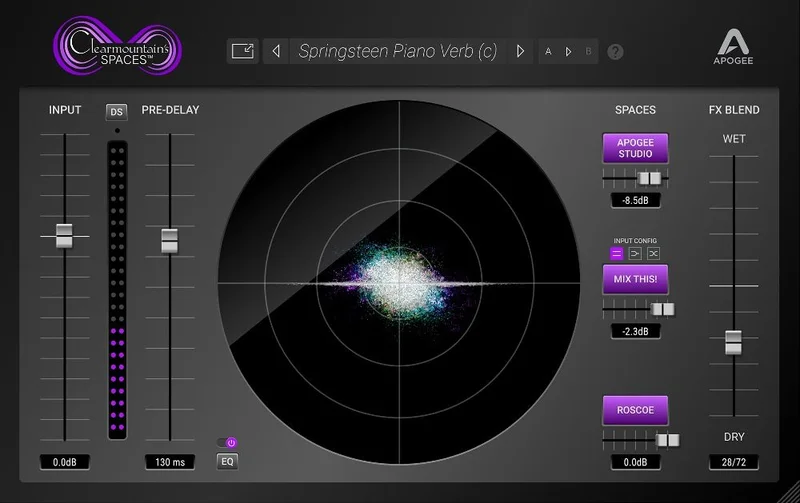
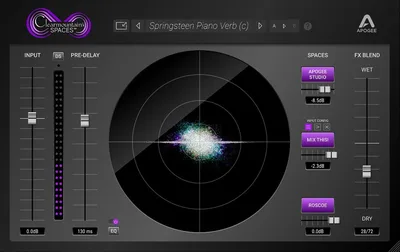
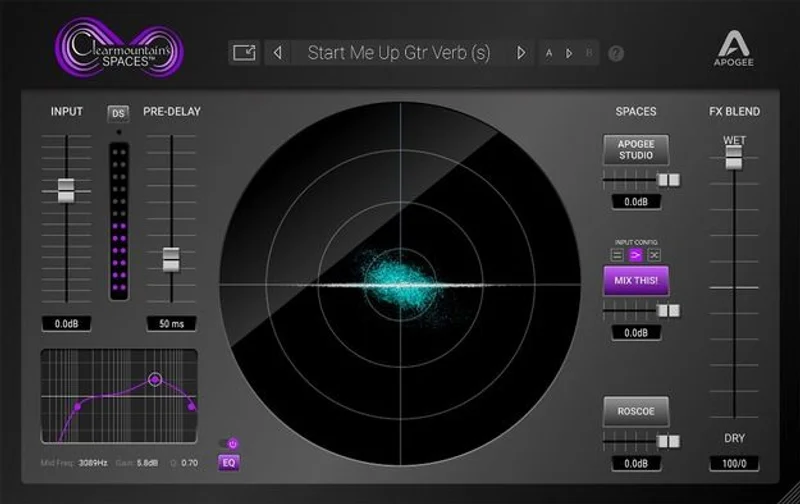
Clearmountain's Spaces flips that. Three IRs. That's it. Apogee Studio, Mix This!, and Roscoe. Each one sourced from spaces Clearmountain actually used on records you've heard. The constraint is the feature.
The plugin is also a direct response to the pricing gap in Apogee's own lineup. Domain, their full-fat Clearmountain reverb, costs more and includes eight spaces plus deeper modulation. Spaces gives you three of those at $49. For a lot of workflows, that's exactly enough.
How It Performs in a Real Session
We ran a dry snare through the Apogee Studio IR first, pre-delay set to 18ms, reverb time pulled to about 0.9 seconds. The tail opened up behind the snap without blurring the attack. That's the thing Clearmountain does better than almost anyone: the reverb knows when to stay out of the way.
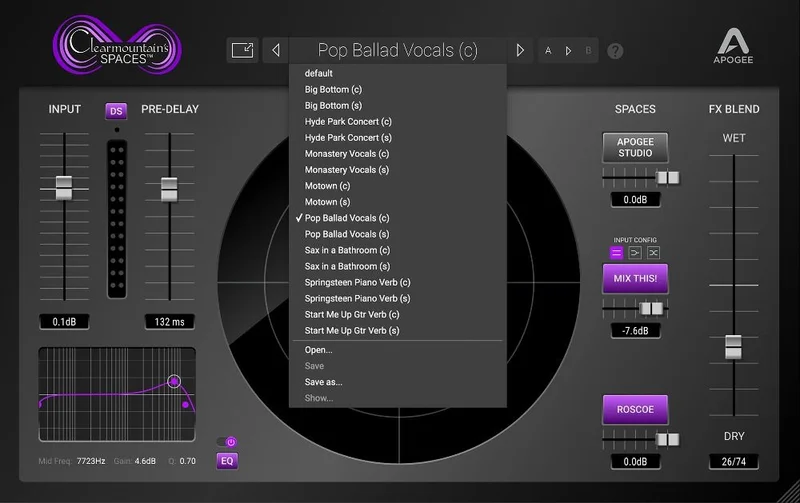
The three-band EQ on the input is more useful than it sounds on paper. We cut 180Hz before the reverb hit to keep low-mid mud out of the room sound. On a drum bus, that single move kept the kick from turning the reverb into a low-frequency blur. Fewer plugins in the chain, cleaner result.
The Composite Spaces feature lets you layer two of the three IRs with a blend knob. We set Mix This! at 70% and blended Roscoe in at 30% on a rhythm guitar bus. The result was wider than either space alone, without the phasiness you'd expect from stacking two separate reverb instances. Clever implementation for $49.
The de-esser on the input also surprised us. It's not deep, but it stops sibilance from exciting the reverb tail on lead vocals, which is an annoying artifact that sends most engineers reaching for a separate de-esser insert before the reverb send. Having it baked in saves a step.
On CPU: Apogee doesn't publish a number anywhere, which is frustrating. In our sessions running Logic Pro on Apple Silicon, Clearmountain's Spaces was light. We had six instances open on separate buses without any buffer issues at 128 samples. On older Intel-based Macs, we'd test before committing to multiple instances.
Compared to a full convolution option like Altiverb 7, Spaces doesn't match the IR library depth. That's not the competition. The real comparison is to something like convolution reverbs at a similar price point, where the value story for Spaces is strong.
Strengths and Weaknesses
The three IRs are the strength. Apogee Studio has a clarity in the 2kHz to 6kHz range that helps transients stay defined inside the reverb. Mix This! has a shorter, denser character that works on snares and claps without washing the top end. Roscoe sits somewhere between them, a little darker, better on guitars and keys than on drums.
We love that the presets aren't generic. "Start Me Up Drum Room" and "Born in the USA Guitar Verb" are actual decisions from actual sessions. Loading one and playing your own material against it is a fast way to hear what Clearmountain heard when he was building those records.
The weakness we can't ignore: three spaces is a hard ceiling. If you want a plate sound, a spring sound, or anything with a longer hall character, Spaces won't get you there. You're locked into these three rooms. For some sessions, that's fine. For others, you'll still need a second reverb in the chain.
The Verb Scope visualization is basic. It shows the tail shape, but it doesn't give you the frequency breakdown of the reverb itself. Mixing by ear is fine, but a spectral display of the IR tail would be genuinely useful and it's not here.
Value for the Price
At $49, this is an easy yes. That's not a hedged statement. Three Clearmountain IRs, input EQ, de-esser, pre-delay, and Composite Spaces blending for less than a dinner for two in a major city.
The comparison that matters: Domain costs more and gives you eight IRs and more modulation depth. If you're mixing records professionally and need that range, Domain earns its price. If you're not there yet, or if you just want the
Clearmountain character on your buses without the commitment, Spaces is the honest choice.
The price difference between Spaces and Domain is real money that buys a lot of other things. best reverb plugins for home studios covers where Spaces sits in the broader market, and it holds up.
Who Should (and Shouldn't) Buy This
✅ Buy if you want a tasteful, low-decision convolution reverb for drum and instrument buses that sounds like a real room without requiring an hour of preset hunting.
✅ Buy if you're a home studio producer who finds most reverb plugins overwhelming and wants something that sounds right quickly.
✅ Buy if you're already a Domain user who wants a portable, lighter version for a laptop session rig or a second machine.
❌ Skip if you need plate, spring, or hall reverb characters. These three IRs are rooms, full stop.
❌ Skip if you're doing sound design or cinematic scoring where long, evolving reverb tails are standard. This isn't built for 8-second decays.
❌ Skip if you need published latency and CPU specs before committing, because Apogee doesn't provide them and that gap is annoying.
Score Breakdown
| Category | Score | Notes |
|---|---|---|
| Sound Quality | 4.3/5 | The Apogee Studio IR in particular is genuinely satisfying on transient sources |
| Value for Money | 4.5/5 | Three usable, pro-sourced IRs plus processing tools at $49 is hard to argue with |
| Ease of Use | 4.5/5 | Low decision count is the point, you're mixing in minutes, not hunting presets |
| Features | 3.5/5 | Composite Spaces and input processing are clever, but three IRs is a real ceiling |
| CPU Efficiency | 3.8/5 | Light in practice, but no published specs is a transparency miss |
| Overall | 4.1/5 | A focused, honest tool that does exactly what it promises and nothing it doesn't |
Alternatives to Consider
If you want more IR variety at a still-reasonable price, Waves IR1 has a larger factory library and similar convolution quality. It goes on sale regularly and is worth watching for a deal. best reverb plugins for mix engineers
If the constraint of three rooms frustrates you and you want a plugin that rewrites how spaces layer, SoundToys SpaceBlender review is where we'd point you. Different philosophy, more creative range, higher price.
If you're considering stepping up to the full Clearmountain system, Domain is the direct upgrade path. Eight IRs, deeper modulation controls, and the same input processing philosophy. If your mix work justifies it, the extra cost buys a meaningful jump in flexibility.
Our Final Call
Most reverb plugins try to impress you with scale. Clearmountain's Spaces tries to be useful. At $49, it's the latter, and that's underrated.
If you mix drums, guitars, or full bands and you're tired of drowning in preset menus, buy it. If you need plate reverb, a hall, or anything beyond three specific rooms, skip it and spend the $49 elsewhere. The plugin isn't wrong. It's just honest about what it is.
The best mixing decisions are usually subtractions. This plugin is a subtraction in the best possible way.
Frequently Asked Questions
What's the difference between Clearmountain's Spaces and Clearmountain's Domain?
Spaces gives you three convolution IR spaces for $49. Domain gives you eight IRs, deeper modulation controls, and more routing flexibility at a higher price. Spaces is the entry point. Domain is for professional mixing sessions where you need more room variety and spend all day in the plugin. If you're not sure which you need, start with Spaces.
What are the three reverb spaces included in Clearmountain's Spaces?
The three IRs are Apogee Studio, Mix This!, and Roscoe. Each was sourced from spaces Clearmountain actually used on recordings. Apogee Studio has the clearest, most transient-friendly character. Mix This! is denser and shorter. Roscoe is darker, better suited to guitars and keyboards than drums.
Does Clearmountain's Spaces work with Logic Pro and Pro Tools?
Yes. It ships in VST, VST3, AU, and AAX Native formats, which covers Logic Pro, Pro Tools, Ableton Live, Cubase, and most other major DAWs. Mac requires OS 10.12.6 or later. Windows requires Windows 10 or later. Check Apogee's site for the latest compatibility notes before buying.
Is Clearmountain's Spaces CPU-heavy?
In our testing on Apple Silicon, six simultaneous instances ran without issue at 128 samples. Apogee doesn't publish an official CPU figure, which is a real gap in their documentation. On older Intel machines, we'd test with a free trial before committing to heavy multi-instance use.