
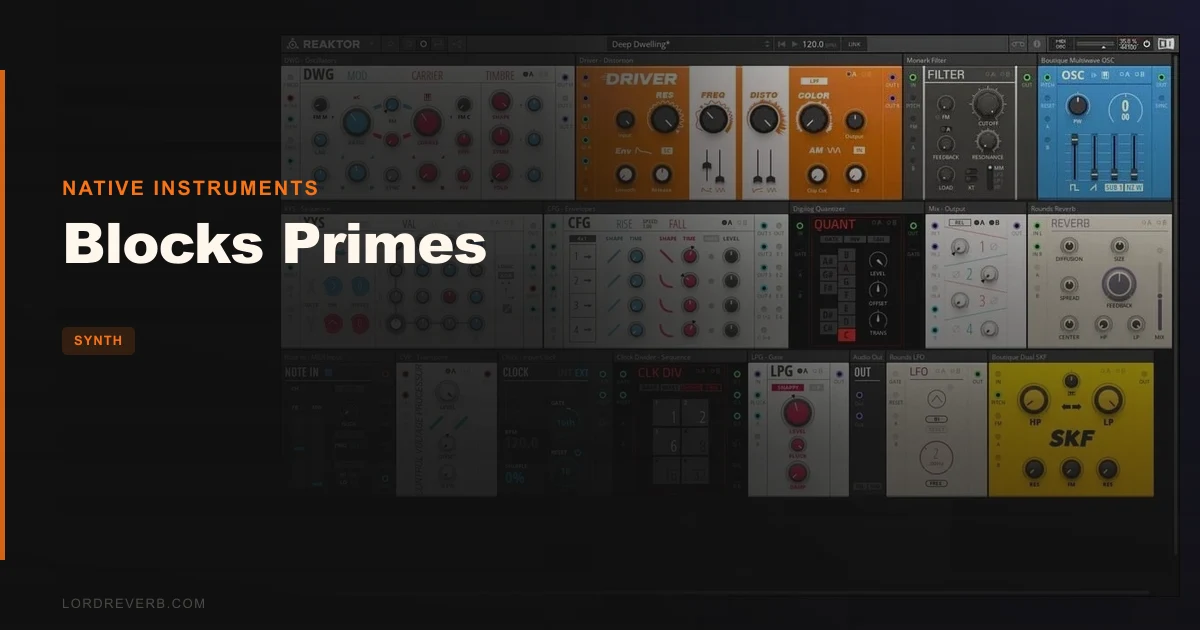
Blocks Primes gets compared to VCV Rack constantly, and for good reason: both put modular synthesis inside your computer for a fraction of what hardware costs. Here's where this review lands: Blocks Primes wins on sound design pedigree and workflow polish. VCV Rack wins on raw module count and price. At $99, Blocks Primes is not the free option, but it's the better-sounding option for producers who already live in a DAW and want modular depth without a patch cable in sight.
This review is for producers who are curious about modular but intimidated by Eurorack. It's also for existing NI users wondering whether Blocks Primes is worth adding to a REAKTOR setup, or whether the free Blocks Base already covers the ground. We've spent serious time with all 23 modules and most of the preset Racks. Here's what we found.
How It Compares Out of the Box
Stack Blocks Primes against VCV Rack and the first difference hits you immediately: VCV Rack gives you an empty case and tells you to figure it out. Blocks Primes gives you 50+ preset Racks that are fully functional synthesizers from the moment you load them.
That's not a small thing. VCV Rack's free model is brilliant for modular obsessives who want to spend hours sourcing individual modules. Blocks Primes is built for producers who want to get to the sound fast, then dig into the patching later.
Compare it to Arturia's Pigments or the MiniFreak V, and the difference is architectural. Those are fixed-architecture soft synths with modulation routing. Blocks Primes is genuinely modular: you can reroute signal paths, swap oscillators, insert sequencers mid-chain, and break patches in interesting ways.
Cherry Audio's Voltage Modular is the closest commercial comparison. Blocks Primes has fewer modules out of the box, but the NI synthesis technology behind modules like the Monark-derived filter and the Driver-based saturation circuits is noticeably stronger. The preset Racks in Blocks Primes sound like finished instruments. Voltage Modular presets often sound like demonstrations.
What Blocks Primes Actually Is
Blocks Primes is a collection of 23 modular Blocks that run inside REAKTOR or the free REAKTOR Player. It extends Blocks Base, the free starting point NI provides, with more sophisticated modules across synthesis, sequencing, and effects.
The word "advanced" in NI's marketing is fair. These aren't beginner modules. The Kodiak family alone covers territory most soft synths don't touch: two sequencers, an oscillator, a morphing filter, and an experimental noise generator that produces textures most standard synths can't approach.
You patch modules together to build a Rack. That Rack becomes your synthesizer. The 50+ included Racks show you what's possible and give you something playable immediately. But the whole point is that you can unpatch, repatch, swap modules, and build something new.
Download size is 34 MB. That's lean. CPU load varies by patch complexity, which we'll cover in the performance section.
The Kodiak Family: Where Things Get Interesting
The Kodiak modules are the heart of what makes Blocks Primes worth the asking price. They don't exist anywhere else in the NI catalogue in this form, and they push into territory that's genuinely unusual for a software modular system.
The Kodiak oscillator covers standard waveforms, but the noise generator is where we spent the most time. It produces textures ranging from white noise through to pitched, evolving grains that sit somewhere between a granular synth and a feedback oscillator. We ran it into the Kodiak morphing filter, swept the morph parameter from low-pass through to band-reject over four bars, and the result was a percussive texture that didn't sound like anything in our sample library.
That's a specific claim, so here's the context: the morph parameter on the Kodiak filter is continuous. It doesn't switch between filter types with a click. It dissolves between them. At morph position 0.0 you have a clean low-pass. At 0.5 you're in an undefined state where both filter characters overlap. At 1.0 you're in band-reject territory. Modulate that morph with the Kodiak sequencer and you get filter behaviour that no fixed-type filter can replicate.
The two Kodiak sequencers differ in scope. One is a standard step sequencer with per-step probability and gate length. The other handles modulation sequencing: it outputs CV values rather than pitch, so you can sequence filter morph positions, oscillator wave shapes, or any other parameter that accepts a CV input. That combination of pitch sequencer plus modulation sequencer built into the same module family is clever, and it shows up clearly in several of the preset Racks.
West Coast Synthesis: The Buchla-Inspired Modules
Four of the 23 modules draw explicitly from Don Buchla's approach to synthesis. If you're not familiar: West Coast synthesis, as Buchla developed it, favours waveshaping and low-frequency complexity over the filter-heavy signal paths of the Moog-derived East Coast tradition.
In practice this means these modules care less about subtractive filtering and more about harmonic content at the source. The wavefolder is the centrepiece. Feed it a sine wave, drive the fold amount, and the harmonic content builds in a way that's musically useful rather than just distorted. It stays in a recognisable pitch relationship with the source signal even under heavy folding, which a simple saturation circuit doesn't guarantee.
We ran a bass patch through the wavefolder with the fold amount at 60%, then automated it down to 20% during the drop. The fundamental stayed solid. The upper harmonics retreated cleanly. No pumping, no pitch drift.
The other West Coast elements handle modulation and dynamics. The function generator covers envelope and LFO duties in a single module, which is how Buchla's original systems worked. It's less intuitive than a standard ADSR if you're coming from a traditional synth background. Give it an hour before you judge it.
For producers who've only worked with East Coast synthesis, the West Coast modules require a mental reset. That's not a weakness. It's the point. But it does mean the learning curve is steeper here than anywhere else in Blocks Primes.
NI's Greatest Hits in Modular Form: Monark and Driver
Two of Blocks Primes' strongest selling points are modules converted directly from NI's own acclaimed synths. The Monark-derived filter and the Driver-based saturation circuit aren't approximate recreations. They're the same DSP, reformatted to accept CV input and play nicely inside the Blocks signal chain.
The Monark filter is a Moog ladder emulation. We've reviewed it in its native context and the behaviour is well-documented: self-oscillation that stays musical, resonance that adds warmth rather than harshness below the cutoff, and a character at the top of the frequency range that sits in a mix without needing a high-cut after it. In Blocks Primes you get all of that, plus you can sequence the cutoff directly from a Kodiak sequencer or modulate it from a West Coast function generator.
That combination is something you can't achieve in standalone Monark without external routing tricks. It's one of the genuine advantages of the modular format.
The Driver module brings NI's saturation and distortion circuit into the chain. Driver as a standalone plugin covers 11 distinct distortion types, from tape saturation through to hard clipping. In Blocks form, it's been optimised for modular use: the gain staging responds to CV input, so you can drive the distortion harder at specific points in a sequence. We used it on a kick drum Rack to add transient weight: Gate opens, gain stages up for 40 milliseconds, backs off for the tail. Satisfying in a way that a static distortion pedal model never quite achieves.
The 50+ Preset Racks: Are They Actually Usable?
Fifty preset Racks sounds like a headline number designed to justify the price. In practice, the quality is higher than we expected.
The Rack categories break down across synthesis styles: there are drone patches, percussive modules, bass instruments, melodic leads, and soundscape generators. Several Racks are genuinely production-ready. We used two of them on a session without modification.
Feedback drone Racks are where Blocks Primes separates itself most clearly from conventional soft synths. There's a Rack that feeds the noise generator into the morphing filter, routes the filter output back through a delay with a fractional feedback amount, and layers the Driver saturation circuit at the final stage. The sound it produces evolves on its own. It doesn't loop. Reviewers frequently mention that the experimental Racks in Blocks Primes produce sounds that feel genuinely alive rather than statically generated.
The percussive Racks are strong. NI has designed several that behave like drum voices rather than melodic instruments: short attack, variable decay, pitch envelope on the oscillator. You can sequence them with the Kodiak step sequencer and get drum patterns with modular character without building the patch from scratch.
Not every Rack is a winner. Some of the simpler lead patches feel like they belong in a beginner's module collection rather than an advanced one. They're competent, but they don't show off what Blocks Primes is capable of. We'd have preferred those slots filled with more complex patches.
All 50+ Racks are fully patchable. That's important. These aren't frozen presets. Every cable in the patch is visible and moveable. You can see exactly how NI built each sound and learn from it.
Front-Panel Patching and Workflow
The workflow in Blocks Primes is built around front-panel patching. Every module exposes its inputs and outputs as physical-looking patch points on the front panel. You connect them by clicking and dragging. The visual language is close enough to Eurorack that hardware modular users will adapt quickly. Software-only producers may need a session to get comfortable.
What Blocks Primes does better than many software modulars is signal flow clarity. The panels are laid out so that signal typically flows left to right and top to bottom. When a patch gets complex, you don't lose track of where audio ends and CV begins. Patch cables are colour-coded: audio is one colour, CV is another. That sounds minor. After 20 minutes of patching, it's genuinely important.
We did hit one frustrating snag. When we first loaded a complex Rack with multiple Kodiak sequencers running, we spent several minutes trying to find where the main output was routing before realising the final module was scrolled off-screen to the right. Blocks Primes doesn't auto-zoom to fit the full Rack in view when you load a preset. You have to scroll manually. That's annoying for large patches. It's a small thing, but it adds friction.
The Komplete Kontrol integration is genuinely useful if you own NI hardware. Each Rack auto-maps 8 macros to sonically relevant controls. For a complex drone Rack, those 8 macros might cover filter morph, feedback amount, noise density, saturation drive, and modulation sequencer rate. You get immediate hands-on control without setting up custom mappings.
Without Komplete Kontrol hardware, you're mapping macros manually. That's fine, but it takes time on complex Racks.
Expanding Beyond Blocks Primes: The Broader Ecosystem
Blocks Primes doesn't exist in isolation. It runs alongside Blocks Base (free) and 200+ additional modules from third-party developers. That pool of compatible modules is one of the strongest arguments for buying into this format over a standalone soft synth.
The third-party selection covers territory that NI doesn't. Physical modelling modules, alternative sequencer formats, spectral processing. The quality varies: some third-party developers have built modules that match the polish of Blocks Primes. Others feel unfinished. You need to evaluate each one individually.
The CV connectivity module deserves specific attention. It bridges Blocks Primes with hardware modular systems. If you have a Eurorack case and an audio interface with DC-coupled outputs, you can send CV from a Blocks sequencer to a hardware module, or receive gate signals from hardware into a Blocks patch. Users with hybrid setups report that this integration works reliably and opens up combinations that would otherwise require dedicated hardware CV tools.
For producers who are purely ITB, the CV module is irrelevant. For anyone with hardware modular ambitions, it's a strong argument for the Blocks format specifically.
The total picture, if you own Blocks Base plus Blocks Primes plus a curated selection of third-party modules, is a software modular system that can compete with a mid-size Eurorack case on sound variety. It's not the same experience. But it covers similar musical ground at a fraction of the cost.
Performance Deep Dive
CPU usage in Blocks Primes scales with patch complexity. A single oscillator through the Monark filter with one envelope is light: on a mid-range laptop from 2023, it barely registers. A complex Rack with three Kodiak sequencers, the noise generator, morphing filter, function generator, wavefolder, and Driver saturation running simultaneously sits around 8-12% CPU on a single core.
That's not negligible if you're running 8 instances simultaneously. It is manageable for most production contexts. We ran 4 instances of a moderately complex Rack alongside a standard production session without issues on an M2 MacBook Pro.
Compare that to VCV Rack, which is notoriously CPU-hungry at scale. Blocks Primes is more efficient per module. The tradeoff is that VCV Rack gives you access to thousands of modules, so you can often find lightweight alternatives when CPU becomes a concern.
Load times are fast. The 34 MB total install size means it's quick to activate and the Racks open within a couple of seconds. No waiting for samples to stream.
Stability is solid. We didn't hit a single crash across multiple sessions. Users report the same in forum discussions. REAKTOR's stability track record is long-established at this point.
One technical note: Blocks Primes requires OpenGL 2.1 or higher for its graphical interface. On older machines with basic integrated graphics, some users report sluggish panel rendering. Audio performance isn't affected, but the visual experience degrades. Worth checking your machine against that spec if you're on older hardware.
Where It Wins
Blocks Primes wins on sound design pedigree. The Monark filter and Driver saturation circuits are genuinely excellent DSP, and having them available inside a modular signal chain is something no other software modular offers by default.
It wins on preset quality. The 50+ Racks are the best starting-point presets in any software modular we've tested. They sound finished. They show you how the system works. They're playable immediately.
It wins on integration depth within the NI ecosystem. If you own Komplete Kontrol hardware, the auto-mapped macros save time on every Rack. If you own REAKTOR 6 full, Blocks Primes is free. That's a significant win for existing NI users.
The Kodiak modules are underrated. The combination of continuous filter morphing and a CV-output modulation sequencer in the same family of modules produces results that fixed-architecture synths simply can't replicate. We love the morphing filter specifically. It's the module we'd miss most if we had to go back to standard modular tools.
The experimental noise generator is brilliant for texture work. Producers making ambient, industrial, or experimental music have something here that doesn't exist in most plugin libraries.
Where the Competition Wins
VCV Rack's free tier has thousands of modules. Blocks Primes has 200+ in the total ecosystem. For sheer variety and community size, VCV Rack wins, and it wins by a large margin. If you want to explore modular synthesis as broadly as possible without spending money, VCV Rack is the right choice.
Cherry Audio Voltage Modular has a more approachable interface for newcomers. The onboarding is better. The documentation is cleaner. Blocks Primes assumes you'll figure it out, which is fine if you're willing to spend the time.
Fixed-architecture synths like the MiniFreak V or SEM V are faster to use for straightforward sound design. If you need a bass sound in five minutes, a fixed synth beats a modular patch every time. Blocks Primes is not built for speed. It's built for exploration.
Non-NI users face genuine friction. REAKTOR Player is free, but installing it adds a layer between you and the instrument. If you don't have Native Access installed already, you're setting up infrastructure before you hear a single sound. That's a real barrier.
Who Should Buy Which
- ✅ Buy if you already own REAKTOR 6, because Blocks Primes is free with it and expands a system you're already invested in.
- ✅ Buy if you want modular synthesis with strong sound design pedigree and you're willing to spend time learning the patching workflow.
- ✅ Buy if you make experimental, ambient, or industrial music and need access to tools like the Kodiak noise generator and morphing filter that don't exist in conventional synths.
- ❌ Skip if you've never used modular synthesis and you need something production-ready in the first session. The learning curve will frustrate you before it rewards you.
- ❌ Skip if you're not in the NI ecosystem and installing REAKTOR Player feels like too much infrastructure for one instrument.
- ❌ Skip if you want maximum module variety: VCV Rack's community is larger and its free tier covers more ground, even if the sound design quality is less consistent.
Specs & Technical Details
| Developer | Native Instruments |
| Price | $99 |
| Plugin Format | VST / AAX / Standalone (Windows); VST / AU / AAX / Standalone (macOS) |
| OS Support | macOS 11+ / Windows 10 or 11 (64-bit only) |
| Activation | Native Access (online activation; offline use after activation) |
| CPU Usage | Light to medium, scales with patch complexity |
| Trial Available | No (free with REAKTOR 6 full licence) |
| Version Reviewed | Compatible with REAKTOR 6.3+ |
| Download Size | 34 MB |
| Modules | 23 |
| Preset Racks | 50+ |
| Ecosystem Modules | 200+ (third-party, via Blocks ecosystem) |
| Hardware Integration | CV connectivity module for Eurorack compatibility |
| Required Software | REAKTOR Player (free) or REAKTOR 6 (full) |
| Komplete Kontrol | Yes, 8 auto-mapped macros per Rack |
| OpenGL Required | 2.1 or higher |
Score Breakdown
| Category | Score | Notes |
|---|---|---|
| Sound Quality | 4.5/5 | Monark filter and Driver saturation are best-in-class; Kodiak morphing filter is genuinely unique |
| Value for Money | 4.0/5 | Free with REAKTOR 6 full; $99 standalone is fair given the DSP quality and ecosystem access |
| Ease of Use | 3.5/5 | Steep for modular newcomers; REAKTOR Player dependency adds setup friction for non-NI users |
| Features | 4.0/5 | 23 modules covers strong ground; West Coast and Kodiak families are genuinely differentiated |
| CPU Efficiency | 4.0/5 | More efficient per module than VCV Rack; complex patches at 8-12% CPU on mid-range hardware |
| Overall | 4.2/5 | A strong modular system with real sound design pedigree, held back only by ecosystem friction and learning curve |
Alternatives to Consider
VCV Rack 2 is the obvious comparison. It's free, open-source, and has thousands of community modules. If maximum variety and cost are your priorities, VCV Rack wins on paper. The tradeoff is that audio quality varies wildly between module developers, and the interface is less approachable than Blocks Primes. There's no equivalent of the Monark filter or Driver circuit in VCV Rack's free tier.
Cherry Audio Voltage Modular sits between VCV Rack and Blocks Primes on usability. The interface is cleaner, the onboarding is better, and the quality floor is higher than VCV Rack's free modules. It doesn't have the NI synthesis heritage, but it's a legitimate alternative for producers who find REAKTOR's interface unfriendly. Check our SEM V review if you want a sense of how Arturia's approach to synthesis heritage compares.
Arturia MiniFreak V isn't a modular system, but it's what many producers reach for when they want experimental synthesis without modular complexity. If you looked at Blocks Primes and thought "I want interesting sounds but I don't want to patch cables," the MiniFreak V is worth serious consideration. It covers wavetable, virtual analogue, and digital synthesis in a fixed architecture that's immediately playable.
For something completely different in the synthesis world, Chromaphone 3 covers physical modelling territory that neither Blocks Primes nor VCV Rack addresses well. It's a different tool for a different sound, but if you're building a synthesis toolkit, it fills a gap that modular systems tend to leave.
Our Verdict
Blocks Primes is one of the most thoughtfully assembled software modular collections available right now. The Kodiak family alone justifies serious attention: a morphing filter that dissolves continuously between filter types, a modulation sequencer that outputs CV rather than pitch, and a noise generator that produces evolving textures rather than static noise. Those aren't features you find in most synths.
The Monark filter and Driver saturation converted to Blocks format are the other strong arguments. Having proven NI DSP inside a freely patchable modular chain produces combinations that standalone Monark or Driver can't achieve without complex DAW routing. We ran the Monark filter after the Kodiak wavefolder in a bass patch and got low-end character that sat in the mix without touching EQ. That's satisfying in the way that good modular synthesis always is: the system works together in ways you didn't predict.
The friction points are real. Non-NI users will find the REAKTOR Player dependency annoying. Modular newcomers will spend time being confused before they start being productive. The interface doesn't auto-fit complex Racks to screen on load, which is a small but frustrating oversight. And if you're looking at this purely for preset-browsing, there are better options at this price.
At $99, Blocks Primes is correctly priced for what it is: an advanced modular expansion for producers ready to engage with synthesis at a structural level. If you're an existing REAKTOR 6 user, it's free, and you should already have it installed. If you're not in the NI ecosystem, the question is whether you're willing to set up that infrastructure for one instrument.
For experimental producers, ambient composers, and anyone who wants to understand what modular synthesis actually does beyond the mythology: buy it. For producers who need fast results and simple workflows: this is the wrong tool, regardless of the price.
The best patch we built in Blocks Primes took 40 minutes to assemble and sounded like nothing in our sample library. That's either a selling point or a warning, depending on who you are.
Related reviews: SkyDust Stereo | Educational Version
Frequently Asked Questions
Do I need to buy REAKTOR to use Blocks Primes?
No. Blocks Primes runs in REAKTOR Player, which is free to download from Native Instruments. You'll need to install Native Access to manage the download and activation, but the player itself doesn't cost anything. Full REAKTOR 6 adds the ability to edit and build new Blocks from scratch, which Blocks Primes doesn't require.
Is Blocks Primes free with REAKTOR 6?
Yes. If you own a full licence for REAKTOR 6, Blocks Primes is included at no additional cost as of version 6.3 and above. Check your Native Access library before purchasing separately. This makes it a particularly strong value proposition for producers who already own REAKTOR.
What's the difference between Blocks Base and Blocks Primes?
Blocks Base is the free starting point: a set of fundamental modules covering basic synthesis and signal routing. Blocks Primes is the advanced expansion, adding 23 more sophisticated modules including the Kodiak family, West Coast waveshapers, the Monark-derived filter, and the Driver saturation circuit. You can use both simultaneously in the same Rack.
Can Blocks Primes connect to hardware modular synthesizers?
Yes, through the CV connectivity module. If you have an audio interface with DC-coupled outputs, you can send control voltage from a Blocks sequencer to a Eurorack module, or receive CV and gate signals from hardware into your Blocks patch. This requires a compatible audio interface and the CV module, which is part of the Blocks ecosystem.
How does Blocks Primes work with Komplete Kontrol?
When you load a Rack in Komplete Kontrol software or on a Komplete Kontrol keyboard, 8 macros are automatically mapped to what NI considers the most sonically interesting controls for that specific Rack. Those might be filter morph depth, oscillator fold amount, feedback level, or sequencer rate. You get immediate hands-on control without building custom macro mappings from scratch.
Is Blocks Primes suitable for beginners to modular synthesis?
It depends on your patience. The 50+ preset Racks mean you can make sounds immediately without understanding the patching. But Blocks Primes is positioned as an advanced collection, and modules like the West Coast function generator require a different conceptual framework than standard ADSR-based synthesis. We'd recommend starting with Blocks Base and one or two Blocks Primes Racks before diving into the full module set.