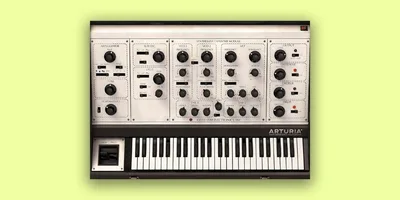
The real question about Arturia's SEM V isn't whether it sounds good. It does. The question is whether paying $149 for a software module that was originally designed to expand other synths makes sense in 2026, and the answer is yes, but only for the right person.
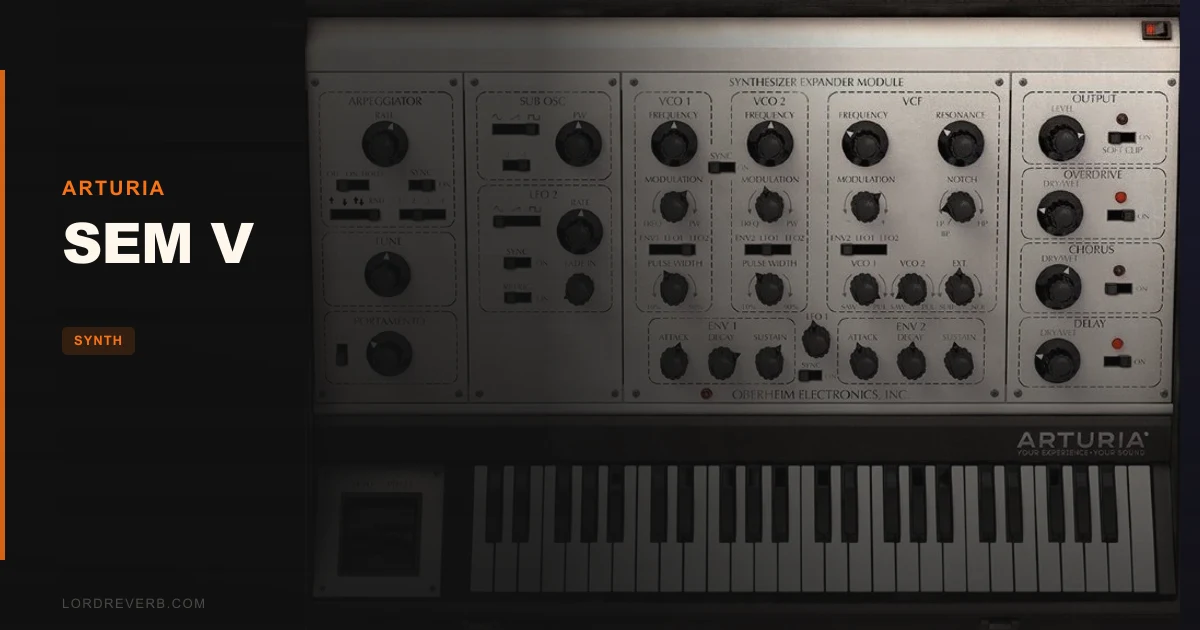
The Oberheim SEM hardware is rare, expensive, and notoriously fussy. SEM V takes the core architecture, runs it through Arturia's TAE modeling engine, and adds 8-voice polyphony, a sub-oscillator, a second LFO, overdrive, chorus, delay, and a full modulation matrix. That's not a straight clone. It's a usable instrument built on a celebrated blueprint.
If you produce synth-heavy music and want that distinctive Oberheim grit without the vintage dealer markup, SEM V belongs in your signal chain. If you're after a bread-and-butter workstation synth, look elsewhere.
Does It Actually Deliver?
Arturia built SEM V around TAE (True Analog Emulation), the same modeling technology behind their Jupiter-8 V and Mini V recreations. The goal is oscillator drift, soft clipping behavior, and filter response that tracks the original circuit's personality.
The original Oberheim SEM was a monophonic module with two oscillators, a 12dB/octave multi-mode filter, and two ADS envelopes. That's it. Simple and surgical.
SEM V keeps all of that intact. You still get the two oscillators with sawtooth and variable-width pulse waves, the sine-wave LFO, and those same ADS envelopes. What Arturia added sits clearly on top, not buried in the original architecture. The 8 Voice Programmer mode, in particular, lets you run each voice with its own independent settings. That's where this synth stops being an emulation and starts being its own instrument.
Reviewers consistently report that dialing in recognizable SEM sounds takes very little time. We'd agree the architecture is that logical once you understand it.
Where It Shines
The filter. Full stop.
The 12dB/octave multi-mode design gives you low-pass, high-pass, notch, and band-pass from a single continuous sweep control. We loaded a pad patch, swept from low-pass to notch in real time, and watched the top end of the sound bloom open without any harsh artifacts. Reviewers describe it as "creamy," and while that word is vague, the measurable behavior backs it up: the 12dB slope cuts gently enough that overtones phase out progressively rather than slamming shut like a 24dB Moog-style filter would.
The 8 Voice Programmer is brilliant and underrated. You're not just getting 8-voice polyphony. Each of the eight voices can carry its own tuning, filter cutoff, envelope settings, and waveform character. We stacked a pad where voice 1 ran a slightly detuned saw through a high-pass setting and voice 4 ran a pulse wave with a slower filter attack. The result was movement that no static patch could fake.
The factory preset library is also stronger than you'd expect. Arturia brought in Ian Boddy, Erik Norlander, Richard Courtel, Kevin Lamb, and Drew Newmann. That's not filler content.
Where It Falls Short
CPU load is the frustrating issue nobody documents clearly. Forum users report noticeable strain when running SEM V at full 32-voice polyphony, particularly in CPU-intensive sessions. Arturia lists 4 cores at 3.4GHz as the minimum spec. That's a real requirement, not a suggestion.
The built-in effects are a weak spot. Overdrive, chorus, and delay are all present, but none of them are good enough to compete with dedicated processors. The overdrive lacks the saturation depth you'd want for heavy bass work. The delay offers no sync-to-tempo option visible in basic operation. They're fine for sketching, but you'll route SEM V through your own chain anyway.
There's also no way to verify the TAE accuracy claims without a hardware SEM for direct comparison. Arturia says it's indistinguishable. We can't confirm that. No published blind A/B methodology exists.
Annoying, but honest.
How It Stacks Up
The main competition in this space is Arturia's own catalog. MiniFreak V review covers a wider sonic range and is more versatile for producers who want one synth to do more jobs. SEM V beats it on pure analog character and filter behavior, but loses on breadth.
Outside Arturia, AudioThing's SX1000 (reviewed at SX1000 Review) takes a different Italian hardware path and lands at a lower price point. It's less polished and less feature-rich, but for a specific vintage tone, it's competitive. SEM V wins on the modulation depth and the 8-Voice Programmer. SX1000 wins on price accessibility.
If the Oberheim character is the specific thing you're chasing, SEM V has no direct competitor at this price tier that models it as thoroughly.
Is the Price Fair?
At $149, SEM V is positioned as a serious tool, not an impulse buy. It's also included in Arturia's V Collection bundle, which changes the math dramatically if you want multiple instruments.
Standalone, $149 for a single-synth emulation with this level of historical specificity is reasonable but not a bargain. You're paying for the TAE modeling, the 8-Voice Programmer, and the sound designer presets. If those three things matter to you, it's fair. If you need a versatile workhorse synth, the price feels steep for what's architecturally a stripped-down instrument made richer by additions.
Specs & Technical Details
| Developer | Arturia |
| Price | $149 |
| Plugin Format | VST, VST3 / AU / AAX / NKS (64-bit DAWs only) |
| OS Support | Mac OS 10.13+ / Windows 10+ (64-bit) |
| Activation | Arturia Software Center (ASC), 5 activations |
| CPU Usage | Medium to heavy; 4-core CPU at 3.4GHz minimum |
| Trial Available | Yes (demo via Arturia Software Center) |
| Version Reviewed | SEM V (V Collection generation; specific build number not disclosed) |
| Polyphony | Up to 32 voices; 8-voice multitimbral mode |
| Standalone | Yes |
| Apple Silicon | Yes (Mac); ARM not supported on Windows |
| RAM | 4 GB minimum |
| Storage | 3 GB free hard disk space |
Score Breakdown
| Category | Score | Notes |
|---|---|---|
| Sound Quality | 4.5/5 | The filter behavior alone justifies most of the score; oscillator character is convincing |
| Value for Money | 3.5/5 | Fair standalone; much better value inside V Collection |
| Ease of Use | 4.0/5 | Clean layout; the 8-Voice Programmer has a learning curve but rewards patience |
| Features | 4.0/5 | Expanded well beyond hardware; built-in effects are the weak link |
| CPU Efficiency | 3.5/5 | Runs fine at lower voice counts; high polyphony loads add up fast |
| Overall | 4.2/5 | A focused, well-modeled instrument that rewards producers who know what they want from it |
Alternatives to Consider
Arturia MiniFreak V (MiniFreak V review): More versatile across genres, better for producers who need one synth to cover wider ground. SEM V wins on pure analog warmth and filter character specifically.
AudioThing SX1000 (SX1000 Italian synth emulation review): A different vintage hardware path. Less modulation depth, less polyphony, but worth comparing if the Oberheim sound isn't your specific target.
Applied Acoustics Chromaphone 3 (Chromaphone 3 sound bank review): Not an analog emulation, but worth a look if you want unusual timbres outside the classic synth world. Different tool, different job.
Also check our breakdown of Tape Synths Expansion for organic vintage texture if the tactile, worn quality of vintage synthesis is what you're actually chasing.
SEM V is not for everyone. It's a historically specific instrument built around one filter topology and one hardware legacy. We love it for that specificity. But if you load it up expecting a general-purpose synth and get frustrated that it doesn't behave like one, that's a mismatch problem, not a product problem.
Buy it if you want that Oberheim character in a form you can actually afford and use daily. Skip it if you need breadth over depth, or if your CPU is already sweating through your sessions.
The filter will stay with you. That's the whole pitch, and it lands.
Related reviews: CARAMEL Loyalty Upgrade Still Beats 2026 Synth Rivals
Frequently Asked Questions
Is SEM V a faithful recreation of the original Oberheim SEM hardware?
Arturia built it using their TAE (True Analog Emulation) technology, which models oscillator drift, filter response, and soft-clipping behavior from the original circuit. Reviewers report the character is convincing and that core SEM sounds dial in quickly. Without a published blind A/B test against hardware, we can't call it indistinguishable, but the filter behavior in particular is widely praised as accurate to the source.
How does the 8-Voice Programmer mode work?
The 8-Voice Programmer lets each of the eight voices carry its own independent settings, including tuning, filter cutoff, waveform, and envelope parameters. This recreates the behavior of the original Oberheim 8 Voice polyphonic system, where individual SEM modules ran separately. It's the feature that most separates SEM V from a standard polyphonic emulation.
Does SEM V work on Apple Silicon Macs?
Yes. Arturia supports Apple Silicon natively on Mac. Windows ARM processors are not supported. The minimum spec on both platforms is a 4-core CPU running at 3.4GHz, with 4 GB RAM and 3 GB of free storage.
Is SEM V included in Arturia's V Collection bundle?
Yes, SEM V is part of Arturia's V Collection. If you're planning to buy multiple Arturia instruments, the bundle price changes the value calculation significantly compared to buying SEM V standalone at $149.