Teaching synthesis in a classroom or learning it from a dorm room runs into the same wall: most synth plugins treat spatial audio as an afterthought, a pan knob slapped on after everything else is done. You want to understand how sound moves through space, not just left and right, and almost nothing in the plugin world is built to teach that. That's the gap SkyDust Stereo's Educational Version fills.
Sound Particles bills SkyDust as the world's first spatial synthesizer plugin, and the Educational Version brings that architecture to full-time students and faculty at $99. You'll need to verify your status after purchase, which adds a small administrative hoop, but the price difference over the standard version is substantial. This review is for anyone considering it as a learning tool, a composition tool, or both.
What Problem Does This Actually Solve?
Standard subtractive synths teach left/right panning. FM synths teach harmonic relationships. Neither teaches you how sound inhabits three-dimensional space, which is exactly what modern immersive audio formats demand.
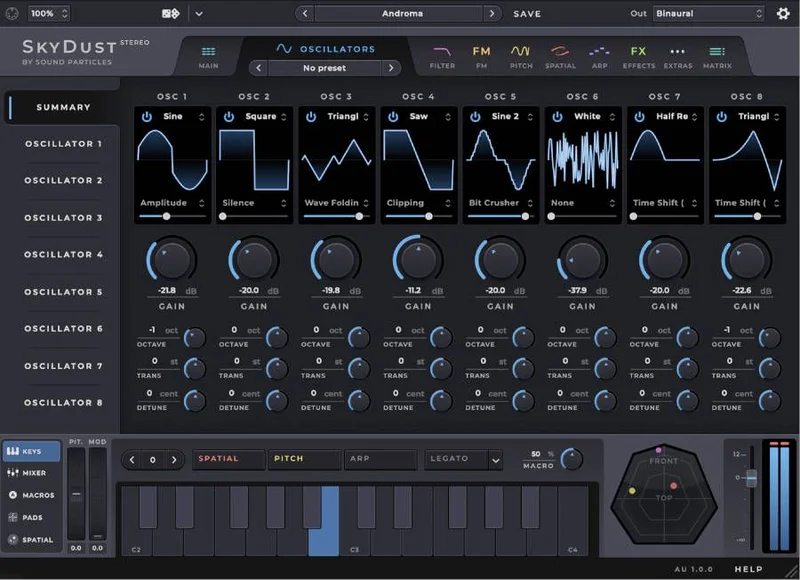
SkyDust's spatial engine is built into the synthesis chain itself, not bolted on at the output stage. Each of the 8 oscillators per voice can hold its own position and movement in 3D space. That's not a mixer feature. That's synthesis-level spatial thinking, and no comparable educational tool approaches it the same way.
For a student working toward Dolby Atmos, game audio, or immersive music production, understanding this at the oscillator level is foundational. The stereo version outputs stereo and binaural only, which is actually ideal for headphone-based learning environments like home studios and dorm rooms.
The frustrating part is that the full spatial output, Ambisonics up to 6th order, 5.1 through 9.1.6, lives in the 3D version only. If your program has a proper immersive rig, you'll eventually want to upgrade. But for learning the concepts? Stereo and binaural gets you very far.
How It Performs in Practice
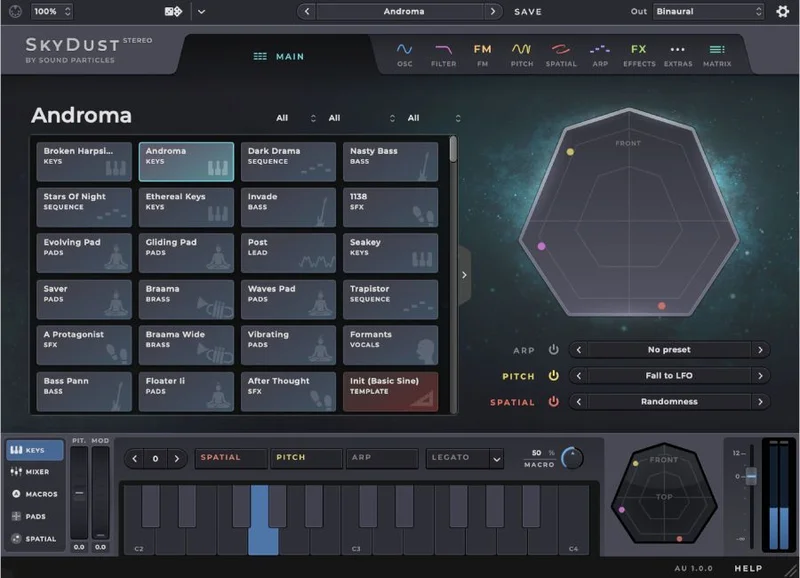
We loaded SkyDust Stereo into a session and pulled up a pad preset to start. The preset browser is genuinely good. You can filter by artist or sound type, which matters when you're working fast or teaching a class and need a reference sound in under ten seconds.
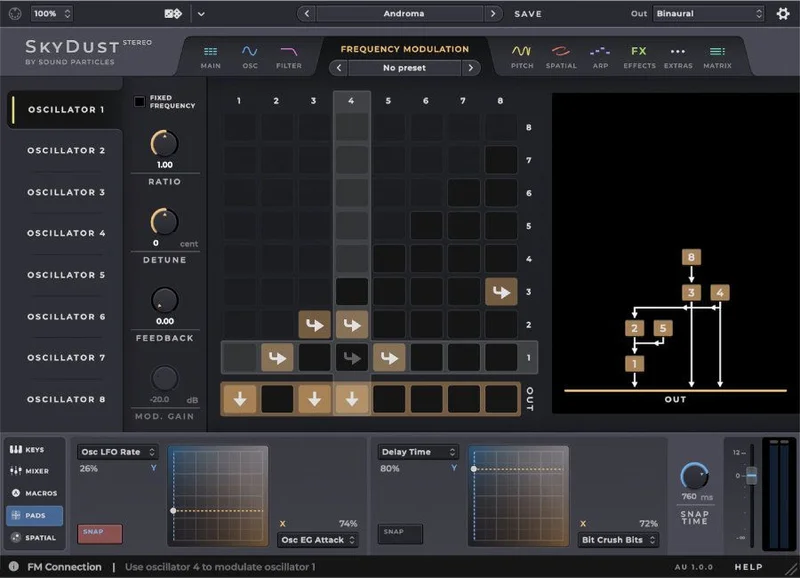
We then built a sound from scratch using three oscillators set to different FM routings via the FM matrix. The visual operator view showed us exactly which oscillator was modulating which, a clarity that textbooks struggle to deliver. Dialling in a metallic, bell-like tone took about four minutes from an initialized patch. That speed matters in a teaching context.
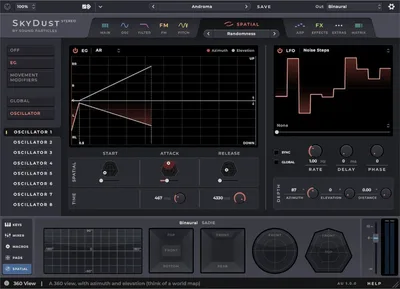
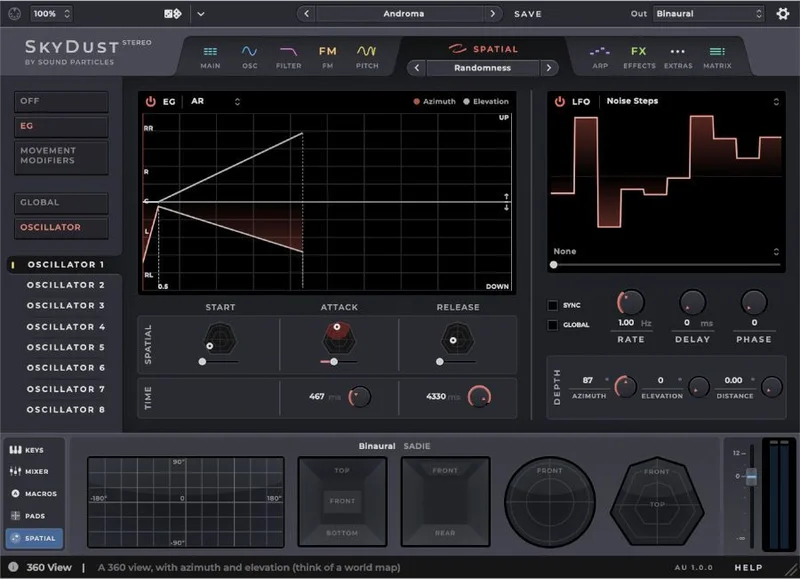
The moment that stayed with us: we assigned a Spatial LFO to the azimuth of oscillator 2 while oscillators 1 and 3 held fixed positions. Through headphones using the binaural engine, oscillator 2 moved. Not panned left-to-right in the traditional sense. It circled. Students hearing that for the first time will have a very specific reaction. It's the kind of thing that makes synthesis click in a way that a diagram never does.
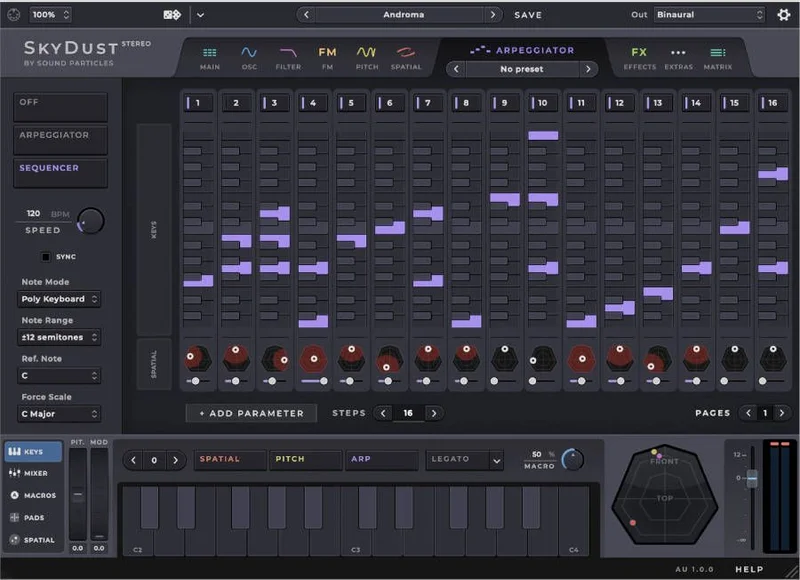
The polyphonic sequencer runs up to 256 voices and handles chord-based sequences with per-step keyboard assignment. We ran an 8-step sequence with spatial movement assigned per step, each note starting in a different position in the stereo field. Satisfying to dial in, and it stayed clean even at high voice counts.
CPU behaviour: the plugin is not light. Eight oscillators per voice across 256 possible voices will push a 4-core machine. Sound Particles specifies a 4-core minimum with 8GB RAM. On a modern laptop, complex patches with active spatial LFOs and multiple FM routings hit the CPU noticeably. Freezing instrument tracks is not optional advice here. It's practical necessity.
Strengths and Weaknesses
The strengths start with architecture. Eight oscillators per voice is generous. The FM matrix is flexible enough to create genuinely strange, interesting sounds without needing a second plugin. The extra 8 EGs and 8 LFOs on top of the per-oscillator modulation are the kind of feature that rewards deep work.
The arpeggiator's 7 modes and polyphonic sequencer feel modern and well-designed. The spatial envelope generators are brilliant: ADSR stages that move a note through 3D positions, from back-of-room attack to ceiling release, is a concept that makes spatial audio intuitive rather than abstract.
The weaknesses are real. The stereo version's output ceiling is a genuine limitation. We wish the educational tier included at least basic multichannel output, even 5.1, to give students a taste of the full system. It doesn't, and that's annoying when the underlying engine clearly supports it.
The educational verification process requires emailing your order number and proof of status to Plugin Boutique support after purchase. It's not the worst verification flow, but it does mean you're not playing on day one. For a classroom scenario with multiple licenses, that friction multiplies.
The interface is large and resizable, which we love. But the feature density is high. New synthesis students who haven't touched FM routing will need to spend real time with the manual before the FM matrix makes sense.
Value for the Price
At $99, this is a significant discount from the standard stereo version. That gap represents real money for a student. The feature set you receive is complete: no crippled oscillator count, no preset limit, no removed modulation options. The only ceiling is output format.
Compared to other educational synth options at similar price points, nothing else offers spatial synthesis as a native architecture. For a student in an immersive audio program, that specificity makes the price easy to justify. For a student in a general music tech program who just wants a great-sounding synth, this is still competitive, though not the only good option in this range.
We'd buy it. With the caveat that you verify you're eligible before adding it to your cart.
Who Should (and Shouldn't) Buy This
- ✅ Buy if you're a music tech or audio engineering student with a focus on immersive or spatial audio production.
- ✅ Buy if you're faculty looking for a teaching tool that makes spatial synthesis concepts tangible rather than theoretical.
- ✅ Buy if you need a deep, feature-complete synth for composition and sound design and qualify for the educational discount.
- ❌ Skip if you need multichannel or Ambisonics output for your current projects. You'll need the 3D version.
- ❌ Skip if you're a beginner who hasn't worked through FM synthesis basics yet. The learning curve is steep and this plugin won't hand-hold you.
- ❌ Skip if you're not enrolled as a full-time student or currently faculty. You're not eligible, and the standard version is the only option.
Specs & Technical Details
| Spec | Detail |
|---|---|
| Developer | Sound Particles |
| Price | $99 |
| Plugin Format | VST3 / AU (AUv2) / AAX |
| OS Support | Mac (macOS 10.13+) / Windows (Windows 10+) |
| Activation | Post-purchase educational verification via email to support |
| CPU Usage | Heavy, 4-core minimum required, 8GB RAM minimum |
| Trial Available | N/A, educational version; check Sound Particles site for demo options |
| Version Reviewed | SkyDust Stereo Educational Version (2026) |
| Disk Space Required | 1.3GB |
| Output Formats | Stereo and Binaural only (3D version required for multichannel/Ambisonics) |
| Oscillators | 8 per voice |
| Max Polyphony | 256 voices |
Score Breakdown
| Category | Score | Notes |
|---|---|---|
| Sound Quality | 4.5/5 | Anti-alias engine keeps it clean; spatial binaural engine is genuinely impressive through headphones |
| Value for Money | 4.0/5 | Educational discount is substantial; full feature set included except output format ceiling |
| Ease of Use | 3.5/5 | Feature density is high; FM matrix and spatial routing have real learning curves |
| Features | 4.5/5 | 8 oscillators, 256 voices, full FM matrix, spatial EGs, LFOs, arpeggiator, polyphonic sequencer, nothing missing except multichannel output |
| CPU Efficiency | 3.5/5 | Resource-heavy on complex patches; track freezing becomes a workflow habit not a choice |
| Overall | 4.2/5 | A serious spatial synthesis tool that earns its place in any immersive audio curriculum |
Alternatives to Consider
If the spatial angle isn't your priority and you want a deep synth for sound design learning, Arturia MiniFreq V review is worth a close look. It covers a wide synthesis range in one package and sits in a similar price bracket at standard pricing.
For students who want physical modelling rather than oscillator-based synthesis, Chromaphone 3 sound bank review covers a completely different tonal territory and teaches resonance-based thinking rather than FM or subtractive approaches.
If you're drawn to classic analogue-style synthesis with a simpler architecture to build fundamentals before tackling something as complex as SkyDust, Arturia SEM V review is a well-documented, approachable starting point. Learn the signal chain there. Come back to SkyDust when you're ready to push it.
For something built around acid-style synthesis and a very different workflow, Audio Blast ABX3 Bundle review covers ground that SkyDust doesn't even attempt.
Final Word
SkyDust Stereo's Educational Version is not a beginner's first synth and it's not trying to be. It's a specialist tool at a specialist price, designed for students who want to understand spatial synthesis at the oscillator level rather than as a post-mix effect.
The stereo output ceiling is a real limitation if your program has immersive monitoring. Know that before you buy. But if you're learning on headphones or a standard stereo setup, the binaural engine delivers the concepts clearly and the full feature set gives you years of depth to explore.
At $99 with valid educational status, it's one of the more honest deals in the plugin market. Just make sure your ears are ready for what it does to them.
Related reviews: Element 2.0 Virtual Analog Synth vs the Field
Frequently Asked Questions
Who qualifies for the SkyDust Stereo Educational Version pricing?
Full-time students and faculty at an accredited educational institution are eligible. After purchasing, you'll need to email your order number and proof of educational status to Plugin Boutique support. The discount is not available to independent learners or part-time students. Verification is done manually, so budget a day or two before activation.
What's the difference between SkyDust Stereo and SkyDust 3D?
The stereo version outputs in stereo and binaural only. The 3D version adds full multichannel support, from 5.1 through 9.1.6, plus Ambisonics up to 6th order, which includes Dolby Atmos compatibility. The synthesis engine itself is the same in both versions. If your studio has immersive monitoring, you'll want the 3D version. If you're working on headphones or a standard stereo setup, the stereo version covers the core concepts.
How CPU-heavy is SkyDust Stereo on a modern laptop?
It's demanding. Sound Particles specifies a 4-core CPU minimum with 8GB RAM, and complex patches with active spatial LFOs across multiple oscillators will push those minimums hard. On a modern 4-core laptop, we'd recommend freezing tracks as a default habit rather than an emergency measure. A 6-core or 8-core machine gives you noticeably more headroom for layered patches and the polyphonic sequencer.
Does the Educational Version include the full preset library and modulation features?
Yes. The educational pricing only restricts the output format, not the synthesis features. You get the full preset library with filtering and random dice, all 8 oscillators per voice, the complete FM matrix, spatial envelope generators, spatial LFOs, the arpeggiator and polyphonic sequencer, 8 extra EGs and 8 extra LFOs, and the full modulation matrix. Nothing is removed from the synthesis engine itself.