
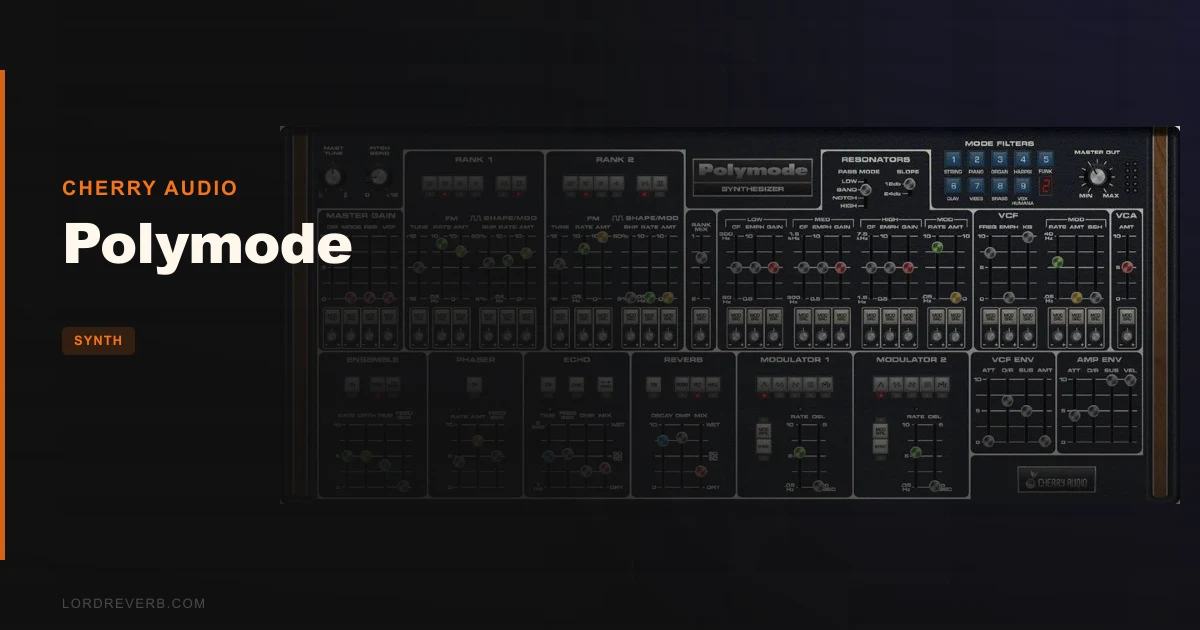
Polymode is Cherry Audio's software recreation of the Moog Polymoog, and it's one of the most sonically distinct polyphonic synths available as a plugin right now. We were three hours into a late session working on a slow-burn cinematic cue when we pulled Polymode up on a MIDI channel feeding an orchestral template. We wanted something that wasn't strings, wasn't pads, wasn't quite either. We dialed up one of the factory string presets, hit a Cmaj7 voicing low in the keyboard, and the mix shifted immediately. Not with a generic pad texture. Something thicker. More alive. The Mode Filter and Resonator working in parallel gave the chord this organ-meets-string quality that no amount of stacking Serum patches had managed in the previous hour. That's the moment we understood what this plugin is actually for. Polymode is priced at $39, it runs across all major formats, and it's built for producers who want something that sounds like nothing else in their plugin folder.
First Impressions: Opening a Plugin That Doesn't Look Like Anything Else
The interface hits you immediately. It's wide, it's dense with controls, and it doesn't follow the standard oscillator-filter-envelope left-to-right layout that most synths default to. Cherry Audio has clearly tried to modernize the Polymoog's chaotic front panel without stripping its character, and largely they've succeeded.
The layout runs in broad horizontal sections: Oscillator Ranks at the top, the Mode Filter and Resonator bank in the middle, the classic Ladder VCF below that, and then the effects chain along the bottom. Once you grasp that structure, navigation becomes natural. But it takes a moment.
The presets browser loads instantly and the 150-plus presets are organized well. We auditioned about thirty in the first ten minutes. Roughly two-thirds of them were genuinely interesting starting points, which is a better hit rate than most synths of this price.
Installation via the Cherry Audio downloader is clean. Activation is tied to a Cherry Audio account and is straightforward. No iLok. No dongle. AU, VST, VST3, AAX, and standalone all appeared in our DAW immediately after install.
Getting It Into a Real Workflow: Where Polymode Fits and Where It Doesn't
Drop Polymode onto a track and the first friction point is orientation. If you've never touched a Polymoog or thought about paraphonic architecture, the signal flow will feel unfamiliar. Most modern synths run a clear oscillator-to-filter-to-amp path. Polymode runs two oscillator ranks into a parallel filter bank where the Mode Filter, the Resonators, and the Ladder VCF all operate simultaneously on the signal. That's the engine. That's also the thing that takes twenty minutes to internalize.
Once it clicks, workflow improves sharply. The 32-voice polyphony means you're not managing voice stealing on dense chord progressions, which is satisfying. Play an eight-note chord with the full polyphony running and it doesn't thin out or choke.
For modern electronic music, there's a friction point worth naming honestly. The architecture is optimized for sustained textures: strings, pads, choral tones, slow-moving chords. It's not fast. Pluck patches and percussive sounds feel retrofitted rather than native to this engine. If your session is built around quick arps, punchy leads, or anything with sharp transient definition, Polymode will fight you.
Automation writes cleanly. We tested DAW automation on the Resonator frequency knobs and the LFO rate simultaneously, and both tracked without stepping or zipper noise. Full DAW automation for all controls is confirmed and it works as advertised.
The standalone mode is genuinely useful for sound design sessions outside the DAW. We spent a half-hour in standalone just exploring the Resonator section. No latency surprises, no odd behavior.
MIDI implementation is full and clean. Velocity, pressure, and a range of modulation sources including white and pink noise all route into the mod matrix, and they respond quickly to hardware controller input.
The Oscillator Ranks: Two Waves, Two Layers, One Complex Starting Point
The Polymoog's oscillator architecture was one of its most unusual features. It ran a dedicated oscillator for every key on the keyboard rather than a shared voice pool, and that's part of what gave the original its specific smeared, dense character. Cherry Audio recreates this approach with two oscillator ranks, each capable of running simultaneously available sawtooth and pulse waves.
Rank 1 and Rank 2 behave as two distinct oscillator layers. You can detune them against each other, adjust their individual levels, and dial in the pulse width on the pulse wave. The pulse width modulation is responsive and adds noticeable movement to sustained chords when driven at moderate rates.
The sawtooth wave in Rank 1 is the workhorse. It's full through the mids with a sharp high-frequency edge that the Mode Filter and Resonators then shape dramatically. The combination of saw and pulse running simultaneously from the same rank is what lets Polymode build that organ-like harmonic density before any filtering even happens.
The octave controls for each rank let you spread the oscillator layers over multiple octave ranges. We found stacking Rank 1 at 8' and Rank 2 at 4' gave the most useful orchestral string character. Drop both to 16' and the bottom end becomes legitimately massive, though you lose clarity fast if the mix is already low-heavy.
One limitation: there's no wavetable import, no FM modulation path, no sample layer. The oscillator section is purely analog-modeled saw and pulse. That's the right call for a Polymoog recreation, but if you want more timbral variety from the source oscillators themselves, Polymode is not the tool.
The Mode Filter: The Heart of the Polymoog Sound
This is where Polymode separates itself from every other polyphonic softsynth we've used. The Mode Filter is a bank of nine selectable filter shapes that closely recreate the original Polymoog's distinctive voicing options. These are not just different cutoff settings. They're genuinely different filter characters with different resonance behavior and frequency contours.
The nine modes range from a full-bandwidth open sound through increasingly shaped bandpass and low-cut variants. Each one imposes a different tonal signature on the oscillator output before the signal even reaches the Resonators or the Ladder VCF. In practice, this means choosing a mode is less like adjusting a filter and more like choosing a different instrument character.
We loaded a basic sawtooth preset with no effects and stepped through all nine modes on a sustained chord. The difference between mode 1 and mode 9 is dramatic: from a wide, orchestral bloom to a thin, nasal mid-forward voice that sounds more like a reed instrument than a synth pad. The middle modes sit in genuinely useful territory for mix work.
The Mode Filter doesn't expose a cutoff knob the way a standard filter does. The shape is the shape. That's intentional and historically accurate. It's also the thing that frustrates producers expecting classic filter-sweep behavior. If you want to automate a sweeping filter motion, that's what the Ladder VCF is for. The Mode Filter gives you fixed character, not a dynamic variable.
What makes the Mode Filter clever from a sound design standpoint is how it interacts with the Resonator section running in parallel. The Mode Filter shapes the midrange character, the Resonators add formant-like peaks, and the Ladder VCF handles the broadband low-pass sculpting. All three layers inform the final sound simultaneously, and that layering is what no other affordable polyphonic synth currently offers.
The Resonator Section: Cherry Audio's Biggest Expansion
The original Polymoog's Resonators were fixed-frequency bandpass filters tuned to specific intervals that gave the instrument its famously alive, almost vocal quality. Cherry Audio kept this architecture and then added meaningful controls that the original never had.
The expanded Resonators section in Polymode gives you three resonant filter bands. Each band has its own frequency, resonance, and gain controls. More importantly, Cherry Audio added a dedicated LFO for the Resonator section, switchable slope options at 12dB and 24dB per octave, and a notch mode that inverts the bandpass into a notch filter shape.
The 12dB versus 24dB slope choice changes the Resonators significantly. At 12dB, the peaks are broader and the formant effect sits softer in the mix. At 24dB, the peaks become sharper and the Resonators take on a more aggressive, almost vowel-like quality. For choral pads and string textures, 12dB is usually more natural. For lead patches or more synthetic textures, 24dB adds a cutting, almost wah-like character.
The notch mode is a genuine addition. We set one Resonator band to notch and tuned it to around 800Hz on a pad sound that was competing with a guitar part in a mix. Pulling a notch at that frequency with the Resonator gave a more musical result than static EQ because the notch depth varied with the input signal's envelope. It breathed with the pad rather than cutting statically.
The Resonator LFO is separate from the two main LFOs lower in the signal chain. It runs five waveforms and can sync to tempo. We set it to a slow triangle wave at 0.3Hz on the Resonator frequency of all three bands simultaneously and the result was a subtle animate wobble that made a simple string pad feel like something a real ensemble was playing. That kind of slow organic motion is what Polymode does better than almost anything at this price.
One frustration: you can't route individual Resonator bands to separate destinations. They all live in the same section and feed the same output path. For more surgical formant work, that limitation becomes real. The three bands are enough for most pad and string work, but if you're hoping to build complex vocal formant synthesis, you'll hit the ceiling.
The 24dB Ladder Filter VCF: Modern Control Over a Vintage Sound
Below the Mode Filter and Resonator section sits the classic 24dB Ladder-style VCF. This is the filter you know from Moog-heritage designs: a four-pole low-pass with a resonance that can self-oscillate, a cutoff that sweeps from subterranean bass rumble all the way into thin, fizzy wire territory.
Cherry Audio's implementation sounds right. The resonance has weight. At high resonance settings there's a genuine squelch character that doesn't feel digital or brittle. Self-oscillation happens cleanly above about 90% resonance and tracks pitch if you want to use it as a sine-wave sound source, which is a nice bonus.
The VCF has its own dedicated envelope with attack, decay, sustain, and release, plus envelope amount. You can set positive or negative envelope depth, giving you both the classic filter-open sweep and an inverted envelope that closes the filter as notes sustain. The inverted envelope into a pad preset is a good trick for making pads that bloom backward, sitting further under the mix at note-on and opening as the note sustains.
The cutoff modulation routing from LFO is clean and wide-ranging. We ran LFO 1 into the VCF cutoff at medium depth with a slow sine wave and the resulting filter movement was smooth with no audible stepping or zipper noise. That kind of clean LFO-to-cutoff response matters more than most specs.
One specific note about the Ladder VCF in context: because the Mode Filter and Resonators are already shaping the signal upstream, the VCF is often working on a sound that's already complex. This means you don't need to push the VCF as hard as you would in a simpler signal chain. We found that keeping VCF cutoff between 40% and 70% and using the envelope for movement gave better results than dramatic sweeps. The upstream filtering does most of the tonal heavy lifting.
Modulation Architecture: Where the Animation Lives
Polymode gives you extensive modulation routing for almost all synthesis parameters. The two main LFOs each offer five waveforms: sine, triangle, sawtooth, reverse sawtooth, and square. Both LFOs support tempo sync, which is useful for filter modulation that locks to a track's grid.
Beyond the LFOs, modulation sources include velocity, pressure (channel aftertouch), white noise, and pink noise. The noise sources as modulation inputs are underused in most synth patches but they're genuinely useful here. We routed a small amount of white noise into the Resonator frequency controls and the result was a subtle, organic randomness that made a string preset feel less like a synth and more like a real ensemble with natural intonation variation.
Pressure modulation deserves a specific mention. Cherry Audio has routed aftertouch deeply into the architecture. We mapped pressure to Resonator resonance amount and VCF cutoff simultaneously on a pad patch. Playing a sustained chord and leaning into the keys opened both controls together, giving an expression-forward swell that worked brilliantly in a slow film cue context. If you play with a keyboard that sends aftertouch data, Polymode rewards that hardware investment.
The modulation matrix is wide. "Extensive modulation routings for almost all synthesis parameters" is the spec, and it holds up. There are a small number of parameters that aren't fully automatable, but we didn't hit any significant gaps in the routing options during real session work.
One limitation is that the modulation system doesn't include a dedicated mod matrix view with a visual grid showing source-to-destination assignments. Routing is handled at the individual parameter level. For complex patches with multiple modulation sources running simultaneously, keeping track of what's modulating what requires attention. It's not a dealbreaker, but a visual matrix would have made sound design sessions faster.
The Effects Chain: Ensemble, Phaser, Echo, Reverb
The integrated effects section is one of Polymode's most practical features for modern workflow. It runs four processors in series: ensemble, phaser, tempo-synced echo, and reverb. All four are enabled or disabled independently, and all parameters are automatable.
The ensemble is the headline effect here. Cherry Audio includes a Solina-style tri-chorus mode that's specifically modeled after the ensemble circuit in the ARP Solina string ensemble. We ran a basic saw wave chord through the tri-chorus with no other effects and the result was immediate and satisfying. The three-phase chorus spread created a wide stereo image that made a mono oscillator sound like a twelve-piece string section. It's not subtle. It's the right kind of not-subtle for this genre of sound.
The standard ensemble mode has depth and rate controls, and at slower rate settings it behaves more like a subtle widener than an obvious chorus. That subtle setting is what we'd use in a dense mix where the pad needs width without calling attention to itself.
The phaser is a classic all-pass design with rate, depth, and feedback controls. It adds movement without the pitch-shifting character of the chorus. We found it most useful on lead patches where the ensemble felt too wide. The phaser kept the sound in a narrower stereo field but still gave it animation.
The echo is tempo-synced, which is the correct call for any production-focused plugin. Dotted-eighth and quarter-note delays on pad patches are immediately useful for adding rhythmic interest to sustained chords. The delay's feedback and tone controls are straightforward. It's a utility echo, not a detailed tape emulation, but it doesn't need to be more than that inside an already-complex plugin.
The reverb is the weakest of the four effects. It's functional: you get size, damping, and mix controls, and it adds space. But compared to dedicated reverb plugins, it's thin. It works as a quick finish coat for a patch that needs to sit back in a mix, but we'd typically bypass it and use a send reverb in the DAW instead for anything that needs to sound truly spatial. Reviewers report the same verdict: the reverb is fine for sketching, not fine for final printing.
The Ensemble Section in Detail: Tri-Chorus and Beyond
The Solina-style tri-chorus deserves its own discussion because it's central to what makes Polymode's pad sounds distinctive. The original Solina String Ensemble used a three-bucket-brigade-device chorus circuit that created a characteristic warbling, spreading motion unlike single-voice chorus designs. Cherry Audio's recreation uses the same three-phase approach.
In practice, the tri-chorus at moderate depth settings adds a shimmer that sits between detune and chorus. It's neither the clean shimmer of a detuned supersaw nor the obvious wobble of a deep chorus. It's the specific texture you hear on vintage orchestral synth records from the late 1970s.
We placed a Polymode pad with tri-chorus engaged under a slow melodic guitar line in a mix. The two elements didn't compete. The tri-chorus spread the pad wide and pushed it to the back of the stereo image naturally, without EQ cutting needed. That's the kind of mix behavior that saves you ten minutes of arrangement work.
The ensemble rate and depth controls affect both the standard ensemble and the tri-chorus mode depending on which is selected. Faster rates in tri-chorus territory start to produce a slight pitch modulation that can sound unstable on precise harmonic content. We'd keep tri-chorus rate below 1.5Hz for anything requiring pitch accuracy. Above that, the warble becomes character-defining rather than supportive.
Preset Library: 150+ Sounds and How to Actually Use Them
One hundred and fifty-plus presets is the spec, and the quality distribution is better than average. We worked through the library systematically and found roughly three categories worth knowing about.
The string presets are excellent. They range from thin, glassy textures that work as high-end sweetener to dense, orchestral washes that can anchor a cinematic arrangement. Several of the string presets use the Resonators set to 12dB slope with slow Resonator LFO motion, and they demonstrate the best of what this architecture does.
The pad presets divide into usable and obvious. About half of them are rich, complex starting points that reward editing. The other half sound like stock pad presets: they're competent but generic. The ones that lean into the Mode Filter's more unusual voicings are consistently more interesting than the ones that rely entirely on the Ladder VCF for character.
The organ and choral presets are where the Mode Filter most clearly earns its keep. A handful of presets use Mode Filter voicings in the mid-range modes to produce a reed organ character that doesn't sound like a dedicated organ plugin but sits usefully in a mix as a textural middle voice. We used one of these on a jazz arrangement over a Hammond simulation and the two didn't clash at all.
Lead presets are the weakest category. There are several, but most of them lack the definition and attack clarity that you'd want for a cutting lead in a modern context. The architecture simply isn't built for it. The sustain-forward character of the Mode Filter and the parallel filtering system add too much texture for a lead that needs to punch through a dense mix on its own. Users who've pushed Polymode's lead presets into hip-hop or electronic contexts report the same finding.
The preset browser has basic search and category filtering. It's functional. No advanced tagging, no sonic similarity browsing. For a 150-preset library, what's there is enough.
CPU Performance: What 32-Voice Polyphony Actually Costs
This is the gap that most Polymode coverage hasn't addressed directly, so we're going to. The plugin's CPU behavior under full load is noticeable and worth knowing before you commit.
With all four effects enabled, the tri-chorus active, both main LFOs running, and a full eight-note sustained chord holding 32 voices, Polymode draws meaningfully more CPU than single-voice synths. It's not catastrophic. It won't instantly cause dropouts on a modern quad-core system with a reasonable buffer size. But it's not light. A 256-sample buffer at 48kHz on a recent Apple Silicon machine handled it without issue. Drop the buffer to 64 samples for low-latency live playing and you'll feel it.
Cherry Audio's system requirements call for a 3.4GHz quad-core or Apple M1 with 8GB RAM. That's a realistic spec. On M1 and later Apple Silicon, the performance is clean. On older Intel systems at lower buffer sizes, we'd recommend keeping the effects chain lean or freezing Polymode tracks once the patch is set.
Apple M1 Ultra support is specifically confirmed. Native Apple Silicon builds are available and they perform noticeably better than Rosetta 2 translation on the same hardware. If you're on Apple Silicon, make sure you're running the native build.
Windows performance follows the same pattern. Quad-core or better at 8GB RAM is the real minimum for comfort. Budget Windows laptops with dual-core CPUs will struggle at low buffer sizes with the effects chain fully engaged.
The honest comparison: a single Serum instance with a multi-oscillator patch and heavy effects is lighter than a fully loaded Polymode. The parallel filter architecture carries a processing cost that you don't pay in a standard single-path synth. That cost is worth it for the sound, but you should plan for it in your session's CPU budget.
What It's Genuinely Good At
Polymode is specifically excellent at slow-evolving textures with complex harmonic movement. No other plugin at this price gives you the combination of Mode Filter voicing, Resonator formant shaping, and Ladder VCF in a parallel architecture. That's not marketing copy. That's a structural difference from everything else in this price range.
The 32-voice polyphony means dense, lush chord voicings without voice-stealing artifacts. Play a Gmaj9 with extensions in both hands and every note sustains completely without any voice cutting off another. For pad and string work, that full polyphony is the right call.
The Solina-style tri-chorus is the best chorus included with any synth we've used at this price point. It adds width and movement that sounds like a real ensemble spread rather than a digital imitation of one.
The modulation routing depth is impressive for the price. Pressure to resonance, noise sources to Resonator frequency, tempo-synced LFOs into the VCF: all of these work cleanly and give you evolving patches that breathe in a mix rather than sitting static.
And the presets, while uneven, have enough strong entries that Polymode functions well as an instant gratification tool for sessions when you need an atmospheric texture fast.
The Rough Edges
The reverb is weak. We've said it, and it's the honest truth. It's fine for rough sketching but you'll bypass it for any final production work. That's a missed opportunity given how strong the ensemble and phaser are.
The CPU cost at full load is real. On a heavily loaded session, you'll want to freeze or bounce Polymode tracks rather than running multiple instances live.
There's no visual modulation matrix. For a synth with this much routing depth, tracking your modulation assignments by memory or manual inspection gets annoying quickly. This is the single workflow improvement we'd most want in a future update.
Lead and percussive sound design isn't what this engine is built for. If more than 30% of your work involves punchy leads, bass stabs, or arpeggiated sequences with sharp transient character, Polymode will leave you wanting. It's not a flaw in the design. It's a boundary of the architecture.
The Mode Filter has no sweepable cutoff. That's historically accurate but modern producers expecting filter automation from the main character filter will need to re-route that expectation toward the Ladder VCF. Not a bug, but an adjustment period is real.
Who This Is Really For
- ✅ Buy if you make cinematic, ambient, or film music and need atmospheric pads that sit wide without crowding a mix
- ✅ Buy if you produce vintage-style synthwave or retrowave and want authentic Polymoog character without sourcing and maintaining hardware
- ✅ Buy if you already have a lead synth you love and need something specifically for evolving string and pad textures to complement it
- ❌ Skip if your main genre is trap, drill, or modern hip-hop where punchy leads and short-decay sounds dominate your palette
- ❌ Skip if you're running sessions on older hardware under tight CPU constraints and can't afford the processing overhead
- ❌ Skip if you want an all-in-one synth that handles leads, basses, pads, and keys equally well, because Polymode doesn't pretend to be that
If you want a broader polyphonic synth that covers more sonic ground, the Arturia MiniFreak V review is worth reading alongside this one. The two plugins cover genuinely different territory.
Specs & Technical Details
| Developer | Cherry Audio |
| Price | $39 |
| Plugin Format | VST / VST3 / AU / AAX / Standalone |
| OS Support | Mac (10.13 or above, including macOS 13 Ventura) / Windows (7 or above, including Windows 11) |
| Architecture | 64-bit required on both platforms |
| Apple Silicon | Native M1 support confirmed, including M1 Ultra |
| Polyphony | 32 voices |
| Oscillator Ranks | 2 (simultaneous saw and pulse per rank) |
| Mode Filters | 9 voicings |
| Resonator Slopes | 12dB and 24dB per octave, plus notch mode |
| Effects | Ensemble (inc. Solina-style tri-chorus), phaser, tempo-synced echo, reverb |
| LFOs | 2 main + 1 dedicated Resonator LFO (5 waveforms each, tempo sync) |
| Presets | 150+ |
| Recommended CPU | 3.4GHz Quad-Core or M1, 8GB RAM |
| Activation | Cherry Audio account (no iLok required) |
| CPU Usage | Medium to heavy under full load |
| Trial Available | Yes (Cherry Audio offers trials via their platform) |
| Version Reviewed | 1.4.0 |
Score Breakdown
| Category | Score | Notes |
|---|---|---|
| Sound Quality | 4.5/5 | The parallel filter architecture produces genuinely distinctive pad and string textures unavailable elsewhere at this price |
| Value for Money | 4.5/5 | At $39 the depth of architecture, 32-voice polyphony, and tri-chorus alone justify the spend |
| Ease of Use | 3.5/5 | Steeper than average learning curve for the Mode Filter concept; no visual mod matrix makes complex patches harder to manage |
| Features | 4.0/5 | Strong feature set for its niche; limited appeal outside sustained textures, and the reverb underdelivers |
| CPU Efficiency | 3.5/5 | Noticeably heavier than single-path synths at full load; fine on modern hardware, requires planning on older rigs |
| Overall | 4.2/5 | A specialist tool that excels in its lane; not an all-rounder, but arguably the best affordable Polymoog-architecture synth available |
How Polymode Compares to the Field
The most common comparison users reach for is Arturia's SEM V, which also draws from vintage analog polyphony. The Arturia SEM V review shows a synth with a cleaner, less complex signal chain that handles leads and melodic work better. Polymode beats it specifically on pad density and ensemble character. For string and choral textures, it's not close.
For producers who want more percussive or acoustic-adjacent textures, the Chromaphone 3 sound bank review shows a completely different approach to polyphonic synthesis that covers ground Polymode doesn't. They don't really compete. They complement.
AudioThing's SX1000 is another vintage Italian synth emulation worth knowing about. The AudioThing SX1000 review covers a narrower timbral range than Polymode but with a more focused sound design experience. SX1000 wins for immediate workflow. Polymode wins for depth and variety of pad character.
If you're comparing Polymode to mainstream workhorses like Serum or Vital: don't. They're different tools for different jobs. Serum gives you spectral precision and modern sound design flexibility. Polymode gives you a specific vintage architecture that Serum can't convincingly imitate. If you want both, you want both.
The Audio Blast ABX3 Bundle review is worth a look if your primary interest is more acid-adjacent territory. That's a completely different sonic world, and reading both reviews together helps clarify where Polymode sits in a plugin collection.
The Broader Picture: Why the Polymoog Architecture Still Matters in 2026
The original Moog Polymoog was commercially available from 1975 to 1980. It sold roughly 1,500 units and was notoriously unreliable in live use. Finding a working hardware unit today costs serious money and usually involves ongoing maintenance costs. Cherry Audio has made the core sound accessible for $39.
But the more important point is architectural. The Polymoog's parallel filter system, where every key had its own resonant filter bank running simultaneously with the main VCF, produced a density of harmonic movement that no single-filter synthesizer can replicate. When a chord was held, every voice was being shaped by its own resonant path. That's why Polymoog pads have that specific alive, shifting quality that sounds different from stacked single-VCF voices.
Cherry Audio has kept this architecture intact and added modern controls around it. The expanded Resonators with LFO control and slope switching are the right additions. They don't change what the architecture is. They give you more ways to steer it.
In a 2026 production context, that architecture matters most for producers who are trying to get away from the homogenized pad sounds that come from wavetable synths with identical filter topologies. If your mixes sound like everyone else's mixes, part of the reason might be that you're using similar filter architectures across your whole stack. Polymode is a structural outlier, and structural outliers are useful.
That's not a claim that Polymode makes everything better. It's a claim that different tools produce different sounds, and different sounds are worth having in 2026 as much as they were in 1975.
A Workflow Session: Using Polymode on a Real Track
We built a slow-tempo track at 72 BPM for a sync licensing brief: cinematic, emotional, not orchestral. We opened Polymode in standalone first to dial in the core pad sound before loading it into the session.
We started with a string preset in the mid-range of the Mode Filter. Mode 4 of the nine options gave us a narrow-mid character that pushed the high harmonics back without fully closing them off. We dropped Rank 2 an octave below Rank 1 and raised the Resonator resonance on the middle band to about 65%.
Then we set the Resonator LFO to a triangle wave at 0.22Hz, with a small depth amount feeding the center Resonator frequency. The effect at those settings was barely audible as a specific movement. What it did was keep the pad from sounding static. Small organic shifts over four-second cycles made the pad feel like something recorded rather than triggered.
We brought that patch into the DAW, placed it under a solo piano line, and the two sat together without EQ intervention on either. The Mode Filter's voicing had naturally pulled the Polymode pad's upper-mids back to give the piano's attack register room. That's the kind of mix behavior that takes time to achieve with more clinical tools.
We then automated the Ladder VCF cutoff over a four-bar section where the arrangement opened up. At the peak, we had the cutoff at 75% with the resonance at 40%. The filter opened slowly over two bars and the pad bloomed from a textured mid-range sound to a full-frequency wash. At that moment, the tri-chorus was engaged at low depth and the stereo image widened with the cutoff. It was a genuinely satisfying moment in the session.
We froze the Polymode track after that because with tri-chorus, the Resonator LFO, and the Ladder VCF automation running simultaneously, the CPU draw was at about 18% on a single plugin instance on an M1 Pro. Not catastrophic. But enough that we'd rather freeze and free that headroom for the mix bus processing.
Cherry Audio's Broader Approach: Where Polymode Fits Their Catalog
Cherry Audio occupies a specific position in the current plugin market. They've built a reputation on accurate, affordable emulations of historically significant synthesizers that are either too expensive, too unreliable, or too rare to use practically. Polymode fits that mission well.
Their approach to the Polymoog is honest about what they've done. They've called it "inspired by" rather than "exact emulation of," and the additions they've made (expanded Resonator controls, additional LFOs, modern effects chain) are improvements on the original design, not departures from it. That's the right balance for this kind of project.
Where Cherry Audio has consistently delivered is in making complex vintage architectures accessible without dumbing them down. Polymode is not a simplified version of the Polymoog. It's a more controllable version. The Mode Filter's nine voicings are accurately recreated, the Resonator architecture is faithful, and the parallel filter topology is intact.
What they've added has been additive in the best sense. The extra LFO, the slope switching, the notch mode on the Resonators: these are features that a hardware Polymoog owner would have dreamed of in 1977. Having them in 2026 for $39 is the correct kind of irony.
Final Recommendation
Polymode earns a 4.2 out of 5. It's a genuinely specialist tool that excels in a specific lane and doesn't try to be more than it is.
Buy it if pads, strings, and choral textures are a meaningful part of your work. The parallel filter architecture, the tri-chorus, and the 32-voice polyphony together produce sounds that no other affordable plugin matches. At $39, there's no real argument against it if atmospheric textures are something you actually need.
Skip it if you're looking for a primary synth to cover leads, basses, and percussive sounds. This is not that. It's a specialist that does its specific job brilliantly and the other jobs not at all.
The Polymoog was famously difficult to keep alive in the 1970s. Polymode just works. And for the sounds it makes, that's the whole story.
Related reviews: Strum GS-2 Upgrade from Strum Session · Bassline
Frequently Asked Questions
Is Polymode a sample-based or synthesis-based plugin?
Polymode is fully synthesis-based. There are no audio samples involved. It uses two oscillator ranks with sawtooth and pulse waves running through an analog-modeled signal chain that includes the Mode Filter, Resonators, and Ladder VCF. This means the sound is generated in real time from mathematical models of the original hardware circuits, not triggered from recordings.
Does Polymode require an iLok or hardware dongle for activation?
No. Polymode activates through a Cherry Audio account. You download the installer, log in with your Cherry Audio credentials, and the license is tied to your account. No iLok, no USB dongle, no physical hardware needed for the license.
What does "paraphonic architecture" mean and how does it affect the sound?
Paraphonic architecture means that while multiple notes can be played simultaneously (up to 32 voices in Polymode's case), certain shared synthesis elements, particularly the filter and envelope sections, affect all voices together rather than independently. In the original Polymoog this created a characteristic massed-voice effect where the filter movement applied to all voices simultaneously. It's part of why Polymoog pads have that specific unified character rather than the more independent voice behavior of a fully polyphonic analog synth.
How does the Mode Filter differ from a standard filter with a cutoff knob?
The Mode Filter doesn't have a sweepable cutoff. Instead, it offers nine fixed filter voicings, each with its own frequency contour and resonance character. Choosing a mode is closer to choosing a different instrument voice than to adjusting a filter parameter. The Ladder VCF below the Mode Filter provides the sweepable cutoff control that most producers expect for filter automation. The two work together: Mode Filter for fixed tonal character, Ladder VCF for dynamic movement.
Can Polymode run as a standalone application outside a DAW?
Yes. Polymode includes a fully functional standalone application on both Mac and Windows. The standalone version runs the complete synthesis engine and effects chain, responds to MIDI input, and produces audio output through your audio interface. It's useful for sound design sessions where you want to explore patches without the overhead of loading a full DAW project.
Is Polymode suited for live performance use?
It can work for live use, particularly on modern Apple Silicon hardware where the CPU performance is strong. The 32-voice polyphony and low-latency behavior at comfortable buffer sizes (256 samples and above) make it practical for keyboardists playing pads and string textures. The standalone mode also supports live use without a DAW. On older or lower-powered hardware, the CPU draw at full polyphony with effects engaged may cause issues at the lower buffer sizes needed for low-latency live performance.
How does Polymode compare to a standard chorus plugin for string sounds?
The Solina-style tri-chorus in Polymode is architecturally different from a standard single-voice chorus. It uses three separate chorus paths with different phasing relationships, producing a wider, more diffuse stereo spread that resembles how a real string ensemble occupies stereo space. A standard chorus adds pitch modulation to a single delayed copy of the signal. The tri-chorus spreads the sound across three simultaneous modulated paths, which is why it produces that specific "real ensemble" impression that a simple chorus effect doesn't achieve.