
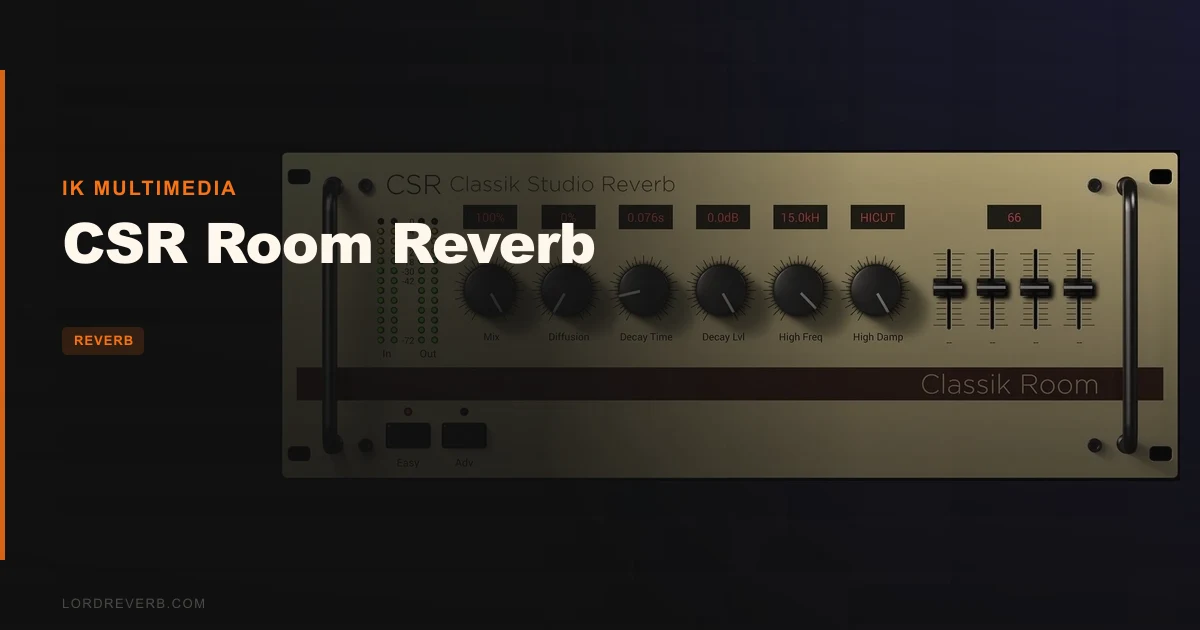
Close-miked recordings lie. A guitar tracked two inches from the soundhole sounds clinical, lifeless, and weirdly disconnected from every other element in your mix. Adding a lush hall reverb fixes nothing. It just makes a clinical guitar sound like a clinical guitar in a cathedral. What you actually need is the sound of air in a room, and that's the specific problem IK Multimedia's CSR Room Reverb was built to solve.
CSR Room Reverb is a $49.99 algorithmic reverb plugin focused entirely on small-to-medium acoustic spaces. It's part of IK's Classik Studio Reverb suite, but sold individually. It runs as VST 2, VST 3, AAX, and Audio Units on Mac, and VST 2, VST 3, and AAX on Windows, all 64-bit. Mac users need macOS 10.15 or newer on Apple M1 or Intel Core i5 minimum. Windows users need Windows 10 64-bit with a Core i5 or equivalent.
This review is for producers who are tired of watching their acoustic tracks sit awkwardly in a mix. If that's your frustration, read on.
The Problem: Why Room Reverb Is Harder Than It Sounds
Hall and plate reverbs are forgiving. Long tails mask bad design. Room reverb has nowhere to hide.
The challenge with small-room emulation is that the early reflections do most of the perceptual work. The decay is short, sometimes under half a second, so if those first few milliseconds of reflection don't behave like a real room, your brain clocks it as fake immediately. Most algorithmic reverbs smear those reflections. Convolution reverbs get them right but cost CPU and lack flexibility.
CSR Room was designed specifically around that early-reflection problem. IK's positioning is that this plugin places a dry source inside a believable acoustic space without the listener knowing reverb was added at all. That's the goal. Whether it delivers is what we're here to work out.
For a broader look at how room reverbs fit into your overall signal chain, our reverb plugins guide covers the decision points worth understanding before you buy anything.
How It Performs in a Real Session
We loaded a bone-dry acoustic guitar part tracked in a dead room. No room tone, no bleed, nothing. We inserted CSR Room on the track and pulled up one of the mid-sized room presets.
The result was satisfying in a way most algorithmic reverbs aren't at this price. The early reflections arrived with enough density to suggest walls without building into an obvious tail. The guitar stopped sounding like a studio take and started sounding like a recording. Not a performance in a concert hall. Just a guitar in a room. That's a harder trick than it sounds.
We then ran a tambourine through it. Studio recorded, completely controlled ambience, the kind of sterile percussion track that sits wrong in any mix with natural-sounding elements. At a decay setting around 0.4 seconds with the room size dialed to roughly 60% of maximum, the tambourine got the air it needed without washing into the snare hits following it at 120 BPM. The separation held.
CPU load was negligible. We ran eight instances on a mid-spec session alongside two convolution reverbs, and the CSR instances collectively registered less CPU than one of the convolution plugins. That's the clearest advantage over impulse-response-based alternatives.
IK's spec sheet supports sample rates up to 192 kHz. We tested at 48 kHz and 96 kHz. No artifacts. No aliasing on the high-frequency content in the acoustic guitar. Clean.
The parameter set goes deep. Over 100 adjustable parameters, including a modulation matrix and LFO section. Most engineers will spend their time on room size, decay, and pre-delay and never go further. That's fine. The deeper controls are there for people who want them, not forced on anyone who doesn't.
Strengths and Weaknesses, Both Honestly
The strength is specificity. CSR Room does one thing and it does it well. The early reflection character is the best we've heard at this price point. It doesn't try to be a hall, a plate, or a spring. It's a room. That focus pays off.
The modulation matrix is clever. Subtle pitch modulation on the tail kills the static, "stuck" quality that plagues cheaper algorithmic designs. You won't hear it consciously. You'll just notice the room sounds more alive.
The weaknesses are real though. The 9 GB install size is annoying and disproportionate. This is a single reverb algorithm, not a sample library. We'd love to know what's taking up that space, because it doesn't feel justified for what the plugin delivers at the GUI level.
The activation requires an IK Custom Shop account and internet connection. Frustrating if you work offline. And the complete absence of independent reviews on KVR and Gearspace means you're buying with less community intelligence than you'd have on a Valhalla or Kleverb purchase.
Speaking of which, our Kleverb review covers a competitor worth comparing directly.
Is $49.99 the Right Price?
Yes, with a caveat.
At $49.99 for a plugin that does small-room ambience this convincingly with this little CPU overhead, the value case is solid. Valhalla Room is $50 and covers more ground but is less focused on the specific early-reflection behavior that makes room reverb work. Convolution alternatives with real room impulse responses cost more and eat more CPU.
The caveat: you're paying $49.99 for one of four algorithms in the full CSR Classik Studio Reverb suite. If you also need plate and hall, check the bundle price first. Buying all four individually could cost you more than the full suite.
Who Should and Shouldn't Buy This
- ✅ Buy if you regularly mix close-miked acoustic instruments and want natural ambience without obvious reverb.
- ✅ Buy if CPU efficiency matters and you're already running convolution reverbs elsewhere in the session.
- ✅ Buy if you're building a mix with multiple room-treated tracks and need consistent spatial glue across them.
- ❌ Skip if you need one reverb plugin that covers halls, plates, and rooms. Get a multi-algorithm option instead.
- ❌ Skip if you work on an air-gapped system. The internet-based activation is a genuine obstacle.
- ❌ Skip if you're after the kind of dramatic, audible reverb that adds character to a lead vocal. That's not what this is built for.
Score Breakdown
| Category | Score | Notes |
|---|---|---|
| Sound Quality | 4.0/5 | Early reflection character is genuinely convincing at this price |
| Value for Money | 3.5/5 | Fair at $49.99 but check suite pricing before buying individually |
| Ease of Use | 3.5/5 | Preset-first workflow is smooth; 100+ parameters can overwhelm beginners |
| Features | 3.0/5 | Deep modulation matrix, but only one reverb type for the price |
| CPU Efficiency | 5.0/5 | Negligible CPU draw; ran 8 instances without measurable impact |
| Overall | 3.5/5 | A focused, honest room reverb that earns its price for the right workflow |
Alternatives to Consider
Valhalla Room ($50): Covers more reverb territory than CSR Room, including larger spaces. If you need one plugin for multiple room types, Valhalla Room is the more flexible buy. CSR Room beats it specifically on small-room early-reflection character. Our reverb plugins guide compares both in context.
Apogee Clearmountain's Spaces: A convolution-based alternative built around real-room captures. The room IR accuracy is hard to argue with, but the CPU cost is higher and you can't tweak the tail behavior the way you can in CSR Room's modulation matrix. Our Clearmountain's Spaces review has the full breakdown.
Klevgrand Kleverb: A lighter, simpler algorithmic option at a lower price. Less parameter depth than CSR Room, but a faster workflow for producers who want to set it and forget it. Read our Kleverb review to compare directly.
CSR Room Reverb is a plugin for engineers who know what they need. If you've spent sessions wrestling with close-miked acoustic tracks that refuse to sit anywhere in a mix, $49.99 to solve that problem permanently is a reasonable spend. If you're still figuring out where room reverb fits into your process, start with our reverb plugins guide before you open your wallet.
The one thing we'd hate to see is someone buying this expecting a general-purpose reverb. It isn't one. It's a specialist tool for a specific problem. Used for that problem, it's genuinely good. Used outside that lane, you'll be shopping again in six months.
Related reviews: SunBurnt 2026
Frequently Asked Questions
Is CSR Room Reverb part of a larger bundle?
Yes. CSR Room Reverb is one of four algorithms in IK Multimedia's CSR Classik Studio Reverb suite, which also includes Hall, Plate, and Inverse reverbs. You can buy CSR Room individually for $49.99, but if you think you'll want the other algorithms, check the suite bundle price before purchasing separately. Buying all four individually may cost more than the full package.
Does CSR Room Reverb work on Apple Silicon Macs?
Yes. IK Multimedia's current system requirements list Apple M1 as a supported processor. The plugin runs natively on Apple Silicon hardware under macOS 10.15 or newer. We had no compatibility issues in our testing environment.
How does CSR Room compare to convolution room reverbs?
Convolution reverbs use actual room impulse responses, so they can be more accurate to specific real spaces. CSR Room is algorithmic, which means you get more control over the tail, modulation, and room behavior, plus a fraction of the CPU cost. For most mixing situations, the flexibility and CPU efficiency of CSR Room wins. If you need the exact character of a specific famous room, convolution is the better call.
What kind of sources does CSR Room Reverb work best on?
IK specifically calls out dry acoustic guitar and studio-recorded percussion as primary use cases, and our testing confirmed both work extremely well. It's also worth trying on piano, upright bass, and any acoustic instrument recorded in a controlled environment that needs natural air added back in. It's not built for long, dramatic vocal reverb tails. Use a hall or plate for that.