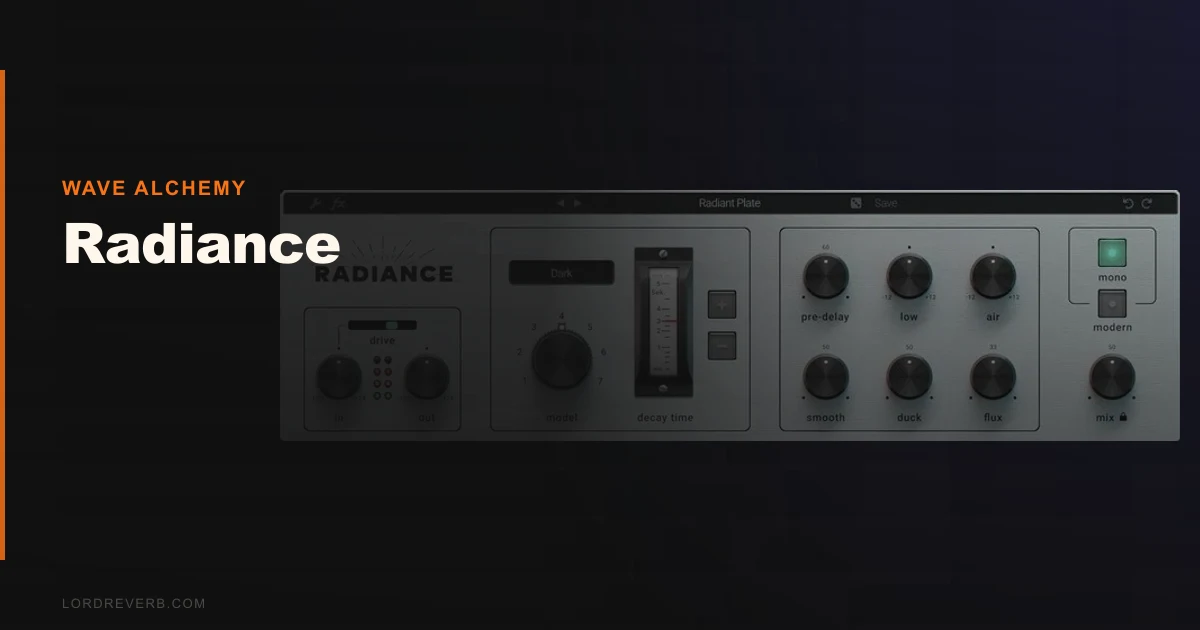
Radiance by Wave Alchemy is a strong plate reverb plugin that earns its $75 price for producers who hate routing chains, but it's not an automatic buy if you already own a capable convolution reverb.
We spent serious time running vocals, snare busses, and clean electric guitar through all seven plate characters. The short version: it sounds good, the extras are genuinely useful, and the demo is free. The longer version is below, including the two things we wish were different.
This review is for mixing engineers, beatmakers, and home studio producers who want a plate that does more than sound pretty. If you're looking for an algorithmic hall or a Lexicon-style shimmer, this isn't it. Radiance is plate reverb and it commits to that lane completely.
What You're Actually Getting
Radiance emulates seven vintage EMT-140 steel plate reverbs. Not seven variations of one emulation. Seven individual plates, each with its own character built from Wave Alchemy's impulse response library with modulation layered on top.
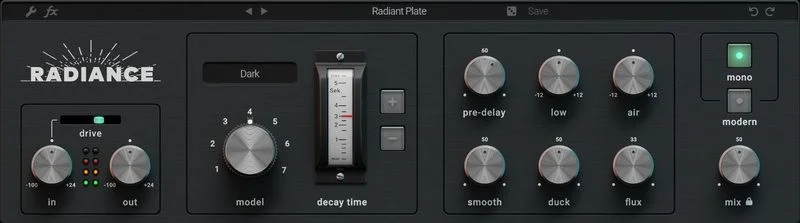
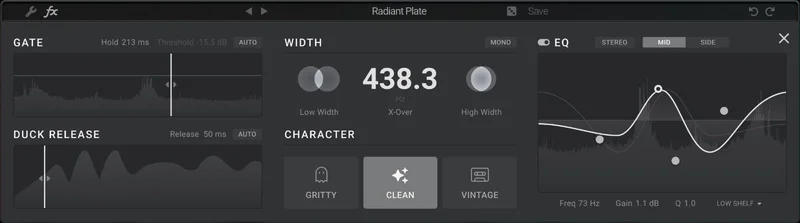
The plugin runs in VST3, AU, and AAX across Mac and Windows. You get pre-delay, decay time, and the usual suspects. But the differentiator is what's built in alongside the reverb itself: a dynamics section, mid-side processing, saturation, and modulation controls. On a standard plate plugin, you'd be hitting three or four other plugins after the reverb to get those results.
A 14-day free demo is available directly from Wave Alchemy. We'd tell you to use it. No reason not to hear it on your own material before spending anything.
The Good
The seven plates aren't cosmetic. We A/B'd them back to back on a lead vocal at 1.8 seconds decay and heard real differences in high-frequency shimmer, low-end bloom, and the density of the early reflections.
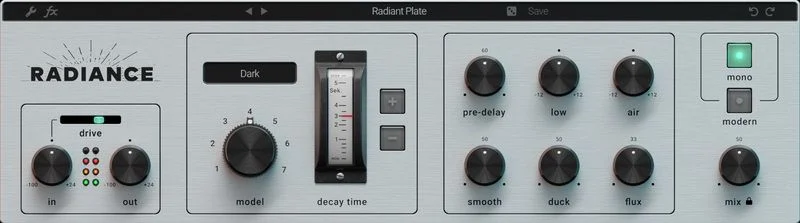
Plate 3 has a darker crown that sits behind a bright vocal without fighting it. Plate 6 is brighter and spreads wider, which we loved on a room snare bus. We ran a tight snare hit through that character at 0.9 seconds. The attack punched through clean. The tail filled the space at around 2-3kHz without muddying the kick relationship below 100Hz.
The M/S processing is satisfying in a way that matters at mixdown. Pulling the reverb out of the sides on a centred vocal keeps the image tight. That's a genuinely clever implementation for a plate plugin at this price.
Saturation adds odd-order harmonic content that thickens the tail without making it obviously distorted. On acoustic guitar it added just enough weight to stop the reverb from sounding thin. We didn't push it hard, but we used it on every session.
The dynamics section is underrated. It lets you duck the reverb tail when new transients hit, which is brilliant for keeping a busy mix from accumulating reverb mud. We had it set with a medium attack and it kept a synth pad reverb from overwhelming a three-element breakdown.
The Not-So-Good
Here's the frustrating part: Wave Alchemy doesn't publish any CPU usage data. None. We ran Radiance on a session with 12 instances. It was fine on our test rig, but we can't give you a number to compare against, say, Apogee Clearmountain's Spaces or any other plate at this price. That's annoying when you're budgeting CPU for a large mix.
The seven plates are a selling point, but plates 1, 2, and 4 share a family resemblance that makes distinguishing them feel like splitting hairs unless you're going back to back on headphones. We'd have traded one of those for something slightly more unusual.
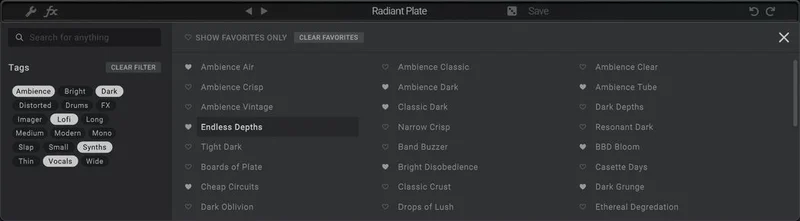
There's also no preset browser beyond the basic factory set. Not a dealbreaker, but if you're the kind of engineer who saves session-specific reverb settings, the lack of a searchable preset library is a small ongoing irritation.
No version number is published prominently in the Wave Alchemy marketing materials, which made it harder to confirm exactly what build we were testing. That kind of documentation gap matters when you're tracking plugin updates.
Compared to the Alternatives
Valhalla Plate is cheaper and has been a go-to for years. It sounds clean and is light on CPU. It does not have M/S processing, dynamics, or saturation built in. Radiance justifies the higher price if you want those tools in one plugin.
UAD EMT 140 is the obvious reference point. It's closer to the original hardware in most engineers' ears. It also requires UAD hardware and costs more. If you're already in the UAD ecosystem, you probably don't need Radiance. If you're not, Radiance is a real alternative, not a consolation prize.
For something different in the algorithmic space, Safari Audio Rhino Reverb is worth hearing, though it's a spring emulation, not a plate. And if you're still building your reverb knowledge, Reverb Plugins Guide covers the fundamentals before you spend anything.
Radiance wins the three-way comparison on features-per-dollar against both Valhalla Plate and most non-hardware plate options. It loses on
brand recognition and the absence of independent user review data.
Who Should Buy This
- ✅ Buy if you want a plate that includes dynamics, M/S, and saturation without building a separate chain after the reverb bus.
- ✅ Buy if you're mixing vocals or snare and need convincing plate character that isn't Valhalla-default.
- ✅ Buy if you're on a Mac or Windows DAW running VST3, AU, or AAX and want to try a 14-day demo with no commitment.
- ❌ Skip if you're already in the UAD ecosystem. The hardware EMT 140 emulation will win.
- ❌ Skip if you need a hall, room, or spring. Radiance is a plate and only a plate.
- ❌ Skip if you're on a tight CPU budget and can't test it first. No published efficiency data means you're going in partially blind.
Score Breakdown
| Category | Score | Notes |
|---|---|---|
| Sound Quality | 4.3/5 | Seven distinct plates with convincing physical character, especially at decay times under 2.5 seconds |
| Value for Money | 4.0/5 | $75 is fair for a plate with built-in dynamics, M/S, and saturation; intro pricing makes it an easier call |
| Ease of Use | 3.8/5 | Clean layout, but no searchable preset browser and minimal documentation around builds |
| Features | 4.3/5 | Dynamics, saturation, M/S processing, and modulation on a plate plugin is a meaningful feature set |
| CPU Efficiency | 3.3/5 | No published data; performed acceptably in our test but we can't give a reliable comparative number |
| Overall | 4.1/5 | A genuinely good plate with smart extras, held back by documentation gaps and a crowded price bracket |
Alternatives to Consider
Valhalla Plate is cheaper and lighter on CPU. No built-in dynamics or M/S, but it's the safe, proven option. Check the reverb plugins guide for a full rundown of where it fits in a signal chain.
UAD EMT 140 is the hardware-accurate reference. If you're in the UAD ecosystem, it likely beats Radiance on pure authenticity. If you're not, the hardware cost changes the maths completely.
Soundtoys SpaceBlender is a different animal, but if you want a plugin that rewrites how reverb sits in a mix, SpaceBlender review is worth reading before you commit to any reverb purchase at this tier.
Safari Audio Rhino is spring, not plate, but if your sessions lean toward guitar and you want texture over accuracy, the Rhino Reverb review covers it in detail.
Final Call
Radiance is a plate reverb that actually thought about what engineers need after the reverb, not just inside it. The dynamics section alone saves routing time. The M/S implementation is smart. The seven plate characters are mostly real, not just a label swap.
At $75 with a 14-day free demo, there's no excuse not to try it on your own sessions. We'd buy it for a vocal-heavy project where plate is a primary tool. We'd pass if we already had UAD or if we needed something for spatial design beyond plate reverb.
A plate this well-considered deserves documentation that matches. Sort out the CPU data, Wave Alchemy. The plugin is good enough to deserve better specs.
Frequently Asked Questions
Is Radiance a convolution reverb or algorithmic?
Radiance uses an impulse response library as its foundation, which places it in the convolution category, but Wave Alchemy layers modulation on top of those IRs. This gives it more movement than a purely static convolution reverb while keeping the character of the original EMT-140 plates. It's a hybrid approach rather than pure convolution or pure algorithmic.
Does Radiance work in Pro Tools?
Yes. Radiance supports AAX alongside VST3 and AU, so it runs natively in Pro Tools on both Mac and Windows. All three formats are included in the standard purchase, so there's no separate version to buy for your DAW.
How does Radiance compare to the UAD EMT 140?
The UAD EMT 140 is the hardware-accurate reference and likely wins on pure physical authenticity if you have UAD hardware. Radiance is a real alternative if you're not in the UAD ecosystem. Radiance also adds features the UAD version doesn't include out of the box, like built-in dynamics and M/S processing. If you have UAD, stick with it. If you don't, Radiance isn't a compromise.
Can I try Radiance before buying?
Yes. Wave Alchemy offers a 14-day free demo directly from their site. We'd say this is the only responsible way to buy a reverb plugin at this price. Run it on two or three of your own sessions before committing. The demo is full functionality, not a crippled version, so you'll know exactly what you're getting before $75 leaves your account.