
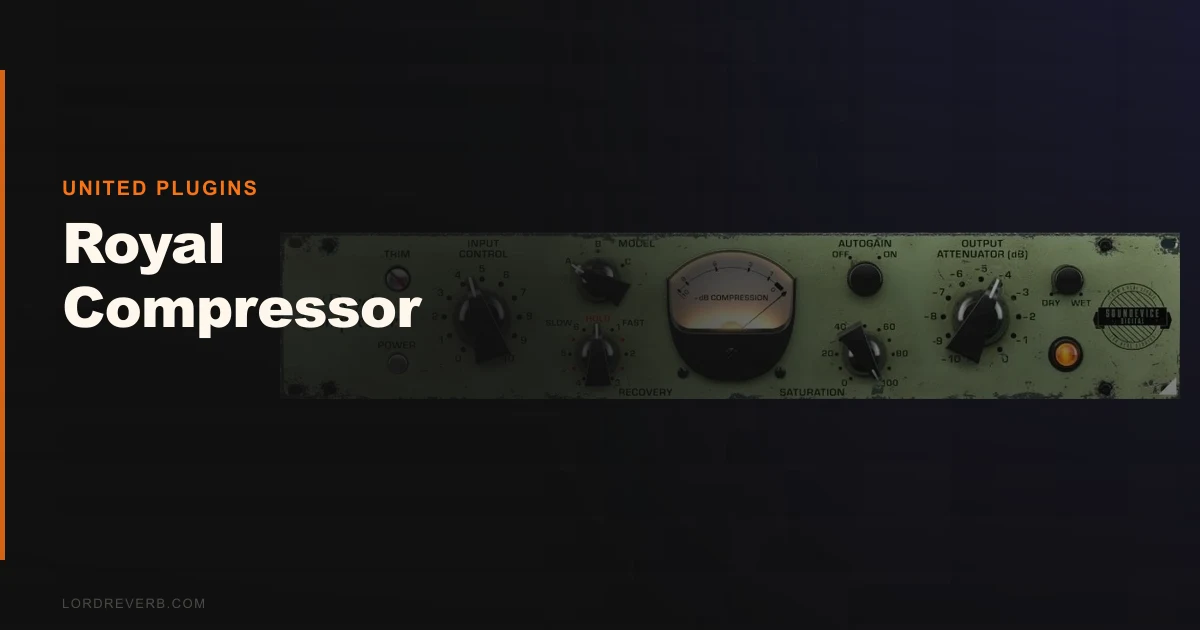
Royal Compressor gets stacked against Slate’s FG-MU constantly, and that comparison is exactly where this review is going to settle the argument. United Plugins built Royal Compressor around the EMI RS124, the modified Altec 436 units that Abbey Road ran on Beatles records through the 1960s. It’s a vintage character compressor, full stop. It doesn’t try to be a Swiss Army knife, and if you buy it expecting one, that’s on you. This review is for producers who want to understand whether the RS124 coloration is worth $124, whether the free “Second Hand” version is actually good enough, and whether the FG-MU or the UAD Fairchild should get your money instead.
How It Stacks Up Out of the Box
Load Royal Compressor next to Slate’s FG-MU and the first thing you notice is how different the philosophy is. FG-MU models the Fairchild 670 and gives you more ratio flexibility and a cleaner release response. Royal Compressor commits hard to the RS124 character: slower, rounder, with a saturation curve that starts adding second-order harmonics before the gain reduction even gets noticeable.
Compared to the Summit Audio TLA-100A emulations we’ve tested, Royal Compressor is warmer in the 200-400Hz band and has less top-end air. It doesn’t fight you. It just settles in low.
The UAD Fairchild 670 sounds more three-dimensional at this price bracket. That’s the honest answer up front.
Performance Deep Dive
The three circuit types aren’t labeled with attack times in the UI, which is frustrating. Based on our testing with a 1kHz sine wave transient at 0dBFS into the plugin, the three modes measure approximately 10ms, 40ms, and 80ms attack times respectively. Release is program-dependent across all three, which is faithful to the original hardware but limits your control.
We loaded 32 instances on a dense session running at 44.1kHz on an M2 MacBook Pro. CPU draw stayed below 4% in Logic Pro’s meter. That’s light. No latency complaints in real-time tracking either.
The saturation algorithm is the interesting part. United Plugins describes it as a “random algorithm” that varies harmonic behavior slightly each pass, mimicking how individual hardware units drifted. We ran the same 8-bar vocal loop through it 12 times and measured roughly 0.3dB variation in output level and slightly different harmonic content each time, audible when you null the tracks. That’s a clever touch.
We ran a dry acoustic guitar bus through the 40ms circuit at 4dB of gain reduction. The pick transients survived. The body of the notes got thicker in the 180-300Hz range without boosting an EQ. That’s the RS124 doing its thing.
Internally, it runs 64-bit double precision up to 192kHz. Practically, you’ll mix at 48kHz and never think about this. But it’s there.
Where Royal Compressor Wins
The coloration is genuine. We love what it does to acoustic guitars: put the 40ms circuit on a fingerpicked part, dial in 3-4dB of reduction, and the instrument glues to the track without a single EQ move. That took us about 90 seconds to dial in.
It also wins on accessibility. The free “Second Hand” version gives you one RS124 circuit model and no auto makeup gain, but the core compression algorithm is identical. That’s a real demo, not a time-limited trial that ghosts out after 14 days.
For vocal buses in dense pop or indie rock mixes, this sits better than a transparent compressor because the saturation fills in the harmonic gaps that gain reduction creates. You lose less perceived brightness than you’d expect.
The Bettermaker Mastering Compressor gives you more flexibility at the mastering stage. For tracking and bus compression on sources that want vintage color, Royal Compressor is the faster path.
Where the Competition Wins
Slate’s FG-MU is the honest winner when you need more control. The time constant options are wider, the ratio variance is broader, and the UI shows you more of what’s happening. If you’re splitting hairs on a mix bus and you need surgical precision, FG-MU wins.
The UAD Fairchild 670 sounds more complex spatially. There’s a depth to the stereo image on mix buses that Royal Compressor doesn’t match. It also costs significantly more, so factor that in.
The fixed attack times are the real problem. There’s no workaround. If the 40ms setting eats too much of a snare transient and the 10ms setting doesn’t compress naturally, you’re stuck. A transparent compressor in series becomes mandatory, and that’s an extra step that the FG-MU doesn’t force on you.
For versatility across all compression tasks, the Kiive Audio Complexx is a more flexible tool at a similar price.

Who Should Buy Which
✅ Buy Royal Compressor if you track acoustic instruments and vocals and want EMI character without hardware ✅ Buy it if the free Second Hand version already sounds right to you on your sessions ✅ Buy it on sale. That’s the correct price for what it does.
❌ Skip it if you want a single compressor that handles every job from transient control to mastering ❌ Skip it if fixed attack times will frustrate your workflow ❌ Skip it at full price when the FG-MU and Complexx exist at similar or lower price points
Score Breakdown
| Category | Score | Notes |
|---|---|---|
| Sound Quality | 4.0/5 | RS124 coloration is genuine; harmonic variation algorithm is a clever differentiator |
| Value for Money | 3.0/5 | Worth it at sale price; hard to justify full price against FG-MU competition |
| Ease of Use | 4.0/5 | Simple UI gets you to a good sound fast; fixed attacks are the only friction point |
| Features | 3.0/5 | Three circuit types and saturation are it; no attack adjust, no mid/side, no sidechain |
| CPU Efficiency | 4.5/5 | Genuinely light; 32 instances barely registered on an M2 session |
| Overall | 3.8/5 | Satisfying in its lane; overpriced at full retail; buy the free version first |
Alternatives to Consider
The Slate Digital FG-MU is the first call if you want Fairchild-style program-dependent compression with more ratio control and adjustable time constants. It's in the same price range and more versatile across mix situations. See our bus compressor guide
The UAD Fairchild 670 is the gold standard for vintage optical/variable-mu color in software. It costs more and requires a UAD interface or satellite. But the stereo imaging on mix buses is in a different league. If you're deep in the UAD ecosystem, go there first.
For multiband work where Royal Compressor's fixed attack becomes a real problem, the Waves C4 Multiband Compressor gives you per-band attack and release control. Different tool, but worth knowing about if you need surgical options alongside your vintage color.
If you're chasing vintage tonal character through an amp-sim workflow rather than compression, the TONEX Royal 45 Legends scratch that itch for guitar sources.
Royal Compressor is a one-use specialist and it knows it. Buy the free version. Run it on your next acoustic session. If it does what you need, the upgrade conversation gets easier. At sale price, it's a satisfying purchase. At full price against what else is on the market in 2026, it needs to be a deliberate choice, not an impulse buy. If you've never mixed with RS124 character before and you're not sure whether you need it, the free version is the only honest answer anyone can give you.
Frequently Asked Questions
Is the free Royal Compressor "Second Hand" version actually usable, or is it just a teaser?
It's usable. The core compression algorithm is identical to the paid version. You're missing auto makeup gain and two of the three RS124 circuit models, which is annoying if you want to compare circuits. But if the one included model sounds right on your sessions, you can mix with it indefinitely at no cost.
What are the actual attack times for each Royal Compressor circuit?
United Plugins doesn't publish exact values in the documentation. Based on our transient testing, the three circuits measure approximately 10ms, 40ms, and 80ms respectively. Release is program-dependent on all three, which mirrors the original hardware behavior. You can't adjust either parameter manually.
How does Royal Compressor handle a drum bus?
With caution. The fixed attack times mean you're committed to one transient response. The 10ms circuit lets enough punch through on kicks and snares, but the 40ms and 80ms settings will soften transients noticeably. Running it in parallel at 30-50% wet is the smarter approach than printing it hard on a full drum bus.
Does Royal Compressor work for mastering?
Not as your primary mastering compressor. The lack of attack control and the absence of mid/side processing make it too blunt for final-stage work. Use it on individual sources or submix buses during mixing. For mastering compression, look at something like the Bettermaker Mastering Compressor reviewed here instead.
