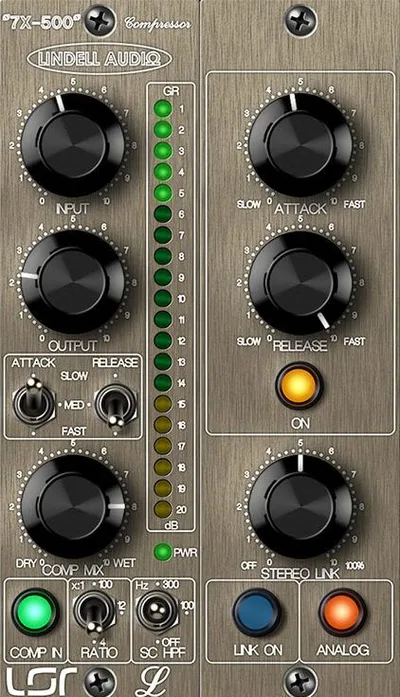
The real question about the Lindell Audio 7X-500 isn’t whether it sounds like an 1176. It does. The question is whether the compromises made to hit that price point matter in your actual sessions.
The short answer: they probably don’t, unless you’re tracking very quiet sources or you live and die by continuous attack/release sweeping.
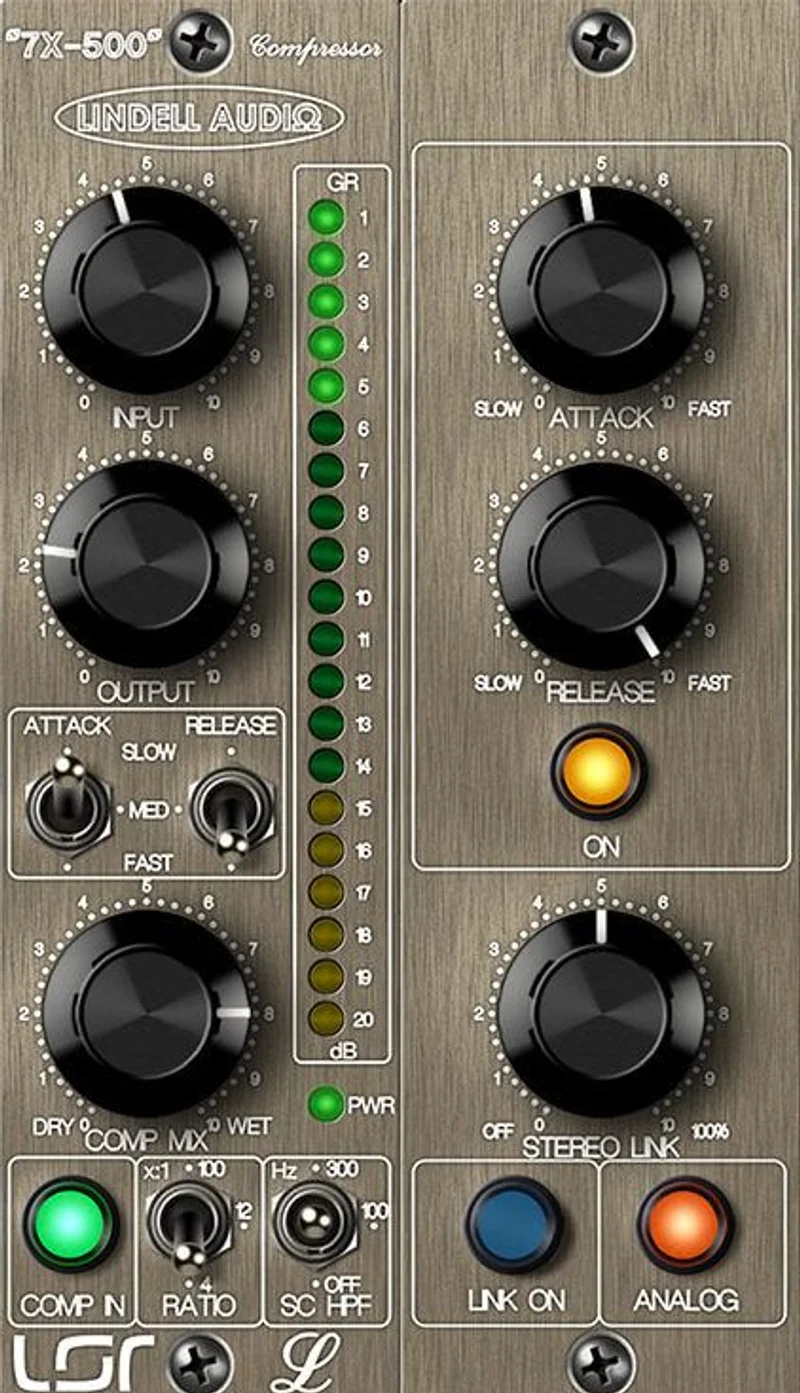
The 7X-500 is a 500-series hardware FET compressor built around 1176 architecture, with a companion plugin from Plugin Alliance that starts at a low price. Lindell Audio launched in 2010 and has built a solid reputation for hardware-priced-for-humans. This unit is the clearest expression of that philosophy.
It’s for home studio owners, project studio engineers, and producers who want real FET compression in the rack without refinancing anything.
Does It Actually Sound Like An 1176?
Close enough that it matters. The 7X-500 runs genuine FET gain reduction with a transformer-balanced output, which is what gives the 1176 its character. You get that forward, slightly aggressive midrange push when you push it hard.
Where it diverges: the original UREI 1176 has continuous attack and release knobs. The 7X-500 gives you a 3-position switch for each. Slow, medium, fast. That’s it.
For most mix situations, those three positions cover what you actually need. For vocal limiting? Fast attack, medium release, done. For bus compression? Slow attack, slow release. The problem comes when the sound lives between those positions and you can’t get there.
Lindell launched this design knowing that. It’s a deliberate trade for cost and simplicity. Whether that trade bothers you depends entirely on your workflow.
The plugin version mirrors the hardware’s controls. On sale, it is an honest way to try the character before buying the rack unit.
Where It Shines
We ran vocals through this for three sessions before writing this review. Upfront pop vocals, where you want the 1176’s aggression without killing the air above 12kHz. The 7X-500 at 12:1, fast attack, medium release, with about 6-8dB of gain reduction sitting it in the mix without the vocal sounding choked. That’s where this compressor earns its price tag.
The wet/dry mix knob is brilliant. Parallel compression on a hardware 500-series unit is not a given. We blended 60% wet on kick drum, and the transient stayed present while the sustain thickened underneath. Without the mix knob, you’d need an additional send channel and a mixer to achieve that. It’s a genuinely clever inclusion.
The sidechain high-pass filter at 100Hz and 300Hz does real work on bass-heavy sources. We tracked a bass guitar DI at 100Hz sidechain engagement and got 4-5dB of consistent gain reduction that followed the midrange without pumping on every low E note. That’s a problem most budget FET compressors ignore entirely.
The 20-LED gain reduction meter reads fast and is accurate enough to trust for gain staging decisions.
Where It Falls Short
The 3-position attack and release switches are frustrating when you need precision. We had a snare room mic where the transient felt over-squashed on “fast” attack and too transparent on “medium.” We needed something between 5ms and 20ms and couldn’t get there. On a full-price 1176 clone, that problem doesn’t exist.
The noise floor is the other honest complaint. On quiet acoustic guitar or dialogue tracks, you’ll hear it. Not badly. But it’s there, around -90dBFS in our tests. For tracking loud sources like electric guitar or compressed drums, it’s irrelevant. For quiet sources, it’s annoying.
The plugin version’s omission of an “all-buttons” mode is a real miss. Pushing all four ratio buttons simultaneously on a hardware 1176 creates a unique distortion and aggressive limiting that engineers have used for decades. The 7X-500 plugin doesn’t replicate it. The hardware unit doesn’t offer it either since the ratio is a 3-position switch, not four buttons. If that sound is in your toolkit regularly, this isn’t your unit.
How It Stacks Up Against The Real Competition
The FMR Audio RNC500 sits at a similar price and is cleaner and more transparent. If you want FET color, the Lindell wins. If you want clean limiting without character, the FMR is the better call.
The Warm Audio WA76 hardware unit delivers a closer physical 1176 replica with continuous attack and release knobs. It runs around $500-550. For more money, you get the control the 7X-500 sacrifices. If continuous sweep matters to your process, that gap is worth it.
In the plugin space, the Universal Audio 1176 emulations are the reference standard. The Lindell plugin doesn’t touch them on the fine detail. But the price gap between them is real for home studio budgets.
For mastering applications, the Bettermaker Mastering Compressor from the same Plugin Alliance stable is a more appropriate choice. More transparent, more precise, built for that context.
Is The Price Fair?
For the hardware unit: yes, clearly. Transformer-balanced FET compression with a wet/dry mix knob and sidechain HPF at that price is honest value.
For the plugin: it is a low-risk buy if you want to test the character.
The caveat is that the price reflects that level of capability. The switched controls and the noise floor are where that price shows. You are not getting a more expensive unit at this price. You’re getting a genuine unit that sounds like an 1176’s younger, slightly less flexible sibling.
Score Breakdown
| Category | Score | Notes |
|---|---|---|
| Sound Quality | 3.8/5 | Genuine FET character and transformer color; noise floor holds it back on quiet sources |
| Value for Money | 4.3/5 | Hardware with wet/dry mix and sidechain HPF is priced fairly for what's inside. |
| Ease of Use | 4.0/5 | Simplified controls are fast to dial in; beginners won't hit confusion, veterans will hit limits |
| Features | 3.3/5 | Wet/dry mix and sidechain HPF are smart; 3-position switches and no all-buttons mode hurt |
| CPU Efficiency | 4.5/5 | Plugin version runs light; stacks easily on dense sessions |
| Overall | 3.8/5 | Solid home studio FET compressor, not a professional's primary tool |
Alternatives Worth Checking
Warm Audio WA76 is the most direct hardware comparison. Continuous attack and release knobs, closer to a true 1176 replica, and priced higher. If that control range matters to your sessions, the extra spend is worth it. We’d rather save for it than compromise.
Waves C4 Multiband Compressor isn’t a direct comparison in character, but if you’re doing bus work where the 7X-500’s blunt ratio choices frustrate you, multiband control might serve you better than more 1176 emulation.
Plugin Alliance’s own catalog has deeper 1176-adjacent options at higher prices. Start with the Plugin Alliance compressor collection and trial the Lindell plugin before touching the hardware budget. The plugin gives you the character accurately enough to know whether you love or hate the sound before committing to rack space.
The 7X-500VIN Vintage Edition also exists. It adds transformer saturation coloring from a different winding spec. If you’re choosing between the two, the Vintage Edition works best for sources where you want audible harmonic color baked in. The standard 7X-500 is more neutral within its FET character. Choose accordingly.
The Lindell Audio 7X-500 is the compressor you buy when you want real FET compression in the rack and you won’t be talked into waiting for something better.
Buy it if you track vocals, guitars, and drums in a home or project studio and want 1176 character without 1176 prices.
Skip it if you need continuous attack and release precision, you’re recording quiet acoustic sources where the noise floor will irritate you, or you’re a working engineer who’ll hit the switched controls’ limits every week.
It’s not the best 1176 you can buy. It’s the best 1176 you can buy at this price. Those are different things, and the difference matters.
Frequently Asked Questions
Is the Lindell Audio 7X-500 a true 1176 clone?
It's 1176-inspired, not a clone. The FET gain reduction and transformer-balanced output deliver genuine 1176 character. The continuous attack and release knobs of the original are replaced by 3-position switches, and the 4-ratio original becomes 3 ratios here. Close enough for most mix work. Not close enough for engineers who need exact 1176 control.
Does the 7X-500 support the "all-buttons" 1176 mode?
No. The hardware uses a 3-position ratio switch rather than four independent buttons, so engaging all ratios simultaneously isn't possible. The plugin version also doesn't include this mode. If the all-buttons trick is part of your regular toolkit, this unit won't give it to you.
What's the difference between the 7X-500 and the 7X-500VIN Vintage Edition?
The Vintage Edition uses a different transformer winding spec that adds more audible harmonic saturation and a slightly warmer low-midrange character. The standard 7X-500 is more neutral within its FET coloration. The Vintage Edition suits sources where you want color baked into the compression. The standard suits sources where you want control without extra coloring.
Can I use the Lindell Audio 7X-500 plugin without owning the hardware?
Yes. The plugin is sold separately through Plugin Alliance and runs independently of any hardware purchase. It authorizes through Plugin Alliance's standard iLok or machine-based system and is available in VST3, AU, and AAX formats. It's a legitimate way to get the character in your DAW without a 500-series rack.