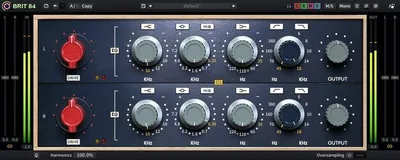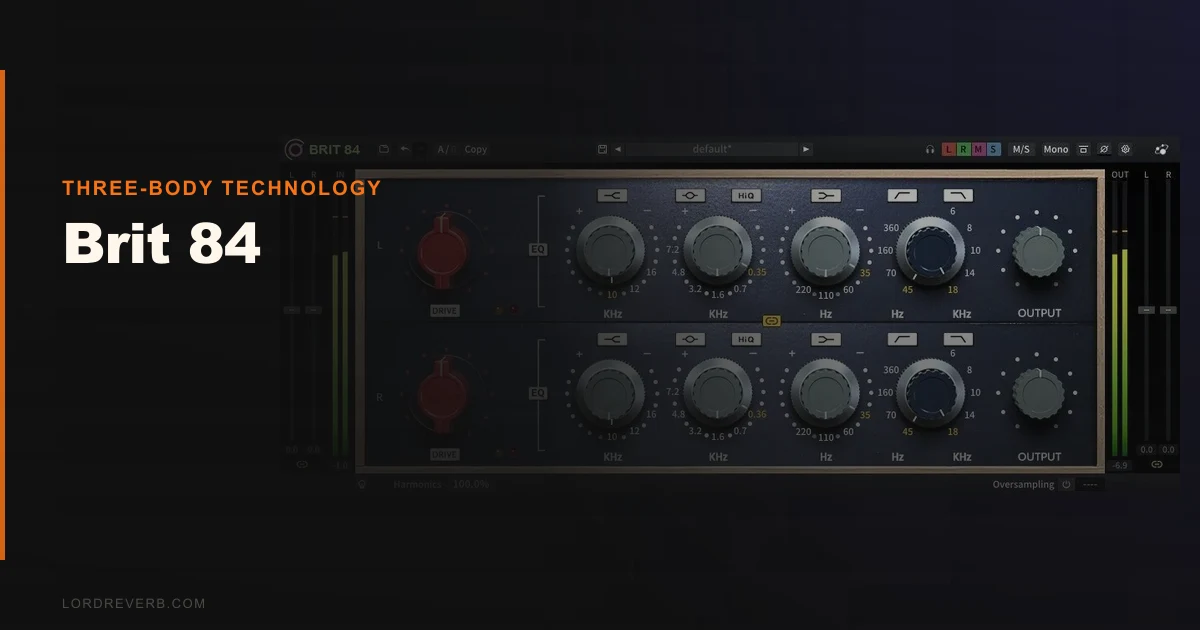
You've pulled the Brit 73 onto a vocal, it's doing something right, but the low-mids are sitting heavier than you want and there's no high-pass tight enough to clean the bottom without killing the air. That's the specific wall the Brit 84 was built to break through. It's a separate EQ plugin from Three-Body Technology, trained on a different piece of hardware, with more frequency bands, a High Q mode, and a Low Pass filter the Brit 73 doesn't offer. This is our full Brit 84 review. It's aimed at producers and engineers who already know what British console EQ sounds like and want to know whether this one earns its place in the signal chain.
The Specific Problem It Was Built to Solve
The Brit 73 is a Neve 1073-inspired EQ. It's warm, it flatters, and it's been on roughly half of every vocal anyone's mixed in the last decade. The problem is its band count and filter options are limited by the original hardware design.
When you need more surgical control, a tighter high-pass, or a more extended top end without switching plugins entirely, you're stuck.
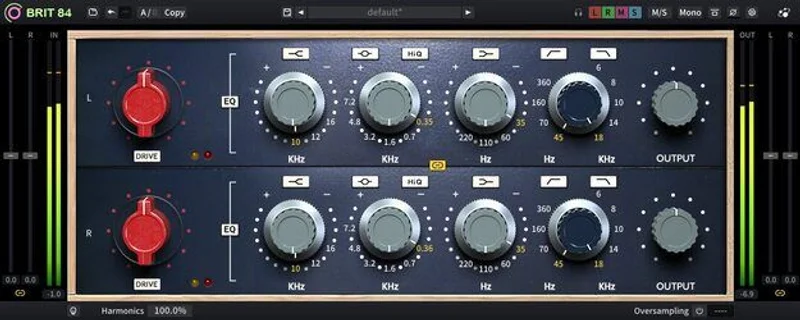
The Brit 84 addresses that directly. It adds frequency bands, introduces a High Q mode for narrower boosts and cuts, and includes a dedicated Low Pass filter. It's not a Brit 73 with extra features bolted on. Three-Body trained it on different source hardware with its APNN 2.0 neural network, so the tonal character actually differs from the 73.
Think of it this way: the 73 flatters. The 84 shapes. Both are useful. They're not interchangeable.
How It Performs in Real Sessions
We ran the Brit 84 on three different tasks: a lead vocal, a stereo drum bus, and a mix bus summing chain.
On the vocal, we boosted around 10kHz using the high-frequency shelf. The result was present without sibilance creeping in, which is harder to achieve than it sounds. We then engaged the High Q mode to cut a room resonance at roughly 450Hz with a narrow Q. That specific combination, shelf air plus surgical mid cut, isn't something we'd typically expect from a single vintage-style EQ. It worked without needing to stack another plugin behind it.
On the drum bus, we pulled the Low Pass filter down to around 14kHz. The top-end softened in a way that felt satisfying rather than dull. It took the digital sheen off an otherwise clean recording without killing the hat presence.
Latency sits at 26 sample points. At 44.1kHz that's approximately 0.6ms. That's honest. You can track through it without compensation headaches in most DAWs.
CPU usage stayed light. We tested in both Ableton Live 12 and Logic Pro on Apple Silicon. No spikes, no dropout at 256-sample buffer. Three-Body's APNN 2.0 architecture is clearly leaner than older convolution-based approaches.
The A/B switching and LR/MS processing are both present. Using MS mode on the mix bus to tighten the mid channel while leaving the sides open is genuinely clever workflow territory. Most vintage EQ emulations don't offer this natively.
Strengths and Weaknesses
The strength here is character without cost. The neural modeling doesn't just replicate frequency response. It captures the way the hardware behaves at different gain stages. Push the input and you get a saturation-adjacent softness that's hard to dial in with a clean digital EQ. That's the thing we love about this plugin.
The BLEASS Motion EQ is a comparison point worth making. That plugin moves. It's animated, it's modern, it's a completely different philosophy. The Brit 84 stays still and colors. Both have a place. They're not competing for the same slot.
The weakness we keep coming back to is documentation. Three-Body doesn't publish frequency response plots or THD measurements for the Brit 84. We can hear what it does. We can't verify it against the hardware it's modeled on. That's annoying for engineers who want to know exactly what they're working with, not just trust their ears.
The download size is 166MB. Not massive, but heavier than a purely algorithmic EQ needs to be. That's the cost of neural model data.
One more frustration: it's not immediately obvious how different the Brit 84 sounds from the Brit 73 on first listen. The difference is real. It takes a focused A/B session to locate it. Casual users might miss it entirely and feel like they bought the same thing twice.
Value for the Price
The Brit 84 sits inside Three-Body's Deep Vintage Suite collection. At least one retailer has listed it at 54% off its standard price, which puts it well into impulse-buy territory if you catch the sale. The current price is shown in the buy box on this page.
At full price, it's a harder call. You're paying for neural modeling, MS processing, and a sonic character you won't find in every free SSL clone.
On sale? Buy it without overthinking it.
Who Should and Shouldn't Buy This
✅ Buy if you already own the Brit 73 and want more frequency control without leaving the same sonic family.
✅ Buy if you mix vocals heavily and want a single EQ that can both flatter and do narrow corrective cuts without switching plugins.
✅ Buy if you work in MS and want vintage character on your mix bus that doesn't require a separate utility plugin for mid-side conversion.
❌ Skip if you've never worked with vintage British EQ emulations before. Learn the basics with something more forgiving first.
❌ Skip if you need published specs and frequency plots to trust a plugin. Three-Body won't give you that paper trail.
❌ Skip if you already own a well-dialed SSL 4000 or 9000 emulation and you're happy with it. The Brit 84 solves a different problem, not a universal one.
Score Breakdown
| Category | Score | Notes |
|---|---|---|
| Sound Quality | 4.3/5 | Neural character holds up; shelf air and High Q cuts both perform on real material |
| Value for Money | 4.0/5 | Strong on sale; full price requires commitment to the vintage British EQ sound specifically |
| Ease of Use | 3.8/5 | Clean layout; sonic difference from Brit 73 takes time to learn to hear |
| Features | 4.0/5 | High Q mode, LPF, MS processing, A/B switching all present and functional |
| CPU Efficiency | 4.5/5 | 26-sample latency, no spikes on Apple Silicon or AMD in our testing |
| Overall | 4.1/5 | A focused, well-executed tool for engineers who know exactly what they're buying |
Alternatives to Consider
If you want movement and modulation baked into your EQ rather than static vintage coloring, the BLEASS Motion EQ is a completely different approach. It won't give you the Brit 84's analog character, but it does things a static EQ never will.
If you want a simpler, single-purpose vintage filter tool before committing to a full character EQ, the VEQ-HLF by Antelope Audio is worth looking at first. It's a Pultec-style high/low filter done with minimal fuss.
For producers who want to understand EQ character in a broader sense before buying into any specific console sound, our EQ plugins category covers the wider field across price points.
If you're looking to build out a broader production toolkit alongside your EQ choices, the Sequel 2 review covers a different category but speaks to the same value-versus-character question.
The Brit 84 isn't for everyone. It's for the engineer who hears the difference between British and American EQ curves and cares about which one they're using on which source. If that's you, and you catch it on sale, it's a clean decision. If you're not yet sure what a vintage British EQ even means in practice, buying this won't teach you that. Experience earns this plugin, not the other way around.
Frequently Asked Questions
Is the Brit 84 just an upgraded version of the Brit 73?
No. They're modeled on different hardware and have distinct sonic characters. The Brit 84 adds more frequency bands, a High Q mode, and a Low Pass filter that the Brit 73 doesn't have. If you own both, you'll use them on different sources for different reasons. Think of them as siblings, not versions.
What neural network technology does the Brit 84 use?
Three-Body Technology built the Brit 84 using their proprietary APNN 2.0 (Audio Processing Neural Network) system. The plugin was trained on the original hardware rather than modeled circuit-by-circuit. The practical result is a 166MB download that captures behavior across different gain stages, not just a static frequency response curve.
Can I use the Brit 84 for mid-side processing?
Yes. LR/MS processing is built into the plugin natively. You don't need a separate MS utility in your signal chain. This makes it legitimate for mix bus work where you want to treat the mid and side channels differently without adding extra plugins and routing complexity.
Does the Brit 84 work on Apple Silicon?
Yes. System requirements list macOS 11 or higher with support for Intel, AMD, and Apple Silicon. We tested it on Apple Silicon without issues. Latency stays at 26 sample points (~0.6ms at 44.1kHz) regardless of the processor architecture, and CPU load stayed light throughout our sessions.