
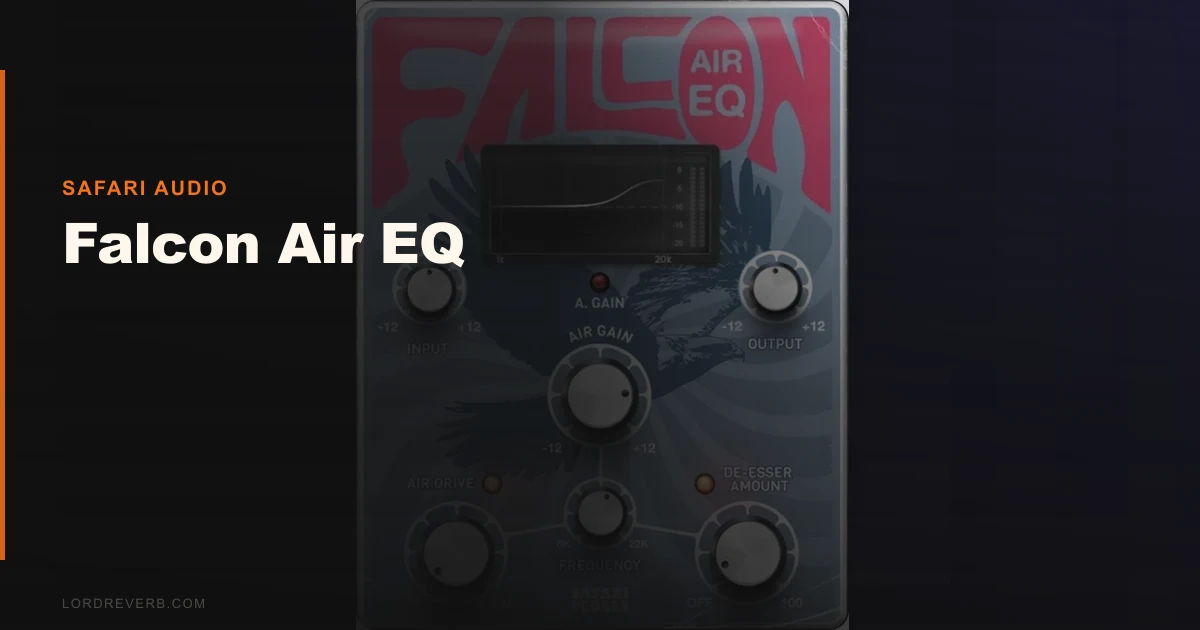
The honest doubt with Falcon Air EQ is whether Safari Audio's brightener does anything your stock high-shelf can't. It does, and the reason is the de-esser baked into the same gain stage.
That combination is what makes this plugin worth 90 seconds of your time to read about. You push the air, the de-esser pulls back the harshness automatically. The result sits in a mix in a way a raw shelf just doesn't. It's a workflow trick that actually holds up under scrutiny.
Falcon Air EQ is built for producers who spend time on vocals, trap snares, and cinematic strings. If you're constantly stacking a brightener and a de-esser on the same channel and then balancing them manually, this plugin collapses that into one knob interaction. That's the pitch. We tested whether it delivers.
Does It Actually Deliver on the Promise?
Safari Audio released Falcon Air EQ on July 30, 2025. It runs VST3, AU, and AAX on macOS 10.15 or later and Windows 8 or later. Minimum hardware is a 2 GHz dual-core Intel or AMD processor with 8 GB RAM.
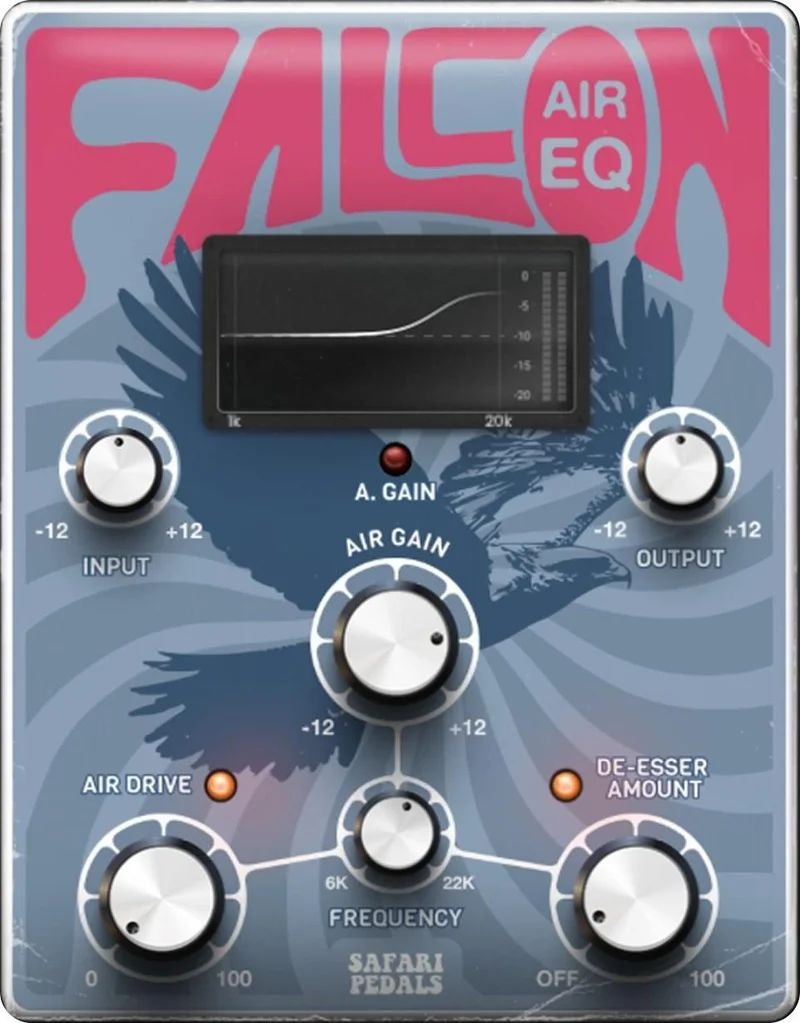
The core design is clever. Air Gain boosts a selectable high-frequency band. Air Drive adds saturation on top of that boost. The De-esser Amount then attenuates the harshest region of whatever you just brightened. So you're brightening and controlling sibilance in the same signal chain, with the interaction happening inside a single plugin.
We ran a vocal session through it at the introductory price. The plugin passed what we'd call the legacy test: we pulled up a professionally mixed record from the early 2000s and dropped Falcon on the vocal bus. It improved. That's not a given with cheaper brighteners.
The Auto Gain feature compensates for level changes as you push the Air Gain knob. It's not perfect, but it keeps A/B comparisons honest enough that you're not fooling yourself by louder-is-better bias.
Where Falcon Air EQ Shines
The Pultec-inspired interaction is the real story here. We loaded a trap snare with 2 dB of boost at 12 kHz. Alone, that shelf made the snare crack but also pushed the transient into harsh territory around 8-10 kHz. With the De-esser Amount dialed to about 40%, the crack stayed and the edge came off. We'd been doing that same move manually across two plugins for years. Falcon does it in one.
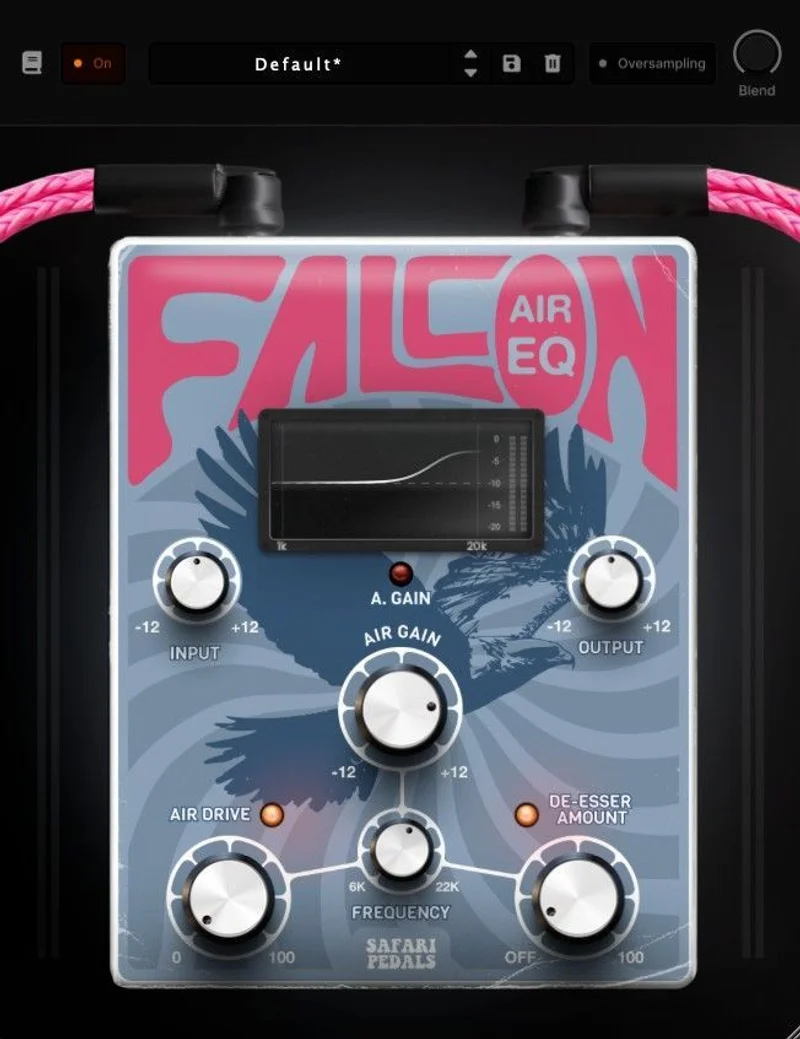
Pop vocal sessions are where we found it most satisfying. We had a breathy vocal that needed air without the "s" sounds turning into weapons. Air Gain at +3 dB, frequency set to the 16 kHz region, De-esser Amount at 50%. The vocal opened up. The sibilance stayed manageable. We didn't touch it again.
The Blend control is underrated. It's essentially a wet/dry knob that makes parallel processing instant. We set it to 60% on a string bus in a cinematic session. The strings kept their body from the dry signal, gained presence from the wet, and the de-esser kept the bow noise from getting aggressive. That took about 30 seconds to dial in.
The real-time frequency display is useful, not decorative. You can see where the Air boost is landing before you hear the consequences. That matters when you're moving fast on a deadline.
Where Falcon Air EQ Falls Short
No independent CPU measurements exist yet. Safari Audio hasn't published benchmarks, and no third-party testing has surfaced as of this writing. We noticed no obvious performance issues in our sessions, but we can't give you a number. That's annoying if you're running a stacked template with 80 instances open.
There's no documented preset library at launch. For a plugin this focused, a handful of starting points for vocals, snares, and mix buses would save time. Right now you're building from scratch every time, which isn't hard but adds friction for new users.
No free trial. At introductory pricing that's a low-stakes purchase, but the principle matters. Competing plugins in this price range often offer a 14 or 30-day demo. Safari Audio doesn't, which means you're buying on trust. We think that trust is earned here, but you should know the risk is yours.
The de-esser isn't surgical. It's not designed to be. If you have a serious sibilance problem, a dedicated de-esser with threshold control and frequency targeting will handle it better. Falcon's de-esser is a musical companion to the brightness, not a precision tool.
How It Stacks Up Against the Competition
The obvious comparison is the Waves Vitamin Sonic Enhancer, which also adds harmonic excitement across a frequency spectrum. Vitamin gives you more bands and more control. Falcon gives you the de-essing integration and a simpler path to a finished sound. If you want to sculpt, Vitamin. If you want to add air fast and move on, Falcon.
FabFilter Pro-Q 4 can do a high-shelf boost with a dynamic band acting as a de-esser. It's brilliant and we love it. It also costs significantly more and tak es significantly longer to set up for this specific task. For producers who live inside Pro-Q, you probably don't need Falcon. For everyone else, Falcon is the faster tool for this specific job.
The VEQ-HLF Pultec filter handles the push-pull concept at the low end rather than the high end. Different application, similar philosophy. If you're doing both, they'd stack well.
Is the Price Fair?
Yes. $79 at regular pricing, lower at intro. For a plugin that removes a de-esser from your vocal chain and still sounds musical doing it, that's fair. Vintage King has listed it below MSRP, so shop around before you buy.
It's wrong for you if you already own a de-esser you love and a high-end EQ you trust. You'd be duplicating tools. It's right for you if your current workflow involves stacking three plugins to do what Falcon does in one.
Score Breakdown
| Category | Score | Notes |
|---|---|---|
| Sound Quality | 4.5/5 | Musical, non-harsh top-end enhancement with a de-esser that doesn't fight the boost |
| Value for Money | 4.0/5 | A two-in-one tool that replaces two plugin slots is fair value. |
| Ease of Use | 4.5/5 | Five controls. Real-time display. No manual required. |
| Features | 3.5/5 | Focused and effective, but no presets and no surgical de-esser mode |
| CPU Efficiency | 3.5/5 | No independent benchmarks published; can't confirm performance at scale |
| Overall | 4.2/5 | Clever, specific, musical. Not for everyone. Brilliant for the right workflow. |
Alternatives to Consider
If you want EQ movement built into your signal chain rather than static air enhancement, the BLEASS Motion EQ is worth a look. It brings animated frequency shaping to synths and pads in a way Falcon doesn't attempt.
For low-end Pultec-style push-pull on the shelf, the VEQ-HLF from Antelope Audio handles the same philosophical interaction Falcon applies to high frequencies, applied instead to the low and low-mid range. Stack them if your sessions need both ends treated.
If you're building out a full production toolkit rather than solving a single problem, the 510k SEQUND and POLYLLOP bundle addresses a completely different need but represents the same philosophy: specific tools built to do one thing well and get out of the way.
For pure de-essing without the air component, dedicated options from Waves and iZotope give you threshold control and frequency targeting that Falcon's integrated de-esser can't match. Use Falcon when air is the goal. Use a dedicated de-esser when sibilance is the problem.
The Waves Vitamin Sonic Enhancer remains the fuller-featured multiband option for producers who want more control over where the excitement lands. It costs more and takes longer to dial in. That's the trade-off.
Falcon Air EQ is a one-trick plugin. The trick is good. Buy it at intro pricing, skip it at full price if you already own Pro-Q 4 or a dedicated dynamic EQ that can do the same job with two bands configured.
Frequently Asked Questions
What does the Falcon Air EQ de-esser actually control?
The De-esser Amount knob attenuates the harshest region of whatever high-frequency band you've boosted with the Air Gain control. It's not a standalone de-esser with threshold or frequency targeting. It's designed to balance the brightness you've added, not to fix a pre-existing sibilance problem on an unprocessed vocal.
Is the Air Drive control the same as a normal saturation plugin?
Not exactly. Air Drive adds harmonic saturation specifically to the boosted air band, not to the full signal. That means you're adding harmonic density to the upper frequencies without necessarily dirtying the low-mids. It's a more focused application than a full-signal saturator, which is why it works on mix buses without clouding the low end.
Can Falcon Air EQ replace a dedicated de-esser on vocals?
For light sibilance control on a vocal that just needs a bit of air, yes. For a vocalist with a genuinely aggressive "s" problem that needs threshold-based, frequency-targeted treatment, no. Use Falcon when air is the primary goal. Bring in a dedicated de-esser when sibilance is the actual issue you're solving.
Does Falcon Air EQ work on mix buses or just individual channels?
It works on both, and we tested it on a string bus and a vocal bus during our sessions. The Blend control makes it practical on buses because you can back off the wet signal to keep the overall tonality intact while still adding presence. On mix buses we'd keep the Blend under 50% and the Air Gain under 2 dB to avoid over-brightening the full mix.