The Millennia NSEQ-2 plugin gets compared to the Sontec MES-432C and the Pultec EQP-1A more than anything else in mastering circles, and here's where we land: for transparent, surgical shaping with an optional tube character switch, the NSEQ-2 wins that fight. This is a Plugin Alliance emulation of a hardware unit that has been sitting in top-tier mastering chains since 1999, and the plugin version holds up that reputation better than most hardware emulations manage.
It's built for mastering engineers, mix engineers finishing in the box, and anyone who needs a parametric EQ that genuinely stays out of the way when you need it to.
How the NSEQ-2 Compares Out of the Box
Load the NSEQ-2 next to a Pultec emulation and the difference is immediate. The Pultec has a personality. The NSEQ-2 in JFET mode has almost none, and that's not a weakness.
The Sontec is the real rival. Both live in mastering chains. Both have a reputation for transparency. The Sontec edges ahead on maximum Q, which matters when you're hunting a 60Hz hum or a narrow resonant peak in an acoustic recording. The NSEQ-2 tops out at Q 4.0. The Sontec goes tighter.
What the NSEQ-2 has that the Sontec emulations don't: a genuine tube mode that adds harmonic weight without sounding like you've bolted a saturator onto the end of your chain. The topology switch actually changes the signal path character, not just a harmonic profile knob.
Performance Deep Dive
We ran a full mix bus through the NSEQ-2 in JFET mode with a 2dB shelf boost at 12 kHz and a 1.5dB cut at 280 Hz, Q set to 1.2. The shelf opened the high end without adding any edge. The cut removed congestion in the low-mids without audibly narrowing the stereo image.
Switch to tube mode on the same settings and the character shifts. There's second-harmonic content added that you can hear as weight in the low-mids, closer to what you'd measure at 0.009% THD typical with 0.003% in best-case conditions. That's not a lot of coloration. But it's perceptible on a flat-signal comparison, especially below 500 Hz.
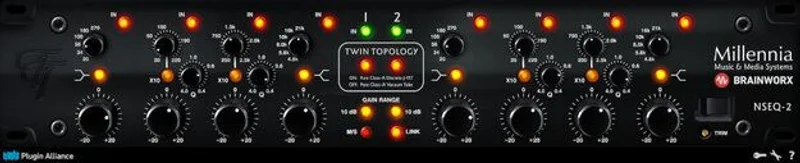
The four-band layout gives you a low band switchable between peak and shelf, two fully parametric mids sweeping 20 Hz to 25 kHz with that Q range of 0.4 to 4.0, and a high band with the same peak/shelf option. The wide Q of 0.4 is a broad, musical lift. At 4.0, you're doing focused corrections. You're not notching out a single frequency.
The plugin reflects the hardware's single active amplifier stage philosophy. Most EQ circuits run three to seven active stages. One stage means less noise accumulation, less phase distortion, and less opportunity for the circuit to impose its character. In JFET mode, that results in what we'd call genuinely transparent EQ. Not "transparent" as a marketing word. Transparent as in: the signal sounds the same, just shaped.
We updated to version 1.12.0, released December 15, 2025. No notable workflow changes from the previous build, but stability on Apple Silicon improved.
Where the NSEQ-2 Wins
The Twin Topology design is the main reason to buy this over a single-character mastering EQ. One plugin handles both your transparency work and your harmonic enrichment jobs. That's two less plugins in the chain, which matters when you're already running a handful of processors on a mastering bus.
We love that the frequency sweep runs all the way to 25 kHz. On high-resolution material, being able to place a shelf at 18 or 20 kHz without it falling off the parameter edge of a cheaper EQ is genuinely satisfying.
The hardware unit has lived in serious studios since 1999. This plugin carries that pedigree honestly. It doesn't oversell the emulation or add features the hardware didn't have. That restraint is underrated in a market full of plugins adding "AI-assisted" controls to analog emulations.
For choosing the right EQ plugin for mastering, the NSEQ-2 is one of the few we'd put on a shortlist without hesitation.
Where the Competition Wins
The Q ceiling is the honest limitation. A maximum Q of 4.0 is fine for mix bus and mastering work on clean material. It gets frustrating on location recordings with HVAC hum, or on anything with a narrow resonant problem below 200 Hz. The Sontec emulations go tighter. So does a well-dialed dynamic EQ plugin in some scenarios.
The plugin-versus-hardware documentation gap is annoying. Plugin Alliance doesn't publish behavioral comparison data. We don't know the exact phase response differences between the emulation and the hardware circuit, and that matters to mastering engineers who've used the hardware for years and are considering moving ITB.
CPU usage sits at medium. Not heavy. But it's not the lightest parametric EQ on the market. Running six instances on a stem mastering session will be noticeable on older systems. A simpler parametric like FabFilter Pro-Q 3 review runs leaner if CPU is the priority.
Who Should Buy Which
- ✅ Buy if you do mastering or mix bus work and need one EQ that handles transparent shaping and light harmonic coloration without chaining two plugins.
- ✅ Buy if you already know the hardware NSEQ-2 and want a faithful ITB version.
- ✅ Buy if you work on high-resolution material and need a frequency sweep that reaches 25 kHz.
- ❌ Skip if your main need is surgical notch filtering. The Q 4.0 ceiling will leave you wanting.
- ❌ Skip if CPU headroom is tight. There are more efficient parametric EQs for the same price range.
- ❌ Skip if you mostly track and edit rather than mix or master. This EQ's strengths are wasted on corrective tracking work.
Score Breakdown
| Category | Score | Notes |
|---|---|---|
| Sound Quality | 4.8/5 | THD at 0.003% in JFET mode is about as clean as analog-modeled EQ gets |
| Value for Money | 4.0/5 | Strong relative to the hardware price, but pricing fluctuates on Plugin Alliance |
| Ease of Use | 4.3/5 | Minimal interface, four bands, no learning curve if you know parametric EQ |
| Features | 4.0/5 | Twin topology is clever; Q ceiling and lack of mid-side mode are the gaps |
| CPU Efficiency | 3.8/5 | Medium load; noticeable on older systems when stacking instances |
| Overall | 4.4/5 | A brilliant mastering EQ let down slightly by Q range and documentation gaps |
Alternatives to Consider
FabFilter Pro-Q 4, More surgical, mid-side capable, and lighter on CPU. If you need notch filtering or M/S processing, it wins on features. It doesn't have tube character. See our EQ plugin guide
Sontec MES-432C emulations, Tighter Q ceiling means you can do surgical work the NSEQ-2 can't. Worth comparing if your sessions regularly involve location recordings or live material with resonance problems. Compare mastering EQ plugins
Pultec EQP-1A emulations, If you want tube character and don't need the transparency of JFET mode, a Pultec gives you that sound at a lower price point. The trade-off is far less surgical control. Full EQ plugin comparison
The NSEQ-2 plugin is the right call if you have priced up the hardware and cannot justify buying a four-band parametric, no matter how good it sounds. The plugin captures the core of what makes that hardware valuable. Check Plugin Alliance for the current price before buying, as their sale pricing can shift the value equation significantly.
It's wrong for you if you track live bands, need tight notch control, or want mid-side processing built in. For mastering and mix bus work on studio material, it's one of the most satisfying parametric EQs we've run on a master bus.
Frequently Asked Questions
What's the difference between the JFET and tube modes in the Millennia NSEQ-2 plugin?
JFET mode runs the signal through a solid-state discrete path with THD as low as 0.003%. It's as close to sonically neutral as an analog-modeled EQ gets. Tube mode adds second-harmonic content, most audible below 500 Hz, with typical THD around 0.009%. You're not choosing between clean and dirty. You're choosing between neutral and slightly weighted.
Is the Millennia NSEQ-2 plugin worth it compared to the hardware?
The hardware costs far more than the plugin. The plugin is a fraction of that. For ITB work, the plugin captures the character of the hardware's single-stage amplifier circuit and gives you the same four-band layout. If you've never used the hardware, you won't miss what's lost in translation. If you've used the hardware for years, the plugin will feel familiar but not identical.
Can the Millennia NSEQ-2 do surgical EQ work?
Not ideally. The maximum Q of 4.0 is workable for focused corrections in a mix bus context. It won't notch out a narrow resonance below 200 Hz the way a tighter Q can. For surgical work, a dedicated dynamic EQ or a plugin with Q values above 6.0 serves you better.
Does the Millennia NSEQ-2 plugin support mid-side processing?
The plugin itself doesn't have a built-in mid-side mode. You can run it in mid-side using your DAW's routing or a dedicated mid-side matrix plugin before and after it in the signal chain. It's workable but not as convenient as EQs with native M/S support.