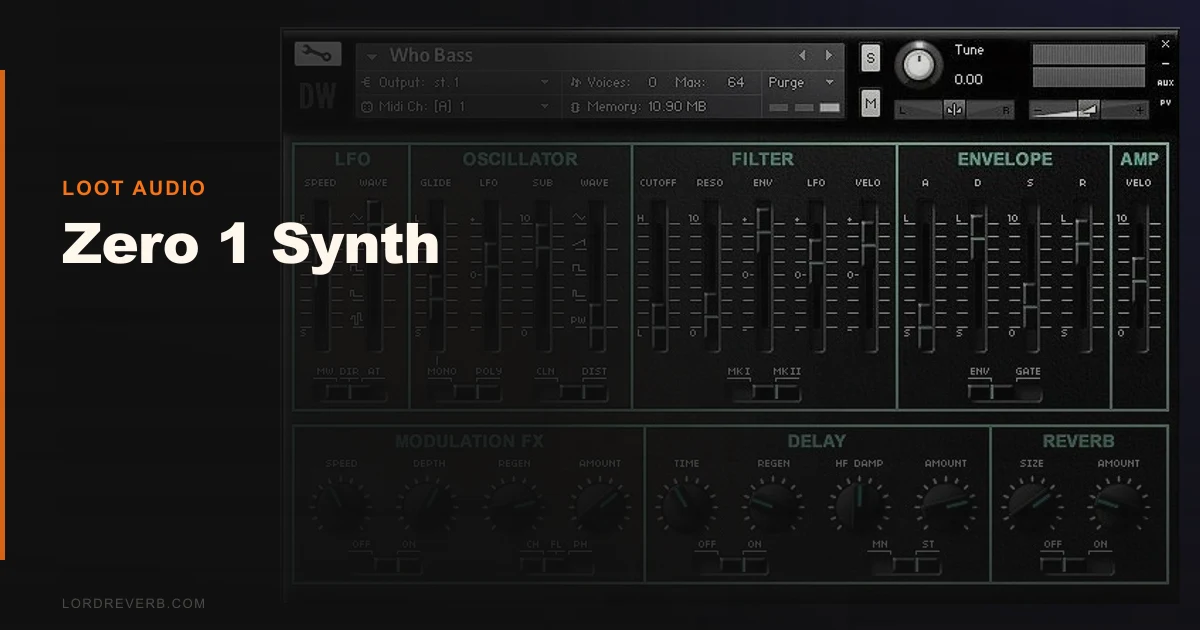
The obvious doubt about Zero 1 Synth is whether a $7 Kontakt instrument built around 50 samples of a 1982 Yamaha CS01 can sound like anything worth using in a real production. It can, and we were surprised enough to keep it in our session.
Zero 1 Synth is a Kontakt instrument from Hideaway Studio, distributed through Loot Audio. It samples a CS01 monosynth processed through tube overdrive and Watkins Copicat tape delay, then captures those waveshaped tones at 24-bit depth. The result is a small, dirty, lo-fi mono lead and bass instrument that costs less than a cup of coffee.
It's built for bedroom producers working in lo-fi hip-hop, synthwave, or any genre that rewards warmth and grit over clinical precision. If you're chasing phase-accurate oscillator modeling or deep modulation routing, this is the wrong tool entirely. But if you want instant character at a price that makes the decision effortless, read on.
Does It Actually Deliver on the CS01 Sound?
The CS01 was a budget monosynth. Yamaha built it in 1982 as a beginner instrument, and its limitations became its character: a thin oscillator section, a single LFO, and a filter that lacks the muscle of its contemporaries.
What Hideaway Studio did cleverly here is not try to model that synth cleanly. They ran it through tube overdrive and Watkins Copicat tape processing before sampling. That processing is baked into the 50 oscillator samples at 24-bit. So you're not getting a transparent CS01 snapshot. You're getting a CS01 that's already been through the hardware grinder.
We loaded Patch 12, a sawtooth-based lead, into a lo-fi hip-hop session at 90 BPM. It sat in the mix without any EQ adjustment. The mid-range had that slightly compressed, tape-worn quality. We'd have spent twenty minutes on a cleaner synth achieving the same result.
That's the pitch. And it holds up.
Where Zero 1 Synth Shines
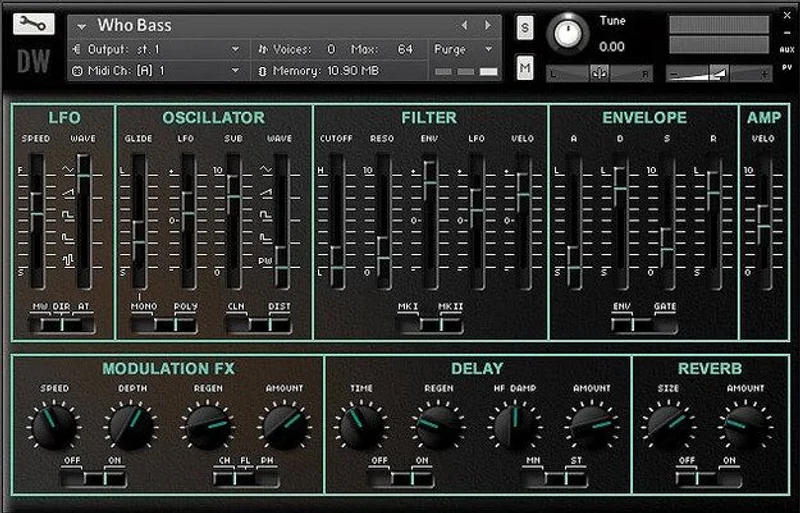
The dual filter modes are the most useful feature here. Mk I runs a 12dB per octave filter, which keeps the top end open and lets the tape character breathe. Mk II switches to 24dB per octave, tightening the resonance curve into something closer to a classic ladder filter cutoff.
We used Mk II on a bass patch in a darker synthwave track. Sweeping the cutoff from around 800Hz down to 200Hz during a breakdown gave a satisfying roll-off that didn't feel fake. The 24dB slope has enough aggression to work as a sound design move, not just a tonal trim.
Five multi-sampled oscillator types cover triangle, sawtooth, 50% square, 25% square, and PWM. That PWM sample set is the one we love most. Loaded through the Mk I filter with the tape grit baked in, it produces a slightly wobbly, detuned quality that would cost you hours of manual modulation to replicate with a cleaner instrument.
At roughly 60MB of disk space, Zero 1 Synth loads fast and stays out of your way. CPU usage is light. We ran four instances across a session without measurable performance impact on a mid-spec laptop.
Where It Falls Short
The 50-sample library is the hard ceiling on what this instrument can do. Fifty samples across five oscillator types, spread across the keyboard, means you're hearing the same recorded tones with pitch-shifting beyond the closest root note. On sustained pads in the upper register, the pitch-shifting artifacts become noticeable. Not ugly, but present.
There's no free Kontakt Player support. You need a full Kontakt license at version 4.2.4 or above. That's an annoying barrier for anyone who only owns the free Player. If Kontakt isn't already in your signal chain, this instrument effectively costs the price of a Kontakt license on top of what you pay for it.
Modulation is thin. You get patch editing across the 40 presets, but there's no macro system, no LFO routing beyond what's baked into the patches, and no MIDI learn for real-time performance beyond velocity and pitch. For a synth instrument, that's a frustrating constraint.
We also wish the 10 layered multi-patches were documented better. There's no preset browser guide explaining what's layered with what. You load them and find out.
How Zero 1 Synth Stacks Up Against Alternatives
The closest free comparison is the Spitfire LABS range, which includes tape-processed and lo-fi instruments at no cost. LABS offers broader sound palettes but less focused vintage synthesis character. If you want a broader toolkit for free, LABS wins. If you want specifically this CS01 grit, Zero 1 Synth has an edge.
Paid alternatives like Native Instruments Monark cost significantly more and model the Minimoog with considerably deeper modulation and polyphonic unison options. Monark is a better synth. It is also orders of magnitude more expensive and requires a completely different workflow commitment.
For CS01-adjacent character specifically, Arturia Mini V offers a more accurate analog emulation with full modulation routing. But you're paying premium plugin pricing for that accuracy.
Zero 1 Synth doesn't compete with those tools on depth. It competes on character-per-pound, and it wins that specific argument.
Is the Price Fair?
$7 is a ridiculous amount to pay for a plugin. We mean that positively. At this price point, the conversation about value is almost irrelevant. If you own Kontakt and make any music that benefits from lo-fi analog texture, buying this to test it costs less than a bus fare.
The caveat is that the instrument price plus a Kontakt license is a different calculation. If Kontakt is already in your stack, this is a trivial purchase. If it isn't, skip it and look at free Kontakt Player instruments first.
Score Breakdown
| Category | Score | Notes |
|---|---|---|
| Sound Quality | 3.5/5 | Tube and tape processing gives genuine character; pitch-shifting artifacts appear in upper registers |
| Value for Money | 5.0/5 | $7 makes this a no-brainer if you already own Kontakt |
| Ease of Use | 4.0/5 | Loads fast, sounds usable immediately; multi-patch documentation is lacking |
| Features | 2.5/5 | Dual filter modes are clever; modulation options are genuinely thin for a synthesis tool |
| CPU Efficiency | 4.5/5 | Light footprint, runs multiple instances without strain |
| Overall | 3.8/5 | Overachieves for its price but has a hard ceiling on depth |
Alternatives to Consider
Native Instruments Monark is the step up if you want full Minimoog-style modulation and polyphonic unison. It costs considerably more and demands more from your CPU, but the sound design depth is in a different class.
Arturia CS-80 V covers a different Yamaha vintage territory with full polyphony and deep modulation routing. Not a CS01 emulation, but if you're after that Yamaha analog warmth in a more capable package, it's the right direction.
Free Kontakt Instruments Roundup is worth checking before you spend anything. Several free Kontakt instruments deliver lo-fi character without any outlay, though none target the CS01 with this level of tape processing specificity.
The honest recommendation: if Kontakt is already open on your machine and you make music with any lo-fi or vintage synthesis element, buy Zero 1 Synth now. The only people who should skip it are producers who don't own full Kontakt and those chasing deep, modular sound design capability. For everyone else, adding a 1982 tape-mangled monosynth to your library at $7 is one of the easier decisions in music production.
It's not the deepest tool we've reviewed. It's the one with the best excuse-to-cost ratio.
Frequently Asked Questions
Does Zero 1 Synth work with the free Kontakt Player?
No. Zero 1 Synth requires a full Kontakt license at version 4.2.4 or higher. It won't load in the free Kontakt Player. If you only have the Player, you'll need to upgrade to the full version of Kontakt before this instrument becomes accessible.
What synth does Zero 1 Synth emulate?
It's based on the Yamaha CS01, a compact monosynth released in 1982. Hideaway Studio sampled the CS01 after running it through tube overdrive and a Watkins Copicat tape delay unit, so the samples carry the processing as part of their character rather than being a clean oscillator capture.
How many presets does Zero 1 Synth include?
It comes with 40 editable single patches and 10 layered multi-patches. The single patches cover the five oscillator types across various filter and envelope configurations. The multi-patches layer combinations of those oscillator samples for thicker or more complex tones.
Is Zero 1 Synth good for live performance?
It's a usable live instrument for simple monosynth lines, but the lack of real-time modulation routing and macro controls limits performance expression. It responds to velocity and pitch as expected in Kontakt, but don't expect to build complex performance rigs around it. It's built for studio session use, not live rig depth.