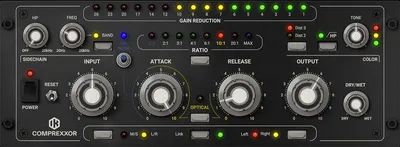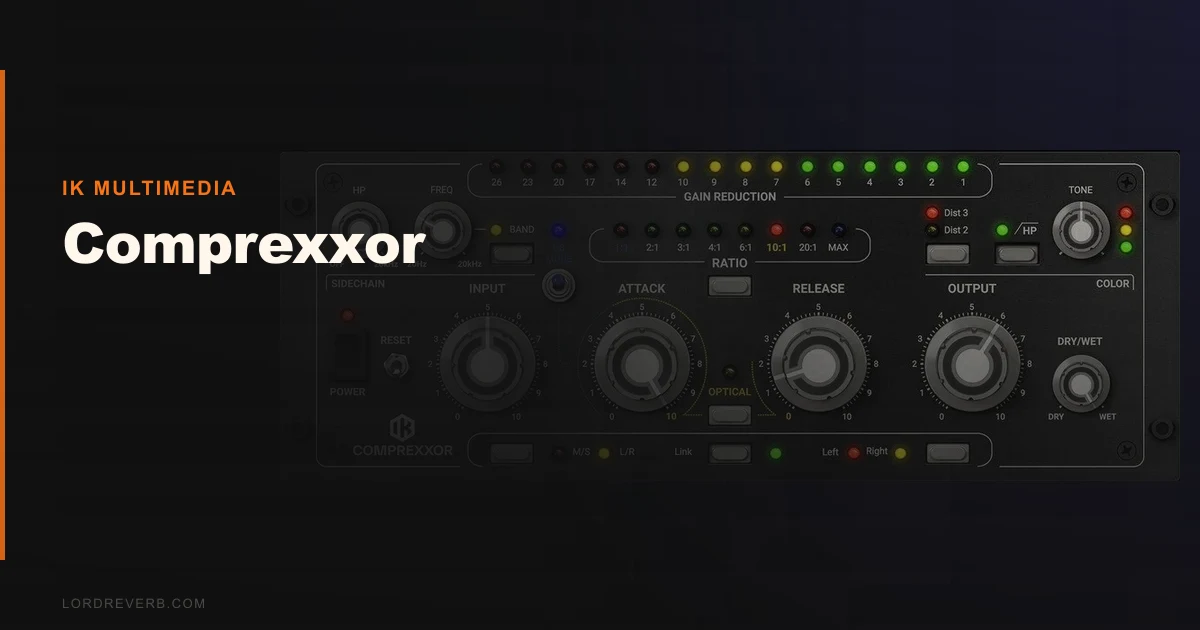
You've been chasing that Distressor sound for years, and the hardware costs a lot new. Every emulation you've tried either felt lifeless or locked you into a UAD ecosystem that costs even more. IK Multimedia's Comprexxor is their answer: a plugin that models the Empirical Labs Distressor, adds stereo and mid-side modes the hardware never had, and lives inside T-RackS 5.
It's not a perfect clone. But it might be the most flexible version of this compressor character you can get without selling something.
We ran it on kicks, snare buses, bass DI tracks, and stereo mixes for several sessions. Here's the full picture.
The Distressor Gap Nobody Wants to Talk About
The Empirical Labs Distressor is mono hardware. One unit. One channel. To do stereo bus work with true hardware, you need two units linked, which pushes the cost very high. That's before rack space, cabling, or an audio interface with enough headroom to loop it in your signal chain properly.
Plugin emulations fill that gap, but most force a trade-off. The UAD Distressor emulation sounds brilliant. It also requires UAD hardware or a UAD Spark subscription. Arousor, built by Empirical Labs themselves, tracks the hardware closely but costs more per copy and skips M-S processing entirely.
Comprexxor exists for the producer who wants Distressor character, stereo and mid-side modes, sidechain filtering, and no additional hardware. Whether it earns that position is what we're actually here to test.
How Comprexxor Performs in Real Sessions
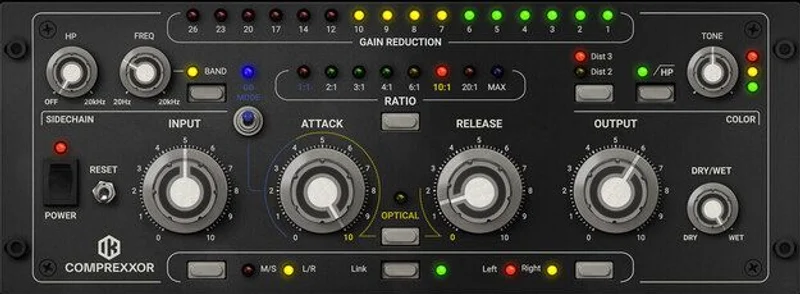
We started with a kick drum that was too present in the 300-400Hz range and losing punch on the 2-bus. We put Comprexxor on the kick channel, selected ratio 4 (the plugin offers eight ratio curves), and engaged the 3rd-order harmonic distortion mode. That mode adds tape-like saturation: odd-order harmonics that push the transient forward without brightening the top end artificially.
The result was cleaner than we expected. Attack at 10ms, release at 100ms, around 6dB of gain reduction. The kick stopped fighting the snare and started sitting underneath it. Satisfying.
On a snare bus, we flipped to the 2nd-order tube distortion mode and pushed the ratio to 6. The snare got thicker through the body without the hat bleed getting louder. The sidechain high-pass filter, set around 120Hz, kept the low-end of the snare from triggering compression too aggressively. That's a genuinely clever feature and one the hardware Distressor can't do internally.
For M-S work on a stereo mix bus, we compressed the mid channel harder than the sides. Ratio 3 on mid, ratio 2 on sides, with the mid release set shorter. The center tightened without narrowing the stereo image. We've tried similar moves with Complexx Review: Is It the Best Bus Compressor in 2026? and gotten comparable results, but Comprexxor's harmonic modes give it a dirtier character when you want that.
Compared to UAD and Arousor: the UAD version tracks the hardware's specific knee behavior more accurately. Arousor's release response feels tighter. Comprexxor trades some of that hardware accuracy for the expanded feature set. If you're trying to match the sound of a specific Distressor recording, the UAD version is closer. If you want Distressor-inspired character with modern routing options, Comprexxor wins on flexibility.
One frustration: IK hasn't published CPU load figures. In our tests inside T-RackS 5, Comprexxor pulled more resources than the White 2A or White 76 models on the same system. Not crushing, but annoying when you're stacking multiple instances on a dense mix.
Where It Wins and Where It Falls Short
The eight ratio curves are the headline feature and they deliver. Ratio 1 is gentle enough for transparent leveling on acoustic guitar. Ratio 8 is a limiter-adjacent wall that works on room mics when you want that squashed, 90s alt-rock drum sound. Having that range inside one plugin reduces the number of compressors you're loading per session.
The harmonic distortion modes are genuinely useful, not just marketing. The 2nd-order mode adds warmth: even-order harmonics that make bass and vocals feel fuller. The 3rd-order mode is more aggressive, closer to what tape does to transients. We love having both available with a single click.
The sidechain filtering is well-implemented. The band-pass option is something you won't find on many compressors at this price. Check out Bettermaker Mastering Compressor Nails Analog in 2026 if you want a mastering-grade alternative with different sidechain behavior.
The weaknesses are real. Living inside T-RackS 5 means you're loading the shell every time. It works as an insert in your DAW through the T-RackS plugin, but it's one extra layer compared to a standalone VST3. The hardware accuracy against the real Distressor is also not the tightest we've heard. If you're a Distressor obsessive who needs it to behave exactly like the hardware in a specific mode, keep looking.
For vocal de-essing behavior using the sidechain band-pass filter, we found the response slightly slower than ideal on fast consonants. It works, but dedicated tools handle it better. See our Can Royal Compressor Replace Your FG-MU in 2026? piece for another angle on character compression with different hardware DNA.
Is Comprexxor Worth the Price?
Comprexxor sits between budget emulations and the UAD ecosystem in terms of price. It's not cheap for a single plugin. But it's not trying to be cheap.
If you already own T-RackS 5, this is close to a no-brainer. The M-S capability alone makes it useful across more scenarios than a mono hardware Distressor. If you don't own T-RackS 5, factor in that cost. The plugin appeared during a sale period at $99.99, which is the point where it becomes easy to recommend without caveats.
At full price, it's worth it if compression with harmonic character is a regular part of your workflow. If you mostly do clean, transparent compression, you're paying for features you won't use.
Who Should Buy Comprexxor (and Who Should Skip It)
- ✅ Buy if you work inside T-RackS 5 and want Distressor-style character with M-S routing built in
- ✅ Buy if you track drums and want sidechain filtering plus harmonic saturation in one insert
- ✅ Buy if you caught it at $99.99 and do any kind of character compression regularly
- ❌ Skip if you need the closest possible match to real Distressor hardware behavior
- ❌ Skip if you're not in the T-RackS ecosystem and don't want to add the shell to your chain
- ❌ Skip if transparent, CPU-light compression is your priority. C4 Multiband Compressor Review: Still Worth It in 2026 handles that territory differently
Score Breakdown
| Category | Score | Notes |
|---|---|---|
| Sound Quality | 4.3/5 | Harmonic modes deliver real character; not the closest hardware clone but genuinely useful color |
| Value for Money | 3.8/5 | Strong at sale price; full price is harder to justify unless M-S and sidechain filtering are priorities |
| Ease of Use | 4.0/5 | Controls are intuitive; T-RackS shell adds a workflow step that's mildly annoying |
| Features | 4.5/5 | Eight ratio curves, two harmonic modes, M-S processing, sidechain filters: this is a loaded feature set |
| CPU Efficiency | 3.3/5 | Runs heavier than competing IK compressors; no official CPU specs is a frustrating omission |
| Overall | 4.1/5 | More flexible than most Distressor emulations; not the most accurate, but the most versatile at this price |
Alternatives Worth Considering
Arousor by Empirical Labs: Built by the people who made the original hardware. Tracks the Distressor's behavior more accurately, especially the release curve. No M-S mode. Costs more. If hardware accuracy matters more than modern routing, this is your pick. Complexx Review: Is It the Best Bus Compressor in 2026?
UAD Distressor: The most hardware-accurate emulation we've used. Requires UAD hardware or a Spark subscription. If you're already in the UAD ecosystem, it's the benchmark. If you're not, the entry cost is hard to swallow just for one compressor character.
Bettermaker Mastering Compressor: A different character entirely, but if you want analog-modeled compression for mastering-level work with serious sidechain options, it's worth comparing. Bettermaker Mastering Compressor Nails Analog in 2026
The Bottom Line
Comprexxor is the most feature-complete Distressor-inspired plugin at this price. It's not the most accurate emulation and it's not the lightest on CPU. But no other plugin in this range gives you eight ratio curves, two harmonic saturation modes, mid-side processing, and a band-pass sidechain filter in one interface.
If you live in T-RackS 5 and do session work that regularly calls for colored compression, buy it. If you're a Distressor purist or need something CPU-light for a busy mix template, look elsewhere.
At full price it's a considered purchase. At $99.99 it's a straightforward yes.
The hardware it emulates costs a lot and only did mono. Remember that when the price feels steep.
Frequently Asked Questions
Does Comprexxor work without T-RackS 5?
Comprexxor is a T-RackS 5 module, which means it runs inside the T-RackS 5 shell. You can insert T-RackS 5 as a plugin in any DAW that supports VST3, AU, or AAX, and run Comprexxor inside it. It does not run as a standalone plugin outside that shell. That's an extra step in your signal chain compared to a native DAW plugin.
How does Comprexxor compare to the actual Distressor hardware?
The hardware Distressor has a specific knee behavior and release character that Arousor and the UAD emulation track more closely. Comprexxor trades some of that hardware accuracy for features the original never had, including stereo and mid-side modes and internal sidechain filtering. If you're trying to replicate a specific Distressor recording, the UAD version is the closer match.
What's the difference between the 2nd and 3rd order harmonic modes?
The 2nd-order mode adds even-order harmonics, which sounds similar to tube saturation: warmer, denser through the body of a signal. The 3rd-order mode adds odd-order harmonics, which behaves more like tape saturation: it pushes transients forward and can feel more aggressive on percussive material. Both modes run continuously alongside the compression, not as a separate parallel chain.
Is Comprexxor good for mastering?
The mid-side mode makes it a viable mastering tool for adding character compression to a stereo bus. That said, the CPU load is higher than we'd like for a mastering session with multiple instances running. For mastering work where transparency and surgical control matter more than color, a dedicated mastering compressor will serve you better.