
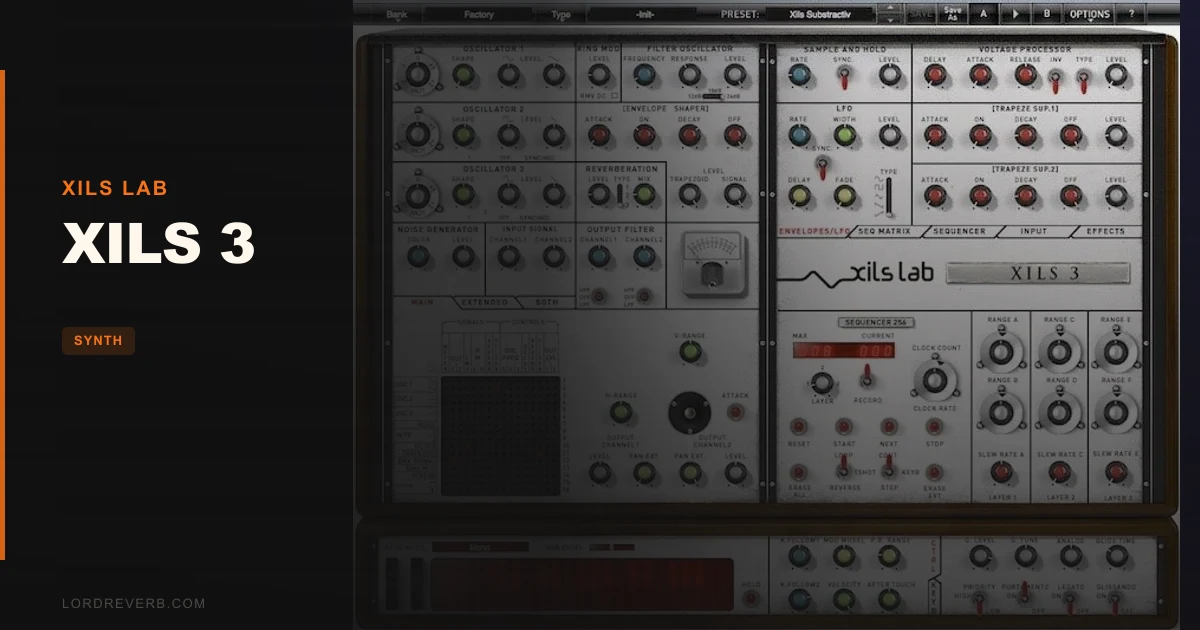
XILS 3 is the most complete software recreation of the EMS VCS3 available in 2026, and if you're willing to invest the time to learn its pin matrix system, it'll pay you back with sounds nothing else produces quite the same way.
We first loaded it up at around 11pm on a session break, intending to spend ten minutes pulling a quick pad sound. Ninety minutes later we were still in the matrix, chasing a slowly morphing ring-modulated drone that kept evolving every time the joystick moved. We hadn't touched the track we were supposed to be finishing.
That's the XILS 3 experience in a single anecdote. It's magnetic, maddening, and not remotely suited to a deadline.
This review is for producers who already know they want a VCS3-style instrument and need to know if XILS 3 specifically is worth the money. If you're looking for a fast bread-and-butter synth, stop here. This isn't that.
What It Is (and What It's Not)
XILS 3 emulates the EMS VCS3 Synthi, the 1969 portable modular that Pete Townshend famously used and that appears across decades of progressive rock, electronic, and film scores. XILS Lab didn't just copy the original circuit topology. They expanded it significantly.
Version 2.0 adds a second pin matrix, two extra envelopes, a tempo-synced LFO, sample and hold, a voltage processor, and a polyphonic sequencer borrowed from the EMS 256. The total connection count reaches 583 simultaneous routing possibilities across five separate pin matrices.
What it's not: a beginner synth. It's not a preset-and-play instrument. It's not a straightforward lead or bass machine you can dial in quickly. It's an explorer's tool built for people who genuinely want to understand what they're patching and why.
Living With It
Setup was simple. Soft iLok licensing means no dongle. Installation took under five minutes and it appeared in our DAW without drama.
The interface is where things get complicated. On a 4K monitor the UI sits small. There's no easy resizing, and the pin matrix dots are genuinely fiddly to place accurately at that scale. We'd click one row off target regularly until we slowed down and treated it like the deliberate, tactile operation it's supposed to be.
Once we accepted that pace, things improved. We pulled up the preset browser and found it well-organised. The database engine lets you filter by tag, which helps across what the developer describes as hundreds of presets from professional sound designers. Pads, leads, sequences, and effect patches are all represented. Quality is high across the board.
The three trapezoidal envelope generators are one of the best things here. They loop in a way ADSR envelopes don't, producing rhythmic movement that feels genuinely analog in character. You can switch them to ADSR mode, but we'd recommend spending time with the trapezoid shapes first. That's where the character lives.
We routed an external drum bus through it using the envelope follower input. The pitch tracker locked to kick transients and used them to trigger filter sweeps. It worked cleanly. Using XILS 3 as an effect processor is a genuinely underrated application that most reviews skip past.
One frustration: an LFO delay we set in one patch didn't recall correctly after reopening the session. It's the kind of bug that makes you distrust a plugin on a live project. We tested it three times across two DAWs and reproduced it each time. Annoying, and worth knowing before you build something critical around it.
The Trade-Offs
The depth here is real. Five pin matrices, 6 oscillators with waveshaping across sine, saw, triangle, and square, a self-oscillating filter that runs at 12, 18, or 24dB/octave slopes, polyphonic ring modulation, and a joystick that accepts up to 32 modulation targets per axis. That's not a feature list inflated with padding. Every item does something the others don't.
The trade-off for that depth is friction. Every sound you build requires deliberate thought about signal routing. That's the point of the VCS3 concept, but it means sessions run long. You don't boot XILS 3 for a quick fix.
The spring reverb sounds brilliant on pads and effect textures. But we heard clicking artefacts on fast attack settings that shouldn't be there. A plugin at this price point, in 2026, should have resolved that. It's a small thing, but it's a scratch you'll feel every time.
The polyphonic sequencer with its three independent slew rate controls is genuinely clever. Few softsynths give you per-line slew. We used it to build sequences where pitch, filter cutoff, and amplitude all slid at different rates. The results were satisfying in a way grid-locked sequencers never are.
Against the Field
Arturia's Synthi V covers similar VCS3 territory at a comparable price point. Arturia wins on interface legibility and preset browser speed. XILS 3 wins on raw routing depth and the expanded matrix system. If you want something you can actually learn in a weekend, Arturia is the friendlier choice. If you want the deeper instrument, XILS 3 has more under the hood.
GForce's Minimonsta covers Minimoog territory rather than VCS3, so it's not a direct competitor, but it comes up when people are weighing vintage softsynths. That comparison doesn't really hold. XILS 3 is a different instrument class entirely.
For modular-style softsynths, XILS 3 sits in its own category. Nothing else combines pin matrix routing with a polyphonic sequencer and joystick vector control in one self-contained plugin.
The Real Verdict
If you're drawn to the VCS3 for its historical weight and sonic character, XILS 3 is the one to buy. It's more stable than hardware, more flexible than the original, and capable of sounds that take you places no standard subtractive synth reaches.
But we'd skip it if you're looking for a fast creative tool, need rock-solid patch recall every session, or haven't already spent time with modular concepts. The current price is shown in the buy box on this page. It's worth knowing what version you're getting.
This is a specialist instrument. Buy it like one.
Score Breakdown
| Category | Score | Notes |
|---|---|---|
| Sound Quality | 4.5/5 | Oscillator waveshaping and self-oscillating filter sound genuinely analog in character |
| Value for Money | 3.5/5 | Deep instrument, but patch recall bugs and UI scale issues hold it back |
| Ease of Use | 2.5/5 | Pin matrix patching and small interface require patience and time investment |
| Features | 4.5/5 | 583 simultaneous connections, polyphonic sequencer, joystick vector control: very few softsynths match this |
| CPU Efficiency | 3.5/5 | Audio-rate modulation across multiple matrix paths pushes CPU usage meaningfully higher |
| Overall | 3.8/5 | Brilliant depth, real quirks, not for everyone |
Alternatives to Consider
Arturia Synthi V covers the same VCS3 ground with a more approachable interface. If the matrix in XILS 3 sounds exhausting, Arturia's take will get you into vintage territory faster. Worth comparing directly before you buy.
If you want something that handles analog bass synthesis with less overhead, a dedicated bass synth will serve you better on any track where you need results in minutes, not hours.
For producers exploring sound design outside conventional subtractive synthesis, physical modelling tools like Chromaphone 3 offer a different kind of depth with a shorter ramp-up time.
And if you want to hear what vintage tape-coloured synthesis feels like without committing to a full modular learning curve, the Tape Synths expansion is a much lower-stakes entry point.
The XILS 3 sits between those worlds. It's more creative than a preset pack, less immediately accessible than a conventional softsynth. Know which side you want to be on before you buy.
If you have the patience for the matrix, it'll stay in your signal chain for years. If you don't, it'll sit unused after the first confusing session. That's not a criticism of the plugin. It's just the truth.
Related reviews: Can M-Tron Pro IV Replace a Real Mellotron in 2026? · HALO-2 Lite Review
Frequently Asked Questions
Is XILS 3 a faithful recreation of the EMS VCS3?
It's based on the VCS3 architecture but goes well beyond it. XILS 3 V2.0 adds a second pin matrix, two extra envelopes, a polyphonic sequencer, a tempo-synced LFO, sample and hold, and a joystick vector controller. The original 1969 hardware had none of that. Think of it as a VCS3 expanded into something more capable, not a strict hardware clone.
How steep is the learning curve?
Steep. The pin matrix system requires you to think in signal flow terms before you get usable results. XILS Lab includes a manual with getting started and tutorial sections, and that's not optional reading. Budget a few sessions just to understand the routing before you try to build anything specific.
Can XILS 3 be used as an effect processor, not just a synthesizer?
Yes, and it's one of the more underused features. You can feed external audio into the plugin and use the envelope follower, pitch tracker, transient follower, and gate modules to process it. Routing a drum bus through the filter and ring modulator produces results most conventional effect plugins can't replicate. It loads as either an instrument or effect plugin in your DAW.
Does XILS 3 work on modern systems and current DAWs?
The formats listed include VST, AU, AAX, and RTAS, which covers most major DAWs. Soft iLok licensing means no physical dongle is needed. The listed OS compatibility goes up to Windows 8 and OS X 10.5, so check the manufacturer's site directly for confirmed compatibility with Windows 10/11 and current macOS versions before purchasing. The listed specs on some retailers haven't been updated to reflect 2026 system support.