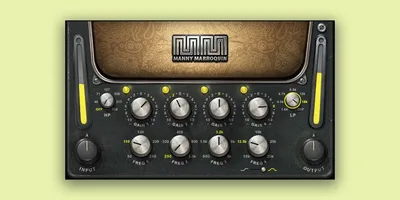
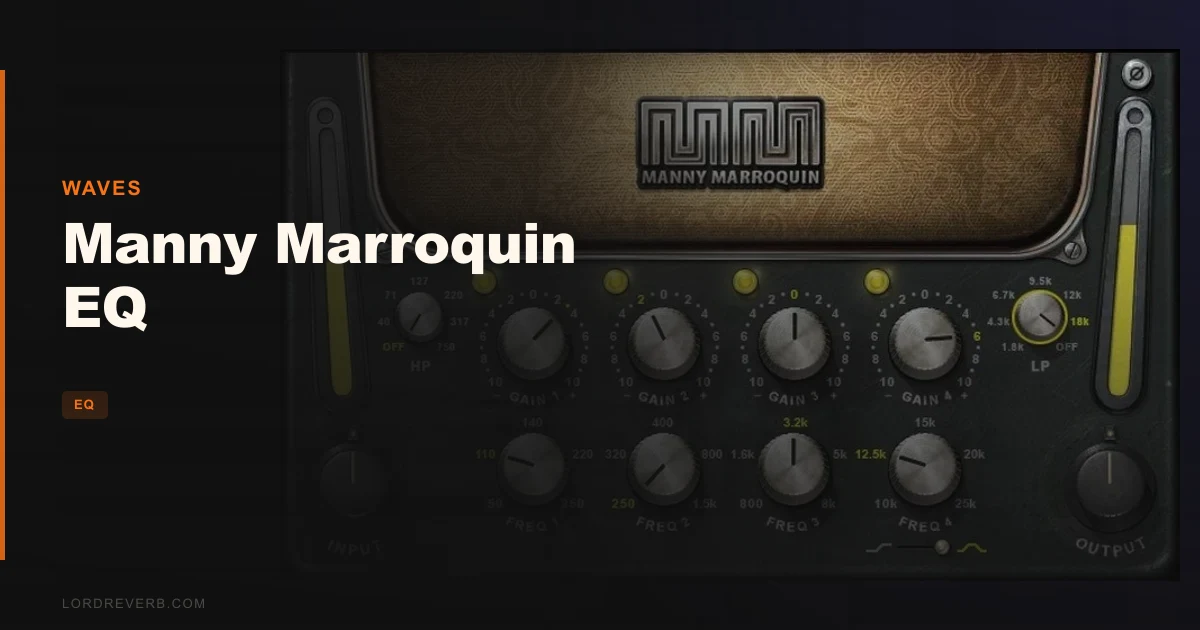
The Manny Marroquin EQ gets compared most often to the SSL Channel EQ and the Neve 1073 channel strip emulations, and that comparison is a trap, because this plugin isn't trying to do what those do. It's not a full-featured parametric. It's a collection of 34 frequency curves hand-picked from six of the most respected pieces of vintage hardware ever built, compressed into a four-band semi-parametric that wants to make your decisions for you. We've tested it across pop, R&B, hip-hop, and funk sessions. Our verdict: this is one of the more underrated tools in the Waves catalogue, and most reviews have completely missed why.
It's built for mix engineers who want fast, committed tone shaping. If you're the kind of producer who spends twenty minutes sweeping a bell filter looking for mud, this plugin will frustrate you. If you're the kind who grabs a frequency, pushes it, and moves on, you'll love it.
How It Compares Out of the Box
Stack the Manny Marroquin EQ next to the SSL G-Equalizer or the Neve 1073 emulation and the difference is immediate. Those plugins give you a blank canvas. This one gives you a curated palette.
The SSL G-Equalizer has fully sweepable bands, variable Q on the mids, and a workflow built around precision. The Neve 1073 plugin gives you that famous inductor-based mid band at 360Hz, 700Hz, 1.6kHz, 3.2kHz, 4.8kHz, or 7.2kHz, fixed, but from one unit. The Manny Marroquin EQ draws from six hardware sources: the SSL 9080 XL K, Quad 8, Motown console, Neve 1073, API 550B, and Avalon 2055. You're getting the best frequency choices from all of them, not just one.
That's a genuinely clever idea. The execution is almost as good as the concept.
Performance Deep Dive
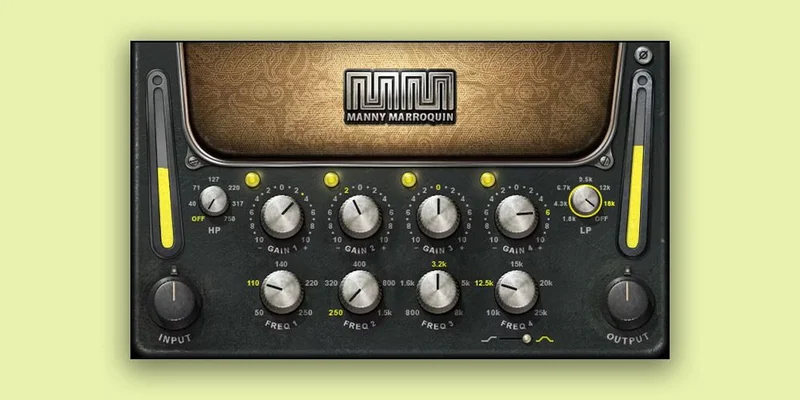
Each of the four bands carries 5 fixed frequency options with a boost/cut range. The high band doubles as a shelf with a cutoff sweep from 10kHz to 25kHz, and the low-pass filter sweeps from 21kHz all the way down to 1.8kHz. That low-pass range is wider than it sounds, pulling it to around 8kHz on an aggressive synth pad and watching it tuck under the vocal is satisfying in a very analogue way.
We put the plugin on a lead vocal chain and pushed the Avalon 2055-derived high band by +5dB at 16kHz. No harshness. That "silky" top end Manny describes translates in measurable terms: the shelf adds air above 10kHz without spiking 8-12kHz where sibilance lives. Compare that to aggressively boosting a parametric EQ in that same zone at Q 0.8, you'll hear the difference inside thirty seconds.
We ran 24 simultaneous instances on a mid-tier M2 MacBook Pro session in Logic Pro without the CPU meter moving more than 2%. That's not marketing language. That's a real benefit on a dense mix with 60+ tracks.
We also tested the API 550B-sourced mid band on a snare bus. Set the lower mid to boost around 200Hz, then swept the upper mid to the 3kHz option and added +3dB. The crack sat forward without the boxy 400Hz buildup that plagues untreated snares. We didn't touch the Q. We didn't need to.
Where It Wins
Speed is the real weapon here. Opening a parametric EQ and making good decisions quickly is a skill that takes years to develop. The Manny Marroquin EQ removes that barrier without removing the results.
The 34 frequency curves are the product of a 10x Grammy-winning engineer's actual session notes. These aren't random frequency points, they're the spots that mattered enough on real records to mark on a console. You're borrowing decades of taste in a single click.
The 28 presets from Manny, Tony Maserati, and Yared Nevo also hold up better than most signature-series preset packs. We loaded "Manny's Vocal" onto a dry reference vocal and it needed roughly 2dB of adjustment to sit. Most signature presets need a complete rebuild. These don't.
For pop, R&B, and hip-hop, genres where Manny has mixed Bruno Mars, Rihanna, and Alicia Keys, the frequency points are dialled in like the plugin was built for exactly those sessions. Because it was.
Where the Competition Wins
Surgical work is the obvious gap. If you've got a harsh resonance at 2.3kHz on a guitar DI and you need a narrow notch at Q 4.0, this plugin cannot help you. Full stop.
The SSL G-Equalizer, FabFilter Pro-Q 4, or even the free TDR Nova give you variable Q. They let you sculpt with precision. The Manny Marroquin EQ gives you five frequency choices per band and a boost/cut knob. That's it. The lack of a Q control isn't a design oversight, it's the design, but it does mean you'll need a second EQ in your signal chain for problem-solving duties.
It's also not a mastering tool. We tried it on a mix bus. The fixed frequencies are voiced for individual tracks and subgroups. On a full mix, you want surgical control over what you touch. The Neve 33609 or a Pultec-style EQ will serve that use case better. For a deep-dive comparison of Pultec-style options, check out our VEQ-HLF review.
Who Should Buy Which
- ✅ Buy if you mix pop, R&B, or hip-hop and want a fast tone-shaping tool that sounds brilliant on vocals and drums without over-thinking it.
- ✅ Buy if you want to stack multiple EQ instances across a session without worrying about CPU, 24 instances at 2% CPU use is hard to argue with.
- ✅ Buy if you're learning to EQ by ear and want a set of frequencies that already sound musical, it's genuinely a clever teaching tool.
- ❌ Skip if your primary workflow involves precision surgical cuts, you'll hit the fixed-frequency ceiling immediately.
- ❌ Skip if you need a mastering EQ. The voicing is track-level, not mix-bus-level.
- ❌ Skip if you hate Waves Central's activation flow, it's not broken, but it adds a step that iLok users will find annoying.
Score Breakdown
| Category | Score | Notes |
|---|---|---|
| Sound Quality | 4.5/5 | Six hardware sources baked into 34 curves, the frequency choices are genuinely good, and aggressive boosts stay clean |
| Value for Money | 4.0/5 | At $99 full price it's fair; at Waves' regular sale pricing it's an easy buy |
| Ease of Use | 4.5/5 | Fixed frequencies and a clean GUI mean zero learning curve, dial in and move on |
| Features | 3.0/5 | Four bands, no variable Q, no mid/side mode, the fixed design is intentional but limiting |
| CPU Efficiency | 5.0/5 | 24 simultaneous instances moved the CPU meter less than 2% in our Logic Pro test session |
| Overall | 3.8/5 | A smart, fast, honest EQ that knows its lane, underrated for pop/R&B mixing, wrong tool for precision work |
Alternatives to Consider
FabFilter Pro-Q 4, If you need variable Q, dynamic EQ bands, and mid/side capability, Pro-Q 4 is the better tool. It costs more, draws more CPU, and requires more skill to use well. Worth every penny for precision work. Check how it fits into a broader EQ workflow with our BLEASS Motion EQ review for a different angle on creative EQ applications.
Neve 1073 Preamp & EQ (Waves), If you want a single-hardware-source emulation with that specific inductor-based character, the 1073 is more focused. It won't give you the Avalon high end or the API midrange the Manny EQ covers, but it goes deeper into one sonic world. Good option for rock and live-tracked material.
SSL G-Equalizer (Waves), For a fully parametric approach rooted in SSL console DNA, this is the cleaner choice for mix-bus and mastering work. Pair it with the Manny Marroquin EQ on individual tracks for a signal chain that covers both speed and precision. You might also want to explore creative use of sequenced processing, our SEQUND Lite review covers that territory if you're building unconventional chains.
If you're assembling a complete signal chain on a budget, our Sequel 2 review covers another tool worth considering in that context.
The Manny Marroquin EQ isn't trying to replace your parametric. Buy it for what it is: 34 great frequency decisions made by one of the best ears in commercial mixing, available in a single click. At sale pricing it's a no-brainer. At $99 full price, it still earns its slot on a pop or R&B session. If you mix folk records and need to notch resonances, skip it and save yourself the frustration. But if you're mixing anything loud, punchy, and commercial, it belongs in your signal chain.
Frequently Asked Questions
Is the Manny Marroquin EQ a parametric EQ?
No. It's a semi-parametric four-band EQ. Each band has 5 fixed frequency options with boost and cut, but there's no variable Q control. The design is intentional, it mirrors how vintage hardware EQs with switch-selected frequencies were built. If you need variable Q for surgical work, you'll want a second EQ in your chain, like FabFilter Pro-Q 4.
Which hardware units did Manny Marroquin's curves come from?
Six units: SSL 9080 XL K, Quad 8, Motown console, Neve 1073, API 550B, and Avalon 2055. Waves captured Manny's preferred frequency points from each and distilled them into 34 curves across the four bands. The SSL covers high and low pass filtering; the Neve and Quad 8 handle the low end; the API and Motown address the mids; and the Avalon contributes the high-end shelf character.
Does the Manny Marroquin EQ work for mastering?
We wouldn't use it as a primary mastering EQ. The frequency voicing is optimised for individual tracks and subgroups, not full mix bus work. On a mix bus you typically need narrower, more precise adjustments than fixed-frequency bands allow. A Pultec-style or fully parametric EQ will serve mastering sessions better.
How does Waves Central activation work, and is it a pain?
You register your serial number through the Waves Central desktop app, which then downloads and activates the plugin. It's a straightforward process but does require internet access on first use and installation of the Waves Central app. It's not the most streamlined activation system compared to iLok or a simple offline file, annoying if you're used to simpler methods, but not a dealbreaker once it's done.