
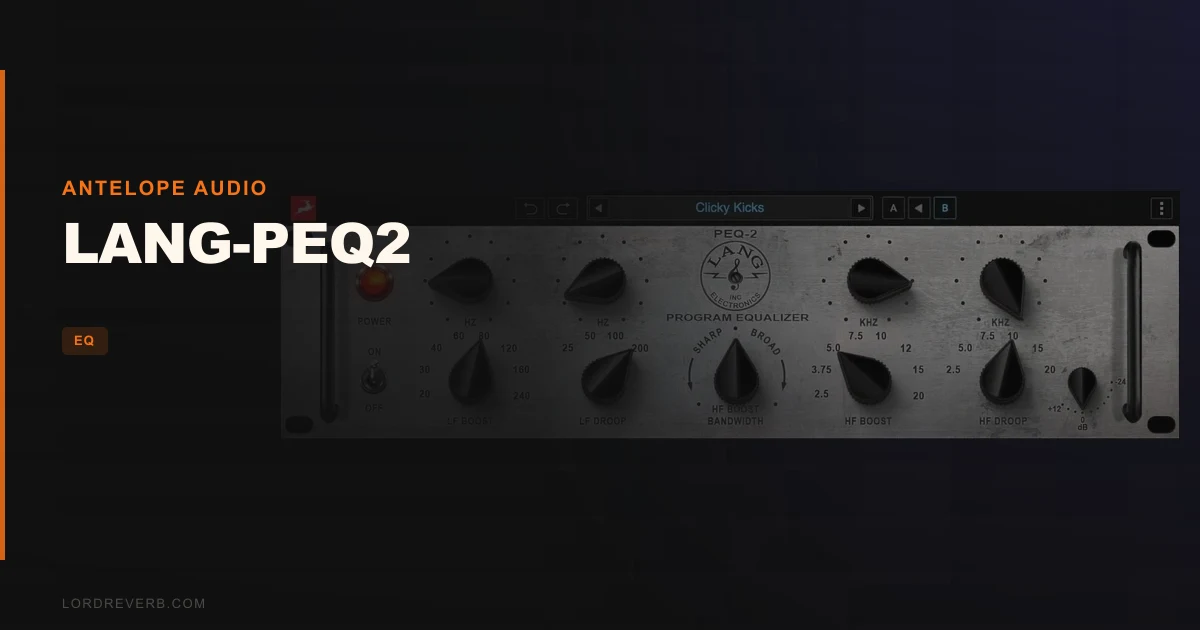
The LANG-PEQ2 review you're reading right now exists partly because buyers sometimes get here and feel a flicker of doubt: they wanted a Pultec-style warmth machine and instead got something tighter, more surgical, and more demanding of intention. That's not regret. That's the product doing its job. At $149, the LANG-PEQ2 is Antelope Audio's plug-in recreation of a 1960s solid-state EQ, and it rewards engineers who know what they want from a low end. It's not for anyone expecting a soft, forgiving colouration tool they can slap on every channel and forget. It's for the producer working bass guitar tones, the mix engineer shaping drum overheads, and the person who keeps pulling the same Pultec preset and wishing it had more focus.
This review is built around the kind of user you are, not just the kind of plugin this is. Keep reading to find out if you're the right buyer or the wrong one.
Who Ends Up Regretting This
The buyer most likely to feel buyer's remorse is the one who wanted smooth and got precise. If you've been chasing the loose, pillowy low-end warmth of a classic tube EQ, the LANG-PEQ2 might feel clinical. Owners specifically describe it as less finicky than tube units, which is a compliment to working engineers but a mild disappointment to anyone who loved how Pultecs misbehave.
If your main job is adding a gentle air shelf at 10 kHz on every vocal and calling it a day, the LANG-PEQ2's high-end section will frustrate you. Reviewers flag that the top-end bell is narrower than ideal for broad, airy applications, and that it picks up cymbal harshness and sibilance if you push it without care. That's annoying when all you wanted was a silky lift.
And if you're running a large session on underpowered hardware without a compatible Synergy Core device, you're buying a Native plugin with no published CPU data to benchmark against. That's a risk worth naming before you check out.
What Owners Actually Say
The word that keeps coming up from owners is "tighter." Specifically, tighter than Pultecs. Owners report the LANG-PEQ2 beats Pultec-style plugins on low end because the boost and droop controls interact in a way that stays controlled, not floppy. You get punch without the bloom spilling where you don't want it.
On full-mix use, users report it works better than expected. The tighter low end stops the mix from getting muddy, and the 20 kHz boost is described as silky rather than harsh. That's a word owners use, and what they seem to mean by it is that the boost adds air without spiking the presence band in a way that makes the whole mix feel strained.
Reviewers single out the saturation control, specifically the linked in/out that adds thickness and dynamic response. They describe it as adding thickness without hitting a ceiling the way other EQs do. That's a real differentiator if you're after character, not just frequency changes.
The complaints are consistent too. The top-end bell is narrower than some would like. And the high-end boost needs careful handling on cymbals and vocals. Those aren't deal-breakers, but they're not edge cases either. They come up often enough to take seriously.
One outlier worth noting: users report it sounded good on live strings. That's a notoriously difficult application for any EQ with strong character, and owners were surprised it held up.
What You Actually Get
The LANG-PEQ2 is a plugin recreation of a 1960s solid-state EQ. You get two versions in the same package: a Native plugin for Mac or Windows, and a Synergy Core Real-Time version that runs on compatible Antelope hardware with no perceptible latency.
The frequency architecture is what separates this from simpler Pultec recreations. There are 26 frequency points total. The LF boost section covers eight frequencies: 20, 30, 40, 60, 80, 120, 160, and 240 Hz, with up to 16 dB of boost. The LF droop section gives you four frequencies: 25, 50, 100, and 200 Hz, with up to 18 dB of cut. Those two sections operate independently, which means you can boost at one frequency and cut at a different one simultaneously. That's the core of how it achieves a tight, controlled low end rather than a broad, wobbly one.
The HF section offers a 20 kHz boost option and a bandwidth control. The developer positions the high-end bands as tools for giving tracks extra shine and providing width in the midrange.
The Low-End Controls in Detail
This is where the LANG-PEQ2 earns its reputation. The separation between LF boost and LF droop is not just a cosmetic feature. It changes how you work.
On a typical Pultec, the boost and cut frequencies are linked or at least interact. Here, they're independent. You set a boost frequency separately from your cut frequency. That means you can boost at 60 Hz for weight while cutting at 100 Hz to stop the low-mid from building up into mud. On a kick drum channel, you might boost at 60 Hz for weight, then apply droop at 100 Hz to control the low-mid. The result is a kick that hits in the chest without pushing a frequency hump into the bass guitar's space.
Eight boost frequencies in the LF section is a real practical advantage. Many Pultec-style plugins give you four or five. Having 20 Hz and 30 Hz as separate options matters on subwoofer content. Having 240 Hz means you can shape low-mid body without switching to a different EQ plugin.
The droop section's four frequencies are coarser, but 25, 50, 100, and 200 Hz covers the main problem areas in most source material. The 200 Hz point is especially useful on bass guitar and male vocals where warmth curdles into honk.
Owners describe achieving tight and controlled low end through simultaneous boost and cut. That's the right way to think about it. Use both sections together and you're sculpting, not just adding weight.
The High-End Section: Brilliant When Careful, Frustrating When Not
The 20 kHz boost is the headline feature in the HF section. Used on vocals, it adds the kind of air that makes a track feel expensive. Users report it working well on full mixes, contributing a silky top end without the brittleness you get from broad presence boosts in the 10-12 kHz range.
But the HF bell is narrower than some mixing applications need. If you're trying to add a wide, gradual air shelf across a whole mix or a drum bus, the bell's focus can feel like a limitation. You get a precise lift rather than a broad one. For some contexts, that's exactly right. For others, it's the wrong tool.
The sibilance issue is real and worth naming clearly. Push the high-end boost on a vocal with an aggressive "s" problem and you'll hear those sibilants get louder and uglier. This isn't a flaw unique to the LANG-PEQ2, but its narrow bell means the boost doesn't spread energy around enough to soften the effect. If you're working a sibilant vocal, dial in the HF boost conservatively and handle the sibilance separately before the EQ in your chain.
Same goes for drum overheads with crashing cymbals. The developer says the plugin excels on drum overheads, and owners confirm it works, but you need to watch the HF boost carefully. Too much and the cymbals turn unpleasant. Keep it moderate and the overheads open up beautifully.
The HF boost bandwidth control is there to help you manage this. Use it. Wider bandwidth spreads the energy and reduces the chance of picking up specific problem frequencies. The control gives you the kind of precision that makes the HF section usable on more source material, not just the well-behaved stuff.
Vocals: The Primary Use Case
The developer calls the LANG-PEQ2 an all-star on vocals. Owners don't argue with that.
Your vocal session might look like this: you've got a lead that's sitting slightly back in the mix, slightly muddy in the low-mid, and lacking that forward, expensive feel. Start with the LF section. Boost at 80 Hz if you want body, apply droop at 200 Hz to clear the mud.
Then move to the HF section. The 20 kHz boost adds air without touching the presence frequencies where sibilance lives. If the vocal needs more presence in the 5-8 kHz range, handle that with a different EQ in your chain, not the LANG-PEQ2's HF bell.
The saturation control, through the linked in/out approach that reviewers praise, adds thickness. This matters on thin vocals recorded in untreated rooms. The added harmonic content fills out the low-mid without requiring heavy compression. That's a satisfying result that you don't always expect from an EQ plugin.
Owners report consistency as a strength here: the LANG-PEQ2 behaves the same way every time, without the variation you get from tube emulations that model tube state changes. If you're mixing multiple vocals in a session and you want the same EQ character on all of them, that consistency is clever engineering rather than a compromise.
Drum Overheads: Rewarding but Demanding
Drum overheads are a genuinely tricky application for a character EQ. You're usually trying to bring out the room, add weight to the shell sound filtering up through the overheads, and open the cymbals without making them shrill. The LANG-PEQ2 does the first two things well.
Use the LF boost at 60 or 80 Hz to add weight. The low end on overheads is often rolled off or thin, and a moderate boost at 60 Hz gives you kick and snare body without cluttering the low end you've built elsewhere. Apply droop at 100 or 200 Hz to stop that boost from building up into a cardboard sound.
The HF section needs attention on overheads. Cymbals are the problem. If the overheads already have bright, aggressive cymbals, the HF boost will pick that up and make it worse. Reviewers flag this directly. The fix is to use the bandwidth control to widen the bell, keeping the boost at 20 kHz where cymbals have less energy and the air of the room lives.
When you dial it in right, the LANG-PEQ2 on drum overheads gives you a wide, open kit with controlled bottom. That's a satisfying result from a single plugin.
Bass Guitar: The Go-To Application
The developer calls the LANG-PEQ2 a go-to EQ for bass guitars. This is the application where the independent boost and droop architecture makes the biggest practical difference.
Bass guitar has two common problems: not enough fundamental weight below 80 Hz, and too much low-mid buildup around 150 to 250 Hz that makes it boom rather than punch. The LANG-PEQ2 fixes both simultaneously. Boost at 40 or 60 Hz for the fundamental. Apply droop at 100 or 200 Hz for the buildup. You end up with a bass that sits under the kick without fighting it, with a clear attack that cuts through without muddying the low end.
The 240 Hz boost option in the LF section is worth exploring on bass guitar. Some players and bass tones need low-mid body rather than sub weight. The 240 Hz point is unusual in a Pultec-style plugin and it gives you an option that most similar tools don't have.
Owners report the LANG-PEQ2 beats Pultec-style alternatives on bass guitar specifically because it's more focused. Less bloom, more control. If you're mixing in a room that makes low-end decisions unreliable, the LANG-PEQ2's tighter response is an advantage because the results translate better to other playback systems.
Full-Mix Use: Better Than Expected
Using a character EQ on a full mix or a stereo bus is a workflow that separates confident mixers from nervous ones. The LANG-PEQ2, based on what owners report, handles it well.
Users report it works better on full mix than alternatives because the low end stays controlled. That's the core risk with any Pultec-style EQ on a full mix: you add low end and suddenly the whole mix is heavier than you wanted. The simultaneous boost and droop architecture prevents that. You can add sub weight without adding low-mid bloat.
The 20 kHz boost at the HF end is particularly useful on a full mix. At that frequency, you're adding air to everything simultaneously without pushing the presence frequencies where it'll make snares too bright or vocals too harsh. Even 2 or 3 dB at 20 kHz can make a dense mix feel like it's breathing.
The saturation control becomes more significant on a full mix. The linked in/out that reviewers describe as adding thickness and dynamic response works like gentle glue. It doesn't clamp the mix down the way a compressor does. It binds it. That's a different kind of control, and for some mixes it's exactly what's missing.
Full-mix use also exposes the HF bell's narrowness more than single-track use does. If you're boosting on a full mix and something in the 15-18 kHz range is already slightly harsh (a bright synth pad, an overcooked overhead), the narrow bell might exaggerate it. Use the bandwidth control and keep the boost amount modest.
Live Strings: The Surprise Result
Users report the LANG-PEQ2 sounded good on live strings. That deserves its own section because it's not an application you'd predict from a plugin designed around pumped-up low end and air.
Live strings are hard to EQ well. They're complex, dynamically alive, and they respond badly to anything that feels forced. The fact that owners found the LANG-PEQ2 usable here says something about how the character translates at lower boost amounts.
If you're working an orchestral or chamber session and you want to add body to cellos and double basses, the LF section at moderate amounts (try the 80 Hz boost at 4 to 6 dB with droop at 200 Hz to keep the honk out) gives you weight without the strings sounding processed. The HF section at conservative settings adds a bit of room air. Keep the boost to 2 dB at most on strings. Push it and they'll thin out or get scratchy.
This is not the LANG-PEQ2's primary purpose, but it performs well here anyway. But if you're a producer who works across genres including orchestral or acoustic music, it's good to know the plugin doesn't embarrass itself.
Synergy Core vs. Native: Which Version Are You Buying?
This is a question worth asking before you spend $149.
The Native version runs on Mac or PC without any additional hardware. It works like any other plugin in your session. If you don't own a compatible Antelope Synergy Core device, this is what you're getting.
The Synergy Core Real-Time version runs on compatible Antelope hardware with no perceptible latency. That's the version that makes the LANG-PEQ2 genuinely useful in tracking sessions. Put it in your signal chain while recording vocals or bass guitar and you're making real-time EQ decisions that the artist hears in their headphones. That's a different level of practical use than a post-recording mix tool.
If you already own Synergy Core hardware, buying the LANG-PEQ2 for $149 is straightforward. You get both versions and the real-time one is the one you'll reach for most. If you're Native-only, the plugin still works, but check Antelope's current compatibility list before assuming the hardware upgrade path is something you want.
CPU impact data for the Native version isn't documented. That's worth flagging for Native users running large sessions. Without a benchmark, you're guessing at the resource impact.
Who This Plugin Is Actually For
The Working Mix Engineer
You've got a mix that needs a low-end decision and a Pultec-style plugin keeps giving you too much bloom. The LANG-PEQ2 is your answer. The independent boost and droop sections give you the control you need to make a low-end decision that translates outside your room. The 26 frequency points mean you're not stuck compromising. You love the idea of a character EQ that doesn't overstay its welcome.
Verdict: Buy it. This is the user the plugin is built for.
The Producer Working ITB
You're producing in the box, shaping bass tones and drum sounds without analog hardware. The LANG-PEQ2 fits your signal chain at every stage. Use it on bass guitar buses, kick channels, drum overheads, and lead vocals. The saturation control adds the analog thickness you're missing without reaching for a separate saturation plugin. The consistency of a solid-state recreation (no tube variation) means your session sounds the same every time you open it.
Verdict: Buy it. You'll use this constantly.
The Vocal Producer
You work vocals primarily. You want a plugin that adds weight to the low end of a vocal, clears the low-mid, and adds air at the top without making sibilance worse. The LANG-PEQ2 does the first two reliably. The third requires care: the HF boost at 20 kHz is usable, but you need to watch the sibilance response and keep boosts conservative. If your vocalists are clean, it's brilliant. If your vocalists are sibilant, it's annoying to manage.
Verdict: Buy it, with the caveat that you'll need a de-esser or sibilance tool in your chain.
The Mastering Engineer
You need certainty. The HF bell's narrowness is a concern when you're applying final EQ to full mixes at high stakes, and independent mastering workflow reviews are not available to validate performance in this context. The plugin might be useful in a mastering context, but without that documentation you're experimenting. The plugin has potential here based on owner reports of full-mix performance, but it's unproven territory.
Verdict: Wait. See more independent mastering reviews before committing.
The Beginner Producer
At $149, you're spending serious money on a specialised character EQ that requires some understanding of boost and droop relationships to use well. If you're still learning what a low-mid buildup sounds like, this plugin will confuse more than it helps. Start somewhere more forgiving.
Verdict: Skip it for now. Come back when you know what you're trying to achieve in the low end.
The Smarter Route
If the LANG-PEQ2 isn't your fit, here's what people actually compare it to and why.
The Pultec EQP-1A is the classic comparison. Owners consistently say the LANG-PEQ2 beats it on low-end control. The Pultec is smoother and less flexible. If smooth and simple is what you want, the Pultec EQP-1A is the right tool. If you want precision, the LANG-PEQ2 wins.
The UAD Pultec plugin offers a different sonic character. If you're already in the UAD ecosystem, it's worth evaluating what that character gives you versus the LANG-PEQ2's tighter, more surgical response. Neither is objectively right. The UAD version suits some workflows better.
The Motown EQ is a different architecture altogether, with minimized frequency interaction by design. If you hate the idea of boost and droop frequencies interacting at all, even in a controlled way, the Motown EQ's approach might suit you better.
Buy or Wait?
Buy the LANG-PEQ2 if you produce or mix bass-heavy material and you've been frustrated by how Pultec-style plugins give you weight without control. Buy it if you're on Antelope Synergy Core hardware and want a real-time EQ option for tracking. Buy it if you're a mix engineer who works vocals and drum overheads regularly and wants a character EQ that actually stays out of trouble.
Wait if you're not sure what you want from a character EQ yet. Wait if you need a mastering-grade tool with published independent reviews.
Skip it if you're a beginner or if your primary need is a wide, gentle air shelf rather than precise, controllable low-end shaping.
Specs & Technical Details
| Developer | Antelope Audio |
| Price | $149 |
| Plugin Format | N/A |
| OS Support | Mac / Windows |
| Activation | N/A |
| CPU Usage | N/A |
| Trial Available | N/A |
| Version Reviewed | N/A |
Score Breakdown
| Category | Score | Notes |
|---|---|---|
| Sound Quality | 4.5/5 | Owners consistently rate the low-end shaping as tighter and more controlled than Pultec alternatives; HF section is usable but requires care |
| Value for Money | 4.0/5 | At $149 you get two versions (Native and Synergy Core Real-Time) and 26 frequency points; competitive for a specialised character EQ |
| Ease of Use | 4.0/5 | Layout is similar to the VEQ-1A tube EQ; independent boost and droop takes some learning but rewards the effort |
| Features | 4.5/5 | 26 frequency points, independent LF boost and droop, HF bandwidth control, saturation via linked in/out; a broader feature set than many Pultec-style alternatives |
| CPU Efficiency | N/A/5 | Synergy Core version offloads processing to hardware |
| Overall | 4.3/5 | A well-regarded character EQ that outperforms Pultec alternatives in low-end control, with a high-end section that rewards careful handling |
Alternatives to Consider
Pultec EQP-1A
The comparison owners reach for most often. The EQP-1A is smoother and simpler. If you want an EQ that flatters without demanding much from you, it's the softer, more forgiving choice. Owners who've used both say the LANG-PEQ2 wins on low-end focus, but the Pultec wins on ease and that classic tube smoothness. If you're not sure which kind of character you want, the EQP-1A is the lower-stakes starting point.
UAD Pultec Plugin
The UAD Pultec plugin is in the same conversation. It offers a different sonic character. If you're already committed to the UAD ecosystem, the question is whether the LANG-PEQ2's tighter low end and broader frequency point selection is worth the platform switch. For engineers who already own UAD hardware, it's a genuine either/or decision based on the low-end control difference.
Motown EQ
The Motown EQ uses a different architecture built to minimise frequency interaction. If the idea of boost and droop frequencies influencing each other sounds like a problem rather than a feature, the Motown EQ's design philosophy might suit your workflow better. It's a different kind of tool, not a direct upgrade or downgrade from the LANG-PEQ2.
The LANG-PEQ2 is the kind of plugin you buy once and reach for constantly, or the kind you buy, feel confused by for a week, and then find exactly one use for. The difference comes down entirely to whether you work with material where low-end control matters as much as low-end character. If you produce bass-heavy music, mix hip-hop or soul or rock with live bass, or shape drum kits for a living, this plugin will become a fixture in your sessions. The LF boost at 60 Hz combined with droop at 100 Hz can cut boxiness and achieve tight low end, while the 20 kHz shelf adds air, a combination owners prefer over a Pultec for tracks that need to sit tight. At $149, with both a Native and a Synergy Core Real-Time version included, it earns its place. It's wrong for beginners, it's wrong for anyone who needs a wide-and-vague air shelf, and it's wrong for anyone who needs a mastering tool with a full independent track record. For everyone else, it's one of the smarter character EQ buys in this price range.
Frequently Asked Questions
Is the LANG-PEQ2 a faithful recreation of a real hardware unit?
Yes. It's based on a solid-state EQ from the 1960s. Antelope Audio positions it as a faithful recreation. Owners who've used both the plugin and original-era Pultec-style hardware report that the newer version has the same vibe as vintage units but with a slightly cleaner sound. No detailed documentation on hardware-to-plugin modeling accuracy has been published, so if that level of technical specificity matters to your decision, that's worth checking directly with Antelope.
Can I use the LANG-PEQ2 without Antelope hardware?
Yes. The Native version runs on Mac or PC without any additional Antelope hardware. The Synergy Core Real-Time version requires a compatible Synergy Core device and provides no-perceptible-latency processing. If you don't own Antelope hardware, you're buying the Native version and it works like any other plugin in your DAW.
How does the LANG-PEQ2 compare to a standard Pultec EQ plugin?
Owners consistently report the LANG-PEQ2 gives tighter, more controlled low end. The key difference is the independent LF boost and LF droop sections, which let you set different frequencies for each rather than linking them. The Pultec EQP-1A is described as smoother but less flexible. The LANG-PEQ2 has 26 frequency points compared to fewer options on many Pultec-style alternatives, which the developer describes as twice the frequency modes of some contemporaries.
Is the LANG-PEQ2 good for mastering?
No independent mastering reviews exist for the LANG-PEQ2 based on current owner and reviewer reports. Users do note it works well on full mixes, with the tighter low end and 20 kHz boost performing better than expected in that context. If you're a mastering engineer who needs proven, documented full-mix performance at a professional level, the evidence base isn't there yet to make a confident recommendation.
How should I handle the sibilance issue with the LANG-PEQ2 HF boost?
Keep the high-end boost conservative, 2 to 4 dB maximum on vocals and cymbals. Use the HF boost bandwidth control to widen the bell and spread the energy away from the specific frequencies where sibilance lives. Handle any existing sibilance with a de-esser placed before the LANG-PEQ2 in your signal chain. The 20 kHz boost point is high enough to add air without directly boosting most sibilance frequencies, but pushing the amount too hard changes that.