The Waves L4 Ultramaximizer is a streaming-era brick wall limiter that earns its place on your master bus, with five limiting algorithms, integrated EBU R128-compliant loudness metering, and real-time gain visualization baked into one plugin.
We loaded it for the first time at the end of a hip-hop session. The track was sitting around -9 LUFS integrated, way too hot for the mix bus, way too quiet compared to references. The producer wanted it competitive. Our usual chain: a Pro-L 2 into a clip gainer, a separate LUFS meter on the output. Fine, but messy. The L4 put everything in one place. We hit -14 LUFS True Peak -1 dBTP in under four minutes without a single restart. That’s not magic. That’s smart workflow design.
First Impressions: Two Interfaces, One Opinion
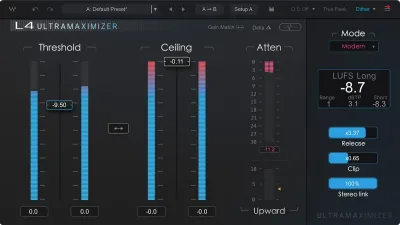
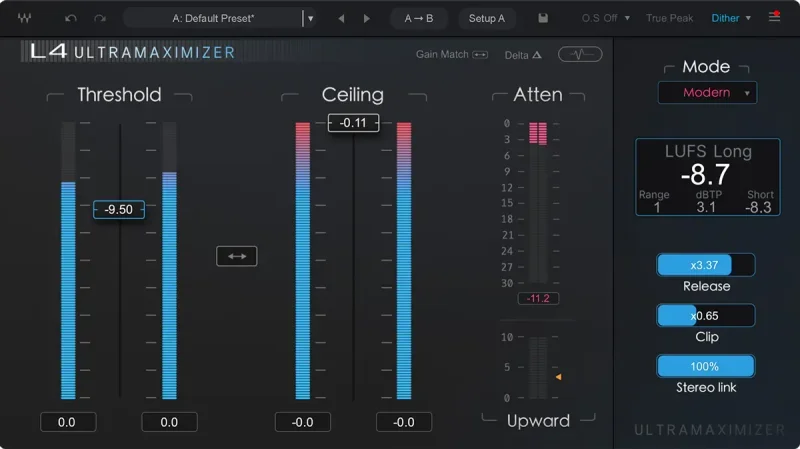
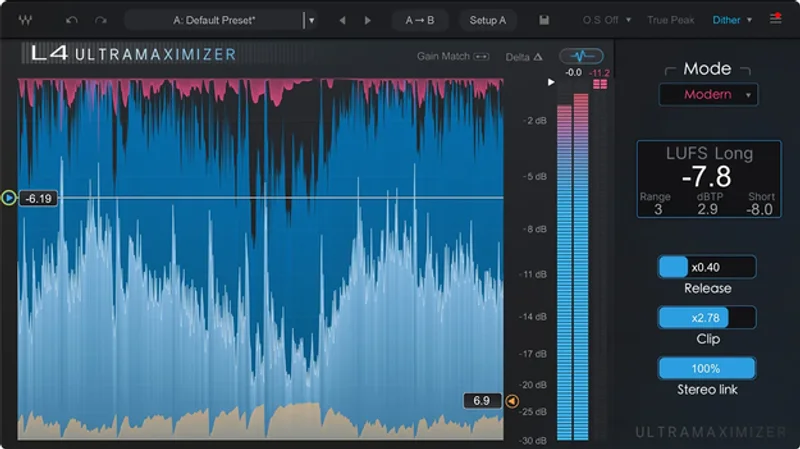
Opening the L4 for the first time, you get a choice. Graph Mode shows you a real-time visualization of the gain reduction curve and limiting activity. Classic Mode strips everything back to match the old L2 layout: threshold, ceiling, release, attenuation meter, output.
We lived in Graph Mode immediately. Watching the limiting curve respond differently between Modern and Aggressive modes in real time changed how we dialed in the threshold. It’s not eye candy. It’s information.
The interface is clean. No annoying hunt for the True Peak display. LUFS integrated, short-term, and momentary are all visible without opening a sub-menu. That alone beats the L2’s workflow by a mile.
Getting It Into a Real Workflow
The L4 sits at the very end of your master bus. Full stop. This isn’t a multi-band compressor, an EQ, or a stereo widener. You need upstream processing first.
We dropped it after a low-end shelf, a mid-side EQ, and a gentle glue compressor. That’s where it thrives. Feed it a mix that’s already balanced and the L4 controls the ceiling with real grace. Feed it a muddy low end and you’ll hear that mud get louder, not cleaner.
The five modes work as follows in practice. Modern is our default: clean attenuation with minimal inter-sample peak distortion at -14 LUFS targets. Smooth backs off transient grab for more natural-feeling limiting on acoustic material. Safe is almost too conservative, leaving a lot of loudness on the table. Aggressive clips harder and faster, useful for electronic music where you want the limiting itself to add character. The L2 mode replicates the original algorithm, which is satisfying for A/B nostalgia but not where we’d finish a modern master.
One friction point: the upward compression feature. We love the concept. It lifts quieter signal to maintain perceived fullness rather than just squashing peaks. But when it’s engaged, the internal gain matching shifts in a way that makes true A/B comparison unreliable. You can’t trust the bypass anymore as a clean reference. Annoying.
What It's Genuinely Good At
The loudness metering integration is the headline feature and it delivers. We set a True Peak ceiling of -1 dBTP, target -14 LUFS integrated for Spotify, and the L4 holds both simultaneously. No external plugin. No mental math. It just stays there.
We ran a dense pop master through it in Modern mode, targeting -13 LUFS. At that setting, we were getting around 3-4 dB of gain reduction on peaks. The snare attack survived. The vocal sat forward. The low end stayed round, not flattened.
Compare that to our experience with FabFilter Pro-L 2 at identical settings: the Pro-L 2 offers more granular transient shaping controls, but the L4 gets to a satisfying result faster with less tweaking. For producers who aren’t career mastering engineers, that speed advantage matters.
The upsampling option is genuinely clever for catching inter-sample peaks before they cause distortion in lossy codecs. We’d keep it on by default. CPU cost is moderate but not heavy.
The Rough Edges
Aggressive mode distorts faster than we’d like. We pushed a drum bus through it at -8 LUFS, which is louder than we’d recommend for anything streaming-destined, but some clients ask. By -7 LUFS the transient distortion was audible. Not a subtle artifact. Actual grit on the snare attack. The Pro-L 2 in the same scenario held together about 1-1.5 dB longer before artifact onset.
The L2 mode is a nice legacy touch. We’re genuinely unsure who needs it on a new plugin in 2026. Maybe for recall sessions on older projects.
The Delta control, which lets you solo the signal being attenuated, is useful but buried in the interface. We’d prefer it front and center. Finding it the first time took longer than it should have.
No mid-side processing. At this price and with this level of metering integration, we wish it was there.
Who This Is Really For
✅ Buy if you’re an ITB mixing engineer or bedroom producer who needs integrated LUFS metering and a reliable limiter in one slot without juggling multiple plugins.
✅ Buy if you’re mastering pop, hip-hop, or electronic music to streaming targets and want a fast, trustworthy path to -14 or -16 LUFS without destroying transients.
✅ Buy if you’re already a Waves user and want something that complements your existing Waves processing chain without adding a separate metering tool.
❌ Skip if you need mid-side limiting. The L4 doesn’t have it. Look elsewher e.
❌ Skip if you’re doing classical, jazz, or film post where Smooth mode’s dynamics preservation still isn’t subtle enough for genre expectations.
❌ Skip if you need surgical gain reduction control at the transient level. FabFilter Pro-L 2 has more detailed per-band and transient controls at a higher price point.
Score Breakdown
| Category | Score | Notes |
|---|---|---|
| Sound Quality | 4.0/5 | Modern and Smooth modes are clean at realistic streaming targets; Aggressive mode shows artifact onset earlier than Pro-L 2 |
| Value for Money | 4.5/5 | Integrated LUFS metering alone justifies the price; replaces a plugin slot |
| Ease of Use | 4.0/5 | Graph Mode is intuitive; Delta control is buried; upward compression A/B issue is a real workflow snag |
| Features | 3.5/5 | Five modes and full streaming metering are excellent; no mid-side is a visible gap at this tier |
| CPU Efficiency | 3.5/5 | Upsampling enabled pushes it to moderate load; fine on dedicated mastering sessions, worth watching on busy mix buses |
| Overall | 4.1/5 | A genuinely useful, streaming-aware limiter that works fast; not a mastering chain replacement, but an honest upgrade from the L2 |
Alternatives Worth Considering
FabFilter Pro-L 2 is the honest benchmark here. It costs more (check FabFilter’s site for current pricing), has more granular transient controls, mid-side processing, and holds together better past -8 LUFS on complex material. If you master professionally and transient behavior at extreme loudness targets matters to you, it’s the better tool. We’d pair it with a dedicated waveshaper for saturation rather than relying on limiting character.
iZotope Ozone Maximizer (standalone or inside Ozone) adds AI-assisted target matching. It’s more opinionated in how it processes. Some producers love that. Some hate it. It’s less transparent than the L4 in Modern mode at identical targets.
Limitless by Tokyo Dawn Labs is underrated and free. It’s a multi-band limiter with more complexity, a steeper learning curve, and genuinely excellent transparency. If your signal chain is already complex and you need zero-cost ceiling control, start there before spending anything.
If you’re still building a core plugin set and thinking about what a mastering chain actually needs, the L4 is a smart final-stage piece. Just don’t drop it on an unprocessed mix and expect a master.
The Bottom Line
We’d buy the L4 without hesitation. At regular price, it’s still worth it if you’ve been running a separate LUFS meter alongside a separate limiter. Combining those two slots into one that actually sounds good is worth the cost.
Check the Waves site for current pricing before you pull the trigger. Waves runs sales constantly and the L4 will likely hit sale price multiple times a year.
The one producer we’d tell to skip it: anyone doing classical music or acoustic jazz who needs transparent limiting below -18 LUFS with true dynamic range preservation. The L4 isn’t surgical enough at those targets. For everyone else making music meant to live on streaming platforms, it’s the most direct path from “too quiet” to “done” that we’ve found at this price.
The L2 made a generation of engineers stop worrying about peaks. The L4 makes you stop worrying about LUFS. That’s not a small thing.
Frequently Asked Questions
What is the difference between the L4 Ultramaximizer and the original L2?
The L2 was a single-algorithm brick wall limiter built for the loudness era of the late 90s and 2000s. The L4 has five limiting algorithms, integrated EBU R128-compliant LUFS metering, upward compression, True Peak limiting, and a real-time graph display. The L2 mode inside the L4 replicates the original algorithm, so you can A/B both from the same interface. The L4 is built around streaming targets. The L2 was not.
Can the L4 Ultramaximizer replace a full mastering chain?
No. The L4 handles ceiling control and loudness targeting. It doesn't replace EQ, compression, stereo imaging, or saturation. You need those processes upstream before the L4 does its job well. Think of it as the final stage of a chain, not the chain itself.
Does the L4 support mid-side limiting?
No. The L4 is stereo only. If mid-side processing is part of your mastering workflow, you'll need to handle that with a separate plugin before the L4 in your signal chain. This is a real limitation at this tier and a reason some professional mastering engineers will still reach for FabFilter Pro-L 2 instead.
What LUFS target should I use with the L4 Ultramaximizer for streaming?
Spotify normalizes to -14 LUFS integrated with a -1 dBTP True Peak ceiling. Apple Music targets -16 LUFS. YouTube sits around -14 LUFS. The L4 displays integrated LUFS in real time, so you can set your ceiling and watch where you land as you play the full track. We'd recommend -14 LUFS integrated and -1 dBTP True Peak as a solid starting point for most streaming platforms in 2026.