
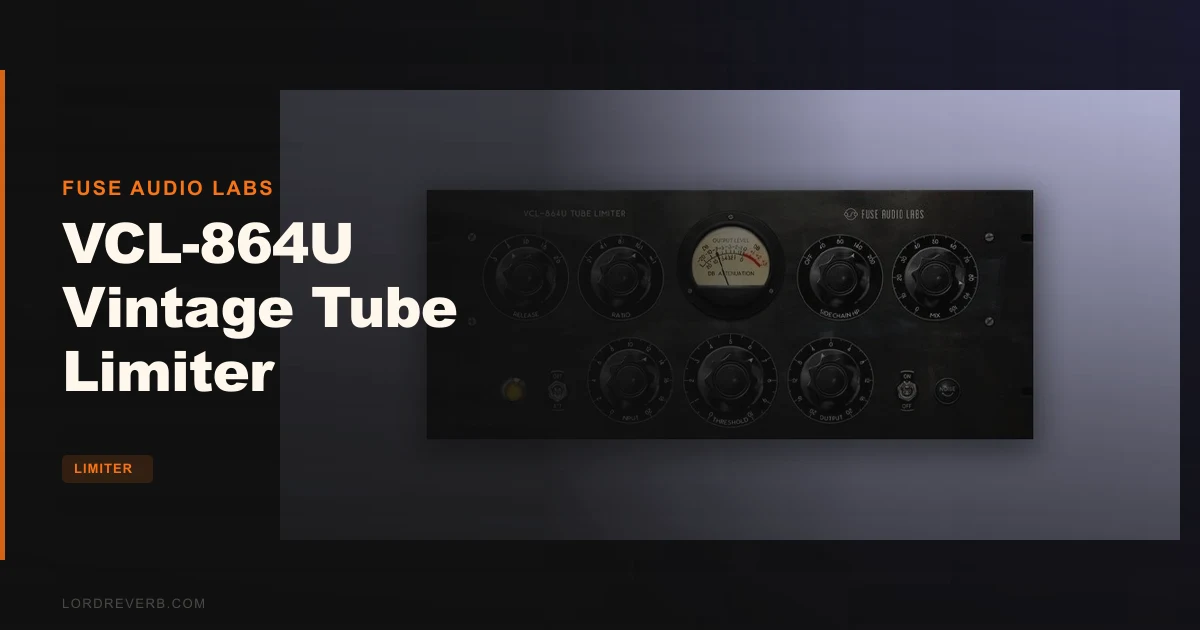
If you're mixing a drum bus that sounds too polished, too clean, or too modern for the track you're building, the VCL-864U Vintage Tube Limiter is built for exactly that problem. Fuse Audio Labs modeled this plugin on a 1940s Vari Mu tube limiter originally designed for US military broadcasting, and at $29 it brings that era's density and character into your DAW. It's not a transparent limiter. It's not supposed to be. This one is for producers and engineers who want their material to sound like it was touched by real iron and glass, not processed through a clean algorithm.
Quick verdict: this is a 4.2 out of 5. At $29, it's a strong pick for anyone working on drums, vocals, or keys who wants tube color baked into their compression. It's less satisfying if you need precision gain reduction. But if you want midrange density and gritty, organic character when you push the drive, this is the lane it's built for.
Where the VCL-864U Belongs
Start with your drum bus. That's the home for this plugin. Owners use it there heavily, and they report an exceptionally meaty midrange.
It also suits lead vocals that need their dynamics tamed. The developer says it does that while keeping the original sound quality intact, and that it can introduce inspiring gritty tones when you push it.
Keys sit well here too. Rhodes, Wurlitzer, organs with too much bloom on the sustain. The release characteristics that owners describe as smooth and musical at longer settings mean sustained chords can ride out smoothly.
Honestly, any source that benefits from parallel compression technique is a candidate. The Mix control is a clever addition that wasn't on the original hardware. It lets you blend the processed and dry signal without setting up a second buss send. For drums especially, that's a satisfying shortcut.
Genre-wise, it suits anything that leans on a vintage or warm aesthetic. If your reference tracks deliberately sound like they came from the era of tube broadcast gear, the VCL-864U speaks that language.
Where It Doesn't Belong
Skip it on sources where transparency is the goal. Mastering chains built for modern pop or electronic music that needs clinical headroom management won't get what they need here. The color is the point, and that's a problem if color isn't what you're after.
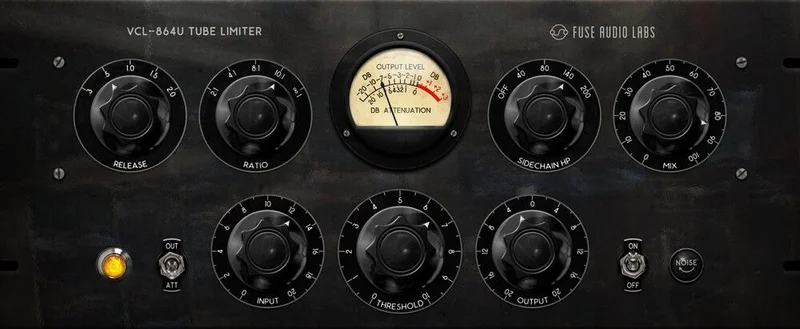
It's also a frustrating choice if you're trying to do precision dynamic control with ratio and attack settings dialed per source. The original hardware had a single Input Gain control, and Fuse Audio Labs stuck to that design. That's faithful to the unit. But it means you don't get the surgical flexibility that other limiters offer. You're shaping with one knob and trusting the circuit behavior to do the rest.
Fast-attack material like tight modern electronic kicks or aggressively compressed trap drums will likely fight this plugin's character rather than benefit from it. The smooth, musical curves that owners love on long releases become a liability when the track demands precision. For that work, look at a different tool in your limiter plugin comparison.
Windows users on Pro Tools sessions need to know upfront: AAX isn't supported on Windows. That's not a dealbreaker for everyone, but it's annoying if PT is your primary host.
The Input Gain Control: One Knob, Real Consequences
The VCL-864U's faithfulness to its source hardware means you get one primary control: Input Gain. That's it. Drive it harder and the tube and transformer modeling gets louder, grittier, and more compressed. Back off and it sits cleaner with less color imparted.
That simplicity is brilliant for speed. You're not clicking through attack and release menus. You're making a single decision: how hard do you want to push the circuit? On a vocal chain, the difference between a subtle setting and a pushed one is the difference between presence and grit. Both are useful.
But it's also the one thing that will frustrate engineers trained on fully parametric compressors. You can't dial in a fast attack independently. You can't set a specific ratio. The Vari Mu topology handles those decisions internally based on the input signal. If you're used to controlling everything, that feels like giving up the wheel.
The workaround is gain staging before the plugin. What you send into the VCL-864U determines what you get out. Feed it a hot signal and it compresses harder and colors more. Feed it a conservative level and it acts like a gentle bus glue. gain staging basics is worth reviewing before you drop this on a loud mix bus and wonder why it sounds over-processed.
Owners describe the result as "sonic butter," and the developer says it adds a unique, pleasant character to mixes.
The Mix Control: Not on the Original, Still Worth It
Fuse Audio Labs added a Mix control that didn't exist on the original hardware, extending its usefulness beyond the original design.
Put the VCL-864U on a drum bus at a fairly aggressive Input Gain setting. Now use the Mix control to blend a modest amount of the dry signal back in. What you get is the transient punch from the unprocessed drums with the midrange density and glue from the tube-compressed version sitting underneath. That combination is what engineers spend time routing parallel busses to achieve, and the Mix control skips all of that routing.
On vocals, keeping Mix mostly toward the processed side gives you the dynamic control while leaving some of the natural performance in. Back it down further and the plugin leans more toward tone-shaping than compression.
It's a single blend control, and that's all it needs to be.
Tube and Transformer Modeling: What Color Actually Means Here
Owners report an "exceptionally meaty midrange," which is where the tube and transformer modeling does its most obvious work.
Push the Input Gain hard and the developer says it can introduce "inspiring gritty tones," which is the direction to head if you want vintage roughness rather than digital sheen.
The developer also says it adds width. There's no dedicated stereo control listed, so treat that as the developer's claim and listen for it yourself.
If you're building a vintage-sounding mix, this plugin is the kind of color you reach for on three or four tracks in a session, not every single one. Used on everything, it can homogenize a mix. Used selectively on the drum bus, the lead vocal, and maybe the keys buss, it gives the record a coherent analog character that's genuinely hard to replicate with a cleaner tool.
System Requirements and Format Notes
The plugin covers VST2, VST3, AAX, and Audio Units. Mac users on Intel or Apple Silicon with macOS 10.12 or newer are fully covered across all formats. Windows users get VST2 and VST3 but no AAX, which rules it out for Pro Tools sessions on PC.
The 2GB RAM minimum is modest. No CPU figures are published, so test it in your own sessions.
The display requirement is the awkward one: a 1280x1024 minimum may not accommodate modern high-DPI displays optimally. It's worth checking against your own monitor before you buy.
Activation and trial details aren't covered here, so check the Fuse Audio Labs site directly before purchasing if that matters to your workflow.
The Verdict
The VCL-864U is a love-it-for-what-it-is plugin at $29. It's not a precision tool. It's a character tool with a specifically narrow brief: add tube density, midrange weight, and musical compression behavior to sources that are too clean for the track you're making. On that brief, it delivers.
The single Input Gain design is either freeing or frustrating depending on how you work. The Mix control is a smart addition that extends its usefulness beyond the original hardware's limitations. And the release behavior that owners describe as smooth and musical at longer times makes it a natural fit for drum busses.
Skip it if you're on Windows in Pro Tools, if your reference tracks are modern and clinical, or if you need full parametric control over your limiting. That's a real portion of the plugin market, and this isn't their tool.
For everyone else mixing in the vintage and organic lane at $29, the VCL-864U earns its spot.
Specs & Technical Details
| Developer | Fuse Audio Labs |
| Price | $29 |
| Plugin Format | VST2 / VST3 / AAX / AU (AAX on Mac only) |
| OS Support | Mac (macOS 10.12+, 64-bit Intel or Apple Silicon) / Windows (7+, 32-bit and 64-bit) |
| Activation | N/A |
| CPU Usage | N/A |
| Trial Available | N/A |
| Version Reviewed | N/A |
Score Breakdown
| Category | Score | Notes |
|---|---|---|
| Sound Quality | 4.5/5 | Meaty midrange color and musical release curves are what owners point to |
| Value for Money | 4.5/5 | At this price, tube and transformer modeling this characterful is hard to argue with |
| Ease of Use | 4.0/5 | One-knob design is fast, but it frustrates engineers expecting parametric control |
| Features | 3.5/5 | Mix control is a smart addition; single Input Gain limits flexibility compared to multi-parameter designs |
| CPU Efficiency | N/A | No CPU figures published |
| Overall | 4.2/5 | A strong character limiter with a narrow brief it fills very well |
Frequently Asked Questions
Is the VCL-864U Vintage Tube Limiter good for mastering?
It's built for color, not transparency, which makes it a tough fit for most mastering chains where clinical gain control is the priority. If you're mastering music that's meant to sound vintage and warm, it could work as a tone-shaping stage before your ceiling limiter. But for modern pop or electronic mastering, a more transparent tool will serve you better.
Can I use the VCL-864U in Pro Tools on Windows?
No. The Windows version supports VST2 and VST3 only. AAX format is not available on Windows, which rules it out for Pro Tools PC sessions. Mac users get the full format set including AAX. If Pro Tools on Windows is your primary host, check the Fuse Audio Labs site for any updates before purchasing.
What makes the VCL-864U different from a standard compressor plugin?
The Vari Mu design means the compression ratio increases automatically as the signal gets louder, rather than hitting a fixed threshold at a set ratio. Combined with tube and transformer modeling, it aims at the behavior of the original hardware. The single Input Gain control reflects that: you're feeding a virtual circuit, not programming a parameter set.