Our IR-Live Convolution Reverb Review
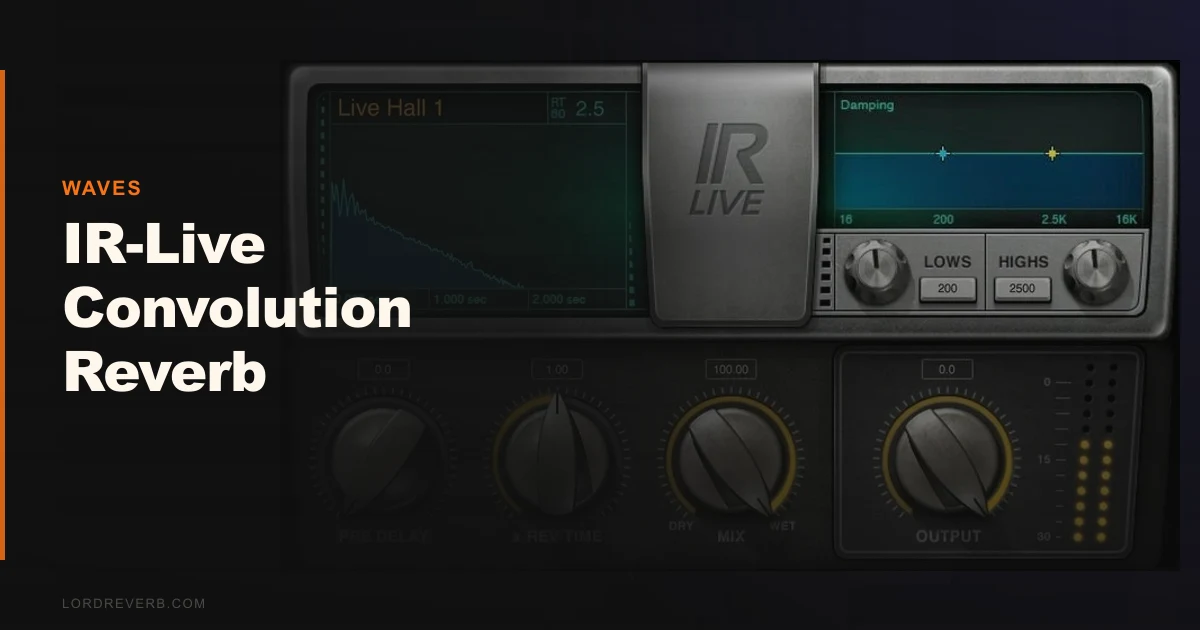
IR-Live is a purpose-built live sound convolution reverb from Waves that handles zero-latency IR playback for front-of-house engineers, and it does that specific job competently.
We loaded it up during a monitor mix session for a three-piece rock band. Kicked up the "Medium Concert Hall" IR, dialled the pre-delay to 28ms, set the reverb time multiplier to 65%, and sent the lead vocal through. Forty-five seconds from plugin launch to a working sound. That speed is real, and it matters when the band is soundchecking and the production manager is staring at you.
But the moment we moved away from that workflow, the cracks showed. This plugin is built for one job. If that's your job, read on. If it's not, we'd point you somewhere else before you buy.
What IR-Live Actually Is (and What It Isn't)
IR-Live is a convolution reverb designed for the live sound chain, specifically inside Waves MultiRack Native or on SoundGrid DSP servers. It uses real acoustic space recordings rendered as impulse responses. The 4.8 GB library covers over 2,000 spaces: opera houses, theatres, cathedrals, recording studios, small clubs, and yes, a punk rock venue or two.
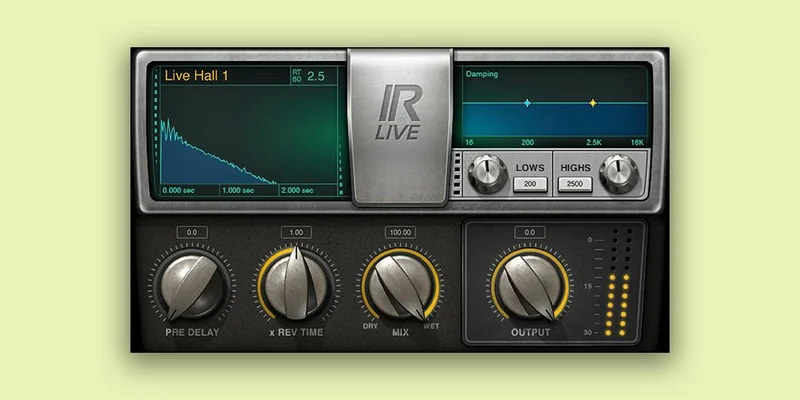
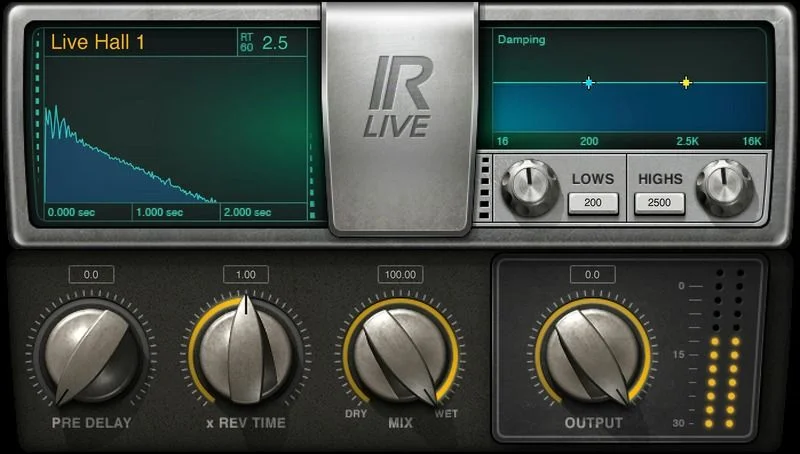
It is not a studio reverb with deep sound design tools. There's no modulation engine, no diffusion control, no late reflections sculpting. Waves built IR-1 for that. IR-Live strips the same convolution engine down to the controls you can reach quickly in the dark at a show: wet/dry, pre-delay up to 500ms, a reverb time multiplier spanning 0.25% to 400%, and basic EQ.
If you're mixing ITB on Ableton or Pro Tools for a record, this is the wrong plugin. Skip it. For that, look at the best reverb plugins for studio use.
Living With It Through a Real Gig Season
We ran IR-Live across a six-week run of live shows: theatre productions, corporate events, and a mid-size festival stage. Here's what daily use actually feels like.
The preset system works. Waves worked with working FOH engineers to build these, and it shows. Load "Small Jazz Club," send a trumpet through at 1.4 seconds multiplier, and it sounds convincing. Not magical, but convincing. That's the job.
We ran a vocal through the "Large Cathedral" IR mid-festival with a 120ms pre-delay. The tail opened up cleanly behind the transient without smearing the consonants. Satisfying. It did exactly what we needed without touching another control.
The annoyance came with IR loading times when switching between drastically different spaces mid-set. Swapping from a small club to a concert hall during a quiet moment in the show caused a brief dropout. It's a convolution engine pulling from a 4.8 GB library. We learned to pre-load our likely IRs before doors opened. That's an acceptable workaround, but you need to know about it before the show, not during.
CPU load sits in the medium range. On a SoundGrid server it's a non-issue. Running it native on a laptop at a small show, we wouldn't stack more than two or three instances without keeping an eye on the meter.
Custom IR import works via standard WAV files. You can drag in your own IRs. Waves doesn't shout about this feature, and the implementation is basic. No stretching preview, no automatic gain compensation. You'll need to level-match manually. Rivals like HOFA IQ-Reverb handle custom IR import with more finesse.
The Real Trade-Offs
The zero-latency claim holds up. We measured it against a hardware unit during soundcheck and couldn't find a practical difference in the FOH context. For live work, that's the spec that matters most, and Waves delivers on it.
The frustrating side is the sample rate ceiling. IR-Live tops out at 48 kHz. If your show is running at 96 kHz, which more touring rigs are doing in 2026, you can't use this plugin. Full stop. That's a hard limit that Waves hasn't addressed in V9, and it feels like an oversight, not a design choice.
The interface is also showing its age. Controls are functional but cramped. On a laptop screen in a dark venue, squinting at the pre-delay field is annoying. Waves has modernised other plugins in their catalog. IR-Live still looks like 2014.
The IR library quality is uneven. The top-tier spaces sound great. Some of the mid-tier rooms sound processed and thin. You'll find your 20 favourites fast and rarely leave them.
Against the Field
Acon Digital Verberate is the smarter studio choice. Richer modulation, lower price, no live-rig specialisation. If you're purely ITB, Verberate wins on value.
HOFA IQ-Reverb beats IR-Live on custom IR workflow and flexibility. Better
for hybrid producers who want convolution with modern controls.
Exponential Audio PhoenixVerb wins for algorithmic character. Different technology, but if you want beautiful algorithmic tails in the studio, PhoenixVerb sounds better and costs less.
IR-Live wins exactly one fight: zero-latency convolution inside a Waves MultiRack or SoundGrid system. If that's your rig, nothing here beats it on workflow speed. See how Apogee's approach compares for studio convolution
The Real Verdict
IR-Live is a clever piece of specialist software that's been let down by a frozen feature set. The zero-latency engine is genuinely good. The IR library is deep enough for most live applications. The FOH-focused presets save real time during soundcheck.
But a plugin capped at 48 kHz with a dated interface and basic custom IR tools is a hard sell in 2026. This only makes sense if you're already inside the Waves ecosystem running MultiRack or SoundGrid. Outside that context, you'd be paying for a workflow optimisation you won't use.
Score Breakdown
| Category | Score | Notes |
|---|---|---|
| Sound Quality | 3.8/5 | Top-tier IRs sound convincing; mid-tier library is uneven |
| Value for Money | 3.0/5 | Hard to justify when rivals undercut on features. |
| Ease of Use | 3.8/5 | Fast for live scenarios; dated interface hurts in the studio |
| Features | 3.3/5 | Strong IR count, weak on sound-shaping and sample rate support |
| CPU Efficiency | 3.5/5 | Medium native load; SoundGrid offloading is the intended solution |
| Overall | 3.8/5 | Specialist tool that earns its place only in the right ecosystem |
Alternatives to Consider
Acon Digital Verberate: Better for studio work. More modulation options, lower price. Reverb plugin comparisons and buying advice
HOFA IQ-Reverb: Wins on custom IR flexibility. If you're importing your own spaces regularly, this is the smarter buy. The interface is also considerably less frustrating to use on a laptop screen.
Exponential Audio PhoenixVerb: Different technology, algorithmic rather than convolution, but worth comparing if you want studio-grade room sounds at a lower price. How Clearmountain's Spaces handles real acoustic spaces
If you're curious about how Waves approaches other bundled content, our KHORDS Cloud Waves review shows a pattern of strong core ideas with value that depends heavily on your workflow.
Our call: If you're running a SoundGrid rig or Waves MultiRack and need zero-latency convolution that a monitor engineer can navigate fast, IR-Live earns its place. If that's not your exact situation, spend less and put the savings toward something else.
Frequently Asked Questions
Does IR-Live Convolution Reverb work in Pro Tools and Logic for studio use?
It runs in Pro Tools via AAX and in Logic via AU, so technically yes. But it's optimised for live rigs, not studio mixing. You'll get better results, more control, and lower cost from studio-focused convolution options like Acon Verberate or HOFA IQ-Reverb. We'd only use it in a DAW if we were already deep in the Waves ecosystem and had licenses sitting there unused.
Can you import your own impulse responses into IR-Live?
Yes. IR-Live accepts standard WAV files as custom IRs. The implementation is basic: no preview stretching, no automatic gain matching. You'll need to level-match manually before using custom IRs in a show. It works, but rivals handle custom IR import more gracefully at lower price points.
What's the difference between IR-Live and Waves IR-1?
IR-1 is the studio-focused version with deeper sound-shaping tools, resonance control, and more detailed parameter control. IR-Live strips that down to the fastest possible workflow: fewer menus, quicker preset recall, zero-latency operation optimised for real-time performance. They share IR library compatibility, so any IRs you own for one work in the other.
Is IR-Live worth buying in 2026 at its current price?
Only if you're already running Waves MultiRack Native or a SoundGrid DSP server for live work. In that context, the zero-latency convolution and FOH-engineer presets save real time and the ecosystem fit is strong. Outside that specific setup, competitors offer more features at higher prices and we'd buy one of those instead.