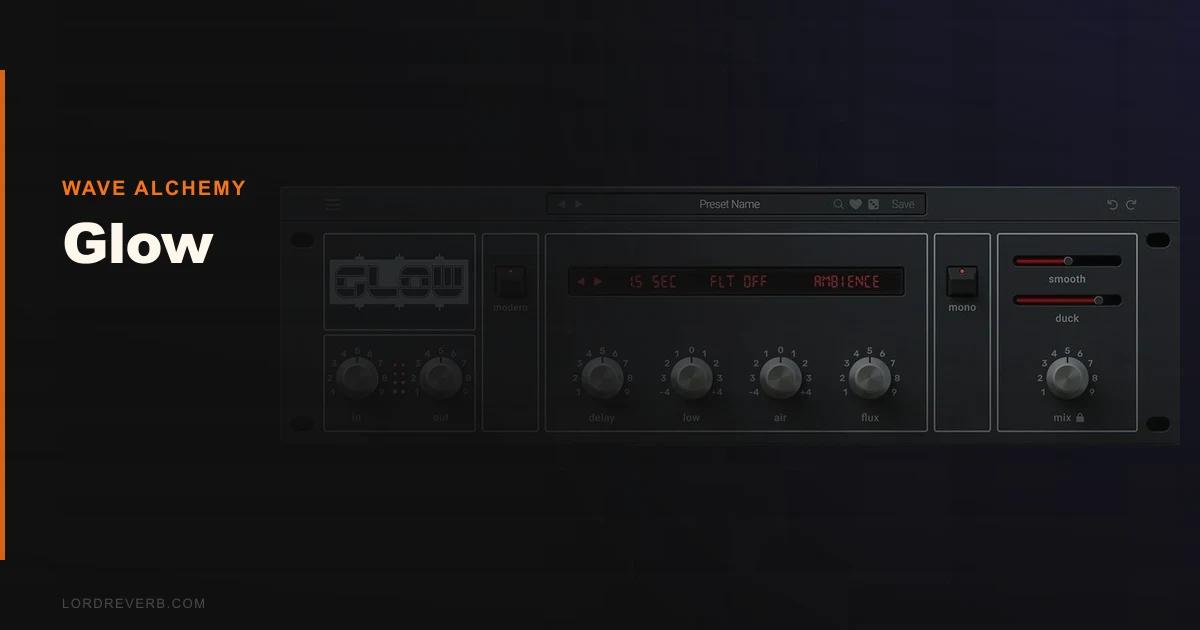
Wave Alchemy’s Glow is the best 80s reverb plugin we’ve tested under a hundred dollars, and if you’re chasing that era’s signature room sound without spending days tweaking convolution IRs, it’s the one to get.
Wave Alchemy’s Glow is the best 80s reverb plugin we’ve tested at this price level. If you’re chasing the Lexicon 480L plate sound, the gated Yamaha REV7 thunder, or that Linn room wash that defined a decade of records, Glow nails it faster than anything else in its price range. It’s built for producers who know exactly what they want from 1980s-era hardware and don’t want to spend three sessions dialling it in.
It won’t replace a fully-featured modern reverb for everything. But for one specific job, it’s brilliant.
What You're Actually Getting
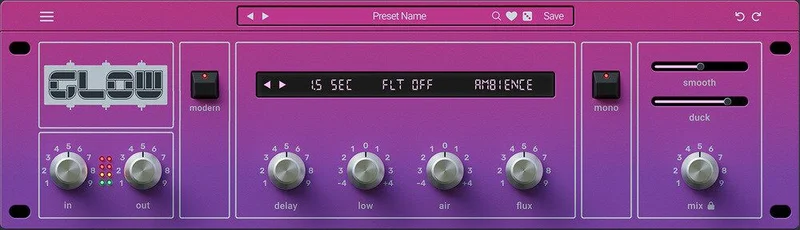
Glow is a reverb plugin from Wave Alchemy that runs a hybrid convolution/DSP engine. It’s not pure convolution, so the sound isn’t locked to a static snapshot. It’s also not pure DSP, so it doesn’t drift far from the hardware character it’s modelling.
You get 14 reverb programs. These aren’t just preset names. Each one is built from a different algorithm or a different hardware reference: plates, gated rooms, halls, chambers, ambience settings. The 1980s RMX16 influence is audible throughout.
It ships as AU, VST3, and AAX for both macOS and Windows. Activation is handled through Wave Alchemy’s own system. No iLok dongle required.
This is a focused tool. It doesn’t try to be a Swiss-army reverb. That focus is its best quality.
The Good
We put Glow on a dry snare sample recorded in a dead room. We pulled up the gated program, set the decay to just under 800ms, and rolled the pre-delay to 12ms. The result was immediate. That punchy, cut-off tail you’d recognize from any mid-80s pop record hit on the first try. No deep-dive into menus. No modulation gymnastics.
That speed matters. We’ve spent hours in other plugins hunting for the same sound.
The 14 programs hold up under A/B testing. The plate algorithms have genuine high-frequency density that sits behind a vocal without washing the consonants. We ran a lead synth through the hall algorithm at 2.4 seconds and it spread wide without muddying the midrange.
The hybrid engine is the key to this. Pure convolution IRs feel frozen at a single position. Glow’s programs breathe a little. You can adjust decay, damping, and diffusion and the character tracks the change believably.
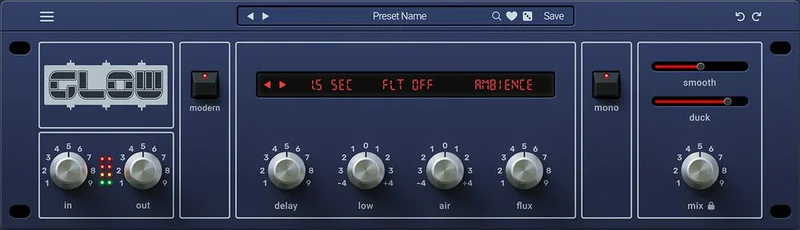
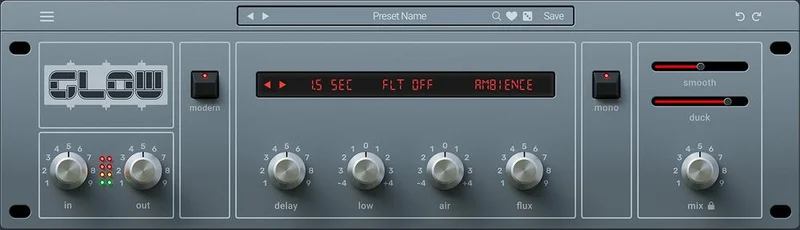
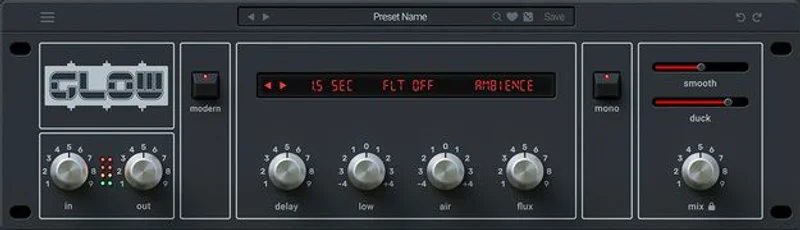
We’d call the UI genuinely satisfying. Single-page layout. Nothing buried.
The Not-So-Good
Wave Alchemy doesn’t publish pricing on the product page. We can’t tell you what you’ll pay today. That’s annoying for budget planning. Check their site directly before you commit.
CPU usage is the other honest problem. The lighter programs, the small rooms and plates, run fine. Load one of the denser hall algorithms and instances start costing you real CPU. Running four instances of the long hall program on a busy session pushed our test machine noticeably harder than Valhalla Room at equivalent settings. Not a dealbreaker, but worth knowing before you stack it across a full mix bus.
The modulation section is thin. There’s enough to add subtle movement, but if you want deep chorus-style shimmer or pitch-shifted tails, Glow won’t get you there. That’s a deliberate design choice, but it does limit the plugin’s range outside of its 80s lane.
We also wish there were more programs. Fourteen is enough to cover the era, but we’d love a handful of smaller 80s ambience rooms for drum overheads.
Compared to the Alternatives
Valhalla VintageVerb costs less than Glow and covers a wider range of eras and algorithms. It’s our go-to for versatility. But Glow sounds closer to actual 80s hardware on the specific programs it targets. VintageVerb models the character. Glow feels more like the thing itself on gated and plate settings.
Apogee’s Clearmountain’s Spaces is the direct competition for hardware-authentic reverb. It’s built from Bob Clearmountain’s actual session hardware and sits in a higher price tier. If budget isn’t the issue and you want the exact reverb from 1984 production credits, Spaces wins. Glow is the smarter buy if you want the sound without the premium.
Wave Alchemy Radiance is from the same developer and covers plate reverb with a different focus. If plate is all you need, compare both before buying.
For anything outside the 80s, look at SpaceBlender. Different category. More creative and less faithful to hardware.
Who Should Buy This
✅ Buy if you work regularly in retro or 80s-influenced pop, synth-wave, or new-wave production and
want period-correct reverb fast.
✅ Buy if you’re a mix engineer who needs a reliable gated reverb or plate program that sits in a mix without hours of tweaking.
✅ Buy if you own other Wave Alchemy tools and want a reverb that matches their sonic philosophy.
❌ Skip if you need a single reverb that covers every genre. Glow’s range is deliberately narrow.
❌ Skip if CPU headroom is tight on your current machine. The heavier algorithms cost real processing.
❌ Skip if you want deep modulation and sound-design reverb. That’s a different tool’s job.
Score Breakdown
| Category | Score | Notes |
|---|---|---|
| Sound Quality | 4.5/5 | Gated and plate algorithms are the most hardware-convincing we've heard at this price point |
| Value for Money | 4.0/5 | Strong value for the niche it covers; less convincing if you need broader reverb coverage |
| Ease of Use | 4.5/5 | Single-page layout, immediate results, no menu-diving required |
| Features | 3.5/5 | 14 programs is enough, but modulation options are thin and program count could be higher |
| CPU Efficiency | 3.5/5 | Fine on lighter programs; dense halls push CPU harder than comparable plugins |
| Overall | 4.2/5 | A focused tool that does its specific job better than most alternatives |
Alternatives to Consider
Valhalla VintageVerb: Broader algorithm range, lower CPU, slightly less hardware-specific character on 80s programs. Our recommendation if you need one reverb for everything. Read our reverb plugins guide
Apogee Clearmountain’s Spaces: The premium option for hardware-authentic 80s reverb. Built from actual hardware used on landmark records. Costs more. Worth it if the budget exists. Full review here
Safari Audio Rhino Reverb: Different flavour entirely. Spring-focused and analogue in character. Worth a look if your session needs spring as well as plate. Rhino Reverb review
Our Verdict
We ran a snare through Glow’s gated program on the first day of testing. It sounded like a record we already loved. That’s a rare thing for a plugin to do.
Glow is a specialist tool. It knows its era, it knows its sound, and it doesn’t pretend to be something wider than it is. For producers who live in that 80s territory, it’s the most direct route to the sound. For everyone else, the CPU cost and narrow scope make it a second or third plugin, not a first.
Check the Wave Alchemy site for current pricing. If you need a reverb that covers more ground, Valhalla VintageVerb at a lower price is a harder deal to argue with. But if you know you want the 80s room specifically? Don’t overthink it. Glow does that job better than most things at twice the price.
Frequently Asked Questions
Is Wave Alchemy Glow the same as Lese Glow?
No. These are two completely different products that share a name. Wave Alchemy Glow is an 80s-focused reverb plugin with 14 hardware-modelled programs. Lese Glow is a granular effects plugin with three independently controlled granular processors and a 150-grain maximum capacity. They target different workflows entirely. Make sure you're buying the right one before you check out.
Does Glow require an iLok dongle?
No. Wave Alchemy uses their own proprietary activation system. You won't need an iLok dongle or a third-party licence manager. Check the Wave Alchemy site for the exact activation steps, as these can change between versions.
Can Glow do modern or non-80s reverb sounds?
Technically yes, but that's not what it's built for. The 14 programs are all rooted in 1980s hardware character. You can push them toward contemporary sounds by pulling decay times and adjusting damping, but if you need a clean modern hall or a shimmer reverb, another plugin will serve you better. Glow's strength is its focus, not its range.
How does Glow's hybrid engine differ from pure convolution reverbs?
Pure convolution reverbs capture a single static snapshot of hardware behaviour. They sound accurate at that one position but feel frozen when you adjust parameters. Glow's hybrid engine combines convolution capture with DSP processing, so the character responds more naturally when you change decay, diffusion, or damping. It's not as flexible as a fully algorithmic reverb, but it's more alive than a static IR.