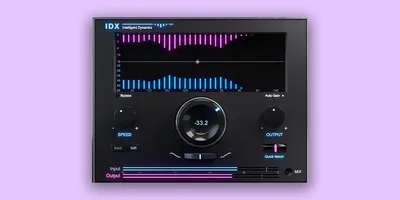
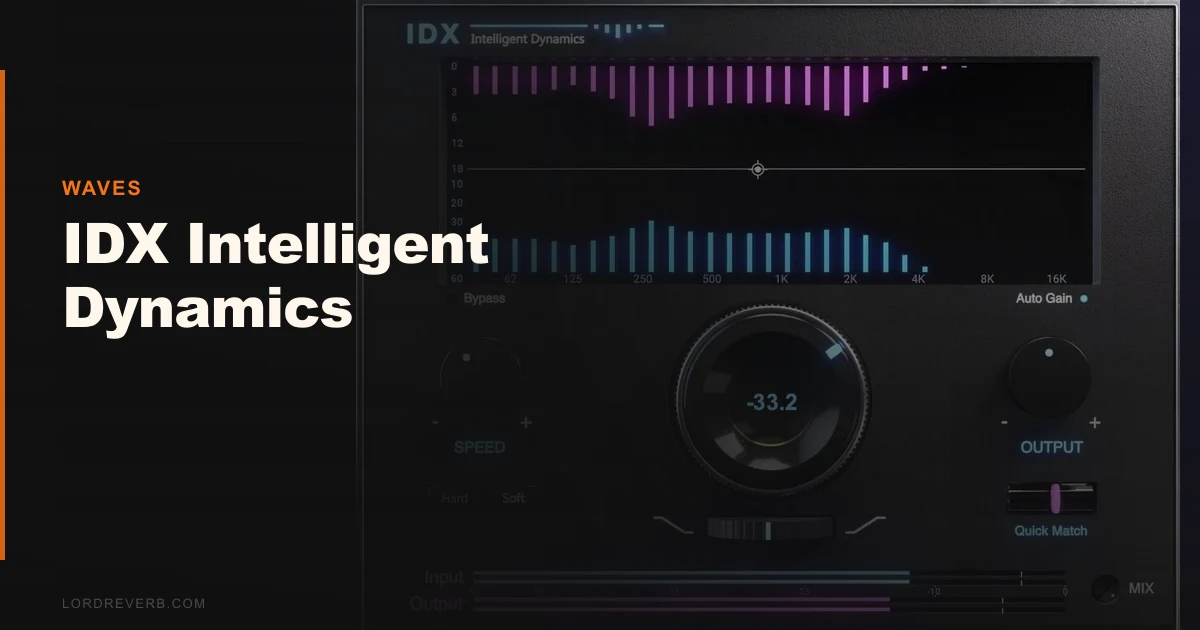
You've compressed a mix bus with a good RMS compressor, pushed the gain back up, and the track still sounds congested in the low-mids. The problem isn't that you applied too much compression. It's that the compressor treated every frequency the same way, and now the 250-400Hz range that was already crowded is the first thing your listener hears. IDX Intelligent Dynamics by Waves exists specifically for that moment.
This is a frequency-dependent compressor that identifies the busiest spectral areas and applies progressive attenuation differently across the frequency spectrum, rather than responding to overall RMS level. It launched above its current price, has seen a significant discount, and sits in both Waves Essential and Ultimate subscription bundles. It's aimed at producers who want smarter compression without building a multiband chain by hand.
The Problem IDX Actually Solves
Standard compressors respond to signal level. When your kick, bass, and low-mid synth all hit together, the compressor clamps down on everything, not just the frequencies causing the pile-up. You lose clarity on top, punch on the transients, and you're left wondering why your mix sounds thick but not full.
That's the frustration IDX targets. Its progressive attenuation algorithm spots the frequency regions carrying the most energy and applies proportionally more compression there. The areas that aren't congested get left alone. In theory, this is what a skilled engineer does manually across three or four separate EQ and compression moves. IDX tries to handle it in one plugin, in one slot.
This approach is most satisfying on individual tracks with complex harmonic content: a DI bass, a layered synth pad, an acoustic guitar sitting poorly in the low-mids. It's less clean on a dense mix bus, and we'll get to that.
How It Performs in Practice
We put IDX first in the signal chain on a DI electric bass track that had an annoying low-mid bloom around 280Hz. With a traditional compressor, catching that bloom meant either a Q-heavy EQ cut first or careful sidechain filtering. We dropped IDX in, pushed its single control to about 60%, and the bloom pulled back without touching the fundamental around 80Hz or the upper harmonic detail above 1kHz.
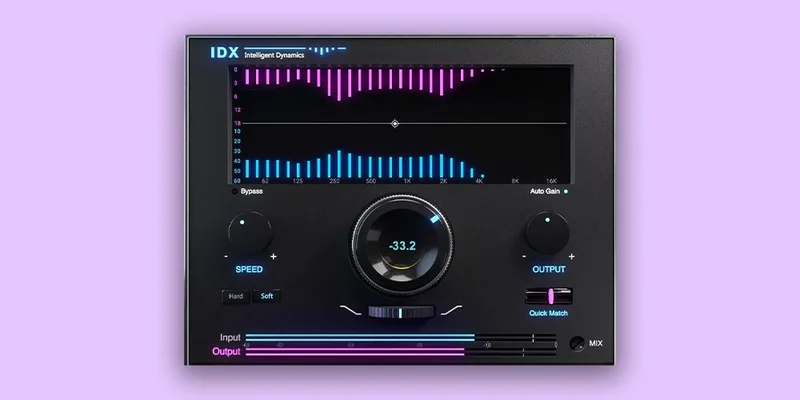
That's the plugin doing what it promises. The frequency-dependent processing is real, not marketing copy.
On a full mix bus, results were more mixed. We ran a 24-track rock session through IDX at the same 60% setting. The low-mid clarity improved, but the snare transient softened in a way we didn't want. Backing off to 35-40% helped. The lesson: master bus use works, but you need to gain stage carefully going in. Clip the input and the algorithm overreacts.
Compared to the Bettermaker Mastering Compressor, which gives you full analog-style control over attack, release, and ratio, IDX is blunt by design. If you want surgical, pick Bettermaker. If you want fast and largely transparent, IDX competes.
The IDX Live variant, with zero latency, tracked cleanly on vocals during a session. No phasing artifacts, no monitoring complaints. That alone justifies keeping it installed.
CPU draw is light. We ran 16 instances across individual tracks in a 48-track session without a measurable spike at 44.1kHz. At 192kHz the footprint rises slightly but stays manageable. It's not the kind of CPU-hungry processor that forces you to bounce before you're done writing.
Strengths and Weaknesses, Straight
The one-knob interface is clever. It's not lazy design. Waves made a deliberate choice that the algorithm should make the frequency decisions, not you. For busy producers working fast, that's a genuine strength.
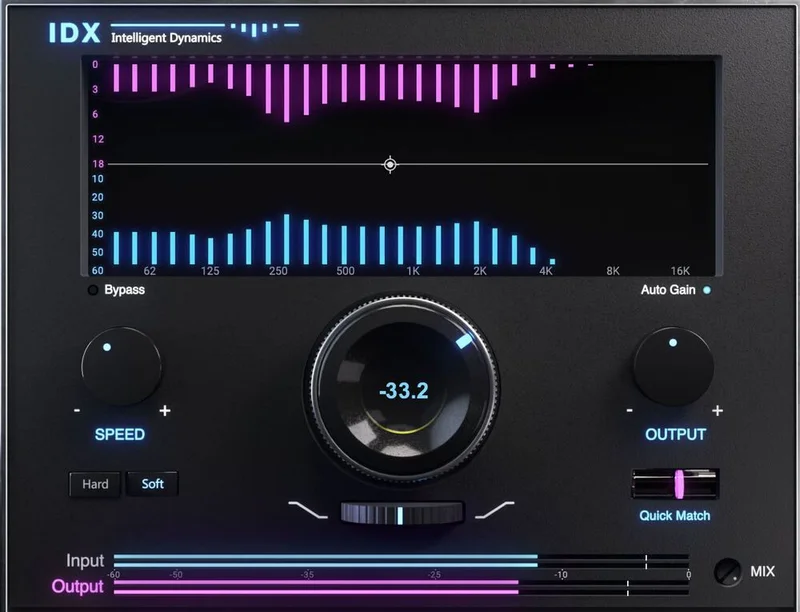
But we wish there was a frequency display. Soothe 2 from oeksound shows you exactly which bands it's attenuating and by how much. IDX gives you nothing. You're trusting the algorithm completely. On individual tracks that's fine. On a bus where you're making mastering-adjacent decisions, flying blind is frustrating.
The lack of attack and release controls is the other honest limitation. We ran a drum bus through IDX and the transient behaviour changed in ways we couldn't correct without adding a second compressor after it. Compare that to the Complexx bus compressor, which gives you ratio, attack, and release on a bus-optimised design. For drums, Complexx wins.
IDX shines brightest on melodic content and polyphonic sources. We love what it does to a piano with a packed left hand. We hate what it does to a drum room mic if you push past 50%.
The 4.67 out of 5 stars across 996 user reviews skews positive because most users are running it on individual tracks in the sweet spot. The master bus criticism is real but underrepresented in that number.
Is $79 Worth It?
At $79 on sale, yes. We'd buy it at that price without hesitation for the IDX Live capability alone. Zero-latency frequency-dependent compression that works during tracking is genuinely useful and not common at this price point.
At the $79 MSRP it's harder to justify if you already own Waves Renaissance Axx or a solid multiband. But if you're starting your plugin collection and you want one compressor that handles mixed polyphonic sources intelligently, $79 is fair. Check the manufacturer's site for current pricing, as Waves discount patterns shift frequently.
It's also included in Waves Essential and Ultimate bundles, so if you're already subscribing, the cost is zero. In that context it's a no-brainer add to your chain.
Who Should and Shouldn't Buy IDX Intelligent Dynamics
- ✅ Buy if you regularly work with harmonically dense sources like piano, acoustic guitar, or layered synths where a standard compressor creates frequency-specific buildup.
- ✅ Buy if you track with monitoring compression and need zero-latency performance via IDX Live.
- ✅ Buy if you're in the Waves ecosystem already and want a fast, low-overhead option to place first in the signal chain on individual tracks.
- ❌ Skip if you primarily need bus compression with controllable transient behaviour. You'll fight the algorithm more than it helps you.
- ❌ Skip if you need visual feedback on what's being compressed. You won't get it here.
- ❌ Skip if your main use case is aggressive parallel compression with dialled-in attack shapes. The CP2V compressor gives you far more control in that role.
Score Breakdown
| Category | Score | Notes |
|---|---|---|
| Sound Quality | 4.0/5 | Transparent on melodic sources, overreacts on transient-heavy material above 50% |
| Value for Money | 4.5/5 | With a zero-latency variant included, the price is hard to argue with. |
| Ease of Use | 4.5/5 | One knob, works immediately, no manual required |
| Features | 3.5/5 | No visual metering, no attack/release control, limited to what the algorithm decides |
| CPU Efficiency | 4.5/5 | Light enough to run across an entire session without bouncing |
| Overall | 4.1/5 | Delivers on frequency-dependent compression for its target use case |
Alternatives Worth Considering
Soothe 2 by oeksound does frequency-dependent dynamic processing with full visual feedback showing exactly which bands are being attenuated and by how much. It's more expensive (check oeksound's site for current pricing), but you get real-time transparency that IDX doesn't offer. Works brilliantly on harshness and resonance control. If you need to see what you're doing, Soothe 2 is the better tool.
Complexx by Kiive Audio is our pick when the bus is the problem. Full ratio, attack, release controls, designed for mix bus and drum bus work. IDX doesn't compete here. Complexx wins on controllability.
FabFilter Pro-MB gives you multiband compression with per-band attack, release, threshold, and ratio. It's more complex to set up than IDX, but the results on a mix bus are more predictable and you're never guessing what the algorithm is doing. If the one-knob approach frustrates you after a week, Pro-MB is the natural next step.
Final Word
IDX Intelligent Dynamics is a useful, honest plugin that does what it says on a specific set of sources. It's not a mix bus solution you can set and forget. It's a track-level tool that removes a genuine pain point when you're dealing with harmonically crowded polyphonic signals.
With IDX Live included, we'd buy it again. At $79 with a cleaner alternative already in your rack, we'd wait for the next sale. And if you're planning to put it across your master bus and walk away, don't. Gain stage it properly or it'll take your snare with it.
Frequently Asked Questions
What makes IDX Intelligent Dynamics different from a standard RMS compressor?
A standard RMS compressor responds to overall signal level across the full frequency spectrum. IDX uses a progressive attenuation algorithm that identifies the busiest frequency regions and applies proportionally more compression there while leaving less congested areas largely untouched. This means a low-mid buildup gets addressed without clamping down on your high-frequency detail at the same time.
Can I use IDX Intelligent Dynamics on my master bus?
You can, but it requires careful gain staging. We found that pushing the control above 40-50% on a dense mix bus softened snare transients in ways that were difficult to recover. Start low, around 30%, and A/B carefully. For heavy bus compression duties, a compressor with manual attack and release controls will give you more predictable results.
What is IDX Live and when should I use it?
IDX Live is a zero-latency variant included with the plugin. It's designed for tracking sessions where any monitoring delay is unacceptable. We tracked vocals through it and had no phasing complaints. Use IDX Live when you're recording live and want frequency-dependent compression on the monitoring chain without introducing latency.
Does IDX Intelligent Dynamics work in DAWs other than Pro Tools?
Yes. IDX supports VST3, AU, and AAX formats, covering the major DAWs including Ableton Live, Logic Pro, Cubase, Studio One, and Pro Tools. It runs at sample rates up to 192kHz and is activated through Waves License Center, which supports both online and USB-based licensing. Mono and stereo versions are included in the same download.